GPT-6.2 Astra at a Glance
| Question |
Short answer |
| What is GPT-6.2 Astra? |
OpenAI’s highest-capability GPT-6.2 model for complex coding and professional work |
| Release date |
November 17, 2026 |
| API model ID |
gpt-6.2-astra |
| Context window |
1.05 million tokens |
| Maximum input / output |
922,000 / 128,000 tokens |
| Modalities |
Text and image input; text output |
| OpenAI standard API price |
$8 input, $0.40 cached input, and $40 output per 1M tokens |
| GPT Proto price |
$6.40 input, $0.32 cached input, and $32 output per 1M tokens — 20% off |
| Best early fit |
Complex debugging, code review, migrations, data analysis, professional documents, science, CAD, and 3D workflows |
| Better everyday default |
GPT-6.2 Sol for routine coding, writing, and lower-cost work |
The OpenAI model documentation lists Responses and Chat Completions support, plus tools including web search, file search, code interpreter, hosted shell, computer use, MCP, and image generation. The model itself returns text. Finished spreadsheets, slides, sites, or 3D assets depend on the tools and execution environment around it.
What Are Early Users Actually Discussing?
The launch conversation is not mainly about benchmark scores. It is about the gap between raw capability and day-to-day usability.
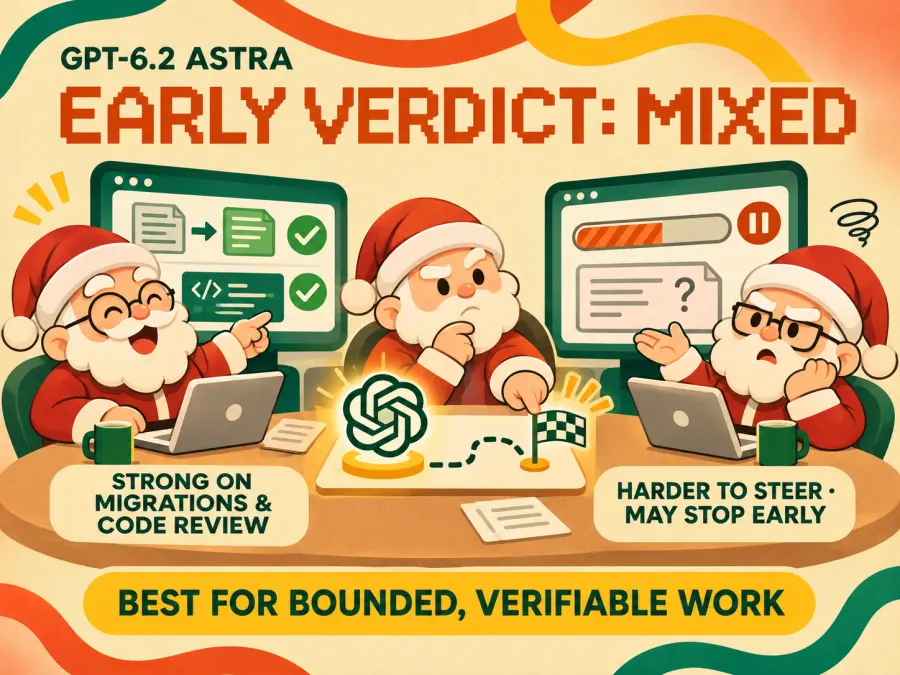
1. Astra can be excellent at reviewing and repairing existing systems
GitHub’s early Copilot testing found that GPT-6.2 Astra caught significantly more real code-review issues than GPT-6 Astra while using fewer tokens. That is more relevant to a production team than another one-shot app demo: the valuable work is often finding the defect, preserving existing behavior, and proving the patch with tests.
Engineer Tibor Blaho described using Astra in everyday infrastructure and software work, including server management, backups, monitoring, research, administration, debugging, and code review. His standout example was upgrading a multimillion-line legacy application and its old dependencies to a current language version. He reported a locally usable result after about three hours and a clean-checkout test pass after roughly six hours, while noting that more work remained.
This is an anecdote, not a controlled benchmark. It is still a useful example because it includes a real codebase, elapsed time, and a verification step. It also points to a practical workflow: Blaho uses Astra and Claude models to research and review one another’s work instead of assuming one model catches every defect.
2. Long autonomous runs can be frustrating
The negative reports are also concrete. Dan Shipper’s early review said Astra often stopped too early on end-to-end coding builds and could be so concise that its writing became difficult to follow. Ethan Mollick called it uneven and harder to steer: it successfully built an ambitious Blender-and-Unity space-elevator experience, yet he still did not find himself reaching for it as a daily model.
Developer Theo’s detailed account is similarly split. He praised Astra as a code reviewer, said it found novel solutions, and credited it with a reverse-proxy design that could save his company $25,000 per month. He also reported long runs that blocked on questions he could not answer, loops that made no progress, and summaries that were harder to understand than the code changes.
These accounts do not prove that every Astra run will fail. They identify the same risk from different angles: the model may be capable enough to do the work but awkward to supervise when the goal is open-ended.
3. Concise output is either efficiency or missing context
OpenAI’s own GPT-6.2 prompting guide says Astra is more concise and direct by default. For a support reply, code-review note, or executive brief, that may be useful. For a complex explanation, it can feel like the model skipped the reasoning a reader needed.
This explains why early reactions conflict. People testing a tightly scoped deliverable may see less filler and fewer tokens. People using Astra as a collaborator across a long project may see abrupt answers, unexplained decisions, or premature handoffs.
4. The real question is task shape, not whether Astra is “smart”
The evidence so far suggests a simple dividing line:
| Task shape |
Early fit for Astra |
| Clear objective, tools, tests, and finish line |
Strong candidate |
| High-value review where missed defects are expensive |
Strong candidate |
| Multi-source data or document work with a checkable output |
Strong candidate |
| Routine email, meeting notes, or small code edit |
Usually use Sol first |
| Open-ended research requiring judgment about what matters |
Compare with Fable 5.2 and keep human review |
| Hours-long autonomous build with ambiguous decisions |
Test carefully before relying on it |
Is GPT-6.2 Astra Good for Everyday Work?
Yes, but most everyday work does not need it. For meeting notes, routine emails, short research, small code edits, or a first draft, GPT-6.2 Sol is the more natural starting point. It is the model OpenAI positions for everyday work, and its token rates are 75% lower than Astra's. GPT Proto applies the same 20% discount to both models, so that price gap remains unchanged.
Astra becomes useful when an ordinary work category turns into a difficult, high-value task. “Review this pull request” may suit Sol; “trace this intermittent failure across three services, fix it, and run the affected workflows” is an Astra-shaped job. “Summarize this CSV” is routine; “find the data-quality problems, explain the statistical traps, and build an editable decision workbook” gives Astra more room to earn its cost.
The practical daily uses reported so far include debugging, server operations, monitoring, backups, code review, multi-source research, and office administration. The common thread is not the profession. It is that the job has enough complexity to benefit from deeper reasoning and enough structure to verify the result.
What Is GPT-6.2 Astra Good For?
Code review, root-cause analysis, and legacy modernization
This is the clearest practical use case. Give Astra the failing workflow, relevant logs, repository, and test commands. Ask it to trace the fault across services, implement the narrowest safe fix, and run the affected tests. That matches OpenAI’s own recommended Astra workflow and the positive reports from GitHub and early engineers.
Legacy upgrades may be an especially good fit because the task is difficult but verifiable. The model can inspect old dependencies, update code in stages, and repeatedly run a clean build. The human still needs to define compatibility requirements and review the migration. “All tests passed” is evidence only if the test suite covers the behavior that matters.
For normal pull-request review or a small revision, GPT-6.2 Sol may be enough. OpenAI explicitly recommends Sol for everyday coding, and it costs one quarter of Astra’s standard input and output rates.
Data analysis, dashboards, and editable workbooks
Astra’s value here is not merely writing a SQL query. It can inspect data, notice quality problems, state assumptions, run analyses, and turn the results into a workbook, chart, or dashboard that another person can review.
An independent Plotly data-analysis test provides a useful real-task example. Astra passed 41 of 43 questions, caught all planted data-quality problems, avoided all five statistical traps, and completed the run for $4.11. Its median question took 12.4 seconds, versus 26.9 seconds for GPT-6 Astra. The trade-off is important: it missed two hidden patterns, and GPT-6.1 Sol achieved a perfect score in that test for $2.61. Astra was fast and capable, but not automatically the cheapest or most accurate option.
OpenAI’s Alderfen valuation example shows the document side of the same capability. Astra built an editable DCF workbook that forecast revenue through 2031, reconciled three financial statements, calculated value per share, and placed the key drivers beside the sensitivity table. Treat this as a vendor demo, not independent proof. It is still a useful template for a test you can reproduce with your own spreadsheet.
Finance, accounting, legal work, and professional documents
GPT-6.2 Astra was trained to follow professional conventions in slides, spreadsheets, memos, and documents. OpenAI reports gains in finance, accounting, consulting, sales, and legal workflows. Customer results on the launch page include fewer review rounds for apps, dashboards, and slides, as well as shorter completion times for long-horizon accounting work. Those are vendor-selected results, so they should be read as promising use cases rather than guaranteed outcomes.
The best applications are checkable deliverables:
A financial model whose formulas reconcile and respond correctly when assumptions change.
A legal memo whose claims can be traced to supplied authorities and source documents.
A slide deck that follows an existing template and turns each title into a supported conclusion.
A compliance tracker that maps every requirement to evidence, an owner, and a status.
Independent evidence is less flattering on open-ended work. In Epoch AI’s realistic workplace evaluation, no tested model met Epoch’s employee standard on any task. GPT-6.2 Astra averaged 65%, 17 points below Claude Fable 5.2. Epoch found that Astra had improved over GPT-6 Astra in concise writing, graphic design, and data-center research, but could be too cautious and omit conclusions that the available evidence supported.
That apparent contradiction is the point. Astra can be very strong when the rubric and output are explicit. When the work requires deciding what matters, making calibrated assumptions, and iterating on an uncertain research plan, model choice and human oversight matter more.
Scientific analysis and technical research
OpenAI positions science as a flagship Astra use case and reports leading results on terminal-based scientific workflows. A separate early user signal comes from biomedical researcher Derya Unutmaz, who favored Astra for science and long-goal coding, while still preferring Opus 5.5 for design taste and emotional intelligence. He also described his own biomedical research experience with Astra as strong.
This does not mean Astra can independently produce publication-ready research. The Epoch evaluation found that frontier models still reused existing ideas, relied too heavily on first attempts, and struggled to identify the most important findings. Use Astra to search, code analyses, compare sources, test a stated hypothesis, or challenge a draft. Do not treat a confident research narrative as validation.
CAD, simulation, 3D design, and visual prototypes
Here the launch examples are more interesting than the games. OpenAI showed Astra modeling vehicle components, writing a Python solver for chassis dynamics, animating the result in Blender, and creating an assembly guide and parts catalog for a radio-controlled buggy. These examples combine visual reasoning, code, computer use, and documentation in one workflow.
That combination can help with early engineering exploration: turn reference images and manuals into an editable model, test a revision in simulation, and produce a visual explanation for a reviewer. A physical design still needs engineering validation. A plausible animation is not proof that loads, tolerances, materials, or safety requirements are correct.
Can GPT-6.2 Astra Build Games?
Yes. Meridian Sound Racing is a playable browser demo, and Ethan Mollick’s space-elevator project combined Blender, Unity, a browser experience, and simulated zero-gravity physics.
But “can build a game” is not the best summary of Astra. These projects are evidence that the model can coordinate code, 3D assets, tools, and interaction across a large build. The same capabilities are useful for simulations, training experiences, digital twins, product configurators, and interactive data stories.
Creative consistency also needs testing. Early users reported strong default visual instincts but repeated design patterns and weaker control over style. Give Astra a visual reference, typography, target audience, interaction rules, and explicit non-goals. Then judge the second revision, not only the first screenshot.
How to Get Better Results From GPT-6.2 Astra
The community complaints suggest that Astra needs a more explicit operating brief than a normal chat prompt. OpenAI’s guide also warns that the model may propose a next step and wait when the intent is unclear.
Use a prompt structure like this:
Goal:
Complete [specific deliverable].

Done when:

1. [Acceptance check]

2. [Test or evidence]

3. [Required output format]

Autonomy:
Make reasonable, reversible assumptions and continue without waiting.
Ask only if a decision would materially change the result or cause an irreversible action.

Constraints:

- Preserve [existing behavior or style].

- Do not change [out-of-scope area].

- Use [tools, files, sources, or conventions].

Verification:
Run [tests or checks]. Report any missing file, failed tool, unsupported assumption,
or incomplete step explicitly.

Final handoff:
Summarize what changed, what was verified, remaining risks, and total usage/cost.
For multi-turn API work, keep the earlier prompt prefix unchanged and append new instructions. OpenAI says this preserves reasoning and improves prompt-cache reuse. For front-end or visual work, provide a real reference and name the typography and imagery you want. “Make it modern” is not a design system.
How Much Does GPT-6.2 Astra Cost Per Task?
These rates are in USD per million tokens for requests up to 272,000 input tokens. The GPT Proto rows apply the current 20% discount to OpenAI's standard rates.
For a request with 20,000 uncached input tokens and 5,000 billed output tokens, the standard token charge would be $0.36 on GPT-6.2 Astra, $0.45 on GPT-6 Astra, and $0.09 on GPT-6.2 Sol. At GPT Proto's current rates, the same token counts cost $0.288 on Astra or $0.072 on Sol. A real agent task may make repeated model calls, reuse cached context, retry failed tools, or produce a much longer result.
At more than 272,000 input tokens in one request, Astra’s input and cache rates double and output costs 1.5 times the short-context rate for the entire request. The 1.05M context window is useful, but filling it casually can create a large bill. Measure cost per completed task, not only price per million tokens.
The Plotly run gives a concrete example: 43 analytics questions cost $4.11 on GPT-6.2 Astra, compared with $19.97 on GPT-6 Astra. Yet GPT-6.2 Sol cost $1.22 and finished only one question behind. Astra’s upgrade is real; the cheaper model may still have better economics for routine production traffic.
Both discounted routes are live now. Check the GPT-6.2 Astra model page or GPT-6.2 Sol model page for the current model ID and request format before sending production traffic. The OpenAI model collection lists the rest of the available OpenAI models.
Is GPT-6.2 Astra Better Than Claude Fable 5.2?
Not across every kind of work.
OpenAI reports that Astra more than doubled Fable 5.2’s strict pass rate on a legal-agent benchmark at roughly one-sixth the cost. In Cognition’s FrontierCode 2.0, however, Fable 5.2 scored higher on changes to existing codebases. Epoch’s open-ended workplace evaluation also favored Fable 5.2 by 17 points.
| Choose GPT-6.2 Astra when… |
Choose Claude Fable 5.2 when… |
| Code review, debugging, tool use, or a checkable technical deliverable is central |
The task is open-ended and requires strong judgment about what matters |
| You need CAD, simulation, 3D, or computer-use workflows |
Collaboration style and readable long-form explanations matter more |
| Repeated task cost and cache efficiency are important |
Your own representative tests show fewer interventions or better completion |
| You want a second model to review another agent’s work |
You want a second model to challenge Astra’s assumptions and patches |
The most practical answer may be to use both. The early cross-review workflow described by Tibor Blaho is more credible than declaring one universal winner: let one model implement or research, then have the other look for missed defects and unsupported assumptions.
For a creative comparison, reuse the interactive watercolor brief from our Claude Fable 5.2 test. Give both models the same existing project and ask for a new control without breaking the current ones. Compare first-pass correctness, revision count, explanation quality, total tokens, and completed-task cost. You can find Fable access on the Claude Fable 5.2 API page.
Where Can You Use GPT-6.2 Astra?
ChatGPT Work: GPT-6.2 Astra is available in Work rather than regular ChatGPT Chat. Access depends on plan, workspace settings, and rollout status.
Codex: Yes. Choose Astra in the Codex app or use /model in the CLI. It is the OpenAI-recommended option for tracing difficult bugs across services and completing the fix and tests.
Claude Code: There is no native GPT-6.2 Astra option. Anthropic’s LLM gateway documentation says routing Claude Code to non-Claude models through a gateway is outside its support.
OpenAI API: Use the official model ID gpt-6.2-astra. OpenAI recommends the Responses API for tool-calling workflows.
GPT Proto: Both GPT-6.2 Astra and GPT-6.2 Sol are live at 20% below OpenAI's standard API token rates. Choose Astra for complex reasoning and checkable professional deliverables; choose Sol for routine coding, writing, and higher-volume workloads. The earlier GPT-6.2 Astra rollout timeline records the pre-launch Codex sightings.
The following request uses the live Astra model ID. You can copy the latest integration snippet directly from its model page.
curl --fail-with-body --silent --show-error \
  https://gptproto.com/v1/chat/completions \
  --header "Authorization: Bearer ${GPTPROTO_API_KEY}" \
  --header 'Content-Type: application/json' \
  --data '{
    "model": "gpt-6.2-astra",
    "messages": [
      {
        "role": "user",
        "content": "We sold 12 units at $25 each. Each unit cost $10. Return revenue and gross profit in USD as JSON using the keys revenue and gross_profit."
      }
    ]
  }'
Revenue should be $300 and gross profit should be $180. For a cheaper routine run, switch to the exact model ID shown on the GPT-6.2 Sol page. You can also browse the OpenAI model collection for other available models.
Final Take
GPT-6.2 Astra’s most convincing advantage is not that it can build a game. It is the ability to combine reasoning, code, tools, files, and computer use on work that has a measurable finish line: a bug fixed and tested, a migration that builds cleanly, a workbook that reconciles, or an analysis that exposes its assumptions.
The limitation is equally practical. Early users repeatedly describe a model that can be brilliant at the task and still difficult to direct or understand over a long run. Use Sol for routine work. Use Astra when the job is hard enough to justify it, define “done” precisely, verify the result, and compare it with Fable 5.2 on the tasks where research judgment and collaboration style matter.