Overview of Qwen 4 Max: From "Qoduck" Blind Test to the 14-Day Preview
If you want a practical overview of Qwen 4 Max, start with the four days before its name became public. Between November 7 and November 10, 2026, an anonymous model codenamed Qoduck appeared inside Qoder, an agentic coding IDE. Developers testing Qoduck noticed an unusual pattern: instead of returning a fast single-pass code snippet and waiting for human feedback, the model spent ten to fifteen minutes spinning up shell checks, writing custom SVG assets from scratch, and running unit tests against its own diffs before returning a final answer.
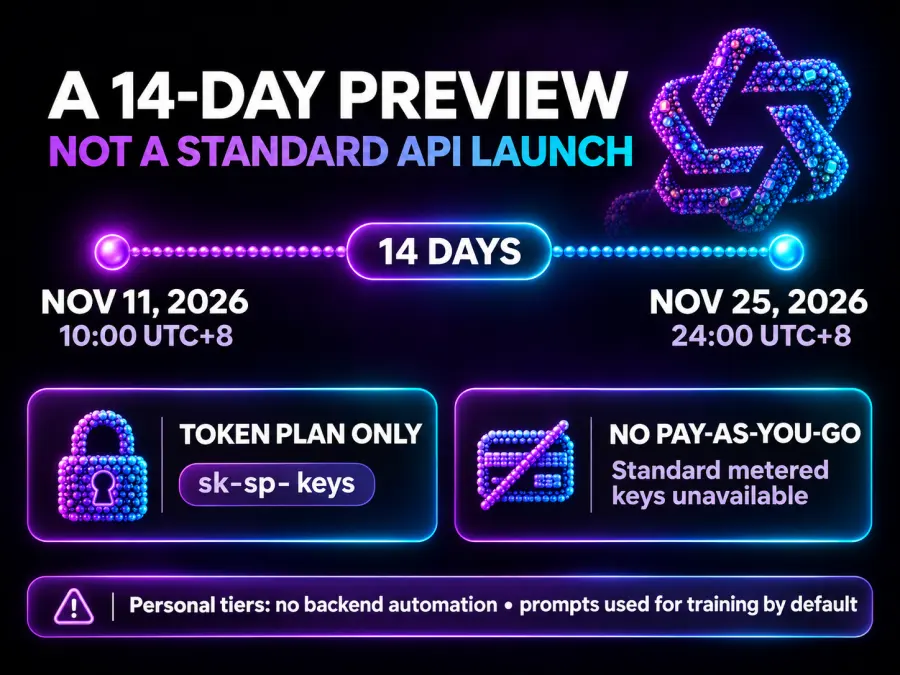
On November 11, 2026 at 10:00 UTC+8, Alibaba confirmed that Qoduck was the Qwen newest model Qwen 4 Max, and exposed it in Alibaba Cloud Model Studio under the model string qwen4-max-preview (referenced as qwen4.0-max-preview in select client configs). Rather than staging a full commercial launch with per-token list prices, Alibaba framed the rollout—often described in developer docs as introducing Qwen 4 Max via a 14-day Qwen 4 Max preview— designed to stress-test agentic workflows inside developer tools like Claude Code, Cursor, Cline, and Qoder.
| Specification |
Confirmed Status (qwen4-max-preview) |
Source / Engineering Note |
| Official Model ID |
qwen4-max-preview |
Alibaba Cloud Model Studio / Bailian docs |
| Preview Window |
Nov 11, 2026 (10:00) – Nov 25, 2026 (24:00 UTC+8) |
Strict 14-day limited preview |
| Context Window |
1,000,000 tokens (max input: 967,000 tokens) |
Verified across CN and International docs |
| Max Output Tokens |
393,216 total (131,072 final output + 262,144 reasoning) |
max_tokens caps combined thinking + output |
| Input / Output Modalities |
Input: Text, Image, Video · Output: Text |
No native audio input on the preview route |
| Reasoning Control |
reasoning_effort: low, medium, xhigh |
Thinking ON by default; defaults to xhigh |
| Supported API Protocols |
OpenAI Chat Completions, Responses API, Anthropic Messages |
Requires dedicated sk-sp- Token Plan endpoint |
| Parameter Size & Weights |
Not disclosed (Closed commercial preview) |
2.4T / 95B figures online belong to Qwen3.8-Max |
| Official Benchmark Table |
Not published at preview launch |
Circulating 49.9 GameFeel score is Qwen-4-Flash-Early |
Understanding qwen 4 max explained as a generational step comes down to how it spends compute at inference time. Where earlier releases treated tool calling as an optional helper, the core qwen 4 max upgrade bakes a self-verification loop into the default reasoning trace. When asked to build a web application or patch a command-line utility, the model routinely chains dozens of tool invocations—inspecting directory trees, running pytest or local headless browsers, catching its own syntax or layout regressions, and rewriting the broken lines before the user ever sees the output.
Architecture, Model Size, and the Benchmark Reality Check
Two pieces of misinformation currently dominate search results for qwen 4 max size and qwen 4 max benchmark. Clearing them up is the fastest way to understand what Alibaba actually shipped and what remains undisclosed.
First, Alibaba has not disclosed the total or active parameter count for alibaba qwen 4 max. Several third-party blogs list it as a 2.4-trillion-parameter Mixture-of-Experts (MoE) model with 95 billion active parameters per token. Those exact numbers belong to the previous flagship, Qwen3.8-Max, which shipped in September 2026. While Qwen 4 Max almost certainly uses a sparse MoE backbone to serve a 1M context window economically, any specific trillion-parameter figure you read in November 2026 is an unverified carryover from the 3.8 generation.
What we do have on the architectural side comes from Alibaba's August 2026 technical release of Qwen3.8-Flash-Next, which the Qwen team explicitly designated as a testbed to validate core architectural upgrades for the Qwen 4 series. That precursor report documented four structural changes that explain how qwen4-max-preview handles million-token workloads:
Hybrid GDN + QSA Attention: Combining Gated DeltaNet (GDN) linear attention layers with Qwen Sparse Attention (QSA) cut time-to-first-token (TTFT) prefill latency on a 1,000,000-token context by up to 7.6x compared to standard full attention.
4-Stream Gated Residual Connections: Expanding the residual stream width with learned gates improves gradient flow and cross-layer feature routing during deep multi-step reasoning.
N-gram Embedding Layers: Injecting multi-token local context directly at the embedding stage offloads lexical pattern matching from the early attention blocks.
Muon Optimizer Training: Switching large-scale pretraining optimization to Muon improved sample efficiency on code and formal logic corpora.
Second, if you search for qwen 4 max benchmark results, you will likely run into claims that Qwen 4 Max scored 49.9 on GameFeel Bench v1.4, edging out Claude Opus 5.5 at 47.2. I checked the leaderboard and the underlying commit logs: that 49.9 score was recorded by an early, lightweight test checkpoint named Qwen-4-Flash-Early (internal codename hawk), not qwen4-max-preview. As of November 13, 2026, Alibaba has not published an official MMLU-Pro, SWE-bench Verified, or AIME leaderboard table for Qwen 4 Max.
What you can verify right now is the mechanics of the qwen 4 max context window and its output budget—and this is where migrating developers hit a wall. While the context window holds 1,000,000 tokens (with a documented 967,000-token prompt ceiling), the maximum output is listed as 393,216 tokens on the international portal and broken down on the domestic portal as 262,144 reasoning tokens plus 131,072 final answer tokens.
Here is the catch: the max_tokens API parameter in qwen4-max-preview governs the sum of reasoning_content and content. Because the model defaults to reasoning_effort: "xhigh" (the highest of three available settings: low, medium, and xhigh), a complex coding prompt can easily burn 15,000 to 40,000 tokens inside the hidden thinking block. If your existing client code passes max_tokens: 4096 or 8192, the model will exhaust its entire allowance mid-thought and return an empty content string. To avoid silent truncation, either raise max_tokens above 65,536 or explicitly step reasoning_effort down to medium for routine tasks.
Hands-On Qwen 4 Max Review: What Community and Media Tests Actually Show
Because Alibaba skipped a traditional benchmark press release, the most reliable qwen 4 max review data comes from engineering teams that wired qwen4-max-preview into live agent harnesses during the first 48 hours of the preview. Their logs show a clear pattern: every jump in output quality comes paired with a noticeable latency and token cost.
On November 11, Japanese AI consultancy WEEL published a three-part evaluation testing the preview model across frontend synthesis, multi-source research, and repository-level debugging inside Claude Code:
908-Line Custom SVG Landing Page (vs Qwen 3.8 Max): Given an identical prompt to build a responsive landing page for a forestry-themed physical therapy clinic, Qwen3.8-Max finished in about 9.5 minutes but pulled random external stock photos that broke the grid or failed to load. qwen4-max-preview took roughly 17 minutes—nearly twice as long. Instead of linking fragile external URLs, it invoked its Code Interpreter dozens of times in the background to programmatically draw custom SVG illustrations of forest canopies, clinic architecture, and staff icons, delivering a 908-line HTML file with zero broken assets.
Autonomous CLI Debugging in Claude Code (36/36 Tests Passed): WEEL pointed Claude Code (powered by qwen4-max-preview via the Anthropic-compatible endpoint) at a local Python household accounting CLI (kakeibo) and asked it to add --export-csv and --month filtering flags with unit tests. The run took 11 minutes and 48 seconds. After writing the initial implementation, the model ran pytest, caught 2 failing tests—including an edge case where a negative currency string like -100日元 was misinterpreted by Python's argparse as a command-line flag—and patched the parser on its own. Without being prompted, it also prepended a utf-8-sig BOM header so Japanese characters wouldn't garble in Microsoft Excel and escaped leading =, +, -, and @ characters to block CSV formula injection. All 36 tests passed, consuming just 0.4% of a monthly Lite plan quota.
Self-Verified Policy Research: Tasked with compiling a 2026 Japanese SME subsidy comparison table, the model spent 2 minutes running over a dozen web queries across ministry portals and another 5 minutes running grep and Python validation scripts to verify that no Markdown table columns shifted before presenting the 8-minute result.
Two days later, on November 13, Chinese tech publication Silicon Star (GuiXingRen) ran a visual and 3D engineering gauntlet against qwen4-max-preview. When prompted to generate the classic "pelican riding a bicycle" SVG animation, the model articulated the pedal stroke and parallax tree shadows while unpromptedly adding a 0.5x–1.75x speed slider and a day/dusk/night theme switcher. In a harder Three.js test—building a playable 3D paper-airplane game called Paper Skies where the plane flies through a bedroom window into a garden—reviewers noted that its physics and obstacle handling matched Anthropic's creative-focused Claude Fable 5.1, though it still trailed the newer Claude Fable 5.2 in shader polish. When asked to redesign Silicon Star's own responsive homepage, the model launched a local browser, spotted that external article thumbnails were returning 403 hotlink errors, replaced them with styled SVG gradient placeholders automatically, and completed a second round of editorial layout revisions in 5 minutes.
Developer feedback on X (formerly Twitter) and Japanese developer forums adds important nuance to every qwen 4 max feature highlight. Developer @round_boys demonstrated the model rendering a complete 3D scene using Java and Three.js in a single shot, but noted that the run burned roughly 69,000 tokens. Other early adopters measuring raw throughput reported streaming speeds hovering around 33 tokens per second under the default xhigh setting, remarking that its reinforcement learning (RL) tool-use trajectories occasionally over-think simple file reads—a reminder that the -preview suffix is literal.
Qwen 4 Max Pricing, Token Plan Rules, and Production Blockers
If you look up qwen 4 max pricing expecting a standard "$X per million input tokens" table, you won't find one. Alibaba does not offer metered, pay-as-you-go billing for qwen4-max-preview. The only way to send requests is through an active Alibaba Cloud Model Studio Token Plan subscription (formerly called the Coding Plan), which bills in abstract monthly "Credits" rather than raw dollars per token.
On the international QwenCloud portal, the Token Plan is split into personal and team tiers:
Lite Plan (3 for the first month for new users): Includes 20,000 Credits per month, governed by a strict rolling throttle of 1,200 Credits per 5-hour window and 9,000 Credits per week.
Pro Plan (15 for the first month): Includes 100,000 Credits per month, capped at 6,000 Credits per 5-hour window and 45,000 Credits per week. (On Alibaba's domestic China portal, Lite and Pro list at 39 RMB and 199 RMB per month, with half-price first-month promos at 19.5 RMB and 99.5 RMB.)
14-Day Preview Discount (Nov 11–Nov 25, 2026): During the two-week preview window, daytime calls (08:00–22:00 UTC+8) consume only 20% of standard Credit weight, while off-peak nighttime calls (22:00–08:00 UTC+8) receive an additional 80% discount on top of that—dropping effective Credit burn to just 4% of normal rates.
For an individual developer tinkering in an IDE at night for $3, that promotional math is tough to beat. For an engineering team building a product or running automated CI/CD agents, however, the Token Plan introduces three hard production blockers:
Ban on Backend Automation and API Integration: Alibaba's Token Plan terms explicitly restrict personal Lite and Pro keys (sk-sp-) to human-triggered, interactive coding inside supported IDE plugins. Using a subscription key to power an automated backend script, a customer-facing SaaS feature, or a batch data pipeline violates the terms of service and triggers account suspension.
Mandatory Data Training on Personal Tiers: Under the Token Plan rules, personal Lite and Pro subscriptions enroll all prompts, repository context, and model completions into Alibaba's model training improvement program by default—and there is no toggle to opt out. Only the enterprise Team Plan ($40 per seat/month) provides a zero-data-retention / no-training guarantee.
Rolling 5-Hour Rate Limits and the November 25 Sunset: Even if your workflow is purely internal, a 1,200-Credit rolling 5-hour ceiling cannot absorb multi-developer bursts, and the qwen4-max-preview endpoint is scheduled to close on November 25, 2026 at 24:00 UTC+8.
Head-to-Head Comparisons: Qwen 4 Max vs Qwen 3.8 Max, Kimi K3.1 Pro, GLM-5.3, and Claude Opus 5.5
Because you cannot wire qwen4-max-preview into a production backend today, the practical question behind every comparison query is which pay-as-you-go flagship covers the same 1M-context agentic workload without subscription lock-in or data-training exposure.
| Model |
Billing & Availability |
Context Window |
Max Output |
Supported Input Modalities |
GPT Proto Metered Rate (Input / Output per 1M) |
Qwen4-Max-Preview (qwen4-max-preview) |
14-day preview only (Ends Nov 25); Token Plan subscription ($6–$30/mo) |
1,000,000 |
393,216 (incl. 262K CoT) |
Text, Image, Video |
Not hosted (No metered upstream API) |
Qwen3.8 Max 0902 (qwen3.8-max-0902) |
Production Pay-As-You-Go |
1,000,000 |
65,536+ |
Text, Image, Video, Audio, Document |
4.20 (30% below official list) |
Kimi K3.1 Pro (kimi-k3.1-pro) |
Production Pay-As-You-Go |
1,048,576 (1.05M) |
131,072 |
Text, Image, Document |
10.00 ($0.20 cached input) |
GLM-5.3 (glm-5.3) |
Production Pay-As-You-Go |
1,050,000 (1.05M) |
128,000 |
Text, Image, Document |
3.74 (15% below official list) |
Claude Opus 5.5 (claude-opus-5-5) |
Production Pay-As-You-Go |
1,000,000 |
128,000 |
Text, Image, Document |
18.00 (10% below official list) |
Qwen 4 Max vs Qwen 3.8 Max
When evaluating qwen 4 max vs qwen 3.8 max, the trade-off is autonomous verification time versus production stability and broader modality support. As WEEL's 17-minute vs 9.5-minute landing page test demonstrated, Qwen 4 Max is willing to spend double the wall-clock time running background Python checks and synthesizing custom SVGs. However, qwen4-max-preview drops native audio and document file parsing on its preview route and cannot be called on a per-token basis.
If your pipeline already relies on Alibaba's prompt formatting, multilingual tokenization, or multimodal vision, qwen3.8-max-0902 is the production-ready flagship to pin today. It offers the same 1,000,000-token context window while accepting Text, Image, Video, Audio, and Document inputs. On GPT Proto, qwen3.8-max-0902 runs at 4.20 per 1M output tokens—30% below Alibaba's official metered list price—and you can compare it alongside smaller open-weight siblings in the Qwen model hub.
Qwen 4 Max vs Kimi K3.1 Pro
The qwen 4 max vs kimi k3.1 pro matchup was tested head-to-head in Silicon Star's November 13 Blender MCP and WebGL benchmarks, and the split between the two models is remarkably clear: Qwen 4 Max thinks like a structural mechanical engineer, while Kimi K3.1 Pro thinks like an industrial designer.
In the Blender prompt ("Jupiter Orbital Megaship Maintenance Dock") and the WebGL deep-sea gate test ("Gate of Ten Thousand Tides"), qwen4-max-preview built denser internal load-bearing ribs, complex docking arms, and a working tide-level UI slider that dynamically recalculated water height and pressure readouts. Yet reviewers consistently scored kimi-k3.1-pro higher on visual composition, water shader lighting, and color harmony. If you are building user-facing frontends, interactive 3D web experiences, or long-context document agents that need a 1,048,576-token (1.05M) context window and 131,072 max output tokens today, Kimi K3.1 Pro is available on GPT Proto at 10.00 per 1M output (with cached input dropping to $0.20 per 1M).
Qwen 4 Max vs GLM-5.3
Developers searching qwen 4 max vs glm5.3 are usually chasing high-volume coding and tool-use efficiency at an aggressive price point. While Qwen 4 Max's $3 first-month Lite promo looks cheap on paper, the 5-hour rolling Credit cap and the ban on automated scripts make it unusable for background agent fleets.
Z.ai's glm-5.3 solves that exact problem on a metered API. It actually slightly edges out Qwen 4 Max in total context capacity—offering a 1.05M context window paired with a 128K output ceiling—and accepts Text, Image, and Document inputs. At 3.74 per 1M output tokens on GPT Proto (15% below Z.ai's official rate), GLM-5.3 is the most cost-effective pay-as-you-go workhorse for automated PR review bots, high-concurrency tool routing, and multi-file code generation.
Qwen 4 Max vs Claude Opus 5.5
Alibaba built native Anthropic Messages API compatibility into qwen4-max-preview specifically to court developers looking at qwen 4 max vs claude opus 5.5 inside Claude Code. As WEEL's Python CLI test proved, Qwen 4 Max can already execute a 12-minute pytest repair loop and catch subtle argparse and CSV-injection bugs.
Where claude-opus-5-5 retains a decisive lead is trajectory efficiency, streaming responsiveness, and production SLA reliability. Community testers noted that Qwen 4 Max's early-stage RL tuning can cause it to loop through redundant shell checks at ~33 tokens/s under xhigh reasoning. When you are refactoring mission-critical production repositories where wasted tool turns or personal-tier data training are unacceptable, Claude Opus 5.5 delivers a 1M context window and 128K max output with mature instruction adherence. Through GPT Proto, you can call claude-opus-5-5 at 18.00 per 1M output—10% below official Anthropic pricing.
How to Call Production Alternatives via Unified API
If you want to run the four production flagships above without managing separate vendor SDKs, subscription credit windows, or sk-sp- regional endpoints, GPT Proto exposes all of them behind a single OpenAI-compatible route (https://gptproto.com/v1/chat/completions).
One authentication detail worth noting before you copy the snippet: as documented on our authentication guide and quickstart page, always pass your key in the Authorization header with the Bearer prefix (Authorization: Bearer $GPTPROTO_API_KEY). Below is a documentation-based example showing how to call qwen3.8-max-0902 and switch directly to glm-5.3, kimi-k3.1-pro, or claude-opus-5-5 by changing a single string:
curl --request POST "https://gptproto.com/v1/chat/completions" \
  --header "Authorization: Bearer $GPTPROTO_API_KEY" \
  --header "Content-Type: application/json" \
  --data '{
    "model": "qwen3.8-max-0902",
    "messages": [
      {
        "role": "user",
        "content": "Audit this Python CLI parser for negative-number flag collisions and CSV formula injection risks."
      }
    ]
  }'
import os
from openai import OpenAI

client = OpenAI(
    base_url="https://gptproto.com/v1",
    api_key=os.environ["GPTPROTO_API_KEY"],
)

# Swap model ID freely across production 1M-context flagships:

# "qwen3.8-max-0902" ($1.40/$4.20) | "glm-5.3" ($1.19/$3.74)

# "kimi-k3.1-pro" ($2.00/$10.00)   | "claude-opus-5-5" ($3.60/$18.00)
response = client.chat.completions.create(
    model="qwen3.8-max-0902",
    messages=[
        {
            "role": "user",
            "content": "Audit this Python CLI parser for negative-number flag collisions and CSV formula injection risks.",
        }
    ],
)

print(response.choices[0].message.content)