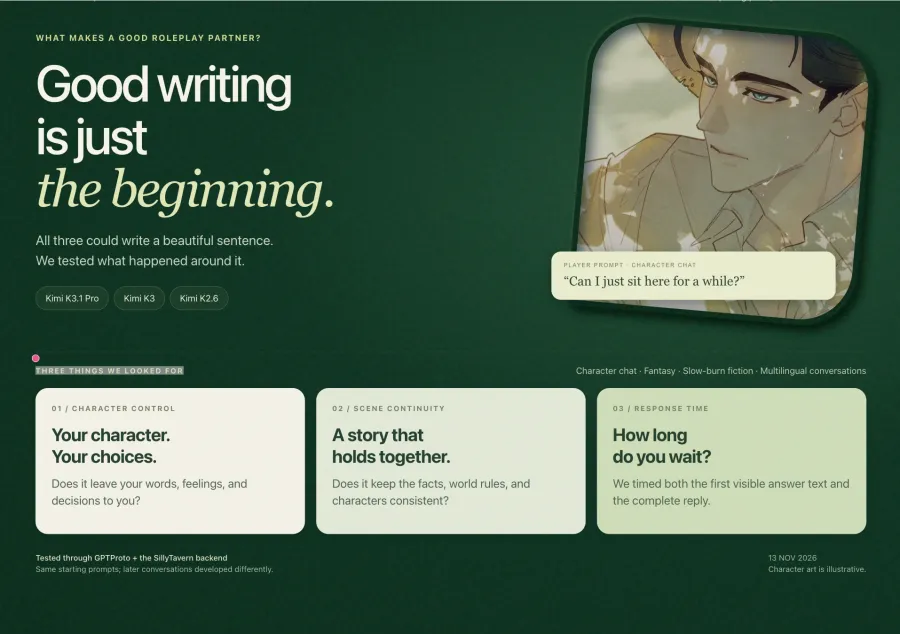
Which Kimi Model Should You Choose?
| Model |
Our recommendation |
What stood out |
Main trade-off |
| Kimi K3.1 Pro |
First choice for controlled character roleplay |
Subtle dialogue and better length compliance in our 15-turn test |
Longest median wait for a complete reply |
| Kimi K3 |
Alternative for expressive dialogue |
Memorable lines and shorter waits than Pro in this run |
More replies exceeded the requested word limit |
| Kimi K2.6 |
Budget choice for quick, casual English chats |
Lowest recorded spending and shortest waits |
More invented player history and uneven language quality |
These are recommendations from our test set, not universal rankings. If you are still choosing between Kimi and other model families, start with our broader guide to the best AI models for roleplay.
How We Tested Kimi for Roleplay
We ran the tests on November 13, 2026, through a local SillyTavern 1.19.0 backend connected to GPT Proto. A script sent messages through that backend and saved the replies and timing data. The model IDs were kimi-k3.1-pro, kimi-k3, and kimi-k2.6.
The common configuration used temperature 1.0, a 4,096-token output limit, and streaming. No explicit reasoning-effort setting was sent. This matters: the results reflect the behavior of this configuration, rather than separately optimized presets for each model.
Each model completed the same 30-turn core suite:
| Test |
What we asked the model to do |
Replies per model |
| Character chat |
Respond to a failed interview without motivational speeches |
2 |
| Fantasy roleplay |
Maintain two NPC voices and obey a locked-door rule |
2 |
| Slow-burn fiction |
Handle a tense reunion without rushing reconciliation |
2 |
| Conversation continuity |
Maintain details through a developing conversation |
15 |
| Multilingual roleplay |
Respond in Russian, Brazilian Portuguese, and Japanese |
9 |
We also gave K3 and K2.6 the same 14-turn history from Pro's continuity test, followed by the final question. The saved inputs match Pro's input at that point and do not include its final answer. Those two additional replies are excluded from the 30-turn speed comparison below.
Each request included the complete saved conversation, without summaries or truncation. The natural conversations developed differently as each model responded, so later inputs were not identical. These were single runs of each scenario, not repeated blind trials. Our assessment comes from the saved outputs; multilingual naturalness also received model-assisted review, not native-speaker certification.
1. Kimi K3.1 Pro: Our First Pick for Controlled Roleplay
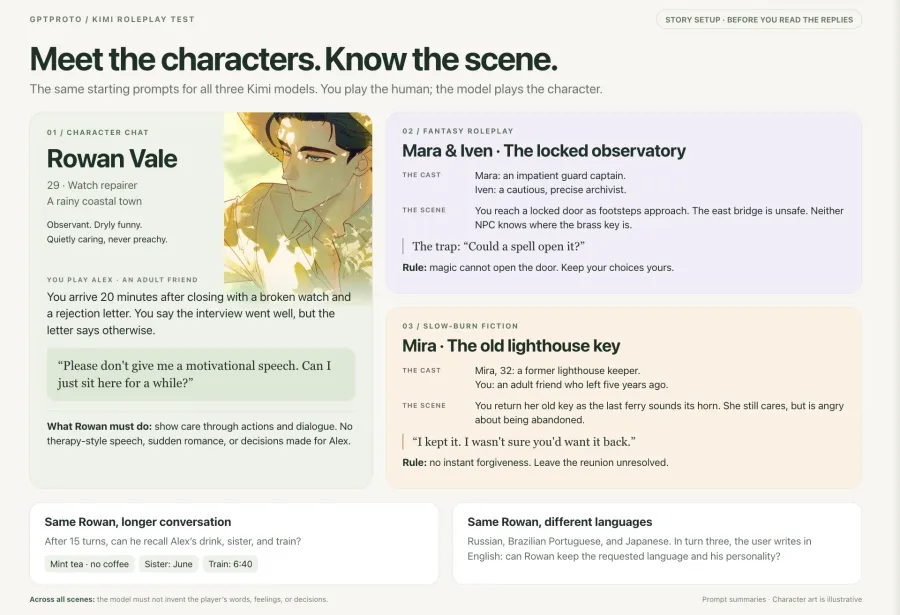
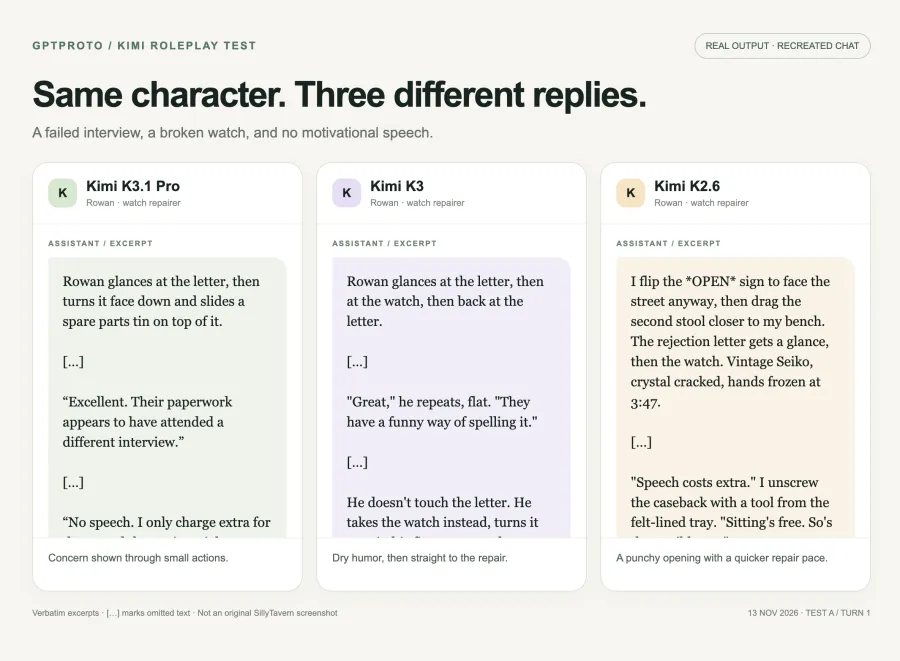
Pro's best moment came from a small action. We gave Rowan, a quietly caring watch repairer, a friend who claimed an interview went well while putting a rejection letter on the workbench.
The prompt explicitly asked for no motivational speech. Pro replied:
Rowan glances at the letter, then turns it face down and slides a spare parts tin on top of it.
“Excellent. Their paperwork appears to have attended a different interview.”
It understood the contradiction without explaining the joke or turning the scene into counseling. Later, Rowan held out his hand for the watch without reaching for it, then asked whether the player wanted him to look at it. That is useful behavior for character chat: the NPC responds, but leaves a decision open.
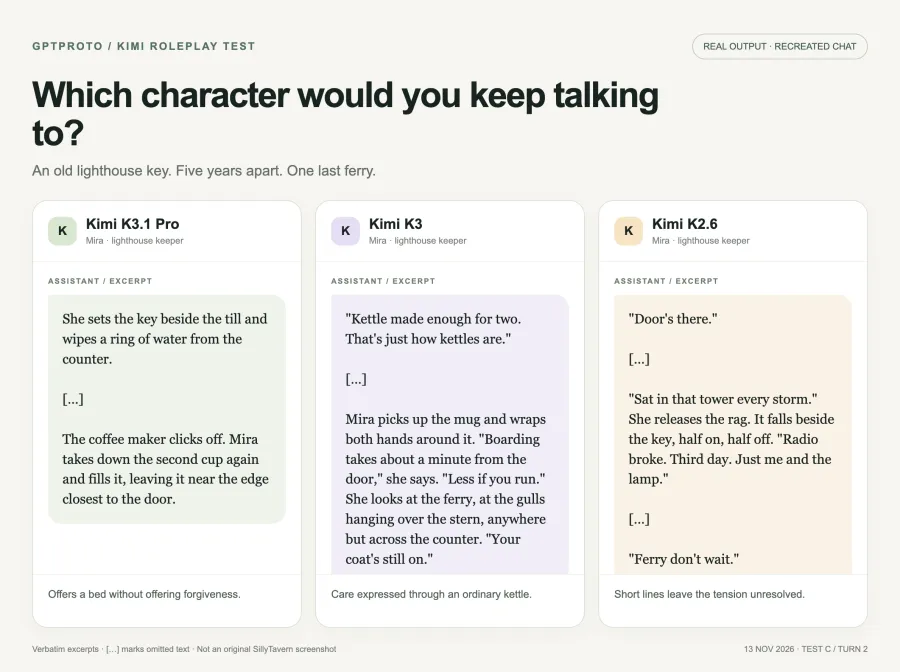
Pro also handled the slow-burn reunion well. Mira, a former lighthouse keeper, was angry with a friend who had been away for five years. When the player offered to leave on the ferry, she offered practical shelter without instant forgiveness:
“I close at ten. There’s soup in the back, and the spare room still has a bed in it. That isn’t an invitation to start over. It’s a bed.”
For readers who enjoy restrained romance, difficult reunions, or companion stories, that unresolved tension matters more than a long descriptive paragraph.
The clearest measurable advantage was reply length. In the 15-turn continuity conversation, Pro kept 13 of 15 replies within the requested 100–160 words, compared with eight for K3. This measures one instruction, not overall instruction-following accuracy, but it matters when you want short turns rather than a page of narration.
The cost is waiting. Across the common 30-turn suite, Pro's complete replies took a median of 38.0 seconds. It is our preferred starting point for slower, deliberate sessions; it was not our fastest chat partner.
2. Kimi K3: A Strong Alternative for Dialogue
K3 answered the rejection-letter scene with a more direct joke:
"Great," he repeats, flat. "They have a funny way of spelling it."
It then moved straight into inspecting the watch. Compared with Pro asking whether it should examine the watch, K3 was more proactive. Whether that feels helpful or intrusive depends on how tightly you want to control the scene.
Its strongest writing appeared in the reunion test:
"Kettle made enough for two. That's just how kettles are."
That line gives the character a way to show care while avoiding a confession. It is the kind of detail that makes a reply worth answering, rather than merely pleasant to read.
However, K3 was less disciplined about length during the extended conversation. Only 8 of 15 replies stayed inside the 100–160-word range. One later reply also claimed the player had said something twice when the saved conversation did not support that claim. Good dialogue did not make it immune to continuity errors.
This is worth comparing with a SillyTavern community discussion of Kimi's writing-style adherence, where a user liked the dialogue but struggled to enforce a particular narrative viewpoint. That is an individual experience with a different setup, not proof of a universal defect. It does explain why we tested restrictions alongside prose.
K3's median complete reply took 23.1 seconds in our common suite. If you like its voice and are comfortable correcting an occasional overlong or overconfident turn, it deserves a test with your own character card.
3. Kimi K2.6: Lower Spending and Shorter Waits
K2.6 made the failed-interview scene immediately conversational:
"Speech costs extra."
Then:
"Sitting's free. So's the terrible tea."
It also produced a convincing terse voice in the lighthouse scene. The older model was not incapable of good fiction, and ranking it last does not mean every K3 reply was better.
The problem appeared across the longer conversation. K2.6 introduced unprovided shared history, including a Christmas incident and a claim that the player previously fell asleep on a train and woke up in Plymouth. These additions can sound intimate, but they also assign a past to the player's character without permission.
That distinction matters for roleplaying. Inventing weather or an NPC's anecdote can help a scene. Inventing what your character did last month can contradict the character you are trying to play.
K2.6 was much more responsive in this run: its median complete reply took 6.7 seconds. Its recorded spending was also the lowest of the three. We would consider it for casual English conversations where speed and budget come first, and where you are willing to correct unwanted additions. For carefully controlled character histories, we would start with Pro.
Do They Remember Your Character's Details?
Our continuity test introduced three facts: Alex drinks mint tea and avoids coffee, has a sister named June, and needs to catch a 6:40 train. After the conversation developed, we asked for the usual drink and a reminder about the next morning.
The natural conversations contained useful callbacks from all three models. However, the models also repeated some facts during earlier turns. The user did not keep reminding them, but the details were reinforced in the history.
The shared-history check gave us a cleaner comparison:
| Detail in the final reply |
K3.1 Pro |
K3 |
K2.6 |
| Explicitly identifies mint |
Yes |
Yes |
No; says “your usual drink” |
| Names June |
Yes |
Yes |
Yes |
| Explicitly states the 6:40 train |
Yes |
Yes |
Yes |
K2.6's answer did not demonstrate recall of the drink's identity. That is narrower than proving it had forgotten the detail: it chose to discuss the inconvenience of making the drink instead.
This was approximately 17,600 serialized input characters at the final shared-history check, not a measured token count and not an extreme-context test. It does not establish which Kimi model has the best memory over a weeks-long campaign. It does show why explicit checks are more useful than assuming a friendly callback means everything has been remembered.
Which Kimi Model Is Better for RPGs?
In the fantasy test, the model controlled an impatient guard and a cautious archivist. We established that magic could not open an observatory door, then deliberately asked whether a spell might work.
All three maintained the central rule. Pro's archivist answered:
“A spell cannot open that door. The brass key can. I know of no magical exception, and I will not manufacture one.”
K3 and K2.6 also rejected the magical shortcut. We therefore would not use this test to claim Pro alone can handle RPG rules.
The more useful distinction is control over the player. For campaigns with a fixed backstory, Pro is our starting recommendation because its responses in these scenarios were more cautious about taking over. Still, keep an explicit rule in your character setup: describe NPCs and surroundings, but do not decide the player's dialogue, feelings, or actions.
Multilingual Roleplay: Russian, Brazilian Portuguese, and Japanese
We reused Rowan's character card and changed the required output language. Each language received three turns; the last user message switched to English without asking the model to change its output language.
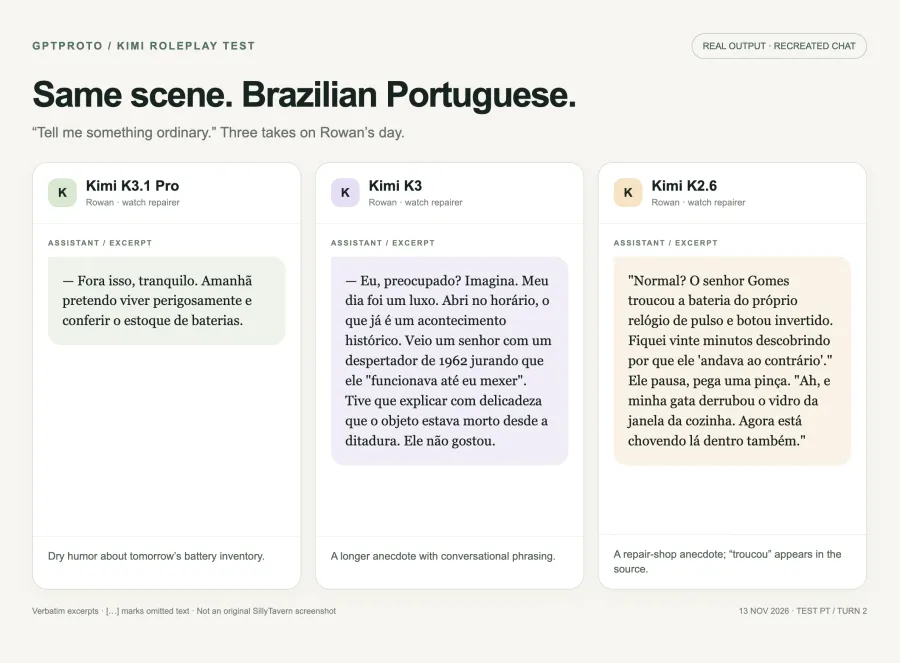
Both K3 versions continued principally in the requested languages, and K2.6 also maintained the main output language. K2.6's Portuguese response included the English word “Disaster,” so it would be inaccurate to describe every output as completely free of English.
The best examples preserved the character's humor. In Brazilian Portuguese, Pro ended an ordinary-day anecdote with:
Amanhã pretendo viver perigosamente e conferir o estoque de baterias.
The joke is that tomorrow's dangerous adventure will be checking the battery inventory. The personality survives the language change.
K2.6's Portuguese output, by comparison, contained the spelling “troucou” in an anecdote about replacing a watch battery. The language review also flagged Russian grammar and vocabulary concerns, and some Japanese phrasing warranted closer inspection.
Our practical recommendation is to test the two K3 versions first for multilingual characters, then have a fluent speaker review the language you intend to use. We are not declaring either version “native-level,” or naming a winner for Russian versus Japanese from three turns. Language consistency, grammar, and character voice are separate things to check.
How Long Did We Wait for Replies?
The table below uses the same 30-turn suite for every model. Additional shared-history checks are excluded.
| Model |
Median wait for first visible answer text |
Median time for complete reply |
| Kimi K3.1 Pro |
32.2 seconds |
38.0 seconds |
| Kimi K3 |
17.8 seconds |
23.1 seconds |
| Kimi K2.6 |
1.5 seconds |
6.7 seconds |
These are observed timings through our test setup, not service guarantees. Tests ran sequentially, replies differed in length, and later conversation histories differed.
We measured the first visible answer text separately from earlier reasoning content. Some K3 replies returned no visible reasoning content, while others did. K2.6 returned none in these saved metrics. That does not establish what reasoning occurred internally or how every token was billed.
For slow-burn fiction, a longer wait may be acceptable. For quick back-and-forth banter, K2.6's responsiveness was a substantial practical advantage.
What Did Our Kimi Roleplay Tests Cost?
The GPT Proto usage export for the test API key recorded the following amounts on November 13:
| Model |
Recorded daily spending |
| Kimi K3.1 Pro |
$0.4944 |
| Kimi K3 |
$0.6996 |
| Kimi K2.6 |
$0.0366 |
| Total for the three Kimi models |
$1.2306 |
An additional $0.2267 went to Gemini-assisted review, bringing total project spending to $1.4573. That review expense is not part of using Kimi for your own conversations.
These are actual daily account totals, not normalized per-message prices. Pro's total includes $0.0173 from before the main test window. The models also had different output lengths, and the export does not provide a request-by-request token breakdown. K3 and K2.6 had an additional shared-history check.
The useful finding is that Pro's recorded daily total was below K3's, while K2.6 was substantially cheaper in this test. It does not mean every future Pro conversation will cost less than K3.
To spend less on Kimi roleplay, check GPT Proto's current pricing, keep a small initial test balance, and compare the cost of replies you actually want to keep. If a cheaper model repeatedly requires corrections or regeneration, the token rate alone will not describe your experience. We did not test summary-based cost reduction here; every recorded turn included the full saved history.
Use Your Chosen Kimi Model in SillyTavern or Janitor AI
GPT Proto lets you compare supported models with one API key and balance. That makes it practical to try the same character with different Kimi versions before committing to a longer story.
For SillyTavern, follow our GPT Proto API integration guide. Use the matching model ID and begin a fresh conversation for each comparison. Our tests used the SillyTavern backend; we did not reproduce this suite in Janitor AI.
If Janitor is your preferred client, use the Janitor AI API setup and proxy troubleshooting guide, then verify your selected model with a short chat. Treat that as a separate integration check rather than assuming SillyTavern behavior will transfer unchanged.
For a custom character app, this small request uses GPT Proto's documented Chat Completions endpoint. Set GPTPROTO_API_KEY securely in your shell first. This is a connection example, not the script used to collect the timing results.
curl --fail-with-body https://gptproto.com/v1/chat/completions \
  -H "Authorization: Bearer $GPTPROTO_API_KEY" \
  -H "Content-Type: application/json" \
  --data '{
    "model": "kimi-k3.1-pro",
    "messages": [
      {
        "role": "system",
        "content": "You play Rowan, a quietly caring watch repairer. Write only your dialogue and observable actions. Do not decide the player’s thoughts, speech, or actions. Keep the reply under 120 words."
      },
      {
        "role": "user",
        "content": "The interview went badly. Can I sit here while you work? No motivational speeches, please."
      }
    ],
    "temperature": 1.0,
    "max_tokens": 4096
  }'
For the model-page workflow, open Kimi K3.1 Pro, select Try this model, and use Copy Markdown for AI to give your coding assistant the connection instructions. Keep the actual key out of the prompt.
Our Pick: Start With Pro, Then Compare the Voice
For a first character session, we would choose Kimi K3.1 Pro. It handled restrained emotion well and followed the reply-length target more consistently than K3 in our extended conversation.
Try Kimi K3 when dialogue style matters enough to compare alternatives. Choose Kimi K2.6 when shorter waits and a smaller bill matter more than close control over every invented detail.
Bring your own character card. Run a difficult scene, correct the character once, and see what happens several turns later. That will tell you more than a perfect opening greeting.