Quick Answer: What Is the Best AI for Roleplay?
| AI model |
Best for |
Main strength |
Main drawback |
| Kimi K3 |
Best overall AI for roleplay |
Consistent characters, emotional dialogue, and continuity |
Can become expensive in long sessions |
| GLM-5.3 |
Best balanced roleplay model |
Strong across dialogue, instructions, and story management |
Writing style can feel inconsistent |
| GLM-5.3 Flash |
Best AI for RPG roleplay |
Strong Game Master behavior and multi-character scenes |
May produce overly long responses |
| Claude Fable 5 |
Best AI for roleplay stories |
Literary prose, subtext, and emotional pacing |
Higher cost and stricter content limits |
| DeepSeek V4.1 Flash |
Best affordable roleplay model |
Good continuity at a lower cost |
Prose is less distinctive |
| Gemini 3.8 Flash |
Best for worldbuilding and lore |
Large context window and multimodal input |
Large context does not guarantee reliable memory |
For most users, Kimi K3 is the strongest starting point. It performs well in both character-focused conversations and story-driven scenes without requiring extensive prompt engineering.
The choice changes when the roleplay has a more specific goal. GLM-5.3 Flash is better at running an RPG world, Claude Fable 5 produces more literary writing, and DeepSeek V4.1 Flash makes more sense when thousands of messages or multiple users are involved.
How We Compared the Best AI Models for Roleplay
This ranking combines results from the independent AI Roleplay Bench, current model usage, published model capabilities, recent roleplay community discussions, and our hands-on API setup experience.
AI Roleplay Bench evaluated 14 models across 10 categories and 840 scored responses. Its tests cover character behavior, companion chat, Game Master narration, player agency, story continuity, mature themes, and instruction limits.
We did not treat a single benchmark score as the final answer. Roleplay quality is unusually subjective: one user may want restrained, realistic dialogue, while another wants dramatic prose and a model that constantly introduces new events. We therefore considered the following six factors.
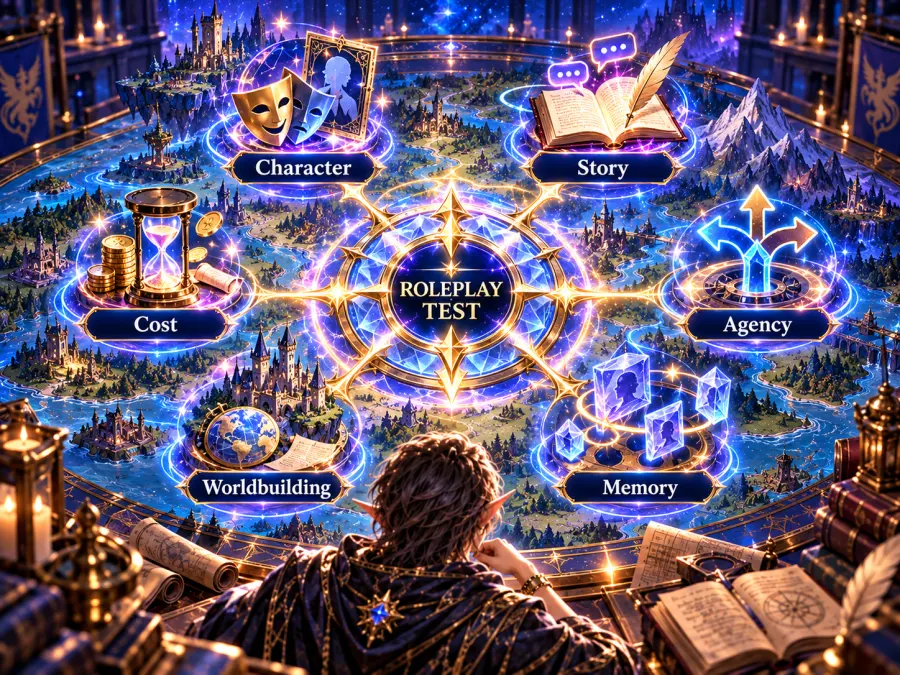
Character Consistency
A good roleplay model should maintain the character’s voice, motivations, relationship, and emotional state across multiple turns.
A weak model may begin as a sarcastic detective or reserved fantasy prince but gradually turn into a generic assistant that explains everything politely. Strong character consistency means the personality remains recognizable even when the conversation moves into an unexpected situation.
Story and Dialogue Quality
Roleplay requires more than grammatically correct text. The model must understand:
Subtext and unspoken emotions;
The pacing of a scene;
When to introduce a new detail;
When to leave space for the user;
How different characters should sound;
Which plot threads should remain unresolved.
We also looked for common writing problems such as repeated sentence structures, excessive metaphors, generic emotional descriptions, and characters who agree with everything the user says.
Player Agency
Some models generate attractive prose but repeatedly control the user’s character. They may decide what the player says, feels, notices, or does next.
For example, instead of ending with an NPC’s response, the model might write:
You forgive him, take his hand, and follow him into the castle.
That removes the user’s ability to choose. A stronger roleplay model controls its characters and the surrounding world while returning the next decision to the player.
Memory and Continuity
Memory is not the same as context-window size.
A context window determines how much text can be included in a request. Roleplay memory depends on whether the model can find and correctly use the relevant details inside that text.
We looked at whether a model could maintain:
Character relationships;
Names and physical details;
Previous promises or conflicts;
Current locations and inventories;
Established world rules;
Unfinished plot threads.
Even a model with a one-million-token context window may gradually lose accuracy as the conversation grows. Long-running stories still benefit from summaries, character memories, and lorebooks.
RPG and Worldbuilding Ability
An RPG roleplay model must manage more than one character. It may need to control locations, factions, enemies, inventory, quests, and consequences without turning the story into a fixed script.
A capable AI Game Master should introduce events and supporting characters while avoiding two extremes: waiting passively for the player to invent everything or forcing the plot toward a predetermined ending.
Cost for Long Roleplay Sessions
Roleplay can consume more tokens than ordinary chatbot use. Each new request may include the character card, system instructions, lorebook entries, summaries, and part of the previous conversation.
This means an expensive model may feel affordable during a ten-message test but become difficult to justify after hundreds of messages. Cost is especially important for roleplay applications serving multiple users.
1. Kimi K3 — Best Overall AI Model for Roleplay
Kimi K3 is our best overall AI model for roleplay because it combines character consistency, emotional awareness, and story continuity without being limited to one particular RP format.

In the September 2026 AI Roleplay Bench, Kimi K3 achieved the highest overall Roleplay Index at 86.3, although its lead over GLM-5.3 and DeepSeek V4.1 Flash was within the benchmark’s stated margin of error. It also received the highest Companion score at 90.0, measuring warm one-to-one conversation, persona consistency, and the ability to remember details shared by the user.
That combination makes Kimi K3 particularly effective for relationship-driven roleplay. It is good at recognizing what a character implies rather than responding only to the literal words. Characters can remain emotionally coherent across arguments, reconciliations, quieter conversations, and changes in the relationship.
Kimi K3 can also handle longer story scenes, supporting characters, and world information. Its strongest quality is not necessarily the most decorative prose. It is the ability to keep the character feeling like the same person as the conversation develops.
Community feedback is more mixed on cost. In a recent SillyTavern roleplay model discussion, several users praised Kimi K3’s prose, continuity, and personality, while others said it becomes expensive during long sessions. Some also reported that it can fixate too heavily on one character trait and turn that detail into the character’s entire personality.
Kimi K3 is therefore best used when roleplay quality matters more than finding the lowest possible token price.
Best for: Character-focused roleplay, emotional dialogue, companion chat, romance, and continuing story arcs.
Avoid if: You run very long daily sessions on a strict budget or prefer short, highly controlled responses.
2. GLM-5.3 — Best Balanced Model for Character Roleplay
GLM-5.3 is the most balanced choice in this list. It does not rely entirely on literary prose, extreme creativity, or a large context-window claim. Instead, it performs well across character dialogue, story management, instructions, and general roleplay scenarios.

GLM-5.3 scored 85.1 on AI Roleplay Bench, placing it just behind Kimi K3. Its Core Roleplay score reached 86.0, slightly below Kimi K3 but ahead of most other tested models.
In practice, GLM-5.3 is suitable for users who move between different styles of roleplay. It can handle a quiet character conversation in one session and a larger fantasy scene with several characters in another. It usually understands character-card instructions and can follow rules about tone, narration perspective, response length, and player agency.
Its main weakness is style consistency. Community opinions about GLM-5.3 vary considerably. Some users consider it a capable and affordable alternative to premium Claude models. Others report that its dialogue can drift toward similar humor, overly polished lines, or unnecessarily elaborate descriptions.
That disagreement is important. A benchmark can measure whether a model follows a scenario correctly, but it cannot decide whether a particular prose style feels natural to you.
GLM-5.3 works best when the system prompt clearly defines:
The preferred narration perspective;
How much initiative the model should take;
Whether it may introduce new characters;
The expected response length;
Actions the model must not perform for the player.
It is a practical middle option for users who do not want to switch models every time the roleplay changes direction.
Best for: General character roleplay, mixed dialogue and narrative scenes, and users who want balanced performance.
Avoid if: You strongly dislike verbose narration or want a model with an immediately recognizable literary voice.
3. GLM-5.3 Flash — Best AI for RPG Roleplay
GLM-5.3 Flash is the strongest choice for RPG roleplay, particularly when the model must behave like a Game Master instead of playing only one character.

It received the highest Game Master score on AI Roleplay Bench at 89.2. The category evaluates whether a model can narrate scenes, control supporting characters, introduce events, and keep the story moving without taking control of the player’s character.
That last point is especially important in RPG roleplay. A model can produce detailed fantasy writing and still be a poor Game Master if it decides how the player reacts to danger, automatically resolves choices, or forces the group toward a fixed outcome.
GLM-5.3 Flash is better suited to managing:
D&D-style adventures;
Fantasy or science-fiction campaigns;
Multiple NPCs in the same scene;
Quest progression and environmental events;
Combat narration;
Factions, locations, and changing world states.
It is also a more cost-conscious option than using a premium literary model for every turn. That matters in RPG sessions because world descriptions, character sheets, lore entries, and conversation history can make each request relatively large.
The trade-off is that GLM-5.3 Flash may generate more text than the scene requires. Some community users also report slower responses when reasoning is enabled. A clear instruction such as “Write no more than four paragraphs and never decide the player’s actions” can reduce both problems.
GLM-5.3 Flash is not automatically the best choice for intimate, dialogue-only scenes. Kimi K3 generally feels stronger when emotional character interaction is the main objective. But when one model must control a living world around the player, GLM-5.3 Flash has the clearer advantage.
Best for: RPG campaigns, Game Master narration, multi-character scenes, quests, combat, and world events.
Avoid if: You want short, fast, dialogue-only replies with minimal narration.
4. Claude Fable 5 — Best AI for Roleplay Stories
Claude Fable 5 is the best choice for users who want roleplay to feel like collaborative fiction rather than a sequence of chatbot replies.

Its main advantage is prose. Fable 5 is particularly effective at writing subtle emotional reactions, maintaining tension between characters, and recognizing what a character chooses not to say. Instead of explaining every emotion directly, it can express hesitation through dialogue, pacing, body language, or a change in tone.
This makes it suitable for:
Slow-burn relationship stories;
Character drama;
Mystery and psychological roleplay;
Dialogue with emotional subtext;
Long-form collaborative fiction;
Scenes in which pacing matters more than constant action.
Claude-family models are frequently praised in roleplay communities for natural prose, emotional intelligence, and their ability to portray characters with conflicting motivations. In a recent SillyTavern community discussion, users placed Fable and Opus models among their preferred choices for long storylines, creative writing, and emotionally detailed roleplay.
However, Fable 5 was not included in the same AI Roleplay Bench used to score Kimi K3, GLM-5.3, and DeepSeek V4.1 Flash. Its position in this ranking is therefore based more heavily on story-oriented evaluations and community experience than on a directly comparable Roleplay Index.
There are two practical drawbacks. First, Fable 5 is more expensive than Flash-class models, especially when large amounts of previous dialogue are included in every request. Second, some themes may encounter stricter content limits. Users specifically looking for models with fewer restrictions can consult our separate comparison of the best uncensored LLM APIs for roleplay.
Best for: Literary roleplay, character drama, emotional scenes, slow-burn relationships, and collaborative fiction.
Avoid if: Low token cost or fewer content restrictions matters more than writing quality.
5. DeepSeek V4.1 Flash — Best Affordable AI for Long Roleplay Sessions
DeepSeek V4.1 Flash is the most practical choice for long or high-volume roleplay. It offers strong general roleplay performance without requiring premium-model spending on every conversation turn.

DeepSeek V4.1 Flash scored 84.4 on AI Roleplay Bench, placing it in the same top group as Kimi K3 and GLM-5.3. Its Core Roleplay score reached 84.7, showing that a more affordable model does not automatically mean sacrificing character behavior, instruction following, or story continuity.
Its strengths are reliability and efficiency. It can follow a structured character card, continue a scene without unnecessary explanation, and process long character histories or world information. This makes it useful not only for personal roleplay but also for applications that may generate responses for many users.
DeepSeek V4.1 Flash is particularly suitable when:
Conversations regularly continue for hundreds of messages;
Each request contains a large character card or lorebook;
Several characters or users share the same API budget;
Response quality must remain stable enough for production;
Cost matters more than highly literary prose.
The trade-off is style. DeepSeek V4.1 Flash can produce coherent and useful roleplay, but its writing is less distinctive than Claude Fable 5. It may describe the correct action and emotion without creating the same level of subtext or atmosphere.
Community opinions also vary between model versions and prompt configurations. Some users describe DeepSeek Flash as a dependable and affordable workhorse, while others prefer earlier DeepSeek releases for prose. This is why it is worth testing the same character card and opening scene before committing a large application to one model.
DeepSeek V4.1 Flash is the better business choice when the goal is not to create the single most beautifully written response, but to sustain many acceptable roleplay conversations at a manageable cost.
Best for: Long sessions, high message volume, budget-conscious users, and roleplay applications serving multiple users.
Avoid if: Your main goal is literary prose, emotionally subtle narration, or a highly distinctive writing style.
6. Gemini 3.8 Flash — Best for Worldbuilding and Large Lore
Gemini 3.8 Flash is the best model in this list for roleplay involving large amounts of reference material.
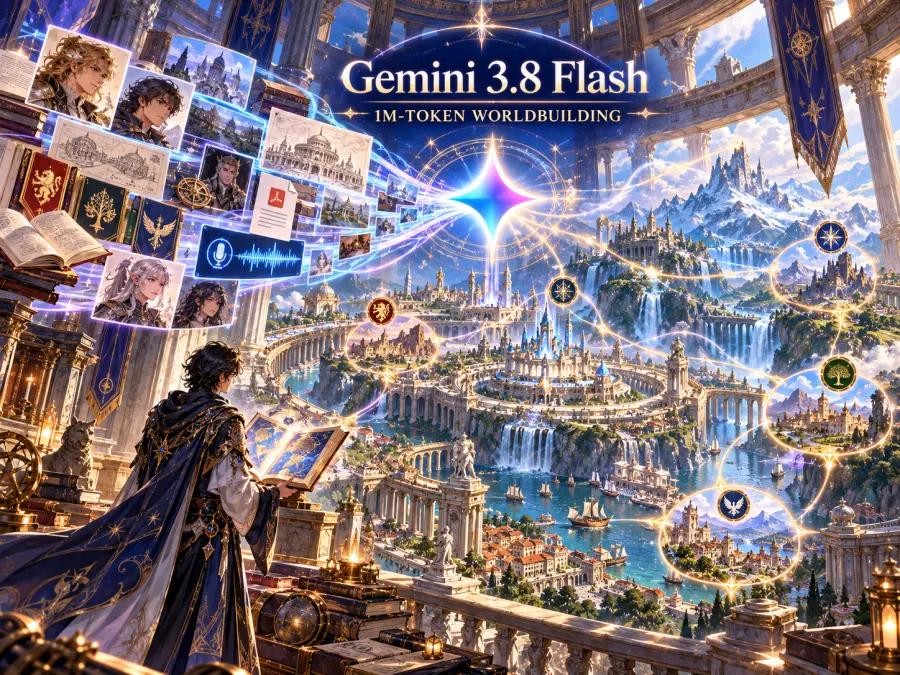
Its 1,048,576-token input window can accommodate character sheets, world histories, faction descriptions, location guides, campaign summaries, and previous story events. Its multimodal input support also allows an application to combine text with character images, maps, PDFs, audio, or other reference material.
That makes Gemini 3.8 Flash a strong option for:
Large fantasy or science-fiction worlds;
Roleplay based on an existing fictional universe;
Campaigns with multiple factions and locations;
Detailed character and inventory records;
Visual character references;
Roleplay applications that combine story text with other media.
Gemini’s biggest advantage is therefore not necessarily character dialogue. It is the amount and variety of information that can be supplied to the model.
However, a large context window should not be confused with perfect memory. Placing hundreds of thousands of tokens inside a request does not guarantee that the model will retrieve the correct detail at the correct moment. Roleplay users frequently report context degradation as conversations grow, even when the advertised limit has not been reached.
Gemini models can also develop recognizable writing habits, including repetitive dialogue structures or similar emotional phrases across characters. A strong character card, clear style instructions, and periodic story summaries can reduce this behavior.
Gemini 3.8 Flash should be chosen when the roleplay depends on a large world that the model must reference. If the goal is primarily intimate character interaction, Kimi K3 is the safer starting point. If the goal is literary writing, Claude Fable 5 is stronger.
Best for: Worldbuilding, large lorebooks, complex fictional universes, multimodal character references, and information-heavy campaigns.
Avoid if: You expect a one-million-token context window to replace summaries, lorebooks, or persistent memory systems.
Which AI Has the Best Memory for Roleplay?
Kimi K3 is the best model in this comparison for remembering and correctly using character details during an ongoing conversation. Gemini 3.8 Flash can accept more background information, but capacity and memory quality are not the same thing.
A simple way to understand the difference is:
A context window is the size of the model’s desk. Memory is whether it can find and correctly use the right note on that desk.
Roleplay memory can refer to several different capabilities.
Short-Term Conversation Memory
This determines whether the model remembers what happened earlier in the current conversation.
For example, if a character hides a key in the second scene, does the model remember its location ten or twenty messages later?
Kimi K3 performs particularly well here because it combines recall with character consistency. It is less useful if the model remembers the key but forgets why the character hid it.
Large-Lore Memory
This refers to how much world and character information can be supplied in a request.
Gemini 3.8 Flash is the stronger choice when an application must load a large lorebook, campaign history, or collection of reference documents. However, relevant information should still be organized and retrieved selectively instead of sending every available document on every turn.
Relationship and Emotional Memory
Claude Fable 5 and Kimi K3 are stronger options when memory involves changes in trust, unresolved conflict, shared experiences, or the emotional meaning of a previous scene.
A model may remember that two characters argued without understanding how that argument should affect their next conversation. Emotional continuity requires more than fact retrieval.
Persistent Long-Term Memory
No model should be described as having unlimited or perfectly reliable long-term roleplay memory.
For stories lasting hundreds of messages, the application should store important information outside the model and add the relevant details back into future requests. Common methods include:
| Memory requirement |
Recommended model |
Why |
| Character details during a conversation |
Kimi K3 |
Strong companion behavior and persona consistency |
| Large lorebooks and reference documents |
Gemini 3.8 Flash |
Large multimodal input capacity |
| Emotional relationship continuity |
Claude Fable 5 |
Strong subtext and character writing |
| RPG world and event management |
GLM-5.3 Flash |
Strong Game Master behavior |
| Affordable repeated context |
DeepSeek V4.1 Flash |
Better suited to high-volume sessions |
| Balanced general memory |
GLM-5.3 |
Strong overall roleplay performance |
The best memory therefore comes from combining a capable model with a well-designed memory system. Simply choosing the model with the largest context number is not enough.
Best Roleplay Model by Scenario
If you still cannot decide which model to use, start with the type of experience you want to create.
| If you want… |
Choose… |
Why |
| The best overall AI for roleplay |
Kimi K3 |
Strong characters, emotional dialogue, and continuity |
| The best AI for roleplay stories |
Claude Fable 5 |
More literary prose and emotional pacing |
| The best AI for RPG roleplay |
GLM-5.3 Flash |
Strong Game Master and multi-character performance |
| The best affordable roleplay model |
DeepSeek V4.1 Flash |
Strong results at a more manageable cost |
| The best model for large fictional worlds |
Gemini 3.8 Flash |
Large context and multimodal input |
| A balanced general-purpose alternative |
GLM-5.3 |
Performs well across different roleplay styles |
The safest method is to run the same character card and opening scene through several models. Compare whether each model stays in character, respects player agency, remembers the same details, and produces a writing style you actually enjoy.
GPT Proto’s roleplay AI API lets you test multiple supported models through one API key and balance, so you do not need to rebuild the integration for every provider.
How to Connect a Roleplay Model to an AI Chat Client
Many AI roleplay clients and character-chat websites allow users to connect an external model through a Proxy, Custom API, Custom Endpoint, or similarly named setting. The labels and interface may differ, but the basic connection process is usually the same.
The chat client manages the character interface, conversation history, and user controls. The external model receives the prompt and generates the actual reply.
The Standard Proxy Setup
Before opening the settings, prepare four pieces of information:
API endpoint: The complete chat-completions URL supplied by the API provider.
API key: The credential used to authorize requests.
Model string: The exact request ID of the roleplay model you selected.
Optional custom prompt: Extra instructions that the client adds to the character prompt.
Then follow this general process:
Open the client’s model, provider, or API settings.
Select Proxy, Custom API, or the equivalent external-provider option.
Paste the full endpoint and API key.
Enter the exact model string rather than guessing it from the public model name.
Leave optional prompt fields empty during the first connection test.
Save the configuration, refresh the page if necessary, and send a short test message.
Do not expose an API key in a public screenshot, character card, shared configuration, or frontend code.
Example: Adding a Proxy in Janitor AI
Janitor AI is one example of a character-chat website that supports an external model through its Proxy option. The same endpoint–key–model relationship also applies to many other clients, even when their field names or layout look different.
For the full interface walkthrough and error explanations, see the Janitor AI API setup guide.
Step 1: Select Proxy
Open the API settings for the chat and choose Proxy as the provider.
[Insert Screenshot 1: Selecting Proxy in Janitor AI]
Step 2: Enter the Endpoint, API Key, and Model String
Paste the complete endpoint, add the API key, and enter the exact supported model string.
[Insert Screenshot 2: Endpoint, hidden API key, and roleplay model string]
For example, GPT Proto currently uses deepseek-flash to access DeepSeek V4.1 Flash. Do not automatically convert a release name into an assumed API model string; confirm the current ID on the model page or dashboard.
Step 3: Save, Refresh, and Test
Save the configuration and send a short test message. If the client does not immediately recognize the new settings, refresh the chat page before changing the configuration.
[Insert Screenshot 3: Successful roleplay response after refreshing the page]
During our Janitor AI setup, the first test displayed a network or “Failed to fetch” error even though the Proxy configuration had been saved. After refreshing the chat page and trying again, the same configuration worked normally.
Refreshing will not solve every connection problem. If the error continues, verify that:
The URL contains the complete endpoint path;
The API key was copied correctly;
The selected model string is available through the provider;
The external API or Proxy option remains selected after saving;
The account has sufficient balance or remaining quota.
If you want control over the complete product rather than connecting a model to an existing client, see how to create your own AI character with an API.
Final Verdict: What Is the Best LLM AI for Roleplay?
Kimi K3 is the best overall AI model for roleplay in 2026. It offers the strongest balance of character consistency, emotional dialogue, memory, and story continuity.
However, the best model changes with the experience:
Choose Claude Fable 5 for literary roleplay stories.
Choose GLM-5.3 Flash for RPG campaigns and Game Master narration.
Choose DeepSeek V4.1 Flash for affordable long sessions.
Choose Gemini 3.8 Flash for large worlds and extensive lore.
Choose GLM-5.3 when you want balanced general performance.
Do not choose a model based only on context size or a leaderboard position. Test the same character, prompt, and scene across several models. The best roleplay model is the one that remembers the details you care about, respects your control of the player character, and produces a style you want to continue reading.