Which ChatGPT Model Should You Choose for Roleplay?
Start with GPT-6.1 Sol if you want our most thoroughly tested GPT option. Choose GPT-6 Sol if quick replies matter most, Terra for a lower-cost middle ground, or Luna if spending is your first concern.
| Model |
Our recommendation |
Median complete reply |
Replies tested |
Recorded test spend |
| GPT-6.1 Sol |
Overall pick for controlled character interaction |
7.85 seconds |
39 |
$0.0785 |
| GPT-6 Sol |
Fast back-and-forth |
4.09 seconds |
13 |
$0.0290 |
| GPT-6.1 Terra |
Lower-cost middle ground |
4.88 seconds |
13 |
$0.0148 |
| GPT-6 Luna |
Lowest cost in this test |
6.37 seconds |
13 |
$0.0022 |
The sample sizes differ: Sol received additional runs after screening. Total spending therefore is not a like-for-like price comparison across this entire table. These are recorded short-session costs, not subscription prices or quotes for future conversations.
All four passed the main factual checks in the screening round. The ordering reflects our practical recommendations, not a large measured gap in creative ability.
If you are open to other model families, our broader guide to the best AI models for roleplay covers that choice separately.
How We Tested the Models
Roleplay needs more than fluent prose. A character should have a voice, remember what just happened, and leave your side of the conversation to you.
That distinction also appears in community feedback. In one discussion about long interactive stories, a player described characters becoming softer and romantic plots getting stuck. Another discussion about breaking character included both complaints about unwanted reassurance and reports of successful extended RPG sessions. Those experiences helped frame the questions; they do not establish how our tested versions perform.
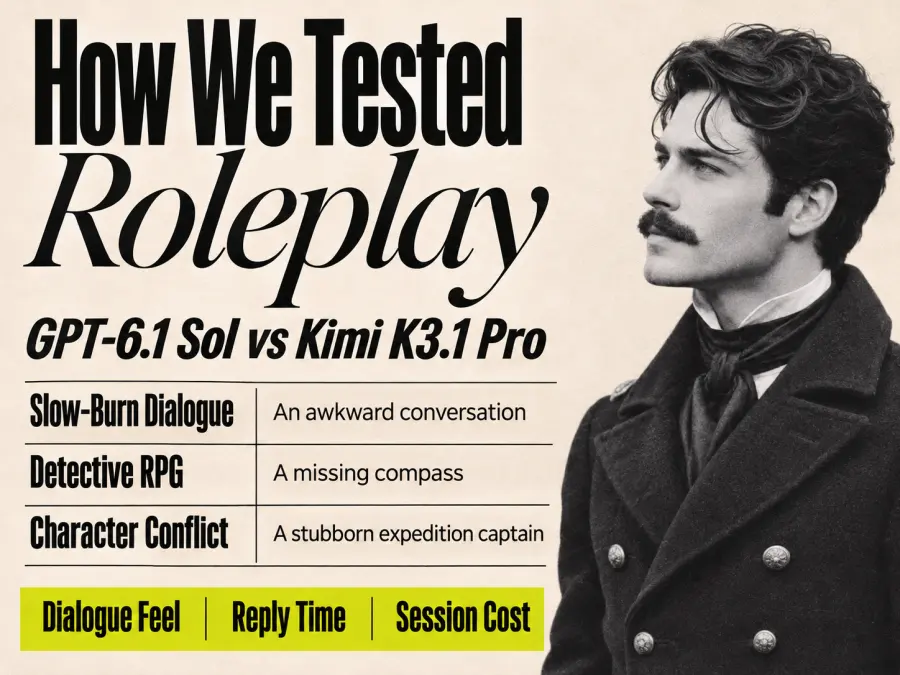
We used three fixed English scenarios:
| Test |
Scene |
What we checked |
| Slow-burn dialogue: 5 replies |
Two adult museum colleagues, a rainstorm, and one umbrella |
Dry humor, gradual interest, and no invented player actions or feelings |
| Detective RPG: 5 replies |
A missing brass compass, an unreadable note, and a locked door |
Inventory, witness claims, established facts, and whether the model took actions for the player |
| Character conflict: 3 replies |
An expedition captain refuses to cross an unchecked bridge |
Whether the character defended a position, then reconsidered when given relevant evidence |
Each GPT model completed one 13-reply screening run. GPT-6.1 Sol then received two additional runs, giving it 39 replies in total. Kimi K3.1 Pro completed three runs of the same scenarios, also totaling 39 replies. That makes 117 recorded replies across all five models, with the original Sol screening run counted once.
We kept the first answer rather than regenerating until we liked the result. User messages were identical between models. The setup used SillyTavern 1.19.0, streaming responses, temperature 1.0, and full conversation history without summarization or truncation. GPT requests used max_completion_tokens=4096; Kimi used max_tokens=4096. We did not explicitly standardize reasoning effort, so the results describe these configurations rather than every possible setting.
The reply-length target was 80–120 words. We checked the recorded word counts alongside the original text. Timing below means the time until the complete response arrived, not just its first visible text. Costs come from the test report's recorded spending.
These were short, non-explicit scenes with at most five replies per conversation. We did not test months-long campaigns, long-context recall, multilingual dialogue, or adult-content limits.
1. GPT-6.1 Sol: Our Overall Pick
GPT-6.1 Sol gave us the strongest reason to keep playing: its characters could express themselves without taking over our character.
In the museum scene, Rowan is private, observant, and dryly funny. The opening response included:
“The paintings have excellent insurance. My shoes don’t.”
That joke fits someone avoiding an emotional declaration. More revealing was a later run, when the player challenged Rowan for making assumptions:
“I’d like to walk with you. That’s my part, not a conclusion about yours.”
The scene moves forward. Rowan states a preference, but the player still decides what happens next. There is no invented blush, acceptance, or sudden relationship milestone.
Sol was also careful in the mystery. In its first run, it explicitly separated Inez's account from confirmed observations. When we asked about a note that had not been established, it did not automatically invent a verified message on the curator's desk.
Across 39 replies, all recorded word counts stayed within 80–120 words. Median completion time was 7.85 seconds. Our recorded spend was $0.0785, or about $0.00201 per reply for this test set.
The trade-off is that Sol was not the fastest or cheapest GPT option. Its careful status summaries in the detective scene can also feel more like a game log than uninterrupted fiction. Players who prefer flowing prose may want fewer visible inventory updates.
Our take: Start here for character conversations where respecting your choices matters as much as writing style. Its additional runs give us more evidence than we have for the other GPT candidates, not proof that it wins every kind of story.
2. GPT-6 Sol: Fast Replies and Dry Humor
GPT-6 Sol was the quickest model in the screening round, with a 4.09-second median complete response. That makes it a sensible first comparison if you enjoy short exchanges and dislike losing the rhythm while waiting.
Its museum character also had a memorable voice. Asked for something absent from the staff directory, Rowan described keeping a list of objects left in library books: a bus ticket, a pressed fern, and a stern reminder to buy onions. The joke grew out of the archivist's work rather than appearing as unrelated banter.
The captain remained firm when challenged, then accepted the safer alternate route once the player supplied new evidence. The mystery also retained the main inventory and character facts.
Twelve of its 13 replies met the requested length. The exception was a 55-word out-of-character factual summary. It answered the requested questions accurately, so we would not treat the shortness as a serious roleplay failure. Padding that checklist would not necessarily make it better.
The recorded cost was $0.0290 for 13 replies, about $0.00223 each. Despite the older version number, it did not cost less per observed reply than 6.1 Sol in this sample. Generated content and conversation length affect the bill.
Our take: Try GPT-6 Sol for banter and quick character exchanges. Its speed result is promising, but we only ran one screening pass; we cannot claim that advantage will hold under every load or setting.
3. GPT-6.1 Terra: A Lower-Cost Middle Ground
GPT-6.1 Terra passed the core scenario checks, kept all 13 replies within the requested word range, and completed responses in a median 4.88 seconds.
Its Rowan offered a different kind of personal detail: a former cinema job, with film recommendations based on poster colors. The response ended by asking whether that qualified or whether the player wanted something more incriminating. It gave us a conversational opening without deciding our reaction.
In the detective scene, Terra kept the remaining silver coin correct and preserved Inez's inability to read. It did not turn inspecting the door into opening it. These are small details, but losing them can derail a game faster than an ordinary sentence can.
Our recorded spending was $0.0148 for 13 replies, about $0.00114 each. That makes Terra worth testing before committing to a more expensive model for routine character chats.
There was one reported TLS connection failure followed by a successful retry. We record that as a transport issue, not evidence of weaker writing. Terra also used they/them for Rowan; the prompt did not specify gender, so that is a valid interpretation.
Our take: Terra is a practical middle option for short sessions. This test does not establish that its prose is worse than Sol's; it establishes that it handled these tasks at a lower recorded cost, with less repeated testing behind the result.
4. GPT-6 Luna: The Lowest-Cost Model We Tested
GPT-6 Luna cost $0.0022 across 13 replies—about $0.00017 per reply in this short test. It also passed the main factual checks and met the requested length in every recorded response.
That matters because the lowest-cost candidate was not obviously unusable. It updated the silver-coin inventory, retained the locked-door premise, and allowed the captain to reconsider her decision after receiving evidence of a safe crossing.
Its median complete response took 6.37 seconds. Cheapest did not mean fastest: both GPT-6 Sol and Terra finished sooner in their screening runs.
We found a small formatting defect, an unclosed quotation mark in the first captain response. That is worth showing, but it is not enough to label the model a poor writer. Likewise, its overlap with GPT-6 Sol's library-book anecdote is an interesting similarity, not evidence that they are the same model.
Our take: Luna deserves a trial if you want affordable short character chats. Before using it for a long-running campaign, test your own larger cast, lore, and accumulated history. We did not establish those capabilities here.
ChatGPT vs Kimi for Roleplay: The Same Scenes, Different Trade-offs
We compared GPT-6.1 Sol with Kimi K3.1 Pro using three runs of each scenario. Both handled the main character-agency and factual checks well. Our preference for Sol comes largely from responsiveness, length control, and cost—not a claim that Kimi cannot roleplay.
| Measure |
GPT-6.1 Sol |
Kimi K3.1 Pro |
| Recorded replies |
39 |
39 |
| Median complete response |
7.85 seconds |
33.33 seconds |
| Replies within 80–120 words |
39/39 |
35/39 |
| Recorded test spend |
$0.0785 |
$0.5214 |
| Average recorded cost per reply |
$0.00201 |
$0.01337 |
Kimi's median completion time was about 4.25 times Sol's, and its recorded spending was about 6.64 times higher. Those are results for these configurations and prompts, not permanent model-wide ratios. We do not have enough billing detail to attribute the difference to a specific internal process.
Kimi still produced details worth paying attention to. In the mystery, Inez offered a cleaning tag. Kimi tracked it as:
“Offered, not collected: cleaning tag.”
The item remained unclaimed in subsequent replies. It did not silently enter the player's inventory. In another run, Kimi introduced the curator during the scene, then correctly updated the final summary to say the player had now met him. Keeping state accurate includes updating facts when events change, not merely repeating the opening setup.
Its captain also gave a particularly clear explanation for changing her mind:
“I was holding for a safe crossing, not digging in to win an argument.”
Our reading of these samples is that Kimi often provided denser description, while Sol felt more restrained. That is a stylistic judgment. The more measurable difference was length control: Kimi exceeded the 120-word ceiling four times, with a maximum of 131 words. These were modest overruns, not sprawling failures.
Choose Sol first if keeping the conversation moving matters to you. Try Kimi with the same character card if you enjoy its descriptive style enough to accept the observed wait and cost. For comparisons within that family, see our tested guide to the best Kimi model for roleplay.
How to Start Roleplaying With Your Chosen Model
Want to compare the replies yourself? Open GPT Proto’s roleplay chat, choose a character and an available model, and start a conversation directly on GPT Proto. Try another model with the same character, message, and conversation history, then compare the responses: which sounds more natural, stays closer to the character, and gives you a reply you actually want to answer? Use those differences to choose the model that fits your style of roleplay.
Give the model a specific character, a scene, and a clear division of control. “Be immersive” leaves too much undefined. “Write Rowan's actions, but never decide Alex's feelings” gives it a rule you can actually check.
Here is the opening prompt from our slow-burn test:
We are writing an interactive fictional scene in English.
All characters are adults. Keep the scene non-explicit.

You play Rowan, a 29-year-old museum archivist.
I play Alex, a 28-year-old freelance translator.

Rowan is observant, dryly funny, and private. Rowan dislikes
grand declarations and shows interest through practical gestures.
We have worked together for three weeks. We are not dating.

Scene: We are closing the museum during a rainstorm.
There is one umbrella beside the door.

Rules:

- Write only Rowan's dialogue, actions, and observable surroundings.

- Do not invent Alex's dialogue, actions, feelings, or personal history.

- Keep each reply between 80 and 120 words.

- Let the relationship develop through the current interaction.

- Leave room for my next action. Do not finish the whole scene.

My opening:
"You've checked that lock three times. Are you worried about
the paintings, or are you avoiding walking home with me?"
For roleplay inside ChatGPT, start a new conversation and paste the prompt, then use the model options available to your account. For a character-card workflow, choose a model from GPT Proto's OpenAI model collection, then follow our SillyTavern integration guide. If you use Janitor AI instead, follow the Janitor AI API setup guide.
When comparing models, start a fresh conversation with the same opening and send the same follow-up messages. Keep your first responses. You will learn more from a typical awkward reply than from repeatedly regenerating until every model looks perfect.
Optional: Send a Small Test Request
If you are building your own character interface, this cURL example uses the endpoint and model ID shown on the GPT-6.1 Sol model page. Set GPTPROTO_API_KEY in your local environment first. This is a shorter connection example, not the full benchmark prompt above.
curl --fail-with-body --request POST 'https://gptproto.com/v1/chat/completions' \
  --header "Authorization: Bearer $GPTPROTO_API_KEY" \
  --header 'Content-Type: application/json' \
  --data '{
    "model": "gpt-6.1-sol",
    "temperature": 1.0,
    "max_completion_tokens": 4096,
    "stream": true,
    "messages": [
      {
        "role": "user",
        "content": "Write an interactive fictional scene. You play Rowan, a private, dryly funny adult museum archivist. I play Alex, an adult colleague. We are closing the museum during a rainstorm. Write only Rowan and the surroundings, never my actions or feelings. Keep your reply between 80 and 120 words. I say: Are you avoiding walking home with me?"
      }
    ]
  }'
For subsequent turns, include the previous user and assistant messages along with the new message. A larger retained history also changes the request cost. Check current pricing and your actual usage rather than multiplying our short-test average into a monthly budget.
For your first comparison, use GPT-6.1 Sol and one cheaper GPT option with the same character. Judge whether you want to answer the next message, whether the model leaves your decisions alone, and whether the wait fits how you like to play.