Introduction
OpenAI released GPT-5.2 on December 11, 2024, marking the company's tenth anniversary with its most capable model series yet. The launch came just one week after CEO Sam Altman declared an internal code red, responding to competitive pressure from Google's Gemini 3 and other rivals. For professionals and developers seeking more reliable AI assistance with fewer errors and better reasoning capabilities, this update addresses critical pain points in coding accuracy, document analysis, and complex problem-solving.
What you'll discover in this guide:
-
Three distinct GPT-5.2 versions and when to use each one
-
Real performance improvements in coding, spreadsheets, and professional tasks
-
Pricing changes and cost-effective alternatives through GPT Proto
-
Practical limitations including speed tradeoffs
Understanding the GPT-5.2 Model Family
OpenAI departed from its traditional single-model approach by releasing three specialized versions of GPT-5.2, each optimized for different use cases and computational requirements.
GPT-5.2 Instant
GPT-5.2 Instant targets everyday tasks requiring quick responses. It handles web searches, translations, and basic writing with minimal latency, continuing the conversational warmth introduced in GPT-5.1 Instant while improving clarity and information organization.
GPT-5.2 Thinking
GPT-5.2 Thinking serves as the workhorse for professional applications. This version excels at programming, mathematical reasoning, and analyzing lengthy documents by applying extended reasoning chains before responding. Complex tasks may require several minutes of processing time, but the quality improvements justify the wait for many professional use cases.
GPT-5.2 Pro
GPT-5.2 Pro delivers maximum accuracy and reliability for extremely difficult problems. It dedicates the highest computational resources to each query, making it ideal when correctness matters more than speed. Early testing shows fewer critical errors in complex domains like advanced programming, though occasional incomplete responses can occur after extended processing.
GPT-5.2 Professional Knowledge Work Performance
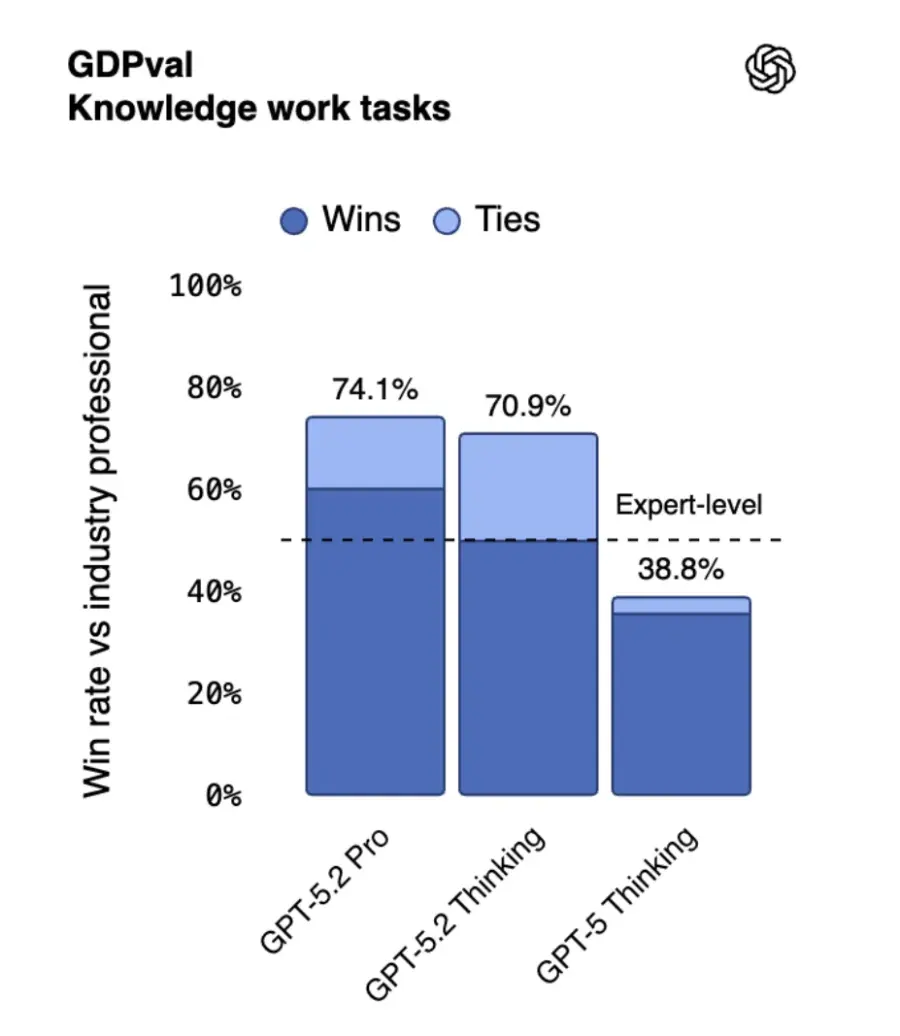
OpenAI designed GPT-5.2 specifically to deliver measurable economic value in real-world professional settings. The company created GDPval, a new benchmark covering 44 occupations across nine industries that contribute most to U.S. GDP. Rather than testing academic knowledge, GDPval measures AI performance on actual work deliverables like sales presentations, accounting spreadsheets, manufacturing flowcharts, and project management documents.
In blind comparisons against industry professionals with an average of 14 years of experience, GPT-5.2 Thinking matched or exceeded expert quality in 70.9% of tasks. GPT-5.2 Pro pushed this figure to 74.1%. The models complete these tasks 11 times faster than human experts while costing less than 1% as much, suggesting significant productivity gains when combined with human oversight.
One GDPval evaluator described the quality improvement as an exciting and visible leap, noting that outputs resembled work from a professional company team with surprisingly excellent formatting and recommendations, though minor errors still required correction.
Real-World Performance Improvements
| Capability Area |
Key Benchmark |
GPT-5.2 Thinking |
GPT-5.1 Thinking |
Change |
| Knowledge Work |
GDPval Win Rate |
70.90% |
38.80% |
0.827 |
| Software Engineering |
SWE-Bench Pro |
55.60% |
50.80% |
0.094 |
| Scientific Reasoning |
GPQA Diamond |
92.40% |
88.10% |
0.049 |
| Abstract Reasoning |
ARC-AGI-2 |
52.90% |
17.60% |
2.006 |
| Chart Understanding |
CharXiv Reasoning |
88.70% |
80.30% |
0.105 |
In OpenAI's internal testing of entry-level investment banking analyst tasks, GPT-5.2 Thinking improved average scores from 59.1% to 68.4%. This 9.3 percentage point gain appeared most dramatically in creating three-statement financial models for Fortune 500 companies and building leveraged buyout models with proper formatting and cell references.
GPT-5.2 Coding Capabilities and Developer Experience
GPT-5.2 Thinking achieved 55.6% on SWE-Bench Pro, a rigorous software engineering benchmark that tests four programming languages rather than Python alone. This represents meaningful progress over GPT-5.1's 50.8% score on tasks designed to resist data contamination and mirror real-world complexity.
On the simpler SWE-bench Verified test, GPT-5.2 Thinking reached 80%, demonstrating more reliable debugging of production code, feature implementation, large codebase refactoring, and end-to-end bug fixes with less human intervention.
Frontend capabilities improved substantially, particularly for complex UI designs incorporating 3D elements. Early testers from platforms like Windsurf, Augment Code, and JetBrains reported quantifiable improvements in interactive coding, code review, and bug tracking.
Jeff Wang, CEO of Windsurf, called GPT-5.2 the biggest leap in agentic coding since GPT-5, noting that the modest version number understates the intelligence jump. His team set GPT-5.2 as the default model for Windsurf and multiple Devin core workflows.
However, speed concerns dominate early user feedback. Matt Shumer, CEO of HyperWriteAI, tested GPT-5.2 extensively for two weeks starting November 25, 2024. While praising substantial improvements in instruction following, code generation, visual understanding, and long-context handling, he identified speed as the main weakness. Thinking mode runs slowly for most questions, and Pro mode occasionally processes for extended periods without reaching a conclusion.
GPT-5.2 Long Document Understanding Breakthrough
GPT-5.2 Thinking became the first OpenAI model to achieve near 100% accuracy on the 4-needle MRCR variant test at 256,000 token lengths. GPT-5.1 managed only 30% at the same length, highlighting a dramatic improvement in extracting and integrating scattered information across massive documents.
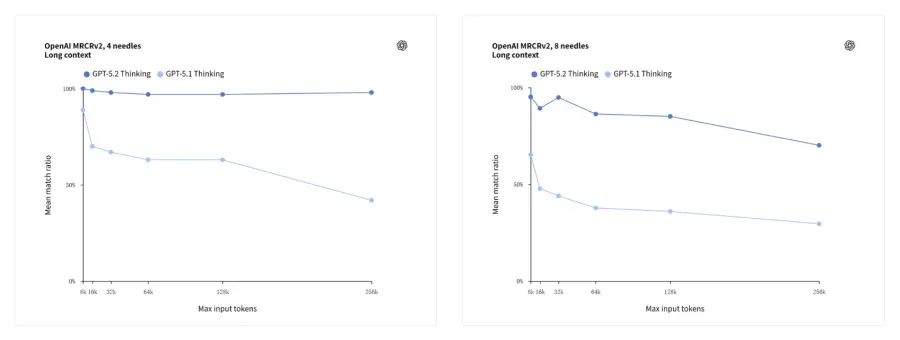
For practical purposes, this capability enables professionals to analyze reports, contracts, research papers, interview transcripts, and multi-file projects while maintaining coherence and accuracy across hundreds of thousands of words. The model particularly suits deep analysis, information synthesis, and complex multi-source workflows common in legal, consulting, and research environments.
OpenAI also introduced a new /compact API endpoint that extends the effective context window beyond standard limits. This feature benefits tool-heavy, long-running agent workflows that would otherwise hit context length restrictions.
GPT-5.2 Visual Understanding and Tool Calling
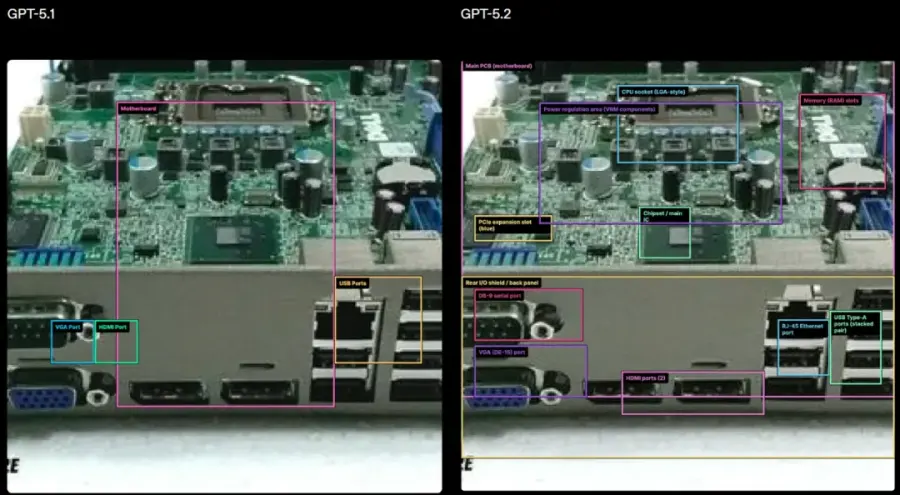
GPT-5.2 Thinking roughly halved error rates in chart reasoning and software interface understanding compared to previous versions. The model demonstrates stronger spatial awareness, accurately identifying component positions even in low-quality images where GPT-5.1 struggled.
In one demonstration, OpenAI asked both models to identify components on a motherboard image and return labels with approximate bounding boxes. GPT-5.2 recognized major regions and placed boxes that sometimes matched true component positions, while GPT-5.1 labeled only a few parts with weaker spatial understanding.
For professional applications, improved visual capabilities mean more accurate interpretation of dashboards, product screenshots, technical diagrams, and visual reports across finance, operations, engineering, design, and customer support workflows.
GPT-5.2 Thinking achieved 98.7% on Tau2-bench Telecom, demonstrating reliable tool calling across extended multi-turn tasks. Even in low-latency mode without extra reasoning, the model substantially outperforms GPT-5.1 and GPT-4.1.
In a complex customer service scenario, a passenger reported a delayed Paris-to-New York flight causing a missed Austin connection, lost checked baggage, an overnight New York stay requirement, and a medical need for front-row seating. GPT-5.2 managed the entire task chain including rebooking, special assistance seating, and compensation, providing more complete results than GPT-5.1.
GPT-5.2 Scientific and Mathematical Reasoning
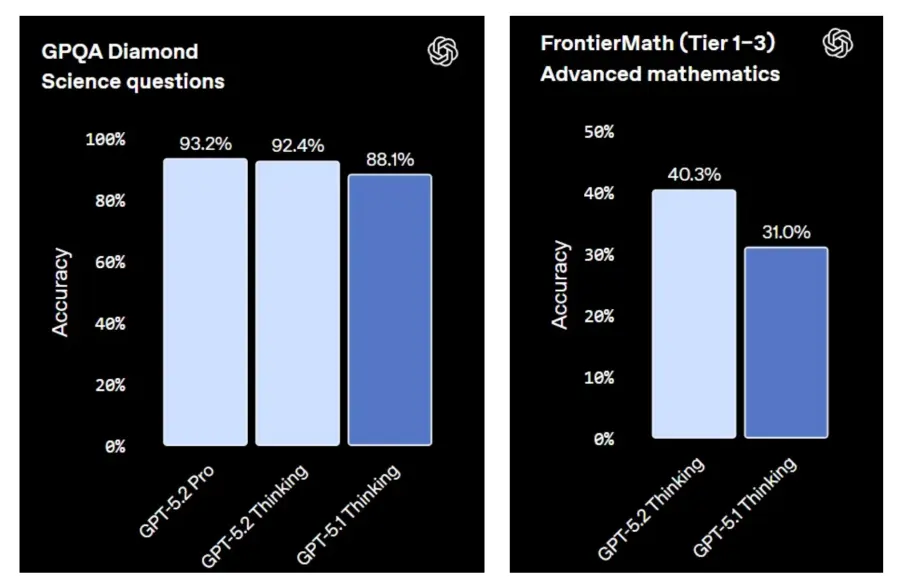
OpenAI positions GPT-5.2 Pro and Thinking as the world's best models for assisting and accelerating scientific work. On GPQA Diamond, a graduate-level science question benchmark designed to resist web searches, GPT-5.2 Pro reached 93.2% with GPT-5.2 Thinking close behind at 92.4%.
On FrontierMath Tiers 1-3, an expert-level mathematics assessment, GPT-5.2 Thinking solved 40.3% of problems. In abstract reasoning, GPT-5.2 Pro became the first model to break 90% on ARC-AGI-1 Verified, achieving 90.5% compared to last year's o3-preview at 87% while reducing costs by approximately 390 times.
On the more difficult ARC-AGI-2 Verified test that better isolates fluid reasoning, GPT-5.2 Thinking scored 52.9% compared to GPT-5.1's 17.6%, tripling performance. This represents genuine improvement in reasoning about novel, abstract problems rather than memorizing training data patterns.
GPT-5.2 Error Reduction and Reliability
GPT-5.2 Thinking reduced error-containing responses by 30% relative to GPT-5.1 when tested on anonymized real ChatGPT user queries. This improvement makes the model more trustworthy for research, writing, analysis, and decision support, though OpenAI emphasizes that users should still verify answers for critical matters.
The hallucination rate improvement addresses a major concern for professional users who need dependable outputs. However, the 30% reduction means errors still occur, and blind trust remains inadvisable regardless of the impressive benchmark scores.
Accessing GPT-5.2: Options and GPT-5.2 Pricing
OpenAI began rolling out GPT-5.2 to paid ChatGPT users (Plus, Pro, Go, Business, Enterprise) on December 11, 2024. The phased deployment ensures system stability, so some users may wait before seeing the new models in their interface. GPT-5.1 remains available as a legacy model for three months before sunset.
In the API, GPT-5.2 Thinking appears as gpt-5.2, GPT-5.2 Instant as gpt-5.2-chat-latest, and GPT-5.2 Pro as gpt-5.2-pro. Developers can now set reasoning parameters in GPT-5.2 Pro, and both Pro and Thinking support a new xhigh reasoning level for maximum quality tasks.
GPT-5.2 Pricing increased 40% over GPT-5.1:
-
Input: $1.75 per million tokens (up from $1.25)
-
Output: $14 per million tokens (up from $10)
-
Cached input: 90% discount available
OpenAI argues that despite higher per-token costs, improved token efficiency means lower total costs for achieving specific quality levels. ChatGPT subscription prices remain unchanged for end users.
GPT-5.2 Cost-Effective Access Through GPT Proto
For developers and businesses working across multiple AI providers, GPT Proto offers a compelling alternative to direct OpenAI API access. The platform provides unified API access to GPT-5.2, Claude, Gemini, Grok, and over 200 other models through a single interface.
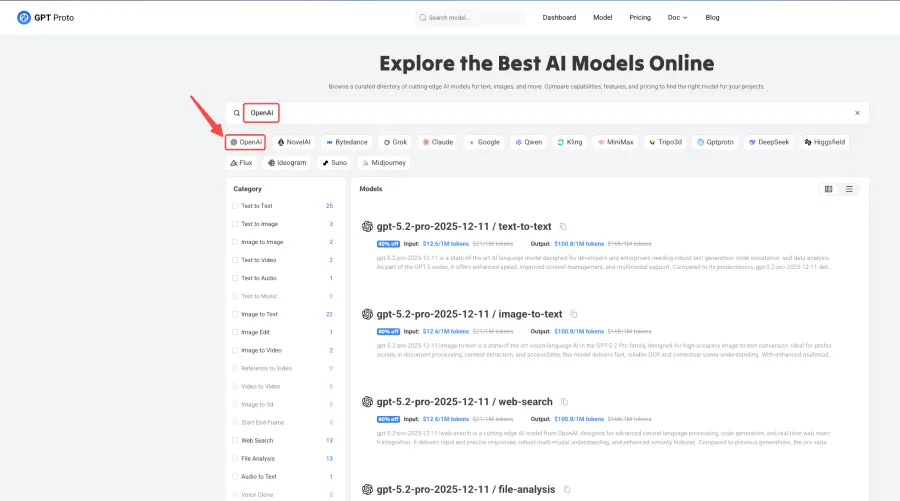
GPT Proto's advantages include:
-
Single API key eliminating multiple authentication systems
-
40% cost savings through volume discounts
-
Sub-200ms response times via global infrastructure
-
99.9% uptime with automatic failover
-
Transparent pay-as-you-go pricing with no hidden fees
-
Automatic integration of new models without code changes
The AI API platform particularly benefits teams that need to experiment with multiple models, maintain flexibility across different AI providers, or manage budget constraints. Startups and enterprises can leverage GPT-5.2 and competing models through volume-based pricing tiers that significantly undercut standard market rates.
Rather than committing exclusively to OpenAI's ecosystem, GPT Proto lets developers compare GPT-5.2 performance against Claude, Gemini, and other options in real-time. This flexibility proves valuable when different models excel at different tasks, or when pricing and availability considerations shift unexpectedly.
GPT-5.2 Practical Limitations to Consider
Beyond the 40% price increase, users should understand several tradeoffs before fully committing to GPT-5.2:
Speed remains the primary concern. Both Thinking and Pro versions operate substantially slower than previous models when handling complex tasks. The extended processing time directly correlates with improved quality, but time-sensitive applications may struggle. For immediate responses, GPT-5.2 Instant provides better speed-to-capability balance.
Generation times can stretch to several minutes for complex spreadsheets and presentations. Users should plan workflows accordingly and avoid expecting instant results for sophisticated document creation.
Incomplete responses occasionally occur with Pro mode after extended processing, though this appears less common than speed slowdowns. The model may process continuously without reaching satisfying conclusions on certain edge case queries.
API migration requires testing. While OpenAI has no current plans to deprecate GPT-5.1, GPT-5, or GPT-4.1 in the API, developers should test GPT-5.2 thoroughly before switching production applications. Performance characteristics differ enough to warrant careful evaluation rather than blind upgrades.
FAQs about GPT-5.2
What makes GPT-5.2 different from GPT-5.1?
GPT-5.2 delivers substantial improvements in professional knowledge work, coding accuracy, long-context understanding, visual reasoning, and tool calling reliability. Error rates dropped 30%, and the model matches or exceeds human expert performance in 70.9% of professional tasks. However, it processes more slowly, costs 40% more, and requires patience for complex queries.
Should I use GPT-5.2 Instant, Thinking, or Pro?
Choose Instant for everyday tasks prioritizing speed over depth. Select Thinking for professional work requiring accuracy in coding, document analysis, or complex reasoning where waiting several minutes is acceptable. Reserve Pro for extremely difficult problems where maximum quality justifies extended processing times and higher costs.
How can I reduce costs when using GPT-5.2?
Consider GPT Proto for 40% cost savings through volume discounts and unified access to multiple AI providers. Test whether GPT-5.2 Instant meets your needs before upgrading to Thinking or Pro. For non-critical tasks, evaluate whether GPT-5.1 or alternative models provide sufficient quality at lower prices. Use cached input options to get 90% discounts on repeated content.
Will GPT-5.2 replace my need for human expertise?
No. While GPT-5.2 matches expert performance in many professional tasks, it still produces errors requiring human verification. OpenAI emphasizes users should validate answers for any critical matters. The AI model works best as a productivity multiplier under human supervision rather than an autonomous replacement for professional judgment.
Conclusion
GPT-5.2 represents OpenAI's most significant capability upgrade since GPT-5, delivering measurable improvements across professional knowledge work, coding, reasoning, and visual understanding. The three-tier structure lets users match computational resources to task requirements, though slower processing times require workflow adjustments.
For developers and businesses managing multiple AI providers or seeking cost optimization, platforms like GPT Proto provide valuable flexibility through unified access to GPT-5.2 alongside competing models. The 40% cost savings and single API key simplify operations while enabling real-time model comparison.
The competitive AI landscape ultimately benefits users through rapid improvement cycles and increasing access options. GPT-5.2 pushes AI capabilities forward in meaningful ways, though understanding its limitations around speed, cost, and reliability remains essential for successful deployment in professional environments.