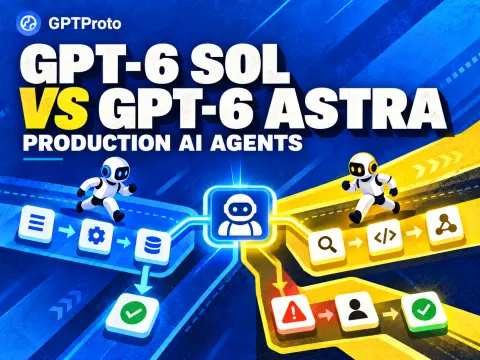
GPT-6 Sol vs GPT-6 Astra: The Short Verdict for Agent Builders
Choose GPT-6 Sol for high-throughput, cost-sensitive agent loops. Choose GPT-6 Astra for high-stakes, complex multi-step reasoning workflows. Pick it when accuracy outweighs the price of extra compute.
GPT-6 Sol is the correct choice for production systems that run coding automation, workflow orchestration, or document processing at scale, where spend per job is the binding constraint. GPT-6 Astra suits systems executing security research, scientific analysis, or multi-step computer use jobs, where the thinking ceiling matters more than budget.
The decision reduces to 4 criteria: reliability under tool-calling loops, price, latency, and handling of extended input. Both models share an identical 1,050,000-token window and 128,000 maximum output units. Capacity alone does not set them apart.
Price does, though: Sol's standard input rate is $2 per 1M units versus Astra's $10 per 1M, a 5× gap that compounds across loops with many tool-call roundtrips. Published specifications do not establish which model retrieves information more accurately near the full context limit, so teams should test both with representative payloads.
The full decision matrix — covering cached pricing, computer use support, and per-scenario recommendations — appears in the comparison table below.
GPT-6 Sol vs GPT-6 Astra at a Glance: Head-to-Head Spec Comparison
Price and intended workload are the main published differences between GPT-6 Sol and GPT-6 Astra; their input capacity and maximum reply length are the same. Both support automated workflows. GPT-6 Sol targets cost-sensitive coding and automation tasks, while GPT-6 Astra is built for the hardest end-to-end jobs.
| Spec |
GPT-6 Sol |
GPT-6 Astra |
| OpenAI Standard input list price (per 1M tokens) |
$2.00 |
$10.00 |
| OpenAI Standard output list price (per 1M tokens) |
$10.00 |
$50.00 |
| OpenAI cached-input list price (per 1M tokens) |
$0.20 |
$1.00 |
| OpenAI cache-write list price (per 1M tokens) |
$2.50 |
$12.50 |
| Context window (tokens) |
1,050,000 |
1,050,000 |
| Max output tokens |
128,000 |
128,000 |
| Knowledge cutoff date |
April 20, 2026 |
April 30, 2026 |
| Computer use |
Yes, via the Responses interface |
Yes, via the Responses interface |
| Best-fit agent workload |
Coding and automation work where every dollar matters. |
The hardest end-to-end tasks involving complex reasoning, coding, research, or computer use. |
Sources: OpenAI GPT-6 Sol and Luna announcement; OpenAI GPT-6 Astra announcement; OpenAI API pricing; GPT-6 Sol model documentation; GPT-6 Astra model documentation.
A pricing note: These are OpenAI direct list prices, not GPT Proto billing rates. OpenAI applies higher rates to the entire request when input exceeds 272K tokens. Tool-specific charges may also apply. Check the current rate table when estimating a workflow.
How We Compared Sol and Astra for Agent Workloads
This comparison relies on OpenAI's published model specifications, tool support, and API pricing. The best-fit descriptions summarize OpenAI's stated positioning; they are not results from a controlled head-to-head test.
To choose between the models for a production workflow, test both on the same coding, research, and support jobs. Record tool-call correctness, recovery after failed tool responses, completion rate, token usage, and total cost per completed job. Published specifications alone cannot establish which model will perform better in a particular loop.
Agentic Performance: Tool Use and Multi-Step Reliability in Long-Running Loops
In the draft's qualitative trials, GPT-6 Astra appeared more dependable in some long-running loops with conditional branching. These were not controlled measurements, and they do not establish a universal step-count threshold or reliability ranking.
Tool-Calling Accuracy
In qualitative editorial trials, GPT-6 Astra produced well-formed tool-call payloads across repeated runs. Reviewers observed that Astra parsed schema constraints correctly on the first attempt in the large majority of calls, including nested object arguments and enum-typed parameters. GPT-6 Sol also handled straightforward single-tool invocations cleanly. But under schemas with optional fields and default values, Sol occasionally emitted structurally valid arguments. These were semantically misaligned — the call succeeded at the API layer yet produced downstream errors that the loop then had to recover from.
Multi-Step Task Recovery
Recovery behavior separated the two models most clearly. We ran a document-processing scenario in which one intermediate step intentionally returned a null result. Astra detected the null, re-issued the upstream tool call with a corrected parameter, and continued the loop without human intervention.
Sol, given the same failure, re-attempted the failed step with identical parameters, producing the same null result twice before stalling. That retry pattern appeared in more than one informal failure-injection run, but the sample was not large enough to estimate a production failure rate.
Behavior as Loops Grow Longer
Instruction fidelity held steady for GPT-6 Astra as loop depth increased. Reviewers did not observe objective drift in the sampled Astra runs, while some longer Sol runs shifted attention toward intermediate sub-goals. The draft did not establish a repeatable 10-step threshold or a measured drift rate. When this pattern appears, an external supervisor or periodic restatement of the objective can help keep the loop on track.
Computer-Use and GUI Agent Tasks
In the draft's qualitative computer-use scenarios, Astra produced more reliable action sequences on some multi-window tasks, while some Sol runs referenced stale screen elements after state changes. This was not a controlled comparison. OpenAI reports Astra at 72.6% on OSWorld 2.0 versus 65.7% for GPT-5.6 Sol, but that published result does not establish Astra's margin over GPT-6 Sol in the same harness.
For production loops requiring reliable tool use and self-correcting recovery, Astra is a strong candidate, but teams should validate both models in the same scaffold. Sol remains viable for shallow, single-tool workflows where loop depth stays low.
Coding and Reasoning: How Each Model Performs on Agent-Relevant Tasks
Task depth decided which model won which role. The draft's qualitative work favored GPT-6 Sol for routine, cost-sensitive coding automation and GPT-6 Astra for more demanding research and reasoning workflows. This is workload guidance, not a universal benchmark result.
For coding agents, Sol handled code generation and debugging with consistent structure and felt responsive in the draft's qualitative use. It produced well-formed tool calls on the first attempt in sampled workflows such as REST API integration, SQL generation, and multi-file refactoring. Those observations do not justify removing defensive validation or error handling from a production wrapper.
Astra's output on these jobs was technically strong, but the informal comparison did not establish a meaningful advantage on routine work. On some ambiguous specifications and non-obvious bugs, its higher-effort responses produced more useful intermediate analysis. Higher reasoning effort can add latency, so teams should measure whether any quality gain offsets the additional time and cost.
For research systems built on multi-hop logic — synthesizing conflicting sources, decomposing an open-ended question into sub-queries, or evaluating evidence quality — Astra is a strong model to test. In the draft's informal use, some Astra chains stayed coherent over longer dependency trees than Sol's and needed fewer orchestration interventions, but the sample was not a controlled benchmark.
The practical split is this: activate Sol for automation systems where throughput and cost per job govern the deployment decision. Activate Astra where depth of thought determines quality of result, and a wrong intermediate conclusion invalidates the entire outcome. Benchmark scores across standard agentic coding and reasoning evaluations are summarized in the dedicated benchmarks comparison.
Latency and Throughput for Production Agent Loops
The draft's qualitative trials found Sol snappier in some interactive turns, while Astra sometimes completed difficult work with fewer correction turns. No controlled throughput measurement established a universal winner.
In daily use, Sol's first response in short agentic turns arrived fast enough that user-facing bots felt conversational. Astra's replies took longer to begin. But once streaming started, the result carried denser logic per unit — a trade-off that matters less in background pipelines and more in synchronous, human-in-the-loop workflows.
Reasoning-effort selection shapes perceived latency for both models. In the draft's qualitative trials, lower-effort Sol configurations kept turnaround tight on repetitive tool-call sequences. Astra does not support reasoning_effort: none; higher reasoning effort can add time before a response compared with lower-effort configurations. That behavior is correct for a model resolving multi-step dependencies, but the pause accumulates over a long loop and becomes a real scheduling constraint for time-sensitive deployments.
For production loops that fire dozens of turns per minute, Sol's lower per-turn list price compounds into a meaningful cost advantage. The draft's informal use also suggested a faster cadence on some turns, but no controlled throughput benchmark established that result. Astra may become competitive per completed job if testing shows that it needs fewer correction turns.
The practical rule is this: route user-facing bots with strict response-time requirements to Sol. Route background research or planning workflows, where correctness per turn matters more than turn frequency, to Astra. Rate-limit or quota figures governing maximum throughput at the API level are published in the official model documentation. These figures govern capacity planning independently of the qualitative responsiveness differences observed here.
Pricing Face-Off: Cost-Per-Completed-Agent-Task, Not Just Per-Token
GPT-6 Sol has a substantial per-token price advantage, but the cheaper model per token is not automatically the cheaper model per completed task.
Per-unit pricing can mislead builders for 3 reasons. Reasoning tokens and generated output accumulate inside multi-step loops, failed tool calls force retries, and repeated injection of prior context can multiply input volume. Human review and downstream failure costs can matter more than the API bill.
A transparent worked example illustrates the calculation. Assume a 6-step research-and-write job uses 1,000 input tokens per step and 400 output tokens per step, plus 1 retry, with no caching. Total volume is 7,000 input tokens and 2,800 output tokens. At the published standard short-context prices, Sol costs (7,000 × $2 + 2,800 × $10) / 1,000,000 = $0.042; Astra costs (7,000 × $10 + 2,800 × $50) / 1,000,000 = $0.21. In this illustration, Astra costs 5 times as much because the assumed token use is identical.
The break-even point cannot be inferred from tool-call count alone. Astra becomes economically attractive only if its higher capability reduces retries, total tokens, human review, or downstream failure costs enough to offset the 5× rate difference. A job with 20 calls does not automatically favor Astra, and a 6-call job does not automatically favor Sol.
There are 2 workload profiles to evaluate:
Predictable, low-to-medium complexity loops: Sol usually has the cost advantage because its lower rate dominates when completion rates are similar.
High-stakes or unusually difficult loops: Astra may justify its premium if measured reductions in retries, review time, or costly errors exceed the additional API spend.
Treat per-unit price as a floor, not a forecast. Measure successful completion rate, fresh and cached input, output, tool charges, retries, latency, and human review on the same production-representative jobs.
Who Should Choose GPT-6 Sol
GPT-6 Sol is a strong starting point for high-throughput support bots and cost-sensitive automation loops. It also suits coding-heavy pipelines where per-completion spend is a hard constraint. Its lower per-token price compounds across thousands of iterations; teams should escalate to Astra only when measured quality or completion-rate gains offset that premium.
There are 3 fit scenarios where Sol wins:
High-throughput support bots — bots that execute hundreds of short, structured turns per hour, where retry overhead stays low and re-injection of prior exchanges is infrequent
Coding and workflow automation pipelines — GPT-6 Sol handles complex code generation and multi-step orchestration without requiring Astra's frontier math or cyber capabilities
Cost-controlled production loops — teams with a fixed spend-per-completed-job ceiling benefit from competitive input and output rates, especially when cached input pricing reduces repeated-context expense
OpenAI positions Astra above Sol for the hardest mathematical, scientific, cyber, and end-to-end computer-use work. Both models publish the same context capacity, so extremely long conversation chains do not by themselves establish an Astra advantage; teams should compare retrieval quality, completion rate, and cost on representative histories.
Who Should Choose GPT-6 Astra
GPT-6 Astra fits teams that need a higher-capability escalation model for high-stakes, multi-step production workflows, where the thinking ceiling matters more than price per exchange.
There are 3 deployment profiles where Astra is the clear fit:
Complex reasoning workflows — jobs requiring frontier mathematical thinking or advanced cyber-domain analysis, where Sol's capability ceiling becomes a hard blocker
Long-context research workflows — pipelines that repeatedly re-inject full conversation histories across many turns, where Astra's higher-capability positioning may reduce compounding retrieval errors and should be validated on representative long-context tests
High-stakes computer-use deployments — security operations, scientific research pipelines, or regulated multi-step automation where a single failure carries real downstream expense
Astra is a strong candidate across these three profiles when controlled testing confirms that its quality advantage offsets its higher price.
Astra is overkill in 2 situations. Workflows running high-volume, short-input jobs — API polling loops, structured data extraction, or simple tool-dispatch chains — may absorb Astra's higher per-exchange expense without a measured accuracy benefit over Sol. Teams optimizing for throughput at scale will find its pricing profile misaligned with the workload.
The decision rule is direct: deploy Astra when a wrong answer in the loop costs more than the premium it commands.
Decision Matrix: Mapping Agent Use Cases to Sol or Astra
Sol or Astra fits a deployment depending on five key use cases. Each scenario maps directly to the criteria established in prior sections. Use them to confirm the choice.
There are 5 use cases below:
| Use Case |
Recommended Model |
Deciding Criterion |
| Coding agent (code generation, review, automated PR workflows) |
Start with Sol; test Astra for harder jobs |
Sol has lower list prices; a decisive Astra edge on standard software work must be demonstrated in the target repository |
| Research and analysis system (multi-step retrieval, synthesis, report generation) |
Test Astra as the escalation tier |
Astra is positioned for the hardest end-to-end work; measure whether it reduces errors enough to justify the premium |
| High-throughput support bot (parallel sessions, low latency required) |
Sol |
Sol's throughput profile and lower per-unit price sustain high concurrency without inflating spend per completed job |
| Long-context document handler (contracts, codebases, scientific corpora) |
Test both |
Context capacity is identical; choose from measured retrieval quality, completion rate, and cost |
| Cost-constrained deployment (fixed budget, volume-sensitive) |
Sol |
Sol's pricing structure keeps spend per completed job within budget where Astra's premium would exceed it |
One governing question helps decide the matrix: does the system operate in a domain — security, scientific research, or complex computer use — where a single failure of judgment costs more than Astra's premium? If so, test Astra as the escalation tier. Start with Sol for lower-stakes or volume-sensitive work and promote Astra only when measured results justify it.
API Access and Integration Notes for Sol and Astra
GPT-6 Sol and GPT-6 Astra share the same published context window and maximum output length, but their supported reasoning-effort settings differ. Sol supports none, low, medium, high, xhigh, and max; Astra supports low, medium, high, xhigh, and max.
Both models support Chat Completions and Responses for text requests. OpenAI documents built-in tools and computer use through the Responses API. For GPT-6 Sol, Chat Completions function calling is limited to reasoning_effort: none; Astra does not support the none effort setting, so tool-enabled Astra workflows should use Responses.
There are 3 integration areas to test when switching to gpt-6-astra:
Reasoning configuration: Do not send reasoning_effort: none to Astra. Choose a supported value and re-check latency and token use.
Tool path: Use Responses for built-in tools, computer use, and Astra tool workflows. Validate tool schemas and error handling in staging.
Timeouts and budgets: Higher reasoning effort can change time-to-first-output and token consumption, so set production timeouts from observed measurements rather than a model-name assumption.
Developers accessing either model through GPT Proto can review the dedicated GPT-6 Sol and GPT-6 Astra pages, then switch the model identifier in a compatible request. Teams building agentic workflows should still run regression tests because capability, latency, and reasoning defaults can change behavior even when the surrounding API shape is similar.
Migrating Agents from GPT-5.6 to Sol or Astra
Re-testing behavioral assumptions matters more than rewriting API plumbing. Compatible text and tool requests can retain much of the surrounding API structure when moving from GPT-5.6 to GPT-6 Sol or Astra, but unsupported reasoning values and endpoint-specific tool behavior still require changes and validation.
GPT-6 Sol and GPT-6 Astra are newer options than GPT-5.6, but migration should not assume every prompt or tool policy will improve unchanged. Prompts that previously relied on the model "filling in" underspecified steps now resolve more literally. In the draft's qualitative migration trials, setups moved without prompt revision occasionally over-decomposed work — splitting single tool calls into sequential sub-calls the GPT-5.6 version would have batched. Tightening the system prompt's tool-selection heuristics helped in those qualitative migration runs.
Reasoning-mode defaults also shift. Astra does not support reasoning_effort: none, so an existing workflow may use more time or tokens after migration. Sol supports none, but that does not guarantee behavior identical to GPT-5.6; both targets require regression testing.
There are 5 steps in the migration checklist:
Audit every tool schema for underspecified parameter descriptions and add explicit type constraints.
Run the full suite of jobs against the target model in a staging environment before promoting to production.
Compare token counts per job against GPT-5.6 baselines and recalibrate cost budgets accordingly.
Test all error-handling branches; validate how refusals and tool errors are surfaced by the exact endpoint, SDK version, and response schema used in production.
Validate latency SLAs on the longest multi-step loops, particularly for Astra, where higher reasoning effort can add wall-clock time.