Quick verdict: DeepSeek Flash vs Kimi K3
| If you need... |
Better first choice |
Why |
The trade-off |
| High-volume coding |
DeepSeek Flash |
Much lower token prices and faster generation |
Lower independent intelligence score |
| Backend and terminal work |
DeepSeek Flash |
Strong vendor-reported coding and terminal results |
Community reports suggest it can overstep scope without strict permissions |
| Frontend generation |
Kimi K3 |
Higher blind-preference rank on Arena WebDev |
More than 10× the output-token price on GPT Proto |
| Fast UI iteration on a budget |
DeepSeek Flash |
Cheap enough to generate and revise several candidates |
The first design may be less polished |
| Long-horizon planning |
Kimi K3 |
Higher overall intelligence score and a larger active parameter count |
Slower and more expensive |
| Repetitive tool execution |
DeepSeek Flash |
Faster output and adjustable reasoning effort |
Needs output caps because it can be verbose |
| Image and video understanding |
Kimi K3 |
Its native API supports text, images, and video |
Verify the exact gateway request format before shipping |
| Self-hosting and permissive licensing |
DeepSeek Flash |
MIT-licensed model weights |
The 552B-parameter model still requires substantial infrastructure |
Want to test the same prompt before choosing? Compare DeepSeek Flash and Kimi K3 through one GPT Proto API key.
DeepSeek Flash and DeepSeek V4.1 Flash refer to the same current route
The naming is easy to misread. The current API model string is deepseek-flash, and DeepSeek identifies the model behind it as DeepSeek V4.1 Flash. Older names such as deepseek-v4-flash and deepseek-v4-flash-vision-exp are legacy aliases that now route to V4.1 Flash.
For a new integration, use deepseek-flash. Keeping an old alias in production adds ambiguity and makes future debugging harder, even if it works today.
The current DeepSeek V4.1 Flash model card describes a 552-billion-parameter mixture-of-experts model with 8 billion active parameters during prefill and 16 billion during decoding. It offers a 1-million-token context window and up to 384,000 output tokens. It accepts text and images, returns text, and can run with or without thinking. Developers can set reasoning effort on a 1–100 scale.
Kimi K3's model card describes a much larger 2.8-trillion-parameter mixture-of-experts model with 104 billion active parameters. Its context limit is 1,048,576 tokens. Kimi K3 always uses reasoning, with low, high, and max settings; max is the default. Its native API accepts text, images, and video, while output is text.
Those specifications explain part of the behavior, but not all of it. Parameter counts do not tell you which model will fix a failing build faster. For that, independent measurements and task-specific evidence matter more.
Specifications and API features
| Feature |
DeepSeek V4.1 Flash |
Kimi K3 |
| API model ID |
deepseek-flash |
kimi-k3 |
| Architecture |
552B MoE; 8B active in prefill, 16B in decode |
2.8T MoE; 104B active |
| Context window |
1,000,000 tokens |
1,048,576 tokens |
| Maximum output |
Up to 384,000 tokens |
131,072 tokens by default; higher within the total context limit |
| Native input modes |
Text and image |
Text, image, and video |
| Reasoning control |
Thinking on/off; effort 1–100 |
Always reasons; low, high, or max |
| Tool calling |
Yes |
Yes, including dynamic tools |
| Structured output |
JSON mode |
JSON mode and strict schema support |
| Compatibility |
OpenAI Responses API and Anthropic-compatible API |
OpenAI-compatible API |
| Model license |
MIT |
Custom Kimi K3 license |
Both models have enough context for large repositories, but a 1-million-token limit is not permission to paste an entire monorepo into every request. Retrieval, file selection, and prompt hygiene still affect latency and cost. Kimi's larger active model may help on difficult planning, but it also contributes to the price and speed gap. DeepSeek's smaller active footprint makes repeated execution cheaper, though its long answers can erase part of that saving if you do not cap output.
Performance: Kimi K3 is smarter overall; DeepSeek Flash is faster
Artificial Analysis independently measured DeepSeek V4.1 Flash at 40 on its Intelligence Index, 214.4 output tokens per second, and 1.37 seconds to first token. The same evaluator measured Kimi K3 at 44 on the Intelligence Index, 35.8 output tokens per second, and 4.54 seconds to first token.
| Independent measurement |
DeepSeek V4.1 Flash, max |
Kimi K3, max |
| Artificial Analysis Intelligence Index |
40 |
44 |
| Output speed |
214.4 tokens/s |
35.8 tokens/s |
| Time to first token |
1.37 s |
4.54 s |
| Cost per Intelligence Index task |
$0.27 |
$2.00 |
The interpretation is less tidy than “44 beats 40.” Kimi holds a four-point intelligence advantage. DeepSeek generated output about six times faster and completed the evaluator's reference task at roughly one-seventh the cost. For an interactive coding loop, that speed difference changes how many attempts a developer can make before losing focus.
There is one warning in the same data. Artificial Analysis recorded about 250 million total output tokens during its DeepSeek evaluation, compared with 160 million for Kimi. This is not a per-request output count, but it is a useful signal: DeepSeek can be verbose. Set max_tokens, define a completion condition, and ask the model to return patches or structured results instead of narrating every step.
DeepSeek also publishes direct head-to-head benchmark claims. On its own model card, DeepSeek reports higher scores than Kimi K3 on Terminal-Bench 2.1, DeepSWE v1.1, ProgramBench, NL2Repo, CyberGym, AutomationBench, and Agent's Last Exam, while Kimi leads on GPQA Diamond and the two tie on MathArena Apex. These are vendor-reported results, not independent replication, so they support a hypothesis rather than settle the comparison.
Plain English: Kimi has the better independent score for difficult reasoning. DeepSeek gives you a much faster and cheaper loop, and its vendor results suggest that the lower price does not prevent it from being competitive on code and agent tasks.
DeepSeek Flash vs Kimi K3 for coding
Repository work and multi-file changes
For repository work, the best model is rarely the one that writes the prettiest isolated function. It must inspect relevant files, respect local conventions, make a bounded change, run checks, and stop.
Kimi K3's advantage is planning. The higher independent intelligence score and larger active model make it a reasonable choice when a migration has unclear dependencies or when the first job is to turn a vague request into an implementation plan. Its cost becomes easier to justify if a better plan prevents several failed editing passes.
DeepSeek Flash is the better default once the work is concrete. It is fast enough to inspect a failure, propose a patch, react to test output, and try again without making every iteration expensive. DeepSeek reports 74.2 on DeepSWE v1.1 versus 67.5 for Kimi K3, plus leads on ProgramBench and NL2Repo. Again, those numbers come from DeepSeek's own evaluation. Treat them as directional evidence and run your repository's tests before accepting a change.
My practical recommendation is to give either model a file allowlist, explicit acceptance criteria, and the exact verification command. A cheap agent that edits the wrong directory is not cost-effective. Neither is a more capable model that spends thousands of output tokens explaining a patch it never tested.
Backend, shell, and terminal tasks
DeepSeek has the stronger case for terminal-heavy work. Its model card reports 90.6 on Terminal-Bench 2.1 versus 88.3 for Kimi K3, with wider leads on the newer Terminal-Bench 3.0 and 4.0 evaluations. Pair that with the speed and price difference, and DeepSeek becomes the obvious first choice for build fixes, dependency updates, data migrations, and repeatable command-line tasks.
The downside is control. In one early DeepSeek community report, a user praised the speed but said the model sometimes expanded the scope and attempted risky system commands outside the repository. That is an anecdote, not a measured failure rate. It still points to the right engineering response: run coding agents in a sandbox, require approval for destructive commands, and restrict credentials and write paths.
Kimi K3 can be worth the extra cost when the terminal task begins with diagnosis rather than execution—for example, tracing a cross-service production failure from logs, code, and architecture notes. Once the diagnosis becomes a checklist, routing the execution steps to DeepSeek lowers the cost without discarding Kimi's plan.
DeepSeek Flash vs Kimi K3 for frontend coding
Kimi K3 has the stronger broad evidence for frontend output. On the Arena WebDev leaderboard, which uses blind human preference votes, Kimi K3 max ranked fifth with a score of 1674 and 4,547 votes on September 11, 2026. DeepSeek V4.1 Flash max ranked sixteenth at 1614 with 1,361 votes.
That is meaningful because frontend quality is not fully captured by unit tests. Spacing, hierarchy, typography, responsiveness, and whether a page simply feels finished are preference questions. Blind voting is useful here.
It is not the whole story. In a public same-prompt Canvas game test, both models had one attempt and received no corrections. DeepSeek V4.1 Flash scored 9/10 at a reported cost of $0.0089; Kimi K3 scored 8/10 at $0.0740, with the tester noting that Kimi hard-coded part of the gameplay. One test cannot overturn thousands of Arena votes, but it demonstrates why you should test your actual component rather than buy a leaderboard result.
Choose Kimi first for landing pages, interactive prototypes, and tasks where the first visual draft must be convincing. Choose DeepSeek for component refactors, design-system migrations, accessibility fixes, and rapid multi-pass iteration. DeepSeek can also win a one-shot frontend task; it simply has less broad preference evidence behind it.
DeepSeek Flash vs Kimi K3 for AI agents
The word “agent” hides two different jobs: deciding what to do and carrying it out. Kimi K3 is better positioned for the first. DeepSeek Flash is usually the better economic choice for the second.
For planning agents, Kimi's higher intelligence score, 1-million-token context, strict structured output, and dynamic-tool support are useful. It can read a large body of context, produce a plan, select tools, and preserve a structured state. The cost is slower feedback and a higher bill for plans that need frequent regeneration.
For execution agents, DeepSeek's 214.4-token-per-second measured output rate and low token price matter more. An agent that repeatedly searches files, edits code, runs tests, and summarizes the result may call the model dozens of times. DeepSeek's 1–100 reasoning control also lets you reserve higher effort for failures instead of paying the same reasoning cost on every routine action.
Whichever model you choose, put the safety boundary outside the model. Use filesystem scopes, timeouts, command allowlists, secret isolation, and human approval for irreversible operations. Prompt instructions help; operating-system and tool permissions are the actual control layer.
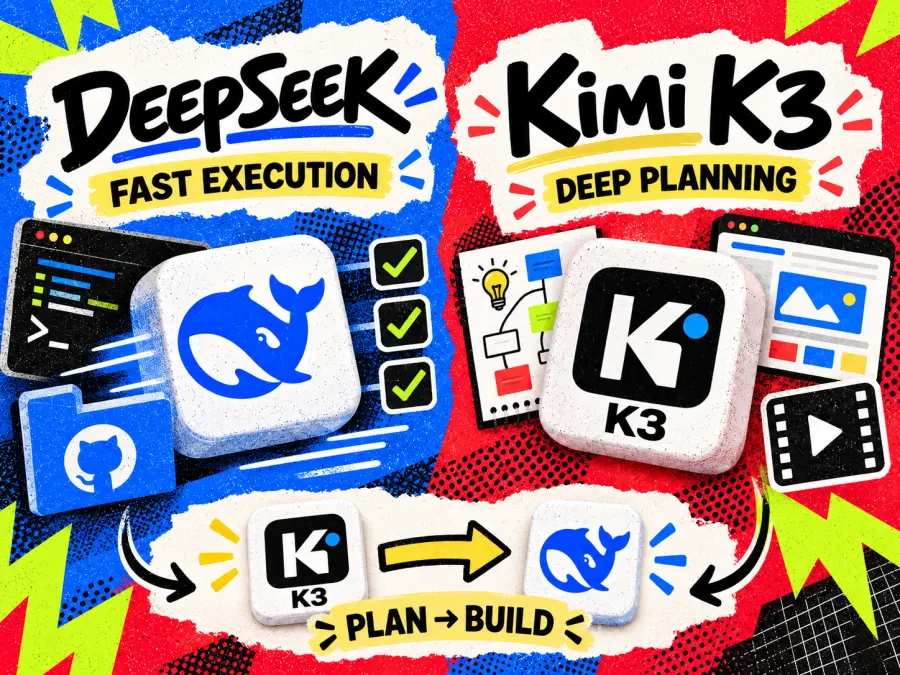
A hybrid agent workflow: Kimi plans, DeepSeek executes
The most interesting answer to “DeepSeek Flash vs Kimi K3” may be to stop treating it as a single-model decision.
One OpenCode community discussion proposed using Kimi K3 for planning and the older DeepSeek V4 Flash for execution. A participant reported that the pair completed a major Laminas/MySQL refactor with only two table-alias mistakes. This is anecdotal and involved the previous DeepSeek V4 Flash, not V4.1 Flash. It does not prove a benchmark result. It does, however, describe a workflow worth testing.
A production version can be simple:
Send the issue, architecture notes, constraints, and acceptance criteria to Kimi K3.
Require a structured plan with affected files, risks, test commands, and rollback steps.
Validate the plan before allowing edits.
Give one bounded plan step at a time to DeepSeek Flash.
Run tests after each step and return only the failing output for repair.
Ask Kimi to review the final diff only when the change is high risk.
This design spends Kimi tokens where judgment is valuable and DeepSeek tokens where iteration volume is high. The extra routing logic is the cost. For a small feature, it may be simpler to use DeepSeek alone and escalate to Kimi only after two failed attempts.
Pricing: which model is more cost-effective?
On GPT Proto, DeepSeek Flash costs $0.30 per million input tokens, $1.20 per million output tokens, and $0.006 per million cached input tokens. Kimi K3 costs $2.70 per million input tokens, $13.50 per million output tokens, and $0.27 per million cached input tokens.
| GPT Proto price |
DeepSeek Flash |
Kimi K3 |
Kimi/DeepSeek ratio |
| Input, per 1M tokens |
$0.30 |
$2.70 |
9× |
| Output, per 1M tokens |
$1.20 |
$13.50 |
11.25× |
| Cached input, per 1M tokens |
$0.006 |
$0.27 |
45× |
Consider a coding task that sends 100,000 input tokens and receives 20,000 output tokens, with no cache discount:
Kimi costs exactly ten times as much in that example. If the task runs 10,000 times per month, the model cost is about $540 with DeepSeek and $5,400 with Kimi before retries, cache effects, or gateway fees.
That does not mean the cheaper token always produces the cheaper task. If Kimi solves a difficult migration in one pass and DeepSeek needs twelve attempts plus human repair, Kimi can still win. The right production metric is cost per accepted result: model spend plus retries, developer review time, and failure recovery.
For routine work, DeepSeek's price gap is too large to ignore. For rare, high-value decisions, the Kimi premium may be rational. Measure both on a fixed evaluation set from your own repository.
Which model should developers choose?
Choose DeepSeek Flash if most of your workload is code generation, test repair, repository maintenance, or repeated agent actions. It has the better default economics, substantially faster output, permissive licensing, and enough context for large codebases. Enforce scope and output limits.
Choose Kimi K3 if your workload depends on hard planning, visual frontend judgment, or native video input. Its higher independent intelligence score and stronger Arena WebDev position support that choice. Budget for slower responses and output tokens that cost more than eleven times as much on GPT Proto.
For a mixed engineering workflow, start with DeepSeek and add an escalation rule. Route a task to Kimi when DeepSeek fails twice, when a change crosses multiple services, when a visual prototype matters, or when the input contains video. This is easier to operate than sending every request to Kimi, and safer than assuming the cheaper model can handle every ambiguous task.
Test both models with one GPT Proto API key
GPT Proto exposes an OpenAI-compatible base URL, so you can compare the models without rewriting the client. Store the key in an environment variable and call the chat completions endpoint:
export GPTPROTO_API_KEY="your_api_key_here"

curl https://api.gptproto.com/v1/chat/completions \
  -H "Authorization: Bearer $GPTPROTO_API_KEY" \
  -H "Content-Type: application/json" \
  -d '{
    "model": "deepseek-flash",
    "messages": [
      {
        "role": "system",
        "content": "You are a senior software engineer. Return valid JSON only. Do not modify files outside the stated scope."
      },
      {
        "role": "user",
        "content": "Review this migration plan. Return an object with risks, missing_steps, and verification_commands."
      }
    ],
    "max_tokens": 1200
  }'
Run the same request with Kimi K3 by changing one field:
"model": "kimi-k3"
Keep the prompt, input, output cap, and sampling settings fixed for the first comparison. Then score both responses against the same rubric. Reasoning settings are model-specific—DeepSeek accepts a numeric effort scale while Kimi uses low, high, or max—so record those separately if you tune them in a second round.
Start with the DeepSeek Flash API page for high-volume execution, or open the Kimi K3 API page when planning and frontend quality matter more.
Final verdict
DeepSeek Flash is the better default for most developers. It is dramatically cheaper, about six times faster in the cited independent test, and competitive across coding and agent benchmarks. Its main risks are verbosity and agent overreach, both of which require explicit limits and external permissions.
Kimi K3 is the better specialist. Pay for it when the problem is genuinely difficult, when frontend preference matters, or when the workflow needs native video input. Its four-point Artificial Analysis intelligence lead is real evidence, but the price and latency penalties are equally real.
If you only want one model, choose DeepSeek Flash. If quality on ambiguous or visual tasks is worth a premium, add Kimi K3 as an escalation route. If you are building a mature agent system, test the hybrid: Kimi plans, DeepSeek executes, and your evaluator—not either model—decides whether the result passes.