The Best Character AI Alternatives at a Glance
| Rank |
Platform |
Best for |
What “free” means |
Memory and continuity controls |
Model choice |
Voice or images |
Setup |
| 1 |
Emochi |
An easy, visual Character.AI replacement |
Free text access with daily limits on media and convenience features |
Memory is part of the product, but public technical limits are unclear |
Several in-app tiers; exact model IDs are not disclosed |
Yes |
Easy |
| 2 |
SillyTavern + GPT Proto |
Full control over characters, lore, models, and cost |
SillyTavern is free; cloud-model usage may cost money |
Character cards, World Info, summaries, Author’s Notes, RAG, and prompt inspection |
You choose the compatible backend and model |
Available through extensions |
Advanced |
| 3 |
Janitor AI |
Free, community-driven character roleplay |
Free access is available; current model limits and queues can change |
Character definitions and chat continuity; public limits are not clearly documented |
Depends on the current chat setup |
Primarily text |
Easy to moderate |
| 4 |
FictionLab |
Long-form character roleplay and detailed scenarios |
Its FAQ advertises unlimited free messages; advanced models and media may be paid |
Scenario-oriented tools and persistent story setup |
In-app model tiers |
Images available |
Moderate |
| 5 |
AI Dungeon |
RPGs, quests, and branching worlds |
A permanent free Wanderer tier with smaller context and fewer saved memories |
Memory Bank, Story Summary, Plot Essentials, Author’s, Author’s Notes, and Story Cards |
Several models, with access depending on tier |
Image generation uses credits |
Moderate |
| 6 |
DreamGen |
Multi-character stories and guided plots |
A free tier with credits; paid plans raise context and usage allowances |
Scenario Codex, plot instructions, and longer paid context windows |
Multiple in-house and third-party options |
Images available |
Moderate |
| 7 |
PolyBuzz |
Visual characters, voice, and creator features |
Basic chat is free; memberships and coins cover stronger models and extras |
Personas, multiple chat models, and paid memory-related benefits |
Several in-app models |
Yes |
Easy |
| 8 |
Replika |
One persistent AI companion |
Limited free use; relationships, voice, images, and advanced memory sit in paid plans |
Long-term companion memory, with manual message saving in higher tiers |
No direct model selection |
Yes |
Easy |
No row in this table says “best memory.” That is deliberate. A service can advertise long-term memory and still lose a relationship change after a long scene. A simpler app can perform well for 30 messages because the active conversation still fits inside its context. Test the behavior you actually care about.
How We Chose Alternatives That Are Actually Better at Something
A useful Character AI alternative should solve at least one problem better than Character.AI itself. A different logo and a larger character count are not enough.
We used nine decision points:
Character consistency: Does the character keep its motives, boundaries, and speaking style?
User agency: Does it avoid writing the user’s dialogue, thoughts, or actions without permission?
Memory controls: Can you pin facts, edit summaries, add lore, or inspect what is sent to the model?
Reply control: Can you keep a casual exchange short instead of receiving an essay every turn?
Free-tier reality: Is it free text chat, a daily allowance, a trial, or only a free frontend?
Model transparency: Can you see or choose the model, or does the app hide it behind plan names?
Character portability: Can you save the character description, examples, cards, lore, and chat summaries?
Setup effort: Can you chat immediately, or must you connect and configure a model first?
Voice and visuals: Are images and voice part of the experience, and are their limits separate from text chat?
Recent roleplay discussions make one point especially clear: “good memory” is too vague. Remembering a name after 20 messages is not the same as recalling an event from the first chapter after 200 replies. Users searching for alternatives that are “actually good” also complain about models that write for them, turn every reply into several paragraphs, repeat stock gestures, or push a relationship forward without earning it.
A 20-Message Test You Can Repeat on Any Platform
Use the same character and opening scene on two platforms. Then run this short test:
In message 2, mention a small but concrete fact, such as a broken watch inherited from the character’s sister.
In message 4, suggest a plan that conflicts with the character’s stated values. Check whether the character disagrees naturally.
Leave your own action unstated. See whether the AI invents it for you.
Ask for replies of one to three paragraphs. Check whether that preference survives.
Around message 10, change the relationship or story status—for example, rivals agree to work together.
Around message 15, return to the fact from message 2 without repeating it.
By message 20, check for repeated gestures, sudden romance, flattened personality, missing names, and contradictions.
This is not a laboratory benchmark. It is more useful for roleplay, though, because it tests the failure modes you will notice every day.
The 8 Best Character AI Alternatives in 2026
1. Emochi — Best Overall for an Easy, Visual Alternative
Emochi is our first recommendation for someone who likes Character.AI’s low-friction browsing but wants a more visual experience. You can choose from a large catalog, create a persona, enter a scenario quickly, and add voice or generated images without building a technical setup first.
The free plan is real, but it is not the same as receiving every feature without limits. When we checked Emochi’s public plan information in late July 2026, the $0 tier listed two free chat models plus limited daily voice messages, Smart Replies, and image generations. Paid plans add more model access, memory-related features, larger profiles, tuning controls, and higher media allowances.
The catch is transparency. Emochi does not publish the exact technical IDs of every chat model, and its public pricing page has shown conflicting descriptions of paid image allowances. Its memory benefits are part of the paid pitch, but there is no dependable public statement saying exactly how many messages or tokens each plan retains.
Choose Emochi if: you want a familiar app, lots of ready-made characters, anime-influenced visuals, voice, and very little setup.
Skip it if: you need published context limits, portable character files, exact model control, or a predictable developer-style usage bill.
For a closer look at its plans, growth, strengths, and transparency gaps, read What Is Emochi AI—and Why Is It Growing So Fast?.
2. SillyTavern + GPT Proto — Best for Total Character and Model Control
SillyTavern is not a hosted Character.AI clone. It is a free, open-source interface that connects to a local or cloud language model. That extra layer changes the ownership equation: your character card, persona, lore, summaries, presets, and frontend are separate from the model generating the replies.
The official SillyTavern documentation covers character cards, World Info, group chats, personas, RAG, prompt inspection, chat summaries, extensions, image generation, and text-to-speech. It can also connect to an OpenAI-compatible API. If one model becomes too expensive or starts producing a voice you dislike, you can keep the same character setup and try another.
That flexibility has a cost. SillyTavern has many settings, and a bad preset can make a good model look terrible. A large lorebook may also waste context or inject irrelevant facts. More controls do not automatically produce better roleplay; they give you more places to diagnose and fix it.
Choose SillyTavern + GPT Proto if: you want reusable character cards, group roleplay, lorebooks, editable memory summaries, model switching, and control over usage costs.
Skip it if: you want to install an app and chat within 30 seconds. Start with Chatbox instead if connecting an API is new to you.
The complete setup is available in How to Create Your Own AI Character With an API—No Coding Required.

3. Janitor AI — Best Free Community-Driven Roleplay Option
Janitor AI remains difficult to ignore because its appeal is straightforward: a large community catalog, custom characters, story-first chats, and less restrictive roleplay than many mainstream apps. Its official mobile listing describes it as a place to step inside interactive stories, especially romance, fantasy, and fan-fiction-style scenarios.
The experience depends heavily on the character definition and whichever model path is currently available. That is both the appeal and the problem. One carefully written bot can feel specific and responsive; another can produce long, generic prose or steer the user’s actions. Recent community posts are sharply divided on its reply style.
Janitor AI provides free access, but its public model limits, queues, and paid options are not documented consistently enough for us to promise a specific daily message count. Treat any exact allowance quoted by an old comparison article as provisional. Check the live interface.
Choose Janitor AI if: you want to browse community characters, create your own, and try roleplay without paying first.
Skip it if: you need a clearly published memory architecture, stable model specifications, or simple control over reply length.
4. FictionLab — Best for Long-Form Character Roleplay
FictionLab is closer to a story workshop than a casual companion feed. It is a good fit when a character needs a detailed premise, supporting cast, world information, and a plot that develops over many scenes.
Its official FAQ advertises free character chat with unlimited messages. That is a stronger free-text proposition than a short trial, although higher-end models and image features may still sit behind paid access. The trade-off is effort: detailed scenarios take longer to create, and users who only want a simple character may find the setup heavier than Emochi or Replika.
Community feedback is also mixed, which is exactly why you should use the 20-message test. Some users praise its story options; others report that model behavior and memory can vary over time. “Unlimited” tells you how many messages you may send. It does not guarantee that message 300 will preserve everything from message 3.
Choose FictionLab if: you enjoy writing character setups, scenarios, and longer narrative arcs.
Skip it if: you mainly want brief everyday chat or the smallest possible character form.
5. AI Dungeon — Best for RPGs, Worlds, and Branching Adventures
AI Dungeon is the clearest choice when the world matters as much as the character. Its structure is built around adventures, player actions, plot information, world entries, and an AI that continues the scene. That makes it better suited to quests and branching stories than to imitating Character.AI’s one-to-one companion feed.
Its memory system is also described more concretely than most. AI Dungeon separates Story Summary, Plot Essentials, Author’s Notes, Story Cards, and a Memory Bank. According to its current membership table, the free Wanderer tier includes up to a 4,000-token context window and 25 Memory Bank entries. Paid tiers raise context and memory allowances and add access to more text and image models.
The price of that structure is a different conversational feel. If you want casual banter with one persistent persona, AI Dungeon may feel like operating a game narrator. If you want a party crossing a kingdom while factions, locations, and inventory remain relevant, that difference becomes its advantage.
Choose AI Dungeon if: you want RPG campaigns, world-building, branching decisions, or stories with several moving parts.
Skip it if: your ideal alternative looks and behaves like a simple private messenger.
6. DreamGen — Best for Multi-Character Stories and Guided Scenarios
DreamGen sits between an AI chat app and a story-writing tool. It supports scenarios with multiple characters, plot instructions, rich lore, and a chat-like interface. You can tell the system how a scene should develop instead of hoping one character carries the entire narrative.
There is a free tier with recurring credits. Its current paid pricing starts at $7.83 per month before temporary promotions, with listed context windows rising from 5,000 tokens on Starter to 30,000 on Pro. Larger context helps with longer stories, but it does not replace a clean scenario design or accurate summaries.
DreamGen is more guided than SillyTavern and less immediate than Emochi. That middle ground is useful for writers who want multi-character control without managing every layer of a local frontend. It is less compelling for someone who only wants an endless catalog of public chatbots.
Choose DreamGen if: you want multi-character scenes, a story bible, plot steering, and a mix of roleplay and prose generation.
Skip it if: you want a native social character feed or completely free heavy usage.
7. PolyBuzz — Best for Visual Characters and Creator Features
PolyBuzz makes more sense as a visual character platform than as a pure text-chat replacement. Its official FAQ describes character creation, voice, personas, image generation, animated characters, character-card imports, and several chat models. Basic chat is available without a subscription, while memberships and coins cover stronger chat models, memory-related benefits, voice use, and other extras.
That gives creators more outputs from one character. You can move from a conversation to an image, voice interaction, or serialized visual idea without leaving the platform. The trade-off is a busier economy: “free chat” can coexist with paid models, coins, voice duration, regeneration tools, and premium visual features.
PolyBuzz also deserves a careful policy reading. Its public content and recommendations are moderated, even when private roleplay has different boundaries. Do not interpret “unrestricted” marketing as permission to ignore platform rules.
Choose PolyBuzz if: you care about character art, voice, imports, visual storytelling, and creator tools.
Skip it if: you want the cleanest possible pricing model or full control over the underlying LLM.
8. Replika — Best for One Persistent AI Companion
Replika is the least suitable option here for browsing thousands of fandom characters—and the best fit if that is not what you want. It focuses on one persistent companion, an ongoing relationship, voice and calls, activities, selfies, and personalization over time.
Limited free use is available. Replika’s paid tiers add relationship settings, voice messaging, calls, images, premium voices, and more advanced memory features. Its help center does not publish one universal web price; the amount is shown in the relevant app store or subscription screen and can vary.
The central trade-off is simple. Replika invests in continuity with one companion, but it is not a portable character-card system and does not let you choose the underlying model directly. You are buying into one managed relationship product.
Choose Replika if: you want one recurring companion with voice and relationship features.
Skip it if: you want public character discovery, complex group roleplay, fandom bots, or model switching.
Free Character AI Alternatives: What “Free” Really Means
The phrase “free Character AI alternative” hides five different business models. Check which one you are actually getting.
| Type of free access |
What it means |
Examples from this list |
Hidden cost to check |
| Free basic text chat |
You can keep chatting on a basic model, while stronger models or media cost money |
Emochi, FictionLab, PolyBuzz |
Ads, lower-quality models, memory limits, or paid images and voice |
| Free with usage allowances |
Messages, credits, or premium actions reset daily or monthly |
DreamGen |
Longer context, regenerations, and media may consume credits faster |
| Free frontend, paid backend |
The interface costs nothing, but a cloud model bills by token |
SillyTavern + GPT Proto |
Long histories are resent as input, so cost rises with context |
| Permanent free game tier |
A smaller context and memory allowance remain available without subscribing |
AI Dungeon |
Premium models, more context, and images cost extra |
| Limited free companion |
Core chat is available, but relationship, voice, images, or memory controls are paid |
Replika |
The best companion features may sit above the free plan |
“Unlimited messages” is not the same as unlimited premium inference, unlimited context, or unlimited images. Read those as separate claims. Also remember that a platform can change limits after this article is published; check the live plan screen before paying.
Which Character AI Alternative Should You Choose?
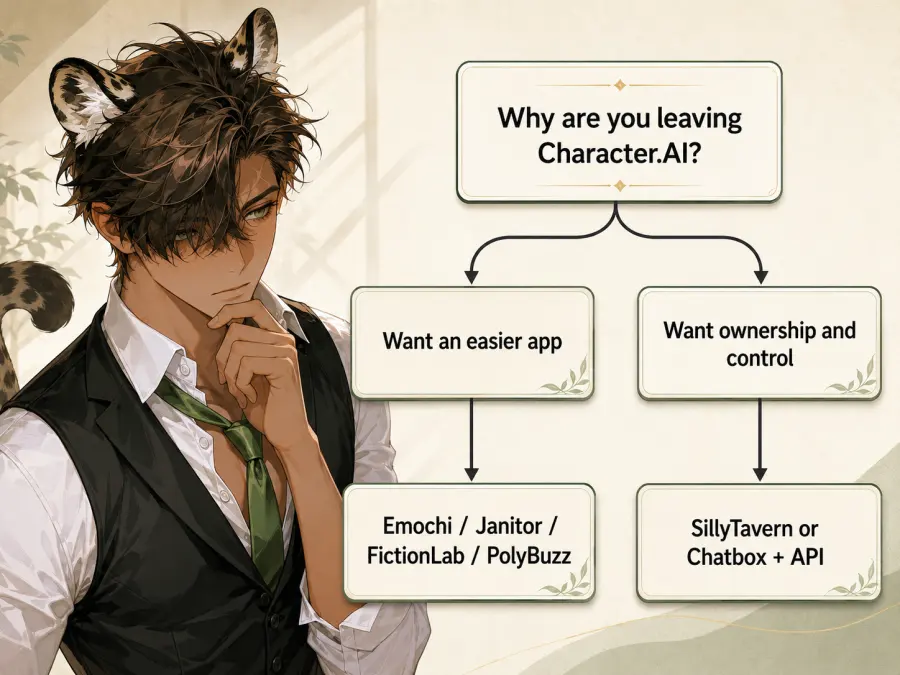
If you want one answer, choose according to the exact reason you are leaving:
Closest easy replacement with visuals: Emochi
Free community roleplay: Janitor AI
Long-form character scenarios: FictionLab
RPGs and detailed worlds: AI Dungeon
Multi-character stories with plot guidance: DreamGen
Images, voice, and creator tools: PolyBuzz
One persistent companion: Replika
Full ownership, model choice, and editable memory: SillyTavern + an API
My strongest recommendation is not to switch because another app claims to be “better.” Switch because it solves a named problem. If you cannot describe that problem—reply length, model choice, character portability, world-building, visuals, or memory controls—run the 20-message test before moving your main story.

When No Closed Character App Is Good Enough
Every hosted character app controls four things: which models remain available, how memory is implemented, what the free plan includes, and whether your favorite character or feature survives a product update. That control is what makes the app convenient. It is also the reason users sometimes feel trapped.
A bring-your-own-key setup separates the pieces:
| Layer |
Beginner option |
Advanced option |
What you keep |
| Chat interface |
Chatbox |
SillyTavern |
Saved chats and frontend settings |
| Character definition |
Conversation system prompt |
Character card, examples, scenario, and persona |
The character blueprint |
| Long-term context |
Corrected summaries |
Summaries, Author’s Notes, World Info, and RAG |
Your memory structure |
| Model access |
GPT Proto OpenAI-compatible API |
GPT Proto with model switching |
One key and a choice of supported models |
The basic connection uses https://gptproto.com/v1 as the API Base URL. Do not append /chat/completions when the frontend constructs that path itself.
These GPT Proto models are practical starting points rather than universal winners:
| Model |
Good starting use |
GPT Proto price per 1M tokens, checked July 29, 2026 |
| Gemini 3.5 Flash-Lite |
Low-cost character drafts, short chats, and repeated tests |
$0.18 input / $1.50 output |
| GPT-5.6 Luna |
A balanced first test for everyday chat |
$0.80 input / $4.80 output |
| Claude Sonnet 5 |
A higher-cost comparison when voice and instruction-following matter more |
$1.60 input / $8 output |
Use the same character blueprint and the same 20-message script with at least two models. A model that wins a coding or reasoning benchmark may still be the worse actor for your character.
Ready to build the setup? Follow How to Create Your Own AI Character With an API—No Coding Required, or create a GPT Proto account when you are ready to connect the frontend.
How to Move Your Character Without Starting Over
Do not begin by copying an entire private chat into a new service. Move the stable character information first, then carry over only the story state you still need.
If You Created the Character
Save these parts separately:
Character Description: identity, motives, values, fears, boundaries, and recurring behavior.
First Message: the opening scene and the expected writing style.
Example Messages: three to six exchanges that demonstrate voice, pacing, disagreement, and emotional restraint.
Scenario: where the story begins and what is currently at stake.
Persona: the user identity the character should recognize.
World or Lore Information: places, factions, rules, relationships, and facts that should appear only when relevant.
Continuity Summary: recent events, unresolved conflicts, relationship status, injuries, promises, and known secrets.
If the platform supports a portable character-card format, export it. If it does not, keep a plain-text master copy outside the app.
If You Did Not Create the Character
Do not scrape, republish, or claim someone else’s character card as your own. You can write a private character inspired by broad traits or ask the creator for permission, but copying a creator’s full definition and publishing it elsewhere crosses a different line.
Protect Your Private Information
Summarize the story instead of uploading every old message. Remove real names, addresses, workplace information, passwords, financial data, intimate images, and anything another person shared in confidence. “Private chat” is a product claim, not a reason to stop practicing basic data hygiene.
Final Verdict
Emochi is the best overall ready-made Character AI alternative for most casual users in 2026. It is fast to enter, visual, and easy to understand. Its weaknesses are model and memory transparency.
Janitor AI is the free roleplay option to try first if community characters matter more than polished documentation. Expect variation between bots and check the current model limits yourself.
AI Dungeon wins for RPGs, while DreamGen is the better fit for guided, multi-character stories. Replika serves a different goal: one ongoing companion rather than a library of characters.
SillyTavern + GPT Proto is the strongest long-term setup for ownership and control. It asks more from you at the beginning, but your character card, lore, summaries, and frontend do not have to disappear when you switch models.
The best alternative is not the app with the longest feature list. It is the one whose compromises you can live with after message 200—not just message 2.