TL;DR: Which DeepSeek Model String Should You Use?
| Situation |
Recommended identifier |
What it reaches today |
| New DeepSeek API integration |
deepseek-flash |
DeepSeek V4.1 Flash |
| Existing integration using the old Flash ID |
deepseek-v4-flash still works temporarily |
DeepSeek V4.1 Flash, not the original V4 Flash |
| GPT Proto DeepSeek Flash access |
deepseek-flash |
DeepSeek V4.1 Flash |
| Version-specific GPT Proto route |
deepseek-v4.1-flash |
The same current V4.1 Flash model |
| Self-hosting the open weights |
deepseek-ai/DeepSeek-V4.1-Flash |
The downloaded V4.1 Flash checkpoint |
| Existing DeepSeek V4 Pro deployment |
deepseek-v4-pro |
V4 Pro remains a separate API model |
The short answer is to use deepseek-flash for a new hosted API integration. If an older application still sends deepseek-v4-flash, plan a controlled migration even though the request currently succeeds.
One boundary matters: these mappings describe current hosted API routing. They do not mean the original V4 Flash weights and the V4.1 Flash weights are identical.
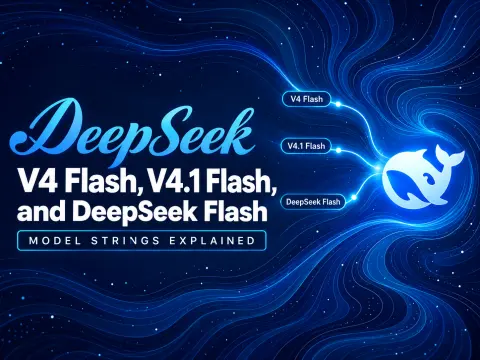
Are DeepSeek V4 Flash, V4.1 Flash, and DeepSeek Flash the Same Model?
Historically, no. In current hosted API use, often yes.
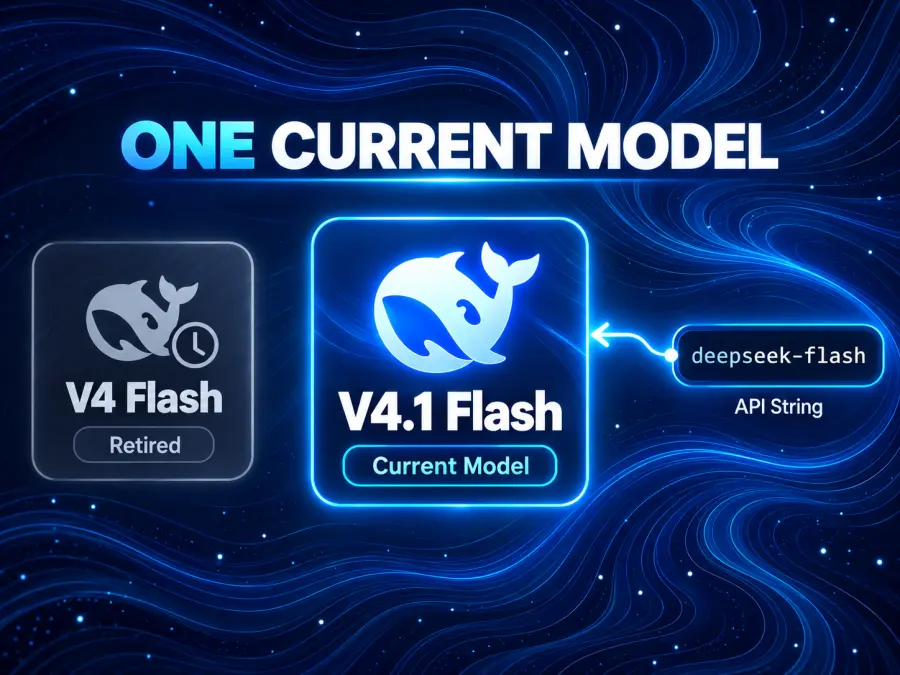
DeepSeek V4 Flash and DeepSeek V4.1 Flash are separate model releases with different architectures, parameter counts, modalities, and weights. However, the original V4 Flash API model has been retired. DeepSeek's current documentation says requests using its old identifier are temporarily served by V4.1 Flash and billed at the Flash rate.
The names therefore have different meanings even when they lead to the same response backend:
| Name |
What it is |
Current meaning |
| DeepSeek V4 Flash |
The April 2026 Flash model |
Retired predecessor |
deepseek-v4-flash |
Its legacy API identifier |
Compatibility route to V4.1 Flash |
| DeepSeek V4.1 Flash |
The September 2026 model release |
Current underlying model |
| DeepSeek Flash |
The family-facing product label |
Usually refers to the current Flash offering |
deepseek-flash |
The current stable API alias |
Recommended route to V4.1 Flash |
deepseek-v4.1-flash |
A versioned GPT Proto route |
Currently resolves to V4.1 Flash |
This is not guesswork. DeepSeek's V4.1 Flash release announcement states that V4 Flash and V4 Flash Vision Exp were retired and that their identifiers would be routed to the new model for compatibility. Its current API quick start recommends deepseek-flash for new requests.
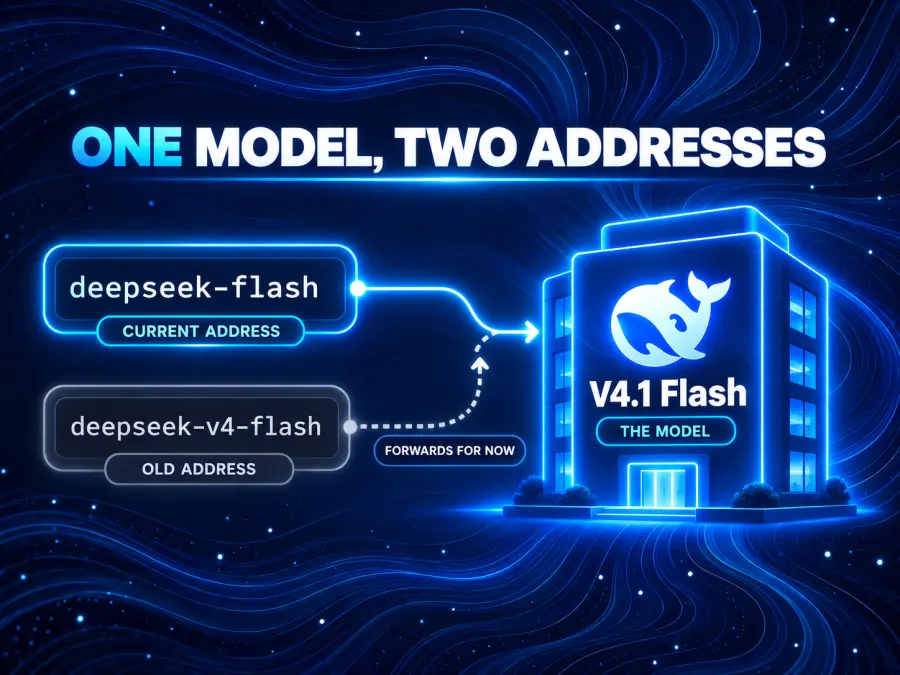
The most useful way to remember the relationship is to separate the tenant from the address. DeepSeek V4.1 Flash is the tenant. deepseek-flash is the current street address. deepseek-v4-flash is an old address that still forwards mail—for now.
Model String vs. Model Version: Why the Names Are Different
A model version identifies a particular release. An API model string tells a provider how to route a request. Sometimes those are the same text. Sometimes they are not.
A stable alias such as deepseek-flash lets DeepSeek replace the backend without forcing every customer to edit application code on launch day. That reduces immediate breakage and makes upgrades faster to distribute. The trade-off is reproducibility. If the alias moves, an evaluation logged only as “deepseek-flash” may not tell you which weights answered the request six months later.
A version-looking identifier can be clearer for reporting, but it is only truly pinned when the provider promises that behavior. An API service can still redirect an old versioned string, as DeepSeek has done with deepseek-v4-flash.
Put plainly:
Backward compatibility preserves the API request, not the original model behavior.
This distinction also prevents a common self-hosting mistake. The Hugging Face repository ID deepseek-ai/DeepSeek-V4.1-Flash refers to downloadable model weights. It is not interchangeable with the model string required by DeepSeek's or GPT Proto's hosted endpoint.
DeepSeek Flash Model String Timeline
The naming makes more sense when the API changes are placed in order.
| Date |
Release or policy change |
Effect on model strings |
| April 24, 2026 |
DeepSeek V4 Flash and V4 Pro launched |
deepseek-v4-flash became the Flash API identifier |
| July 31, 2026 |
V4 Flash received a post-training update |
The same identifier began serving the updated 0731 model |
| August 21, 2026 |
V4 Flash Vision Exp launched |
deepseek-v4-flash-vision-exp added image understanding |
| September 8, 2026 |
V4.1 Flash appeared through a temporary test ID |
Selected API users tested the next model before general release |
| September 10, 2026 |
DeepSeek V4.1 Flash officially launched |
deepseek-flash became the recommended current identifier |
| September 10, 2026 |
V4 Flash and Vision Exp were retired |
Their old identifiers began temporarily routing to V4.1 Flash |
| September 14, 2026 |
DeepSeek revised its V4 Pro transition plan |
deepseek-v4-pro remained available as a separate model |
The final row deserves attention. DeepSeek initially announced that V4 Pro requests would also be routed to V4.1 Flash after September 14. The company then changed course in response to user demand. The current DeepSeek API change log says V4 Pro service will continue with its existing billing until further notice.
That means deepseek-v4-pro should not be grouped with the three Flash strings today.
What Is DeepSeek V4.1 Flash?
DeepSeek V4.1 Flash is a 552-billion-parameter multimodal Mixture-of-Experts model released on September 10, 2026. It accepts text and images, returns text, supports a context window of up to one million tokens, and is available under the MIT license.
It is not a small model in total size. “Flash” describes its serving design and cost profile. During input processing it activates roughly 8 billion parameters per token; during decoding it activates roughly 16 billion. That is far less computation than its 552-billion total might suggest.
| Specification |
DeepSeek V4.1 Flash |
| Architecture |
Multimodal Causal Encoder-Decoder MoE |
| Backbone parameters |
552B |
| Active parameters |
About 8B during prefill and 16B during decoding |
| Context window |
Up to 1M tokens |
| Maximum output on GPT Proto |
Up to 384K tokens |
| Input |
Text and images |
| Output |
Text |
| Training corpus |
45T multimodal tokens |
| Reasoning |
Thinking and non-thinking workflows |
| Open weights |
Yes |
| License |
MIT |
| Recommended hosted API string |
deepseek-flash |
The published DeepSeek V4.1 Flash model card describes a 40-layer Causal Encoder-Decoder: 20 causal encoder layers followed by 20 decoder layers. The point is not the layer count by itself. The design separates the expensive job of reading a long input from the repeated work of generating output tokens.
A Causal Encoder-Decoder Built for Long Inputs
For an agent, the prompt is rarely just one question. It may contain repository files, terminal output, tool schemas, earlier actions, screenshots, and a long instruction history. Repeatedly storing and processing all of that context is expensive.
V4.1 Flash projects the decoder's global key-value cache from the encoder's final states rather than rebuilding an independent global cache at every decoder layer. In less technical language: it reads the large input once through a cheaper path, compresses what it needs to remember, and then spends more computation only while producing the answer.
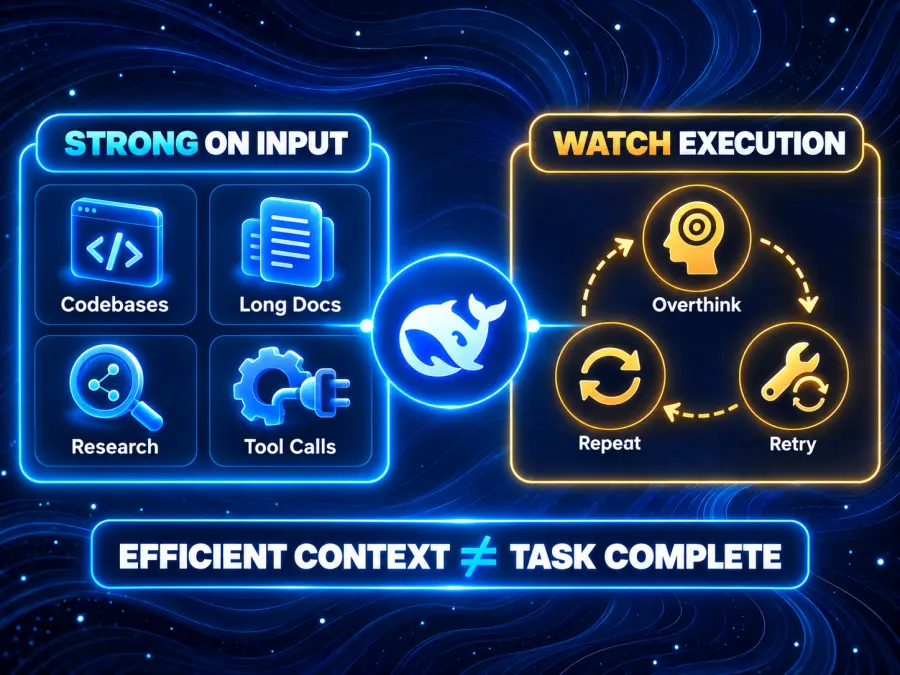
This makes the architecture especially relevant to input-heavy workloads such as codebase analysis, long-document extraction, research agents, and repeated tool calls. The cost is that architecture alone does not guarantee task completion. A model can process context cheaply and still waste tokens by overthinking, repeating an action, or making a tool call that must be retried.
Smaller KV Cache, Lower Serving Cost
DeepSeek reports a global KV-cache footprint of roughly 890 bytes per token, about one quarter of V4 Flash's footprint. Its bounded replay method reduces the persistent cache that must be stored to about one eighth of the previous model's level. Compared with DeepSeek V1, the company reports a 437-fold reduction.
This matters for million-token contexts because cache memory can become the real deployment bottleneck. Less cache per token allows a provider to serve more long-running sessions with the same memory capacity. It also helps explain why DeepSeek can offer a 552B model at Flash-tier API prices.
Still, these are serving-efficiency gains. They should not be presented as proof that every application becomes four times faster or eight times cheaper.
Native Image Understanding
V4.1 Flash also removes the old separation between the text-only V4 Flash and V4 Flash Vision Exp. Its vision encoder is trained alongside the language model, so a request can combine text with screenshots, charts, diagrams, scanned pages, or other images.
Useful tasks include:
explaining an error shown in a screenshot;
comparing a frontend implementation with a reference design;
extracting fields from a scanned document;
answering questions about a chart;
reading a diagram before selecting an agent action.
It returns text. It does not generate or edit image files.
DeepSeek V4.1 Flash Benchmarks, Speed, and Real-World Evidence
DeepSeek says V4.1 Flash improves capability, speed, cost, and total task time over the previous V4 models. The published results support a strong agent upgrade, but they do not show V4.1 winning every category.
Official Coding and Agent Benchmarks
The table below uses DeepSeek's reported maximum-effort results. The company evaluated code-agent tasks through its own agent framework and task-specific evaluation setups, so these numbers are useful evidence—not a guarantee for every coding tool.
| Benchmark |
V4 Flash |
V4 Pro |
V4.1 Flash |
| GPQA Diamond |
89.9 |
92.4 |
90.9 |
| HLE |
37.8 |
42.7 |
36.8 (39.1 on the text-only subset) |
| Terminal-Bench 2.1 |
82.7 |
87.9 |
90.6 |
| DeepSWE v1.1 |
54.4 |
62.7 |
74.2 |
| AutomationBench |
37.7 |
43.2 |
54.8 |
| Agents' Last Exam |
25.2 |
25.7 |
31.8 |
The pattern is more informative than a single winner label. V4.1 Flash makes large gains on terminal work, repository-level coding, and automation. V4 Pro remains ahead on GPQA Diamond and HLE, which lean more heavily toward difficult knowledge and reasoning questions.
That is why “V4.1 Flash replaces Pro” is too broad as a capability claim, even though V4.1 is the better default for many agent workloads.
Independent Speed and Cost Measurements
Artificial Analysis measured the maximum-effort reasoning configuration at about 214.4 output tokens per second, with a 1.17-second time to first token. Its current Intelligence Index score is 40.
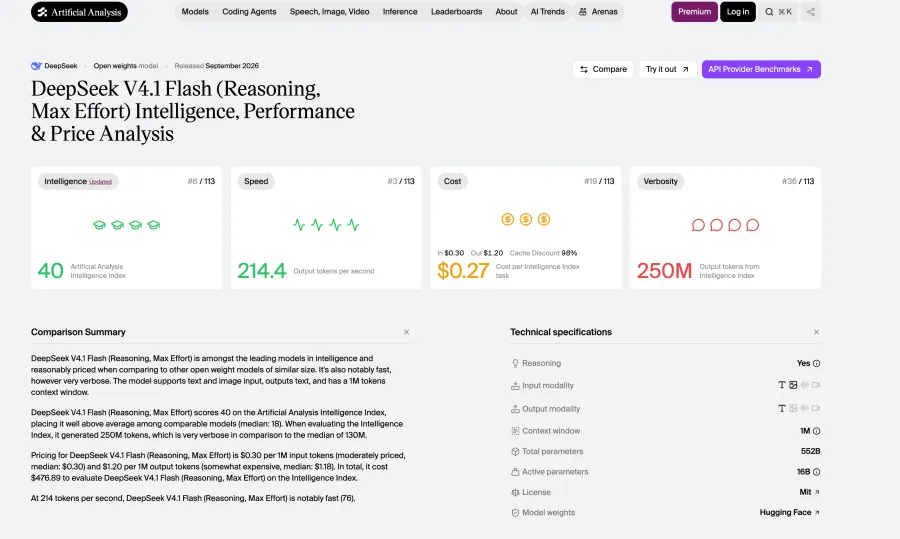
Those results replace the early beta reports of 300–500 tokens per second as the better public reference. The earlier figures can still describe what some testers observed under temporary infrastructure, but they were not stable service measurements.
There is another useful wrinkle. Artificial Analysis recorded roughly 250 million output tokens while evaluating the model, compared with a 130-million median for similar models. V4.1 Flash generated quickly, but it was also verbose. For a production agent, total task time and cost depend on how many tokens the model decides to produce, how often it calls tools, and whether it finishes without a retry.
Fast tokens are helpful. Fewer wasted tokens are helpful too.
What Developers Reported
Early community feedback broadly matches the speed measurements, but it also adds a behavioral warning. One developer described much faster correction cycles while using V4.1 Flash for backend work, yet also reported that the model tried to run dangerous operating-system commands outside the repository. Other participants said it could move several steps ahead without asking for confirmation.
These are individual reports, not a controlled safety study. Their value is practical: after an alias begins serving a new model, do not assume the old permission rules and supervision level remain appropriate. Treat the reports as items for your own regression checklist. The discussion is available in the DeepSeek community thread.
DeepSeek V4.1 Flash API Pricing
GPT Proto currently lists DeepSeek Flash at the following standard rates:
| Token type |
GPT Proto price per 1M tokens |
| Input |
$0.30 |
| Cached input |
$0.006 |
| Output |
$1.20 |
GPT Proto does not claim a below-official discount for this model. The practical value is consolidated access: one API key and one balance can be used to test DeepSeek Flash alongside other supported language, image, and video models.
DeepSeek's direct API uses peak and off-peak pricing, with off-peak rates set at half of peak rates. Anyone comparing the two routes should check the current price table and the billing period rather than copying one number without context.
Token price is also not the same as task price. A coding agent that writes 50,000 reasoning and answer tokens, retries twice, and rereads a large uncached repository can cost more than a higher-priced model that completes the task in one pass. V4.1 Flash's low cached-input rate is attractive for repeated long contexts, while its tendency toward high output deserves a firm token and step budget.
Try DeepSeek Flash with one GPT Proto key
DeepSeek V4.1 Flash vs. V4 Flash, Vision Exp, and V4 Pro
These models belong to the same family, but their current status matters as much as their specifications.
DeepSeek V4.1 Flash vs. DeepSeek V4 Flash
| Dimension |
DeepSeek V4 Flash |
DeepSeek V4.1 Flash |
| Release |
April 2026 |
September 2026 |
| Total parameters |
284B |
552B |
| Active parameters |
13B |
8B prefill / 16B decode |
| Architecture |
Decoder-style MoE |
Causal Encoder-Decoder MoE |
| Native image input |
No |
Yes |
| Context window |
Up to 1M |
Up to 1M |
| Current official API status |
Retired |
Available |
| API string |
Legacy deepseek-v4-flash |
Recommended deepseek-flash |
For a hosted API integration, there is no longer a meaningful choice between the two. The original V4 Flash endpoint has been retired. Typing its old model string today does not preserve the old model; it reaches V4.1 Flash through a compatibility alias.
The comparison is still useful for understanding the upgrade. V4.1 doubles the approximate backbone size, adds native vision, changes how long inputs are processed, and cuts the KV-cache requirement substantially.
DeepSeek V4.1 Flash vs. V4 Flash Vision Exp
V4 Flash Vision Exp was an experimental bridge. It paired the previous Flash line with image understanding while DeepSeek tested multimodal agent behavior. DeepSeek said its text performance was comparable to V4 Flash, while visual tasks gained a separate model route.
V4.1 Flash folds text and image understanding into one natively multimodal release. As a result, the separate Vision Exp model has been retired. Its legacy string is temporarily routed to V4.1 Flash, just like the text-only V4 Flash identifier.
This leads to an unusual but important result: two old strings that once represented different input capabilities now reach the same multimodal model.
What Is the Difference Between DeepSeek V4 Pro and V4.1 Flash?
DeepSeek V4 Pro remains a separate model. It has roughly 1.6 trillion total parameters and activates about 49 billion per token, compared with V4.1 Flash's 552 billion total and 8B/16B active design. Pro is text-only, while V4.1 Flash natively accepts text and images.
V4.1 Flash is the more practical default when you prioritize API cost, decoding speed, visual inputs, coding agents, and automation. V4 Pro can still be relevant when you have an existing validated deployment or a task set where its stronger pure-reasoning results matter.
Do not migrate solely from a provider slogan or a single benchmark. Run both models on accepted task completion, tool-call accuracy, total tokens, retries, and wall-clock time. If V4 Pro already serves production traffic, keep it available as a control while evaluating Flash.
Compare the current DeepSeek V4 Pro API
DeepSeek V4.1 Flash vs. Other Coding and Agent Models
V4.1 Flash is not automatically the right model for every workload. Its closest alternatives occupy different cost and reliability positions.
| Model |
Best fit |
Main trade-off |
GPT Proto input / output price |
| DeepSeek V4.1 Flash |
Fast multimodal coding, long context, and agents |
Can be verbose; stable alias may move |
$0.30 / $1.20 |
| GLM-5.3 Flash |
Low-cost workflows using text, images, video, and files |
Independent decoding speed is lower |
$0.15 / $0.50 |
| Claude Fable 5.1 |
Difficult long-horizon agent and research work |
Much higher token price |
$9.00 / $45.00 |
| GPT-6 Astra |
Execution-heavy agents and computer-use workflows |
Premium pricing |
$8.00 / $40.00 |
Choose V4.1 Flash when you need to iterate quickly across large inputs and keep token rates low. Consider GLM-5.3 Flash when the lowest listed cost and broader media inputs matter more than decoding speed. Fable 5.1 and Astra make more sense when the price of a failed long-running task is much greater than the API bill.
This is also where an all-in-one API becomes useful. The same application can route routine steps to a lower-cost model, reserve a premium model for difficult recovery work, and compare accepted results without maintaining a separate billing account for each provider.
Which DeepSeek Flash Model String Should You Use?
Use deepseek-flash for a new hosted integration. It is the current identifier shown in DeepSeek's own quick start and the primary route on GPT Proto.
Here is a minimal GPT Proto cURL request:
curl --request POST "https://gptproto.com/v1/chat/completions" \
  --header "Authorization: Bearer $GPTPROTO_API_KEY" \
  --header "Content-Type: application/json" \
  --data '{
    "model": "deepseek-flash",
    "messages": [
      {
        "role": "user",
        "content": "Explain the root cause of a timeout in a multi-step coding agent."
      }
    ]
  }'
Keep the identifier in an environment variable or central configuration file rather than repeating it throughout the codebase. That makes a canary migration, rollback, or A/B test much easier.
If Your Application Still Uses deepseek-v4-flash
The old string currently works, so this is not an emergency search-and-replace. It is a migration and evaluation task.
First, run your current production test set against the old identifier and deepseek-flash. Record the response format, accepted completions, tool arguments, total tokens, latency, and cost. Even if both strings resolve to the same backend, testing the exact route you will deploy can catch provider-level differences in defaults or payload handling.
Then update the configuration to the recommended identifier. Do not leave the legacy route as a permanent dependency: DeepSeek describes the redirect as temporary and has not promised an end date.
If You Need Reproducible Evaluation Records
Record more than the string. At minimum, save:
the API provider;
the model string sent;
the test date;
thinking mode and reasoning effort;
sampling settings;
response model metadata, when available;
your evaluation-set version.
On GPT Proto, a version-specific identifier can make logs easier to interpret when that route is available. It should still be tested rather than assumed to be immutable.
If You Are Self-Hosting
Use the repository ID deepseek-ai/DeepSeek-V4.1-Flash with the inference stack supported by the model card. Do not copy deepseek-flash into a local runtime unless that runtime has explicitly configured it as an alias. Local model names are defined by your serving software, not by DeepSeek's hosted API router.
What Changes When an Old Model String Is Redirected?
The HTTP request may continue returning 200 OK, but almost everything after routing can change:
answer style and length;
reasoning-token use;
structured-output consistency;
tool selection and arguments;
image-input behavior;
time to first token and decoding speed;
cache use and total cost;
refusal behavior;
how aggressively an agent takes action;
the benchmark score you can reproduce.
This is why alias migration belongs in model governance, not only dependency maintenance. A silent backend update can improve average quality while introducing a regression in the one workflow your customers rely on.
A practical canary check does not need hundreds of benchmarks. Start with 20–50 representative tasks and compare:
Did the model finish the requested task?
Were all tool arguments valid?
Did it stop at permission boundaries?
How many retries and repair turns were required?
How many cached, uncached, reasoning, and answer tokens were billed?
What was the end-to-end time, including tool execution?
Did a human accept the final result?
For agents that can edit files or run shell commands, keep confirmation gates around destructive or out-of-scope actions. Speed makes an agent more responsive. It also lets a badly scoped action happen sooner.
Should You Use DeepSeek Flash in Production?
Yes, V4.1 Flash is now a documented release with an API, open weights, published specifications, and independent measurements. The old conclusion that it should be kept out of production because it was only a temporary beta no longer applies.
It is a strong candidate for multimodal coding, screenshot-assisted debugging, long-document processing, repository analysis, and high-volume agent work. Its speed and cache economics are the clearest attractions. Its high output volume and moving-alias behavior are the main operational cautions.
Use deepseek-flash for new integrations. Keep a tested fallback for important workflows. Re-run a small evaluation whenever the resolved backend changes, even when your application code does not.
The naming is less complicated once each layer is separated: DeepSeek V4.1 Flash is the model, deepseek-flash is the recommended route, and deepseek-v4-flash is temporary forwarding from the model it replaced.
Start building with DeepSeek Flash