Nano Banana Pro vs Seedream 5.0 Pro: Quick Verdict
Choose Seedream 5.0 Pro first when the image must satisfy several layout, language, product-format, and information-density constraints at once. It produced the more complete first-pass result in our multilingual poster and product infographic tests.
Choose Nano Banana Pro when you need native 4K output, knowledge-heavy visual generation, or large typography that remains easy to read at thumbnail size. Its clean packaging result was the most immediately scannable design in that round.
| If you need... |
Better first choice |
Why |
| Complex ecommerce advertisement |
Seedream 5.0 Pro |
Followed more simultaneous layout and copy constraints in our test |
| Simple packaging concept with large text |
Nano Banana Pro |
Produced the clearest information hierarchy |
| Multilingual promotion |
Seedream 5.0 Pro |
Preserved the specified English and Japanese copy more faithfully |
| Dense product infographic |
Seedream 5.0 Pro |
Created the requested product form and structured three-part layout |
| Native 4K output |
Nano Banana Pro |
GPT Proto currently lists 1K, 2K, and 4K output |
| Low-cost 1K batch |
Seedream 5.0 Pro |
$0.0405 per 1K image on GPT Proto |
| 2K batch |
Test both |
$0.0804 versus $0.081 is not a meaningful cost gap |
| Reference-based lifestyle edit |
Either |
Nano produced a warmer scene; Seedream rendered sharper product details |
You can test Nano Banana Pro and Seedream 5.0 Pro through the same GPT Proto account instead of maintaining separate provider balances.
What Are Nano Banana Pro and Seedream 5.0 Pro?
Nano Banana Pro is the creator-facing name for Google's Gemini 3 Pro Image model. Google positions it for image generation and editing with reasoning, real-world knowledge, multilingual text, reference composition, and output up to 4K. Google's launch material also documents composition with up to 14 standard input images, although limits can vary by product surface. See Google's Nano Banana Pro announcement and Gemini image documentation for the upstream capabilities.
Seedream 5.0 Pro is ByteDance Seed's professional image generation and editing model released in July 2026. ByteDance emphasizes information visualization, multilingual layouts, realistic material rendering, position-aware editing, and layer separation. Its official release article shows region-based edits and the separation of a finished design into more than ten editable layers. See ByteDance's Seedream 5.0 Pro introduction.
GPT Proto uses platform-specific model strings and request schemas. Nano Banana Pro is currently called with gemini-3-pro-image-preview, while Seedream 5.0 Pro uses dola-seedream-5-0-pro-260628.
Nano Banana Pro vs Seedream 5.0 Pro Comparison
| Feature |
Nano Banana Pro |
Seedream 5.0 Pro |
| Developer |
Google DeepMind |
ByteDance Seed |
| Model family |
Gemini 3 Pro Image |
Seedream 5.0 Pro |
| GPT Proto model string |
gemini-3-pro-image-preview |
dola-seedream-5-0-pro-260628 |
| Image generation |
Yes |
Yes |
| Image editing |
Supported by the underlying model; follow the live GPT Proto task schema |
Yes; GPT Proto documents a separate image-edit task |
| Reference composition |
Google documents up to 14 standard inputs, depending on surface |
GPT Proto documents up to 10 reference images for editing |
| Output on GPT Proto |
1K, 2K, and 4K |
1K and 2K |
| 1K GPT Proto price |
$0.0804 |
$0.0405 |
| 2K GPT Proto price |
$0.0804 |
$0.081 |
| 4K GPT Proto price |
$0.144 |
Not currently listed |
| Notable strengths |
Reasoning, real-world knowledge, reference composition, 4K delivery |
Structured layouts, multilingual design, precise editing, layer-aware workflows |
Prices and exposed inputs can change. Check the live model pages before putting either route into production.
What Independent Image Benchmarks Say
Our test focuses on ecommerce prompts, so it should not replace a broader quality benchmark. The current Artificial Analysis leaderboards provide useful context because their Elo scores come from blind preferences between images generated from the same prompts.
On the text-to-image leaderboard, checked on August 21, 2026:
Nano Banana Pro scored 1,297 Elo and ranked sixth.
Seedream 5.0 Pro scored 1,279 Elo and ranked tenth.
That gives Nano Banana Pro an 18-point lead in general text-to-image preference. It is evidence that Nano Banana Pro remains a stronger all-round generator across a broad prompt mix, not evidence that it wins every commercial design task.
On the image-editing leaderboard:
Seedream 5.0 Pro scored 1,247 Elo and ranked eighth.
Nano Banana Pro scored 1,245 Elo and ranked ninth.
The editing difference is only two points, and their rank ranges overlap. The responsible interpretation is that they sit in the same editing tier—not that Seedream has a decisive benchmark advantage.
The apparent tension between the benchmark and our results is useful. Nano Banana Pro leads the broader text-to-image leaderboard, while Seedream won more of our tightly constrained ecommerce rounds. General preference and task-specific production fit are not the same measurement.
How We Tested Nano Banana Pro vs Seedream 5.0 Pro
We used five prompts designed around common ecommerce deliverables rather than abstract art styles:
A skincare product hero image
Packaging with exact English copy
A multilingual ecommerce poster
A reference-based product background replacement
A dense product infographic
Each round used the same prompt for both models and the closest equivalent output settings. We compared the returned images on:
| Criterion |
What we checked |
| Instruction following |
Whether the model included every requested element and respected exclusions |
| Product or reference fidelity |
Whether the product form, color, label, and identity remained stable |
| Text accuracy |
Spelling, numbers, language, repetition, and omitted copy |
| Visual quality |
Materials, lighting, shadows, perspective, and composition |
| Production readiness |
Whether the first result could be used with little or no repair |
This is a five-prompt, one-output-per-model test. It shows how these particular models behaved on these particular tasks; it is not a claim that either model will win every rerun.
Test 1: Ecommerce Product Hero Image
The first prompt tested realistic glass, water droplets, clean composition, and three lines of exact packaging copy.
Create a square 1:1 premium ecommerce hero image for a fictional skincare product.

The product is a 30 ml frosted amber glass serum bottle with a matte ivory dropper cap. The bottle must remain upright and centered. Print the following exact label text on the bottle:

MORA LAB
BARRIER SERUM
30 ML

Place the bottle on pale travertine stone with soft morning sunlight entering from the left. Add subtle water droplets, realistic glass refraction, a soft shadow, and a warm neutral background. No hands, no people, no additional products, no decorative text outside the bottle, and no duplicated label elements. Clean luxury skincare photography suitable for a product landing page.
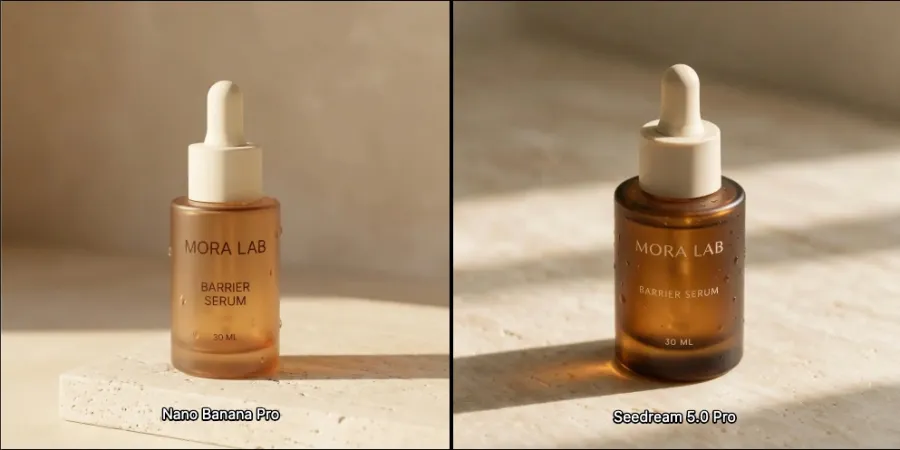
Both models correctly rendered MORA LAB, BARRIER SERUM, and 30 ML. Neither added another product, person, or decorative headline.
Nano Banana Pro produced the brighter and cleaner listing image. Its label had stronger contrast, and the extra negative space would make the output easy to crop for a product page. Seedream 5.0 Pro rendered deeper amber glass, clearer droplets, stronger refraction, and more convincing directional light. Its result felt closer to a finished commercial photograph, although the label was slightly less prominent.
Winner: Seedream 5.0 Pro, by a narrow margin. Nano Banana Pro was better for label visibility; Seedream won on material depth and photographic finish.
Test 2: Packaging With Exact English Text
This round tested whether each model could place the same five lines of copy on a can and its matching package without losing readability.
Create a 4:5 ecommerce product advertisement for a fictional sparkling tea brand.

Show one slim aluminum can and its matching cardboard package. Use a cream, forest green, and muted orange color palette. Print the following exact text without changing, repeating, or adding words:

NORTH LEAF
SPARKLING TEA
YUZU + JASMINE
0 SUGAR
330 ML

Place “NORTH LEAF” as the largest brand text, “SPARKLING TEA” directly below it, and the remaining three lines in a smaller information block. Keep the typography readable and aligned on both the can and package. Use a clean studio background with realistic aluminum reflections and soft shadows. Do not generate fruit slices over the text.
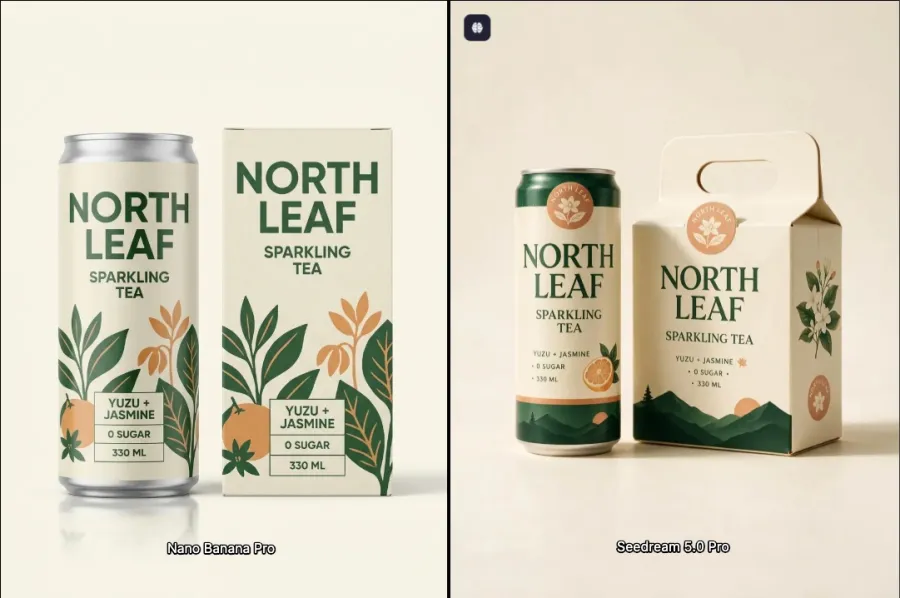
Both outputs preserved the required core copy. The difference was how they prioritized readability and brand styling.
Nano Banana Pro made NORTH LEAF and the supporting information large enough to read immediately on both surfaces. Its design was flatter and less photographic, but the hierarchy worked well at thumbnail size. Seedream created the more polished physical package, with stronger depth, shadows, and a cohesive outdoor-inspired identity. However, its supporting copy was smaller, and it introduced extra seal-like branding details that were not part of the brief.
Winner: Nano Banana Pro. For a simple packaging task where exact copy must survive a small ecommerce thumbnail, clarity mattered more than decorative finish.
Test 3: Multilingual Ecommerce Poster
The third prompt mixed English, Japanese, a currency symbol, and a fixed price. It also prohibited translation and rewriting.
Create a vertical 4:5 ecommerce launch poster for a fictional portable coffee maker.

The product is a compact matte-black cylindrical coffee maker placed in the center. Use a modern Japanese retail advertising style with warm beige, black, and red accents.

Include the following exact text:

KADO MINI
COFFEE ANYWHERE
新発売
価格 ¥12,800
FREE SHIPPING

Keep every English and Japanese character readable. “KADO MINI” must be the main headline. Place “新発売” inside a small red promotional badge. Do not translate, rewrite, repeat, or invent additional text. Preserve generous white space and a clear ecommerce hierarchy.
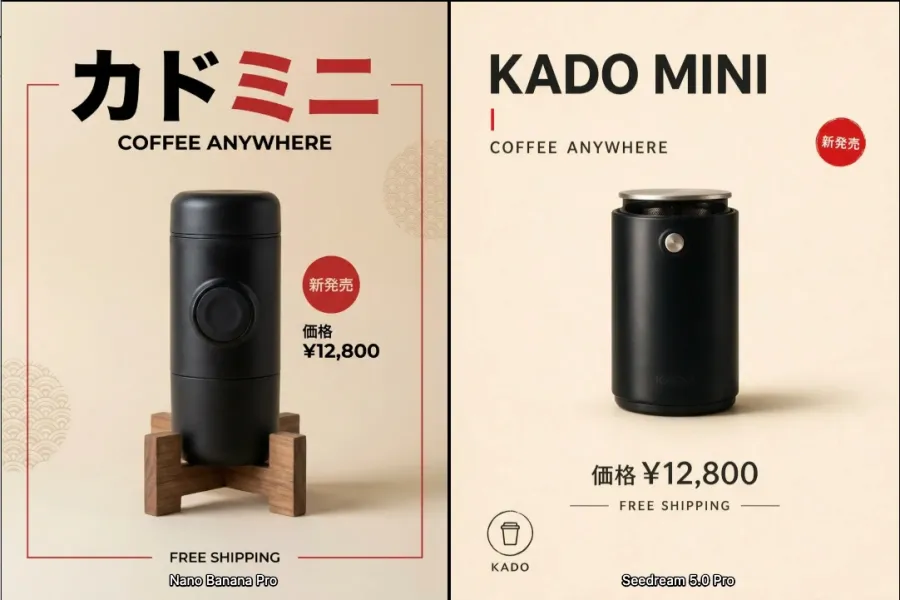
This was the clearest separation in the test.
Nano Banana Pro replaced the required KADO MINI headline with the Japanese rendering カドミニ. The meaning remained recognizable, but the prompt explicitly prohibited translation or rewriting. It also placed the device on an unrequested wooden stand, and the object read more like a flask than a compact coffee maker.
Seedream preserved all five required text elements: KADO MINI, COFFEE ANYWHERE, 新発売, 価格 ¥12,800, and FREE SHIPPING. It also kept the red launch badge, central black product, warm neutral palette, and generous spacing.
Winner: Seedream 5.0 Pro, decisively. The main difference was not artistic taste; it was compliance with locked copy and product-format instructions.
Test 4: Product Background Replacement
This editing prompt asked both models to preserve an uploaded skincare product while replacing its plain background with a warm bathroom scene.
Use the uploaded product image as the only source of product identity.

Replace the plain white background with a warm minimalist bathroom scene featuring pale limestone, soft morning window light, and one blurred eucalyptus branch in the distance.

Preserve the product exactly as shown in the reference image, including its shape, dimensions, cap, logo, label text, colors, reflections, and camera angle. Do not redesign the packaging, rewrite the label, add accessories, alter the product proportions, or duplicate the product.

The final result should look like a realistic ecommerce lifestyle photograph while keeping the original product fully recognizable.
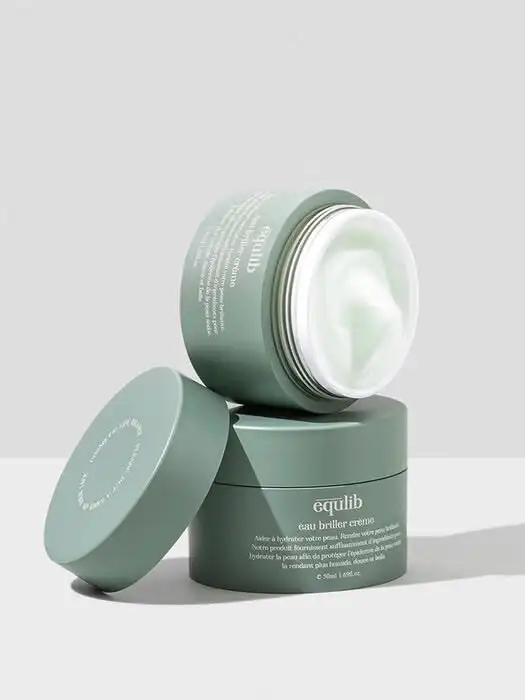
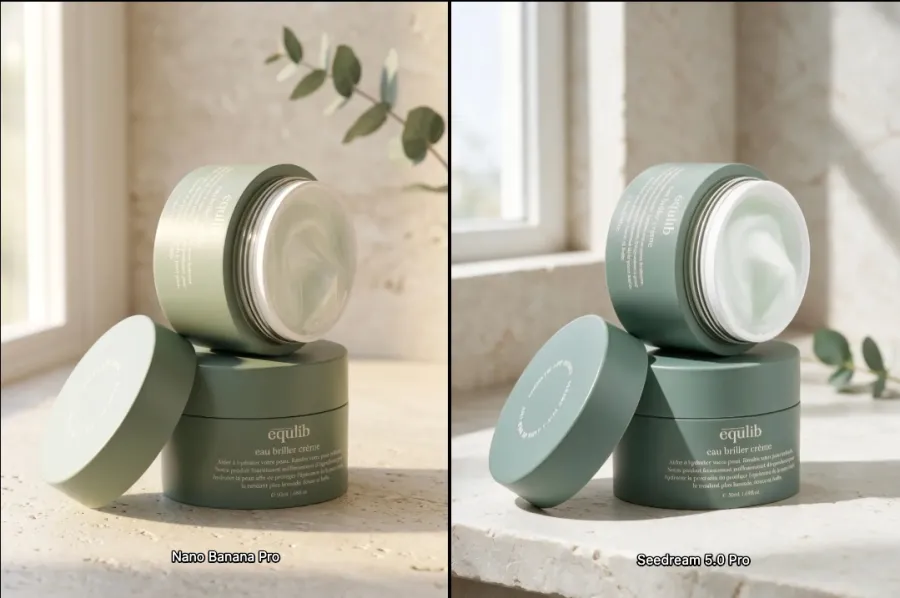
Both models retained the green containers, open cream texture, lid arrangement, and label placement while integrating the objects into a limestone-and-window setting.
Nano Banana Pro produced the warmer and more atmospheric photograph. The soft light and blurred greenery made the scene feel natural, although some product text and edges became less distinct. Seedream delivered sharper container geometry, clearer label details, and stronger separation between the product and background. Its scene was slightly cooler and more staged.
Result: Too close to call. Nano Banana Pro had the more natural lifestyle atmosphere; Seedream had the clearer product presentation. For a rigorous fidelity judgment, compare both outputs against the original reference at full resolution.
Test 5: Dense Product Infographic
The final round combined an exact product format, multiple text sections, icons, prohibited claims, and a three-part reading structure.
Create a vertical 4:5 ecommerce infographic for a fictional mineral sunscreen named “SOLARA SPF 50”.

Show the sunscreen tube in the upper-right corner. Organize the remaining information into three clearly separated sections with simple icons.

Use the following exact text:

SOLARA SPF 50
DAILY MINERAL SUNSCREEN

BROAD SPECTRUM
UVA + UVB PROTECTION

KEY BENEFITS
• NO WHITE CAST
• WATER RESISTANT 80 MIN
• FRAGRANCE FREE

HOW TO USE
APPLY 15 MINUTES BEFORE SUN EXPOSURE

Use a clean editorial layout with ivory, pale yellow, and terracotta colors. Keep every word readable. Do not add ingredients, medical claims, ratings, prices, or additional benefit text.
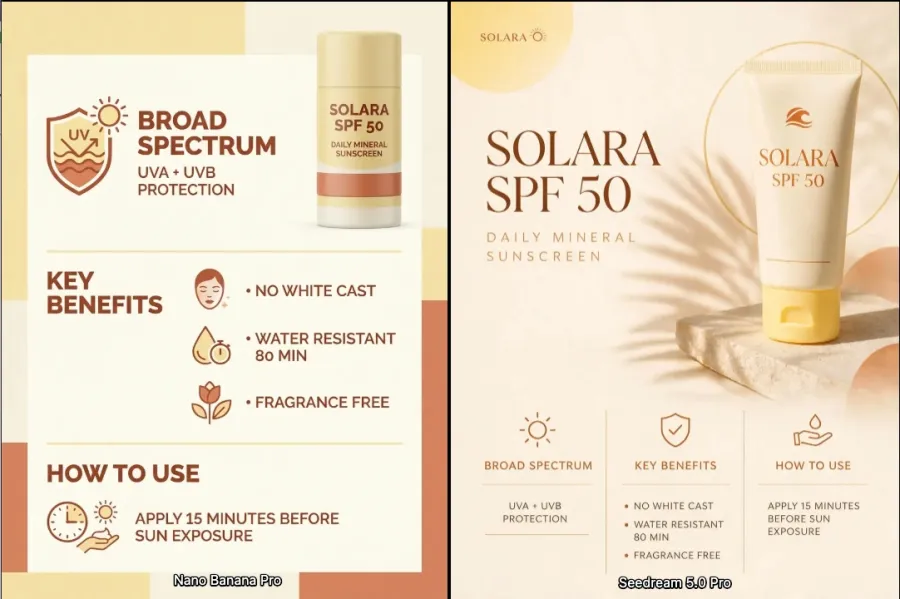
Nano Banana Pro rendered the required benefit text at a large, readable size. Its result would remain easy to scan on a phone. The main failure was the product itself: it generated a cylindrical stick rather than the requested sunscreen tube. The page also behaved more like an information card than a complete brand advertisement.
Seedream generated the requested tube in the upper-right area and organized the information into three separated columns with simple icons. Its smaller supporting text requires closer inspection, but the product form, layout, color system, and reading order matched the brief more faithfully.
Winner: Seedream 5.0 Pro. Nano Banana Pro won on immediate text size; Seedream completed more of the full deliverable.
Overall Test Results
| Round |
Winner |
Deciding factor |
| Product hero image |
Seedream 5.0 Pro, narrowly |
More realistic glass, droplets, refraction, and light |
| Packaging with exact text |
Nano Banana Pro |
Larger typography and clearer thumbnail hierarchy |
| Multilingual poster |
Seedream 5.0 Pro |
Preserved the locked English and Japanese copy |
| Product background replacement |
Tie |
Nano atmosphere versus Seedream product clarity |
| Dense product infographic |
Seedream 5.0 Pro |
Correct product format and more complete information structure |
Across five one-shot ecommerce tests, Seedream 5.0 Pro won three rounds, Nano Banana Pro won one, and one was too close to call.
Seedream's advantage became more visible as each prompt added layout, localization, product-format, and information-density constraints. Nano Banana Pro remained highly competitive on simpler visual tasks and won the packaging round because its typography was easier to read at a glance.
This does not mean that Seedream is universally better. It means that Seedream 5.0 Pro was the stronger first choice for this particular set of ecommerce deliverables.
Cost and Generation Speed During Our Test
At the settings used for the five comparisons, each Seedream 5.0 Pro image cost $0.081, while each Nano Banana Pro image cost $0.0804.
The difference was $0.0006 per image:
| Volume |
Nano Banana Pro |
Seedream 5.0 Pro |
Difference |
| 1 image |
$0.0804 |
$0.081 |
$0.0006 |
| 1,000 images |
$80.40 |
$81.00 |
$0.60 |
| 10,000 images |
$804.00 |
$810.00 |
$6.00 |
We also observed no meaningful difference in completion time. Both models returned the tested images within a similar amount of time, so neither had a practical speed advantage in this run.
Price and speed therefore did not determine the winners. We judged the rounds primarily by instruction following, text accuracy, product fidelity, visual quality, and first-pass usability.
Nano Banana Pro vs Seedream 5.0 Pro Pricing
The test price is only part of the cost story because the difference changes with resolution.
| GPT Proto output tier |
Nano Banana Pro |
Seedream 5.0 Pro |
Cost takeaway |
| 1K |
$0.0804 |
$0.0405 |
Seedream is about 49.6% cheaper |
| 2K |
$0.0804 |
$0.081 |
Effectively the same price |
| 4K |
$0.144 |
Not currently listed |
Nano Banana Pro is the available choice |
For high-volume 1K catalog images, Seedream has a meaningful budget advantage: 1,000 generations cost $40.50 instead of $80.40. For 2K campaign assets, the $0.60 difference per 1,000 images is too small to drive the decision. Run the same brief through both models and pay for the output that requires fewer repairs.
Which Model Is Better for Ecommerce Products?
The answer depends on where the asset sits in the ecommerce workflow.
Bulk Catalog and Marketplace Images
Start with Seedream 5.0 Pro when 1K output is sufficient. Its $0.0405 1K rate is much easier to scale across large SKU catalogs. Test a small representative batch first, especially if packaging text must remain exact.
Packaging and Label Concepts
Nano Banana Pro deserves the first test when large, readable type is the main requirement. It won our packaging round by keeping the brand and product information easy to scan. Seedream may produce the richer physical package, but small supporting copy still needs inspection.
Multilingual Promotions
Seedream 5.0 Pro was the stronger option in our English-and-Japanese poster. It preserved the requested text without translating the brand name. That makes it the better first route for localized sale cards, regional posters, menus, and marketplace graphics—provided every generated character is reviewed before publication.
Product Infographics
Seedream also won the information-dense round. It created the requested sunscreen tube and separated the content into three sections. Nano Banana Pro made the copy easier to read but missed a high-value product-format constraint.
Premium Hero Images and 4K Delivery
Nano Banana Pro remains the practical choice when the final asset must be delivered at native 4K through the current GPT Proto routes. It also remains competitive for hero photography: Seedream only narrowly won our first round, while Nano produced the cleaner label and more flexible negative space.
Reference-Based Lifestyle Edits
Test both on the actual product. Nano Banana Pro may be preferable when natural atmosphere and soft integration matter most. Seedream may be safer when container edges, printed copy, and product separation must remain crisp.
Nano Banana Pro Prompt vs Seedream 5.0 Pro Prompt
Both models accept detailed creative briefs, but our results suggest slightly different priorities.
How to Prompt Nano Banana Pro
Use this order:
Deliverable + subject + exact copy + composition + camera and lighting + protected details + prohibited changes
Nano Banana Pro responded well when the typography was prominent and the layout remained relatively simple. Put exact copy on separate lines, state which phrase must be largest, and explicitly prohibit translation when mixing languages.
For more examples, browse the Nano Banana Pro prompt gallery.
How to Write a Seedream 5.0 Pro Prompt
Use this order:
Layout structure + product form + exact copy + position rules + elements to preserve + materials and lighting + exclusions
Seedream performed best when the prompt described the deliverable as a structured design rather than a loose visual idea. Put layout and position instructions before style adjectives. For edits, separate the requested change from the details that must remain untouched.
For ready-to-remix examples, browse the Seedream 5.0 Pro prompt gallery.
How to Compare Both Models With One GPT Proto API Key
The model routes use different size syntax, but the same GPT Proto key can authenticate both requests. The example below sends the same square product prompt to each 2K route and waits for the completed result.
First, store your key in an environment variable:
export GPTPROTO_API_KEY="YOUR_API_KEY"
Call Nano Banana Pro:
curl --request POST "https://gptproto.com/api/v3/google/gemini-3-pro-image-preview/text-to-image" \
  --header "Authorization: Bearer $GPTPROTO_API_KEY" \
  --header "Content-Type: application/json" \
  --data '{
    "prompt": "Square premium ecommerce hero image of one frosted amber serum bottle on pale travertine, soft morning side light, clean neutral background, realistic glass and shadow, no extra products or text",
    "size": "2K",
    "aspect_ratio": "1:1",
    "output_format": "png",
    "enable_sync_mode": true,
    "enable_base64_output": false
  }'
Call Seedream 5.0 Pro with the same prompt:
curl --request POST "https://gptproto.com/api/v3/doubao/dola-seedream-5-0-pro-260628/text-to-image" \
  --header "Authorization: Bearer $GPTPROTO_API_KEY" \
  --header "Content-Type: application/json" \
  --data '{
    "prompt": "Square premium ecommerce hero image of one frosted amber serum bottle on pale travertine, soft morning side light, clean neutral background, realistic glass and shadow, no extra products or text",
    "size": "2048x2048",
    "enable_base64_output": false,
    "enable_sync_mode": true
  }'
Keep more than the image URL when you run a production comparison. Record the model ID, prompt version, resolution, reference-image count, completion time, charged cost, number of reruns, and whether a reviewer accepted the first output. The cheapest request is not economical if it requires several regenerations or manual repair.
Final Verdict: Nano Banana Pro or Seedream 5.0 Pro?
Seedream 5.0 Pro is the winner of our ecommerce-focused same-prompt test. It won three of five rounds and handled the most constrained briefs more reliably. Its strongest results came from multilingual layout and dense product information—two tasks where missing or rewritten details can make an otherwise attractive image unusable.
Nano Banana Pro remains the better choice for native 4K delivery and deserves the first test for simple packaging with large text. It also leads Seedream on the broader Artificial Analysis text-to-image leaderboard, so our task-specific result should not be read as a universal quality ranking.
At the tested prices—$0.0804 for Nano Banana Pro and $0.081 for Seedream—the cost gap is negligible, and we saw no meaningful speed difference. For 2K ecommerce work, choose by first-pass acceptance rate. For 1K bulk generation, Seedream's lower rate changes the calculation substantially.
The most practical production setup is not permanent loyalty to one model. Use one GPT Proto key to run a small sample through both, route structured and multilingual briefs toward Seedream, and keep Nano Banana Pro available for 4K assets, clean typography, and briefs where its broader reasoning profile fits better.