GPT-6.1 Sol vs GPT-6 Sol at a Glance
|
GPT-6 Sol |
GPT-6.1 Sol |
| API model ID |
gpt-6-sol |
gpt-6.1-sol |
| Released |
September 22, 2026 |
September 29, 2026 |
| Context window |
1,050,000 tokens |
1,050,000 tokens |
| Max output tokens |
128,000 |
128,000 |
| Knowledge cutoff |
Apr 20, 2026 |
Apr 30, 2026 |
| Modalities |
Text + image in, text out |
Text + image in, text out |
| Reasoning effort |
none, low, medium, high, xhigh, max |
low, medium, high, xhigh, max |
| Tool calling in Chat Completions |
Only with reasoning_effort: "none" |
Not supported — Responses only |
| Ultrafast mode |
Not available |
service_tier: "ultrafast" |
| Data residency |
EU |
US and EU, including Fast and Ultrafast |
| Input / output per 1M |
$2.00 / $10.00 |
$2.00 / $10.00 |
| Cached input per 1M |
$0.20 |
$0.10 |
| Cache writes per 1M |
$2.50 |
$2.50 |
One row moved. Cached input. Everything else on the pricing side is identical, and the capability differences hide in the two rows about reasoning effort and tool calling.
The Pricing Question: What Actually Changed
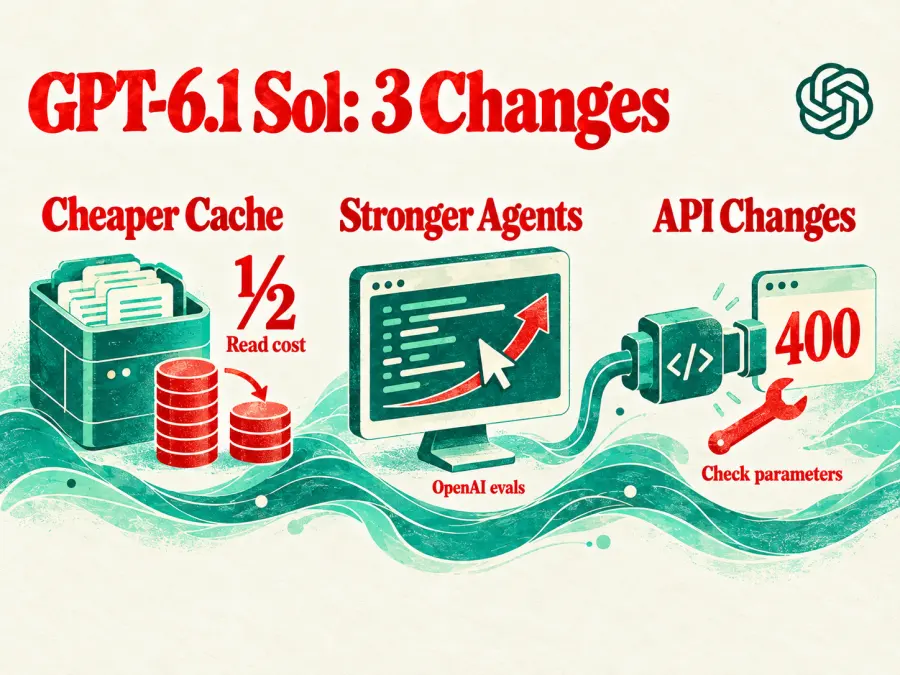
OpenAI's model page lists cached input at $0.10 per million tokens for GPT-6.1 Sol against $0.20 for GPT-6 Sol. Expressed as a share of the uncached input rate, that's 5% versus 10%. The documentation states cache writes are billed at 1.25x the uncached input rate on both models, which works out to $2.50 per million either way.
That last number deserves attention, because it's the cost attached to the discount. Writing a 200,000-token prefix into cache costs $0.50. Sending the same 200,000 tokens as plain uncached input costs $0.40. A prefix you write once and never reuse is 25% more expensive for having been cached. The cheaper read rate only pays you back if the read actually happens, repeatedly.
Two other billing boundaries apply to both models equally and catch people out. First, prompts above 272K input tokens are priced at 2x input and cache rates and 1.5x output for the entire request — not just the overage. A request with 270K input and 2K output costs $0.56; push it to 280K input and the same request costs $1.15. The 1.05M context window is real, but the pricing wall sits at roughly a quarter of it, and long agent sessions grow into that wall without announcing themselves.
Second, the service tiers multiply everything. Batch and Flex run at 50% of standard. Fast mode is 2x. Ultrafast — available on 6.1 Sol only — is 6x, which puts it at $12.00 input and $60.00 output per million tokens for up to 8x faster token generation. Regional processing adds 10% where available.
On GPT Proto's GPT-6.1 Sol model page, both models list at $1.60 input and $8.00 output per million tokens, which the page marks as 20% below official rates. Same figures on the GPT-6 Sol page. The 20% discount doesn't change the comparison between the two models — it applies to both — but it does change the arithmetic against Astra, which sits at $8.00/$40.00 there.
A Worked Cost Example: Where the Cheaper Cache Actually Pays Off
Abstract rate comparisons hide which side of the trade you're on. Here's a workload with the arithmetic exposed.
Assume an agentic coding loop: a 200,000-token repository context as a stable prefix, 2,000 new input tokens per step, 1,000 output tokens per step, 50 steps per task. All figures at standard-tier official rates, no regional premium, cache TTL within a single session, cache write excluded from the first-step total.
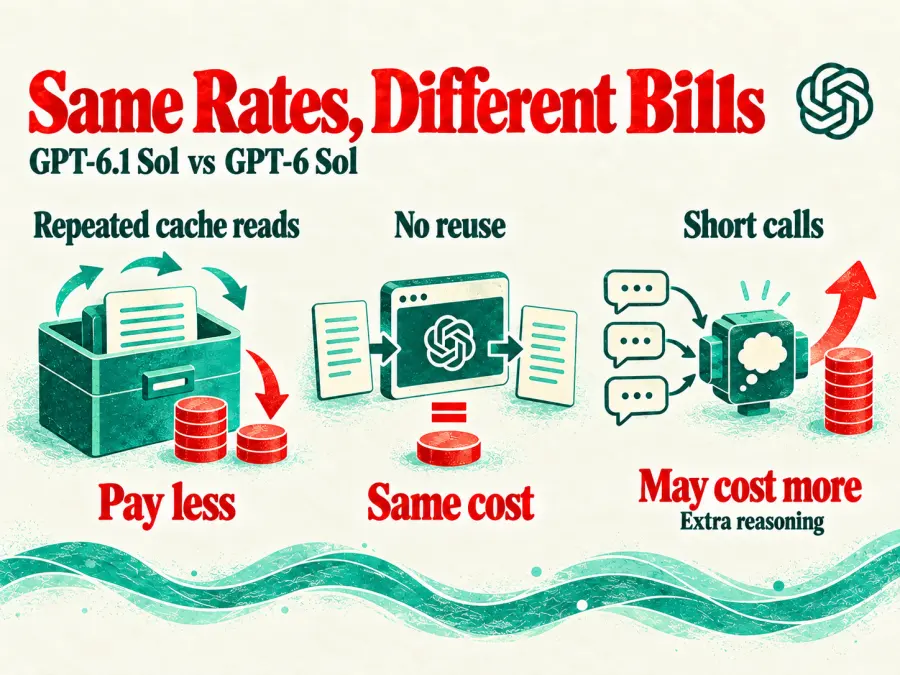
Scenario A — the prefix stays cached. Step one pays uncached input on the prefix: $0.41. Steps two through fifty read the prefix from cache. On GPT-6 Sol that's $0.04 per step for the cached prefix; on 6.1 Sol it's $0.02. Totals: **$3.06 on GPT-6 Sol, $2.08 on GPT-6.1 Sol** — 32% lower for the same task, same listed headline price.
Scenario B — no prefix reuse. One long prompt, one answer, nothing cached. 200,000 input tokens plus 1,000 output tokens costs $0.41 on both models. The savings are exactly zero. Every article calling 6.1 Sol cheaper is describing Scenario A and omitting that Scenario B exists.
Scenario C — high-frequency short calls. 100,000 requests, 800 input and 150 output tokens each. On GPT-6 Sol at reasoning_effort: "none", no reasoning tokens are generated: 510.00 — 65% more. At 500 reasoning tokens per call, $810.00. More than double.
The one-line version: the cache discount rewards architectures that reuse a dense prefix across many requests, and penalises nothing. The loss of none penalises architectures built on cheap high-volume calls, and no price cut compensates for it. Find which scenario describes your traffic before you touch the model string.
Coding and Agentic Benchmarks: How Big Is the Jump
Every number in this section comes from OpenAI's launch materials. Treat them as vendor-reported.
On DeepSWE v1.1, which runs agents against real software-engineering tasks in full repositories, OpenAI reports 6.1 Sol exceeding GPT-6 Sol's best score by 6.4 percentage points — at a lower reasoning effort and lower cost. The same materials put it level with GPT-6 Astra at roughly one-fifth of Astra's cost per task.
On OSWorld 2.0's offline set, covering long-horizon computer-use workflows, 6.1 Sol comes in seven percentage points above GPT-6 Sol at maximum reasoning effort for less than half the cost, and within 2.1 percentage points of Astra at roughly one-seventh the cost per task.
On AutomationBench 1.0.6, testing end-to-end business workflows across 47 tools, 6.1 Sol scores 4.8 percentage points above GPT-6 Sol at the same reasoning setting.
On Terminal-Bench Science 0.1, it more than doubles GPT-6 Sol's score at maximum effort for less than half the cost per task, averaging $5.47 per task against $23.80 for Astra. Worth noting what OpenAI says next: Astra still posts the highest score in that set at 68.1%, and remains the recommendation for the hardest scientific work. The gap is real, and the cheaper model does not close it.
Factuality improved most at the low end. On a set built from de-identified conversations where users had flagged an earlier model's error, the share of answers containing a factual error fell from 11.4% on GPT-6 Sol to 7.7% on 6.1 Sol at low reasoning effort — about a 32% reduction. Across tested settings the error rate stays within 1.9 percentage points of Astra. These prompts were selected to induce errors and don't represent typical traffic.
The alignment numbers follow a similar shape. In an evaluation testing whether an agent tells you its search tool is broken instead of guessing, 6.1 Sol fails to disclose in 2.1% of cases against 4.9% for GPT-6 Sol and 1.5% for Astra. Neither model showed attempts to bypass the automated safety reviewer.
My read: the direction is consistent enough across five independent evaluation suites that I'd expect a real improvement on agentic work. The magnitude is another matter. These are first-party numbers on benchmarks partly selected to show the gap, and "6.4 percentage points on DeepSWE" tells you nothing about your codebase. Run both models on the same tasks with your own acceptance criteria and compare cost per accepted result, not benchmark rank.
The Tool Matrix Nobody Mentions
Here's the difference I haven't seen covered anywhere, and it may matter more than any benchmark delta.
OpenAI's model pages carry a section listing which built-in tools each model supports through the Responses API. The GPT-6.1 Sol page lists web search, file search, image generation, code interpreter, hosted shell, apply patch, Skills, computer use, MCP, and tool search. The GPT-6 Sol page lists web search, file search, and image generation — the remaining seven are not marked as supported there.
I'm describing what the pages state, not asserting what OpenAI built or removed. But if those listings are accurate, the agentic benchmark jump isn't only a model doing the same work better. It's a model with access to a materially larger tool surface: a shell it can run, a patch mechanism it can apply, MCP servers it can reach, Skills it can load.
That reframes the choice. If your agent needs hosted shell access, apply-patch, or MCP connectivity, this stops being a performance comparison and becomes a feasibility one. GPT-6 Sol's page doesn't offer those tools, so no amount of prompt engineering gets you there. One line: check the tool list before you compare scores, because the scores may be measuring access rather than ability.
The Migration Cost: Five Things That Break
OpenAI's migration guide is explicit that changing the model string is not sufficient. These are the changes it documents, ordered by how loudly they fail.
The first is the one everyone hits. GPT-6.1 Sol does not support reasoning_effort: "none" or "minimal". GPT-6 Sol and GPT-6 Luna do. The official mapping is to use low instead, and the guide suggests starting there and comparing on representative tasks if you were on minimal. The quiet part is in Scenario C above: low still generates reasoning tokens, so latency-sensitive paths get slower and more expensive, not just different.
Second, and following directly from the first: tool calling through Chat Completions stops working. GPT-6 Sol permitted function calling on Chat Completions only when reasoning_effort was none, and plenty of projects leaned on exactly that combination for cheap tool calls. With none gone, Chat Completions on 6.1 Sol supports requests without tools. Anything with a tools array has to move to /v1/responses.
Third, the sampling parameters go away permanently. temperature, top_p, and top_logprobs are only allowed when reasoning effort is none. Since 6.1 Sol has no none, you can never use them on this model. Chat Completions also needs logprobs removed, and Responses needs message.output_text.logprobs dropped from include. If you were reading logprobs to derive confidence scores or classification thresholds, that approach is gone and structured outputs with an explicit confidence field is the obvious replacement — at the cost of trusting the model's self-report instead of the token distribution.
Fourth, caching parameters moved. prompt_cache_retention becomes prompt_cache_options.ttl set to "30m". You can set prompt_cache_options.mode to "explicit" to avoid unnecessary writes, which matters given that cache writes bill at 1.25x. Changing reasoning effort mid-conversation invalidates the cached prefix, so the guide points to a configuration_update input item to adjust effort while leaving the request-level reasoning.effort untouched — applicable to standard single-agent requests.
Fifth, and the quietest failure of the set: max_output_tokens counts reasoning tokens. A ceiling that was comfortable at none can be consumed entirely by reasoning at low or above, returning status: incomplete with no visible output while still billing you. Audit hardcoded limits, including max_tokens values carried over from Chat Completions.
Worth checking too: the knowledge cutoff moved from April 20 to April 30, 2026, so a ten-day window of library and API changes shifts. Standard rate limits are identical across both models — 5,000 RPM and 1M TPM at Build, 10,000 and 4M at Launch, 15,000 and 40M at Grow — but Ultrafast on 6.1 Sol draws from a separate TPM pool.
One line: a text-only request migrates by changing the model name. Anything holding tools, sampling parameters, or logprobs needs rewriting.
Quick Start: Calling Both Models Through One Key
A first call against either model, no tools involved, so this form works on both:
curl --request POST "https://gptproto.com/v1/chat/completions" \
  --header "Authorization: Bearer $GPTPROTO_API_KEY" \
  --header "Content-Type: application/json" \
  --data '{
    "model": "gpt-6.1-sol",
    "messages": [
      { "role": "user", "content": "Summarise the failure modes in this stack trace." }
    ]
  }'
Swap "model": "gpt-6.1-sol" for "gpt-6-sol" to run the same request against the previous model. For text-only work that single edit is the whole A/B setup, and it's the cheapest way to get a real comparison on your own prompts.
For anything with tools, 6.1 Sol requires the Responses API. Note the nested reasoning.effort rather than the flat reasoning_effort used by Chat Completions, and the absence of temperature:
import os
from openai import OpenAI

client = OpenAI(
    api_key=os.environ["GPTPROTO_API_KEY"],
    base_url="https://gptproto.com/v1",
)

response = client.responses.create(
    model="gpt-6.1-sol",
    reasoning={"effort": "low"},
    max_output_tokens=25_000,
    tools=[
        {
            "type": "function",
            "name": "run_tests",
            "description": "Run the test suite for a given package and return failures.",
            "parameters": {
                "type": "object",
                "properties": {"package": {"type": "string"}},
                "required": ["package"],
            },
        }
    ],
    input="Run the tests for the billing package and explain what broke.",
)

print(response.output)
Two things to flag rather than assume. The max_output_tokens value above is deliberately generous because reasoning tokens draw from that budget — a 1,024 ceiling copied from a text demo will return incomplete on reasoning work. And the Responses route and service_tier: "ultrafast" support need confirming on the platform you're calling through; OpenAI documents both for gpt-6.1-sol, but model access and route availability are separate things. Smoke-test a full tool loop before you move live traffic.
In multi-turn tool use, send every reasoning item, function call, and function-call output since the last user message, not just the final result. Replaying partial history is a common source of confusing failures on reasoning models.
Which One Should You Use?
| Your situation |
Pick |
| Agentic coding, multi-file patches, CI repair loops |
GPT-6.1 Sol |
| Agent needs hosted shell, apply patch, MCP, or Skills |
GPT-6.1 Sol — 6 Sol's page doesn't list them |
| Long stable prefix reused across many requests |
GPT-6.1 Sol (cached reads at half the rate) |
| Computer use and GUI automation |
GPT-6.1 Sol |
| Complex PDF and multi-step business workflows |
GPT-6.1 Sol |
| Need Ultrafast, or US data residency |
GPT-6.1 Sol |
Latency-critical short calls at none |
Stay on GPT-6 Sol |
Pipeline depends on temperature, top_p, or logprobs |
Stay on GPT-6 Sol |
| Tool calling wired into Chat Completions, no migration budget |
Stay on GPT-6 Sol |
| One-shot long prompts with no cache reuse |
Either — cost is identical |
| Hardest scientific or mathematical research |
Neither — Astra still leads |
| Bulk classification and structured extraction |
Neither — Luna is far cheaper |
Choose GPT-6.1 Sol if your workload is agent-shaped: repeated calls over a stable context, tool loops, computer use, document analysis. You get the better scores and the halved cache rate at the same headline price, and you pay for it once in migration work rather than monthly in token spend.
Stay on GPT-6 Sol if your integration depends on anything 6.1 Sol removed. The none effort level is the big one — it has no equivalent, and low is not a drop-in substitute for either latency or cost. Same if you're reading logprobs, setting temperature, or calling tools through Chat Completions and can't fund the rewrite right now. A working pipeline that meets its acceptance criteria is worth more than 6.4 percentage points on someone else's benchmark.
Consider neither at the two extremes. For the hardest research work, OpenAI's own numbers still put Astra on top at 68.1% on Terminal-Bench Science. For high-volume classification and extraction, Luna at $0.10/$0.50 per million tokens costs a twentieth of Sol and will do the job. Both sit in the same OpenAI model catalogue under one key, so testing across tiers doesn't mean managing more credentials.
Final Verdict
GPT-6.1 Sol is the better model at the same listed price, and that sentence is only useful with the condition attached: the savings require cache reuse, and the capability gains require migration work. Agent-shaped workloads should move, budget a day for the Responses rewrite and the parameter audit, and verify cost per accepted result rather than trusting the benchmark delta.
Everything else should wait. If your pipeline runs on none, reads logprobs, or calls tools through Chat Completions, moving to 6.1 Sol buys you a slower, pricier version of something that already works.
Verified October 9, 2026 against OpenAI's published model pages and migration guide, and GPT Proto's model pages. All benchmark figures are vendor-reported and not independently reproduced. This comparison is based on documentation and listed prices, not a latency or reliability benchmark. Prices and model availability change — re-check before committing.