Claude vs ChatGPT for Coding in 2026: Which Is Better for Debugging, Frontend, Python, and Large Codebases?

Claude or ChatGPT for coding? Compare code generation, debugging, frontend work, Python, large codebases, benchmarks, pricing, and usage limits.

Claude vs ChatGPT for Coding in 2026: Which Is Better for Debugging, Frontend, Python, and Large Codebases?

Claude vs ChatGPT for Coding in 2026: Which Is Better for Debugging, Frontend, Python, and Large Codebases?

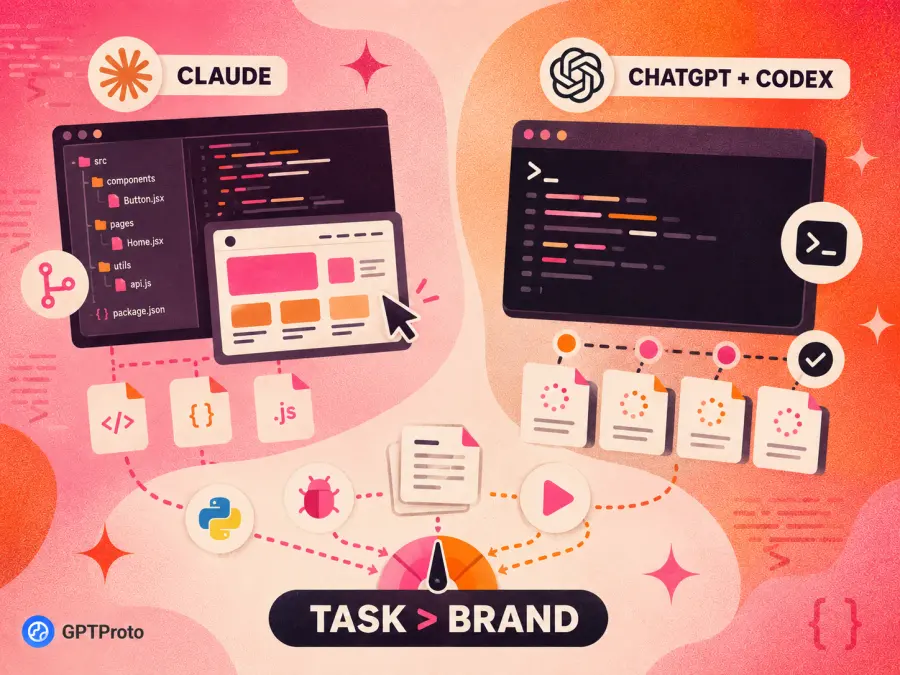
Is Claude or ChatGPT better at coding? Claude is usually the better fit for interactive development, frontend iteration, and repository-wide reasoning. ChatGPT with Codex is often stronger for terminal-heavy tasks and long autonomous jobs. For routine generation, Python scripts, and isolated debugging, the selected model, supplied context, and ability to run the code matter more than the brand.

A useful Claude vs ChatGPT for coding comparison must also separate Claude Code from Codex and Claude APIs from GPT APIs. This guide uses current documentation, published benchmarks, and disclosed third-party tests—not a claimed GPTProto hands-on test.

목차

Claude vs ChatGPT for Coding: Quick Verdict

The best choice depends on how you code and how much of the task you want the AI to complete independently.

Coding task Better starting point Why
Small functions and scripts Tie Prompt quality and model tier usually matter more than provider
Interactive pair programming Claude Code Fast feedback and deep terminal customization
Long autonomous coding jobs Codex Strong delegate-and-review and background workflows
Frontend and UI generation Claude A slight qualitative advantage for visual implementation and iteration
Terminal-heavy debugging ChatGPT/Codex GPT-5.6 Sol narrowly leads the shared Terminal-Bench comparison
Repository-wide refactoring Claude Opus 5 Strong code-migration and multi-file engineering performance
Python development Tie The winner changes with the task, libraries, tests, and repository access
Large codebases Claude, slight edge Strong repository reasoning, although both families now support very large contexts
Entry-level coding subscription ChatGPT Plus Its published Codex allowance is generally easier to estimate and stretch
API deployment Depends on model tier Cost per accepted result matters more than the cheapest individual request

Choose Claude for close collaboration and large interconnected changes. Choose ChatGPT with Codex when you prefer to delegate and review. API teams should evaluate individual models rather than treating either provider as one fixed product.

What Are We Comparing: Claude, ChatGPT, Claude Code, or Codex?

The difference between Claude and ChatGPT starts with the product surface.

Claude.ai and ChatGPT are general applications for explaining, generating, and reviewing code. Claude Code and Codex are coding agents that can inspect repositories, edit files, run commands and tests, and revise failures. That changes the task from “write code” to “produce and verify a working change.”

APIs are another layer: the surrounding application selects files and tools, runs commands, returns errors, and decides when work is complete. A model that writes a correct function in chat may therefore behave differently inside an agent. A fair Claude AI vs ChatGPT comparison must evaluate both the model and its working environment.

Current Claude and GPT Models for Coding

A current Claude vs ChatGPT for coding guide must compare equivalent model tiers. Anthropic recommends Claude Opus 5 for most complex workloads and Fable 5.1 for especially demanding long-horizon work. OpenAI positions GPT-5.6 Sol as its complex-coding flagship, with Terra and Luna for lighter workloads.

Model Best coding fit Context window Main trade-off
Claude Fable 5.1 Demanding, long-running agentic coding 1M tokens Highest Claude API price and slower latency
Claude Opus 5 Complex coding, migrations, and repository work 1M tokens More expensive than mid-tier models
Claude Sonnet 5 Everyday coding with lower latency 1M tokens Lower ceiling on the hardest engineering tasks
GPT-5.6 Sol Complex coding, agents, and terminal work 1.05M tokens Higher cost and latency than smaller GPT models
GPT-5.6 Terra Everyday development and production tasks 1.05M tokens Less capable than Sol on the hardest work
GPT-5.6 Luna Focused scripts and high-volume transformations 1.05M tokens Not intended for the most ambiguous engineering tasks

You can review the current Claude model family and OpenAI model family on GPT Proto. For difficult coding workloads, the most relevant individual pages are Claude Fable 5.1, Claude Opus 5, and GPT-5.6 Sol. For routine production work, GPT-5.6 Terra is a more economical comparison point.

Match models by workload, then measure the total cost required to obtain an acceptable result.

What Coding Benchmarks Actually Show

Current benchmark evidence does not support a universal winner. Claude leads some repository and code-generation evaluations, while GPT-5.6 Sol narrowly leads a shared terminal benchmark.

Benchmark Claude result GPT result What it suggests
Terminal-Bench 2.1 Fable 5.1: 85.02% GPT-5.6 Sol: 85.77% GPT holds a narrow lead on terminal-based agent tasks
SWE-bench Verified Opus 5: 97.00% GPT-5.6 Sol: 96.20% Both are highly competitive on real repository issues
Vibe Code Bench Fable 5.1: 90.26% GPT-5.6 Sol: 80.50% Claude shows an advantage in end-to-end app generation
LiveCodeBench Fable 5.1: 90.52% Strong code problem-solving, but not a complete product comparison

These results come from Vals evaluations of Claude Fable 5.1, Claude Opus 5, and GPT-5.6 Sol, but they still require context.

For example, Fable 5.1 was evaluated with server-side Claude fallbacks for refusals. Vals reports that its Terminal-Bench 2.1 score falls from 85.02% to 79.03% when fallback-assisted tasks are counted as failures. The evaluation settings also differ: Fable 5.1 and GPT-5.6 Sol used maximum effort, while Opus 5 used high effort for Terminal-Bench.

Claude performs particularly well on code-generation, migration, and application-building evaluations. GPT-5.6 Sol is close on repository resolution and slightly ahead on the shared terminal benchmark. Those gaps may reverse with different agents, tools, or codebases.

Claude vs ChatGPT for Code Generation

For small, clearly specified code-generation tasks, Claude and ChatGPT are close enough that there is no dependable universal winner. Both can generate functions, data transformations, API handlers, test cases, and small applications when the prompt contains the relevant requirements.

Claude is a good starting point for implementation planning and coordination across several files. ChatGPT is equally practical for focused scripts, structured outputs, and tasks with a precise definition of done. Inside Codex, GPT models can implement and verify changes rather than only suggest code.

When comparing Claude or ChatGPT for programming, give both the same language and dependency versions, editable files, expected behavior, compatibility constraints, and required tests. A shorter answer may still be better if the code passes on the first attempt. Measure accepted output, not how impressive the response appears.

Claude vs ChatGPT for Debugging

Claude vs ChatGPT for debugging is not one comparison. Debugging a pasted stack trace is different from finding a regression spread across an unfamiliar repository.

For a single error message, both products can usually explain likely causes and propose checks. The result depends heavily on whether the user includes the surrounding code, runtime version, dependency versions, input data, and the full error rather than only its final line.

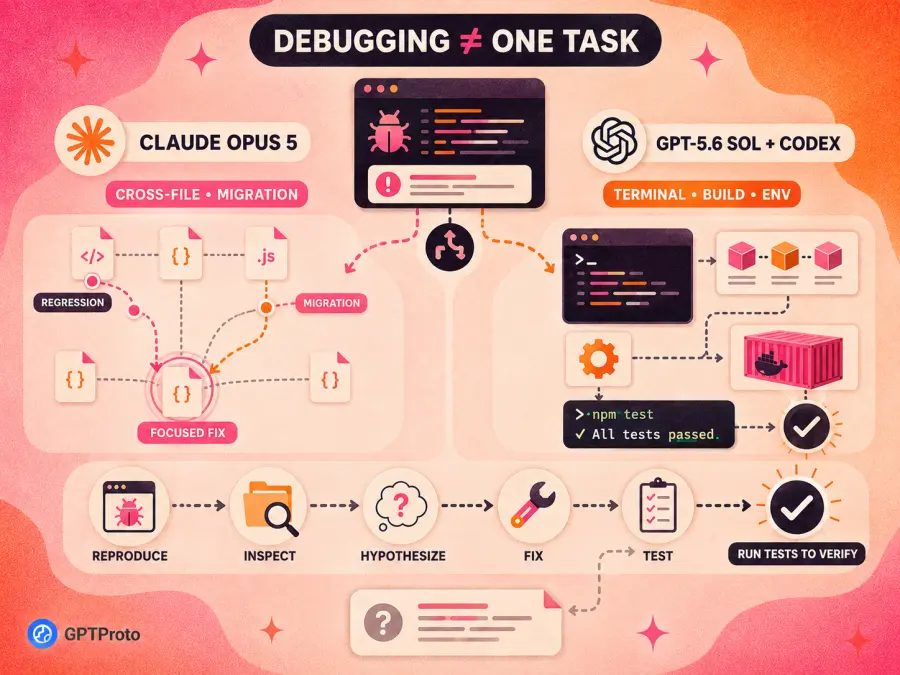
For terminal, dependency, build, and environment problems, GPT-5.6 Sol with Codex is a strong starting point. Its narrow Terminal-Bench lead suggests strength on tasks that require command-line interaction, although the difference from Fable 5.1 is less than one percentage point under the reported settings.

For cross-file logic bugs, migrations, and architectural regressions, Claude Opus 5 is a reasonable first choice. Its strong repository and code-migration results indicate that it can be effective when a fix depends on understanding relationships across several modules.

In practice, debugging quality depends on whether the agent can reproduce the failure, inspect the relevant files, form a testable hypothesis, apply a focused fix, and run the affected tests. If it cannot access the environment, treat its answer as a hypothesis—not a verified fix.

Claude vs ChatGPT for Frontend Coding

Claude has a slight qualitative advantage for frontend coding, especially when the task involves translating a visual direction into components, layouts, responsive behavior, animations, or interactive states. Early reports around Claude Opus 5 have also highlighted improvements in full-stack application builds, including visual and interactive work.

That does not mean every Claude output will look polished. Both products can fall back to generic cards, gradients, and desktop-first layouts when the brief is vague. Give them the same design reference, viewport sizes, framework, brand rules, interaction states, accessibility requirements, and acceptance criteria.

Neither model should judge its own visual output from source code alone. Performance improves when the agent can launch the page, inspect screenshots, compare them with the reference, and revise the CSS. Claude may provide the better first attempt; the better workflow is the one that includes visual verification.

Claude vs ChatGPT for Python

There is no general winner for Claude vs ChatGPT for Python because “Python coding” covers everything from a ten-line file-renaming script to a large Django service or machine-learning pipeline.

Python task Better starting point
Small automation script Either Claude or ChatGPT
Data cleaning and transformation A balanced model such as Sonnet 5 or GPT-5.6 Terra
Large Python application refactor Claude Opus 5
CLI, package, or environment troubleshooting GPT-5.6 Sol with Codex
Long notebook explanation Claude is often easier to follow
Repetitive high-volume transformation A smaller, cheaper model after validation

Evaluate both in the same environment and check dependency compatibility, edge cases, file handling, type checks, linting, and pytest results. A clean explanation matters less than verified behavior.

Claude vs ChatGPT for Large Codebases

Claude is the stronger first choice for many repository-wide analyses, code migrations, and coordinated multi-file changes. Claude Opus 5 performs strongly on code-migration and repository benchmarks, while Fable 5.1 is intended for demanding, long-running agentic work.

However, context-window size alone does not establish this advantage. Current Claude flagship models offer up to a 1M-token context window, while the GPT-5.6 family offers approximately 1.05M tokens. Both are large enough to hold substantial code, but blindly inserting an entire repository can waste tokens and obscure the relevant dependencies.

Large-codebase performance depends on whether the agent can map the repository, locate relevant files, follow project instructions, preserve interfaces, and verify its changes. Effective context selection and compaction may matter more than the advertised maximum.

Choose Claude Opus 5 when the task involves a broad migration, architectural reasoning, or coordinated changes across interconnected modules. Choose GPT-5.6 Sol with Codex when the task is well specified, terminal-heavy, and suitable for a longer autonomous run. For either option, divide very large changes into verifiable stages and require tests at each boundary.

Claude Code vs Codex: The Agent Can Matter as Much as the Model

Claude Code and Codex differ in workflow even before their default models are considered.

Dimension Claude Code Codex
Typical workflow Interactive terminal development Delegate, run, and review
Repository instructions CLAUDE.md AGENTS.md
Customization Deep hooks, skills, and agent configuration More managed defaults and sandbox controls
Feedback style Fast and interactive More deliberate and autonomous
Good fit Developers who remain closely involved Background work, review, and parallel tasks
Main trade-off Complex sessions can consume limits quickly Some tasks take longer to finish

A useful third-party test from Composio helps separate the harness from the underlying model. The evaluator ran the same DeepSeek V4 Flash model through Claude Code and Codex, using 30 identical multi-application tasks, the same hosted MCP setup, maximum reasoning, and a 900-second limit per task.

Result Claude Code Codex
Tasks passed 16/30 16/30
Median completion time 122.7 seconds 245.0 seconds
Tool calls 358 448
Estimated total cost $3.116 $1.294
Cost per success $0.195 $0.081

The two harnesses achieved the same pass count. Claude Code finished in about half the median time, while Codex cost approximately 58% less. The full Composio comparison supports a narrow conclusion: Claude Code offered faster feedback in this setup, while Codex stretched the budget further. It does not prove that Claude models are smarter because the test used the same third-party model in both tools.

Claude Pro Usage Rates Compared with ChatGPT Pro

Claude Pro usage rates compared with ChatGPT Pro are frequently described with misleading fixed message counts. Both providers vary consumption according to the selected model, context length, reasoning effort, tools, and task complexity.

The closest current price comparison is:

Monthly price Anthropic plan OpenAI plan
$20 Claude Pro ChatGPT Plus
$100 Claude Max 5x ChatGPT Pro 5x
$200 Claude Max 20x ChatGPT Pro 20x

Claude usage is shared across Claude.ai, Claude Desktop, and Claude Code. Its plans combine five-hour session limits with weekly limits; users can wait for a reset, upgrade, or enable separately billed usage credits.

ChatGPT Work and Codex also share the applicable usage budget. OpenAI publishes broad estimates for local Codex messages per five-hour window. For GPT-5.6 Sol, the current ranges are approximately 10–100 on Plus, 50–500 on Pro 5x, and 200–2,000 on Pro 20x. Cloud tasks can consume more than local messages, and two apparently similar tasks may use different amounts.

These are planning ranges, not guarantees. One long repository task can consume more capacity than several focused edits. At $20, ChatGPT Plus is generally the safer starting point for sustained agent use; intensive Claude Code users may need Max capacity or usage credits. At $100 and $200, preferred workflow matters more than the headline multiplier.

Claude vs ChatGPT API for Developers

Subscription plans are intended for people working inside Claude or ChatGPT products. Developers building an application should compare API models and usage-based billing instead.

Workload Claude option GPT option
Hardest long-horizon agentic work Claude Fable 5.1 GPT-5.6 Sol
Complex daily coding Claude Opus 5 GPT-5.6 Sol
Balanced production workload Claude Sonnet 5 GPT-5.6 Terra
High-volume focused tasks Claude Haiku 4.5 GPT-5.6 Luna

Official token prices can help select an initial model, but they do not reveal the full cost of a coding workflow. A more capable model may finish with fewer retries. A cheaper model may be economical for repetitive tasks but expensive if engineers must repeatedly repair its output.

On your own task set, track first-pass completion, tests passed, retries, human interventions, failed tool calls, total tokens, time, and cost per accepted result. The winner may change by stage: Claude might handle repository analysis, GPT the terminal-heavy implementation, and a smaller model repetitive transformations.

Can You Use Claude and GPT Models Together?

You do not need to select one provider for every coding workload. Applications can route tasks according to complexity, latency, cost, or the type of engineering work involved.

GPT Proto provides access to Claude and GPT model families through one API key and shared balance. This makes it easier to send the same evaluation tasks to both providers, compare quality and cost, and switch models without maintaining separate provider billing accounts.

This does not mean a GPT Proto key replaces a Claude or ChatGPT subscription inside every native coding client. Developers can call supported Claude and GPT APIs from their own applications; client compatibility still depends on custom-endpoint and request-schema support.

Claude or ChatGPT for Coding: Final Decision

Choose Claude if you spend most of your time in an interactive terminal workflow, care about frontend implementation, or need a model to reason across a large and interconnected repository. Claude Opus 5 is the sensible starting point for most complex development work, while Fable 5.1 is intended for the hardest long-horizon tasks.

Choose ChatGPT with Codex if you prefer delegate-and-review workflows, terminal-heavy autonomous tasks, or coding access integrated with a broader ChatGPT subscription. GPT-5.6 Sol is the strongest GPT option for difficult work, while Terra and Luna can reduce cost for clearer and more repetitive tasks.

For API development, settle the Claude vs ChatGPT for coding decision with your own acceptance tests. Run the same tasks, tools, and tests against comparable tiers, then measure successful outcomes, corrections, latency, and cost. Public evidence shows two highly competitive families—not one permanent champion.

Frequently Asked Questions

Is Claude or ChatGPT better at coding?

Claude is usually the better starting point for interactive coding, frontend iteration, and repository-wide reasoning. ChatGPT with Codex is a strong choice for terminal-heavy work, autonomous background tasks, and developers already using the ChatGPT ecosystem. For routine scripts and isolated functions, the difference is often small.

Is Claude better than ChatGPT for debugging?

It depends on the bug. Claude Opus 5 is well suited to cross-file logic and architecture problems. GPT-5.6 Sol performs strongly on terminal-based tasks. Either model becomes substantially more useful when it can reproduce the failure, inspect the repository, run tests, and verify the fix.

Is Claude or ChatGPT better for Python?

Neither wins every Python task. Both can handle scripts, APIs, data processing, and tests. Claude is a good first choice for large multi-file refactors, while GPT-5.6 Sol with Codex is strong for command-line and environment troubleshooting. Balanced models are usually sufficient for routine Python automation.

Is Claude Code the same as Claude AI?

No. Claude.ai is Anthropic’s general-purpose AI application. Claude Code is an agentic coding tool that can inspect projects, edit files, run commands, and execute tests from development environments. The model may be related, but the available tools and workflow are different.

Can developers use Claude and GPT through one API?

Yes. A multi-model API platform can provide access to supported Claude and GPT models through one account and API key. Developers still need to account for differences in model IDs, parameters, reasoning controls, tool calling, and response formats when switching between providers.
Introducing Claude Fable 5.1 and Claude Mythos 5.1: Same Model, Different Safeguards

Introducing Claude Fable 5.1 and Claude Mythos 5.1: Same Model, Different Safeguards

Anthropic introduced two model names on September 1, 2026, but only one new underlying model. Claude Fable 5.1 is the generally available version. Claude Mythos 5.1 is the restricted version for vetted cybersecurity and life-sciences organizations. The difference is not a hidden intelligence setting or a larger parameter count. It is access and safeguards. That distinction matters because the launch is easy to misread. Fable 5.1 is not simply a smaller Mythos 5.1, and ordinary API customers cannot turn Fable into Mythos with a request parameter. The two share capabilities, while Fable applies additional controls to risky cybersecurity, biology, and chemistry requests. There is a second complication. Anthropic says Fable 5.1 can reduce typical token-billed workload costs by about 25%, with savings reaching approximately 45% for highly agentic work. Yet its normal input and output rates have not changed from Fable 5. The reduction comes from cheaper cache reads, and independent testing shows that more output tokens can still make some completed tasks more expensive. So the useful story is not merely “new Claude scores higher.” It is how one model became two products, what actually became cheaper, and what developers must change before migrating an existing agent.

Michael Johnson | 2026-09-02

GLM 5.3 Flash vs DeepSeek V4 Flash: Which Is Better for Code, Agents, and Cost?

GLM 5.3 Flash vs DeepSeek V4 Flash: Which Is Better for Code, Agents, and Cost?

If you want the short answer, choose GLM-5.3 Flash for lower API costs, coding agents, and multi-step automation. Choose DeepSeek V4 Flash when faster text generation, adjustable reasoning, or exceptionally long outputs matter more. Both are Chinese open-weight mixture-of-experts models with one-million-token context windows. However, they are not interchangeable. GLM-5.3 Flash has stronger published results on several agent and software-engineering benchmarks, while DeepSeek V4 Flash generates tokens faster and supports outputs of up to 384K tokens. Get GLM-5.3 Flash Key Get Deepseek-V4-Flash Key There is also an important distinction between the base models and the API endpoints compared here. The official GLM-5.3 Flash model has native multimodal capabilities, but GPTProto currently provides text-to-text access to GLM-5.3 Flash. This comparison therefore evaluates both models primarily as text and coding APIs. This GLM 5.3 Flash vs DeepSeek V4 Flash comparison uses official documentation, published benchmark results, an independent model tracker, current GPTProto pricing, and community deployment reports. We did not run a separate private benchmark for this article.

Schuyler Stacy | 2026-09-01

What Is Hunyuan 4? Tencent Hy4 Preview Features, Pricing, Benchmarks, and Release Status

What Is Hunyuan 4? Tencent Hy4 Preview Features, Pricing, Benchmarks, and Release Status

Hunyuan 4 commonly refers to Hy4 preview , Tencent’s preview-stage flagship language model released on August 28, 2026. It uses a 770-billion-parameter Mixture-of-Experts architecture, activates 49 billion parameters for each token, and supports a context window of up to one million tokens. The naming needs clarification. Tencent officially calls the model Hy4 preview , while “Hunyuan 4” and “Tencent Hunyuan 4” are the names many people use when searching for it. It is also unrelated to Hunyuan-4B, an earlier four-billion-parameter model. Hy4 preview is already available through Tencent products, Tencent Cloud and open weights. However, “preview” matters: Tencent says the model can spend too long reasoning through complex tasks and sometimes verifies its own work more than necessary. It is available to test today, but it is not yet a fixed final release. GPTProto does not currently offer Hy4 preview, although support is planned. Until then, developers can compare available alternatives through the GPTProto model catalog . Get Cost-lower Key

2026-08-31

ChatGPT Plus cost: Is the $20 fee worth it?

ChatGPT Plus cost: Is the $20 fee worth it?

TL;DR The standard ChatGPT Plus cost is $20 per month, providing priority access to top-tier models like GPT-4o. While it offers immense value for power users, it exists as a separate billing entity from OpenAI's developer API services. Deciding whether to pay for a subscription involves looking past the flat fee. You need to evaluate the included features like DALL-E 3, advanced data analysis, and custom GPTs against the pay-as-you-go flexibility of the API. For most professionals, the convenience far outweighs the monthly hit to the wallet. OpenAI has kept the pricing stable, but as the market floods with competitors, the definition of value is shifting. This guide cuts through the noise to tell you exactly what you get for your money and when you should stick to the free version.

Schuyler Stacy | 2026-08-31