TL;DR
GPT-4는 2025년 4월 30일 ChatGPT에서 공식적으로 제공이 종료되었으며, GPT-4o("o"는 "omni"를 의미함)로 완전히 대체되었습니다. GPT-4는 여전히 API를 통해 사용할 수 있지만, GPT-4o는 뛰어난 멀티모달 기능과 50% 낮은 비용, 더 빠른 처리 속도를 제공합니다. 대부분의 사용자와 개발자에게 GPT-4o는 단일 신경망에서 텍스트, 이미지, 오디오 처리를 기본적으로 지원하므로 명확한 선택지입니다.
종합적인 2025년 12월 가이드에서 GPT-4o와 GPT-4의 주요 차이점을 알아보세요. 가격, 성능, 멀티모달 기능을 비교하고, 귀사의 요구에 가장 적합한 OpenAI 모델을 확인해 보세요.

GPT-4는 2025년 4월 30일 ChatGPT에서 공식적으로 제공이 종료되었으며, GPT-4o("o"는 "omni"를 의미함)로 완전히 대체되었습니다. GPT-4는 여전히 API를 통해 사용할 수 있지만, GPT-4o는 뛰어난 멀티모달 기능과 50% 낮은 비용, 더 빠른 처리 속도를 제공합니다. 대부분의 사용자와 개발자에게 GPT-4o는 단일 신경망에서 텍스트, 이미지, 오디오 처리를 기본적으로 지원하므로 명확한 선택지입니다.
The landscape of artificial intelligence experienced a major shift in April 2025 when OpenAI officially retired GPT-4 from ChatGPT, marking the end of an era for one of the most influential AI models in history. GPT-4, which launched in March 2023, powered millions of conversations and helped businesses worldwide integrate advanced AI capabilities into their workflows.
Recent developments show that the AI industry continues to evolve at breakneck speed. OpenAI has introduced several new models in 2025:
GPT-4o: Now powers ChatGPT's free tier (launched May 2024)
GPT-4.1: Enhanced coding model with 1M token context (April 2025)
GPT-4.5: Research preview with improved reasoning (February 2025)
GPT-5 series: Latest generation with reduced hallucinations (late 2025)
GPT-5.2 series: Professional-grade flagship series optimized for agentic workflows (launched December 2025)
Understanding where GPT-4o stands compared to its predecessor remains crucial for developers, businesses, and users making informed decisions about AI implementation in December 2025. This comprehensive comparison examines architectural improvements, performance benchmarks, and practical use cases to help you choose the right model.
The most transformative advancement in GPT-4o lies in its native multimodal design. Unlike GPT-4, which relies on separate external models, GPT-4o processes text, images, and audio through a single integrated neural network.

GPT-4's Modular Approach:
Uses DALL-E for image generation
Relies on Whisper for speech recognition
Requires handoffs between separate systems
Creates latency with each model switch
GPT-4o's Unified Design:
Single neural network for all modalities
End-to-end training across text, vision, and audio
No handoffs or external dependencies
Seamless transitions between input types
This architectural difference creates tangible benefits in real-world applications. When GPT-4 analyzes an image, it must hand off the task to another system and wait for results. GPT-4o eliminates these delays entirely, providing faster response times and more coherent outputs when working with mixed media.
GPT-4o's native multimodal architecture delivers superior performance for applications requiring real-time analysis of visual or audio content, making it the clear choice for modern multimedia applications.
GPT-4o delivers significant speed advantages over its predecessor. According to OpenAI's official benchmarks, GPT-4o generates tokens approximately twice as fast as GPT-4, though real-world performance varies based on use cases and server loads.
Speed Comparison:
GPT-4o: Up to 109 tokens per second
GPT-4 Turbo: 20 tokens per second
Improvement: 5x throughput in optimal conditions
However, performance isn't always consistent. Some real-world testing from 2025 has shown GPT-4 occasionally outperforming GPT-4o in specific reasoning tasks, particularly in complex arithmetic operations measured by the DROP dataset benchmark.
The improved computational efficiency extends beyond simple speed metrics. GPT-4o demonstrates better resource utilization, making it more suitable for applications requiring consistent performance under varying loads. This efficiency translates directly into cost savings and improved user experience.
While GPT-4o generally outperforms GPT-4 by 2-5x in speed, organizations should conduct their own testing for mission-critical applications to ensure optimal performance for their specific use cases.
The economic advantages of GPT-4o represent one of its most compelling features for businesses and developers. The cost difference between models is substantial and impacts operational budgets significantly.
API Pricing Comparison:
| Model | Input Cost (per 1M tokens) | Output Cost (per 1M tokens) | Cost Reduction |
| GPT-4 | $30 | $60 | Baseline |
| GPT-4o | $2.50 | $10 | 83-92% lower |
Real-World Savings Examples:
Small business processing 10M tokens/month: $300 → $25 (92% savings)
Enterprise processing 100M tokens/month: $3,000 → $500 (83% savings)
High-volume app processing 1B tokens/month: $30,000 → $5,000 (83% savings)
Beyond raw API costs, GPT-4o's efficiency means fewer tokens are often needed to accomplish the same tasks, further amplifying cost benefits. For web application users, GPT-4o now powers the free version of ChatGPT, providing access to advanced capabilities that previously required paid subscriptions.
With 83-92% cost reductions and improved efficiency, GPT-4o delivers compelling economic value that justifies migration for most businesses, particularly those running high-volume applications.
GPT-4o introduces significant improvements in handling non-English languages through enhanced tokenization. The new system more efficiently compresses text in languages using non-Western alphabets, reducing costs and improving response speeds for global applications.
Languages with Major Improvements:
Asian: Chinese, Japanese, Korean, Hindi, Thai
Middle Eastern: Arabic, Farsi, Hebrew
African: Afrikaans, Swahili
European: Italian, Portuguese, Javanese
Key Benefits:
Over 50 languages supported (97% of global speakers)
Reduced token consumption for non-English text
Faster processing speeds for multilingual content
Lower costs for international applications
Testing has shown that GPT-4o handles prompts in non-English languages more cheaply and quickly than GPT-4. For businesses operating in international markets, this optimization opens new possibilities for customer service, content generation, and global communication without requiring separate models.
GPT-4o's enhanced multilingual capabilities make it the superior choice for global businesses, delivering better performance and lower costs across 50+ languages compared to GPT-4's less optimized tokenization.

GPT-4o has demonstrated superior performance across multiple industry-standard benchmarks when compared to GPT-4:
| Benchmark | GPT-4 Score | GPT-4o Score | Improvement |
| MMLU (Reasoning) | 86.50% | 88.70% | 0.022 |
| GPQA (Science) | 35.70% | 53.60% | 0.179 |
| MATH | - | 76.60% | New capability |
| HumanEval (Coding) | - | 90.20% | New capability |
| MGSM (Multilingual Math) | - | 90.50% | New capability |
These improvements showcase GPT-4o's enhanced reasoning capabilities, particularly in scientific domains and coding tasks. The GPQA benchmark, which tests knowledge in biology, physics, and chemistry, shows the most dramatic improvement with nearly a 50% performance gain.
GPT-4o demonstrates measurable superiority across industry-standard benchmarks, with particularly strong gains in scientific reasoning (+17.9%) and new coding capabilities that GPT-4 lacked entirely.
GPT-4 lacked native vision capabilities, requiring external systems for image-related tasks. GPT-4o addresses this gap comprehensively with built-in image understanding that operates at the same sophistication level as its text processing.
GPT-4o Vision Strengths:
Analyzing complex diagrams and charts
Understanding spatial relationships
Interpreting graphs and data visualizations
Connecting visual inputs with written content
Document analysis with embedded images
Recent updates in March 2025 further enhanced these capabilities, with improved performance on multimodal benchmarks like MMMU and MathVista. The model can now handle tasks such as visual question answering, diagram interpretation, and multimodal content creation without requiring separate systems.
Practical Applications:
Medical image analysis (with specialist review)
Educational diagram explanations
Document processing with visual elements
Visual troubleshooting and support
GPT-4o's native vision capabilities eliminate the need for external image processing systems, delivering seamless multimodal experiences that GPT-4 simply cannot match without complex integrations.
Despite GPT-4's retirement from ChatGPT in April 2025, the model remains available through OpenAI's API. This continued availability serves important purposes for specific organizations and use cases.
Valid Reasons to Maintain GPT-4:
Existing integrations built over 2+ years
Applications architected for GPT-4's specific behavior patterns
Stability requirements in regulated industries
Complex compliance and testing requirements
High migration costs exceeding potential benefits
Organizations with established GPT-4 implementations may find value in maintaining these during transition periods. Applications specifically designed for GPT-4's response patterns might require significant modifications to fully leverage GPT-4o's capabilities.
Some enterprises prioritize predictability over cutting-edge features, particularly in regulated industries where model changes require extensive testing. For these organizations, GPT-4's well-established track record provides valuable reassurance during evaluation periods.
While GPT-4o offers superior capabilities, organizations with substantial existing GPT-4 investments should carefully weigh migration costs against benefits, particularly in regulated industries requiring extensive revalidation.
While GPT-4o demonstrates general superiority across most benchmarks, certain specialized tasks may still favor GPT-4's approach. Understanding these exceptions helps organizations make informed decisions.
Areas Where GPT-4 May Excel:
Specific creative writing styles and tones
Certain reasoning patterns in edge cases
Complex arithmetic tasks (DROP dataset benchmark)
Established workflows optimized for GPT-4 outputs
The DROP dataset benchmark showed GPT-4 Turbo outperforming GPT-4o in complex reasoning and arithmetic tasks, suggesting architectural differences can produce varied results depending on the specific challenge.
For applications where these specific strengths matter more than overall performance or cost, continuing to use GPT-4 remains defensible. This is particularly true when combined with system integration costs and stability requirements.
Organizations should conduct task-specific benchmarking before migration, as GPT-4 may still outperform GPT-4o in narrow use cases where specialized reasoning patterns or established workflows are critical.
The AI landscape has evolved considerably beyond the simple GPT-4 vs GPT-4o comparison. OpenAI now offers several specialized models, each optimized for different use cases.
Current OpenAI Model Lineup (December 2025):
| Model | Launch Date | Key Strength | Context Window | Best For |
| GPT-4o | May 2024 | General versatility | 128K tokens | Most applications |
| GPT-4.1 | April 2025 | Coding excellence | 1M tokens | Software development |
| GPT-4.5 | Feb 2025 | Reasoning & creativity | 128K tokens | Nuanced tasks |
| GPT-5 | Late 2025 | Advanced reasoning | Variable | Next-gen applications |
Model-Specific Strengths:
GPT-4o serves as the versatile workhorse, powering ChatGPT's free tier and offering broad capabilities at competitive prices. It remains the default choice for most general-purpose applications requiring text, image, and audio processing.
GPT-4.1 focuses on coding with a massive one million token context window and superior performance on SWE-bench (54.6% vs GPT-4o's 33.2%). It targets developers building complex applications and comes in mini and nano variants.
GPT-4.5 emphasizes enhanced reasoning, creativity, and better understanding of user intent. Available to Pro users in research preview, it represents OpenAI's exploration beyond pure parameter scaling.
Each model serves distinct purposes—GPT-4o for general use, GPT-4.1 for coding, GPT-4.5 for reasoning—making model selection dependent on specific application requirements rather than a simple "best" choice.
For organizations wanting to experiment with different models or maintain flexibility across multiple AI providers, GPT Proto offers a comprehensive API aggregation platform. GPT Proto provides a unified interface for accessing diverse AI models through a single integration, eliminating the complexity of managing multiple vendor relationships.
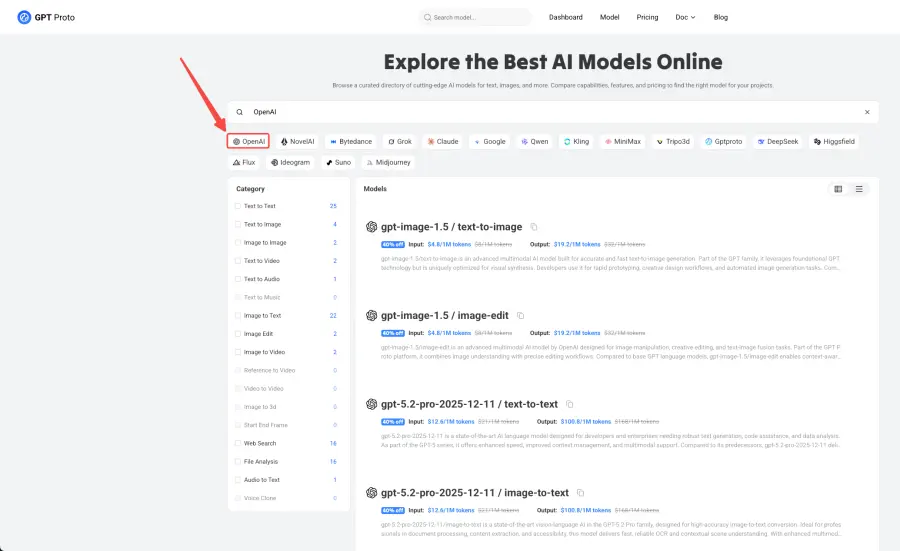
Key Benefits of GPT Proto:
Reduced Complexity:
Single integration point for GPT-4o, GPT-4.1, GPT-5, Claude, Gemini
Consistent API structure across all providers
Simplified billing management with pay-per-use pricing
Unified monitoring and analytics dashboard
Cost Efficiency:
Pay-per-use pricing with no minimum commitments
No need for multiple vendor contracts
Reduced administrative overhead
Transparent pricing for accurate budgeting
Development Velocity:
Test different models without changing code
Rapid experimentation and optimization
Single API call works across all models
Faster time to production deployment
Comprehensive Model Access:
Latest GPT models (GPT-4o, GPT-4.1, GPT-5 series)
Claude API (including Claude Sonnet 4.5)
Midjourney, Runway, and other specialized APIs
Continuous updates with newest releases
GPT Proto eliminates the complexity of managing multiple AI providers, enabling teams to experiment freely and optimize model selection through a single, developer-friendly platform built specifically for AI integration.
When evaluating API platforms for GPT model access, several factors determine which solution best fits your organization's needs. GPT Proto excels across all critical evaluation criteria.
GPT Proto's Competitive Advantages:
| Criteria | GPT Proto Offering | Benefit |
| Model Availability | GPT-4o, GPT-4.1, GPT-5, Claude, Gemini | Access all major models instantly |
| Pricing Transparency | Clear per-token costs, no hidden fees | Accurate budgeting and forecasting |
| API Reliability | Enterprise-grade infrastructure | Production-ready stability |
| Documentation | Comprehensive guides with code samples | Faster development and integration |
| Geographic Distribution | Globally distributed edge locations | Minimized latency worldwide |
What Makes GPT Proto Stand Out:
Model Freshness: GPT Proto continuously adds the latest models from OpenAI, Anthropic, and Google, ensuring you always have access to cutting-edge AI capabilities. When GPT-5 or Claude Opus 5 launches, it's available on GPT Proto immediately without requiring you to establish new vendor relationships.
Developer-First Design: Built by developers for developers, GPT Proto features clean, well-documented APIs that make integration straightforward. Whether you're building applications or testing prototypes, the platform removes technical barriers.
Global Performance: Globally distributed and highly optimized API endpoints ensure fast response times regardless of your location. The platform delivers consistent performance whether you're generating text, images, music, or videos.
Continuous Innovation: GPT Proto regularly adds cutting-edge models like Grok, Runway, and Kling, ensuring you stay ahead of technological developments without switching platforms or managing multiple integrations.
GPT Proto provides a future-proof solution for accessing GPT-4o and other leading AI models through a single, reliable platform designed specifically for developers who need flexibility without complexity.
The comparison between GPT-4o and GPT-4 reveals a decisive victory for the newer model across virtually every meaningful dimension, from its native multimodal architecture that processes text, images, and audio through a single neural network to its 2-5x faster processing speeds and 83-92% lower API costs. With GPT-4's retirement from ChatGPT in April 2025 and the emergence of specialized models like GPT-4.1 for coding and GPT-4.5 for advanced reasoning, organizations face an increasingly complex AI landscape that demands strategic model selection based on specific use cases. While GPT-4o stands as the optimal choice for 90% of applications—offering superior multilingual support across 50+ languages, enhanced benchmark performance (particularly the 17.9% improvement in scientific reasoning), and seamless integration of vision capabilities—successful AI implementation in December 2025 requires more than just picking the right model. Platforms like GPT Proto have become essential for organizations seeking to maintain flexibility across multiple AI providers, offering unified access to GPT-4o, GPT-4.1, GPT-5, Claude, and Gemini through a single developer-friendly interface that eliminates vendor management complexity while enabling rapid experimentation and cost optimization. Whether you're migrating from GPT-4, implementing multimodal customer support, deploying educational applications, or building industry-specific solutions in healthcare, finance, or legal services, GPT-4o combined with a robust API aggregation platform provides the optimal balance of capability, performance, and cost-effectiveness for the modern AI-powered enterprise.
한 줄 요약 GPT-4o는 GPT-5 출시 이후에도 여전히 높은 관련성을 유지합니다. 이는 GPT-4o의 기초적인 돌파구들, 즉 매끄러운 멀티모달 통합, 실시간 처리, 크게 향상된 맥락 이해 덕분입니다. 이러한 혁신은 새로운 업계 표준을 확립하고 현대 AI 애플리케이션의 토대를 마련하여, 이 모델을 AI 진화의 중요한 가교로 만들었습니다.
Michael Johnson | 2026-02-03
핵심 요약 gpt-4o-mini의 도입은 현대 소프트웨어 개발에 중요한 전환점이 되었습니다. 대형 플래그십 AI 모델에 비해 빠르고 비용 효율성이 매우 높은 대안을 제공합니다. 속도와 효율성에 집중하여 예외적인 신뢰성과 최소한의 오버헤드로 대용량 운영 워크플로우를 처리합니다. 실시간 고객 지원, 문서 파싱, 기본 코드 생성과 같은 작업을 위해 설계된 이 모델은 지연 시간을 최소화하고 API 지출을 획기적으로 줄입니다. 또한 인상적인 멀티모달 기능을 갖추고 있어 기존 비전 모델의 무거운 인프라 요구 사항 없이도 빠른 이미지 처리를 가능하게 합니다. 일상적인 데이터 추출과 합성에는 뛰어나지만, 고도로 복잡한 논리 작업이나 정교한 데이터베이스 쿼리에는 사용하지 않는 것이 좋습니다. 이 경량 모델을 계층형 AI 아키텍처에 통합하면 심층 추론이 필요한 작업에 프리미엄 컴퓨팅 성능을 아끼면서도 비즈니스를 빠르게 확장할 수 있습니다.
Schuyler Stacy | 2026-04-02
지저분한 메모와 끝없는 오디오 재생에 지치셨나요? GPT-4o Transcribe를 만나보세요. 음성을 즉시 완벽한 텍스트로 변환하도록 설계된 혁신적인 AI 모델입니다. 전문가와 크리에이터는 회의, 강의, 인터뷰를 수동으로 받아 적는 데 수많은 시간을 낭비하고 있습니다. GPT-4o Transcribe는 심한 배경 소음이나 겹치는 발화자 속에서도 비교할 수 없는 정확성을 제공하여 이 거대한 병목 현상을 해결합니다. 이 가이드에서는 GPT-4o Transcribe가 정확히 어떻게 작동하는지, 놀라울 정도로 합리적인 가격을 분석하고, 오늘 바로 원활하게 도입하여 일상 업무를 한층 강화하는 방법을 보여드리겠습니다. 자동 전사(자동 받아쓰기)의 미래로 함께 뛰어들어 봅시다.
Tiffany Layne | 2026-03-02