MiniMax M3 vs DeepSeek V4 Flash: Quick Verdict
DeepSeek V4 Flash is the better default for most text-only developers. Its max-reasoning version leads the independent Intelligence Index, writes slightly faster, uses an MIT license, and has inexpensive cache reads—useful when agents resend repository context and tool schemas.
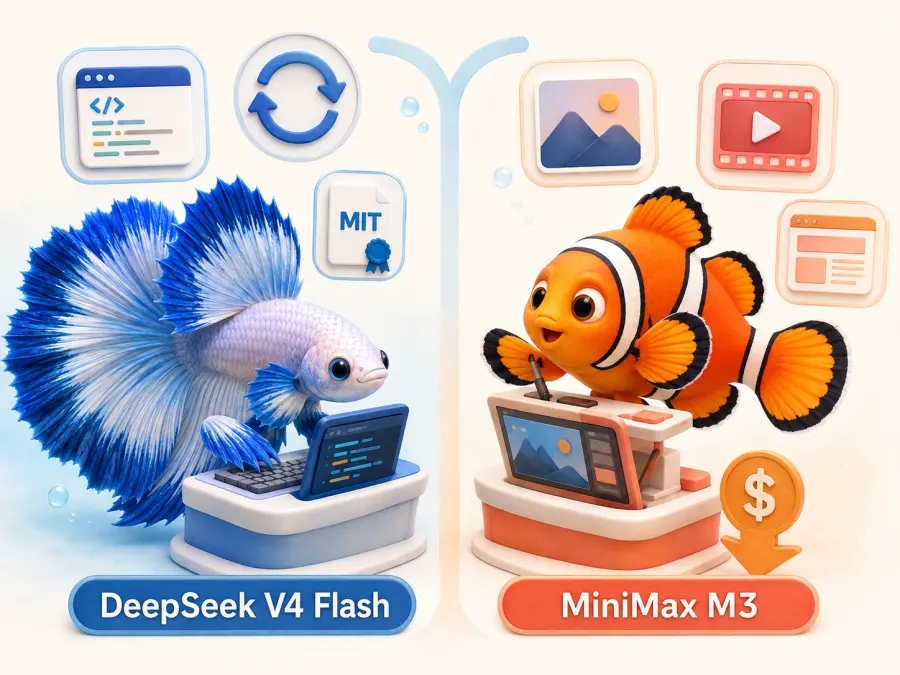
MiniMax M3 is broader. It accepts images and video, supports a larger maximum output, and currently costs less per output token on GPT Proto. It fits screenshot-to-code, visual debugging, and long output.
| Your workload |
Recommended model |
| Text-only coding |
DeepSeek V4 Flash |
| Repository agents with repeated context |
DeepSeek V4 Flash |
| Screenshot-to-code |
MiniMax M3 |
| Visual frontend debugging |
MiniMax M3 |
| Output-heavy calls during DeepSeek peak hours |
MiniMax M3 |
| Scheduled off-peak batch jobs |
DeepSeek V4 Flash |
| Commercial self-hosting |
DeepSeek V4 Flash |
| Native image and video input |
MiniMax M3 |
For high-risk code, neither model should be selected by leaderboard position alone. Authentication changes, database migrations, infrastructure work, and multi-service refactors need tests, static checks, or a separate review because the cost of repairing one wrong change can exceed the token savings from dozens of successful calls.
Try MiniMax M3 on GPT Proto or try DeepSeek V4 Flash on GPT Proto.
MiniMax M3 vs DeepSeek V4 Flash at a Glance
The table below uses the current hosted versions and GPT Proto rates available on August 28, 2026. Prices and hosted limits can change, so the live model pages should remain the final reference before deployment.
| Specification |
MiniMax M3 |
DeepSeek V4 Flash 0731 |
| Release |
June 1, 2026 |
July 31, 2026 API update |
| Architecture |
428B total / 23B active |
284B total / 13B active |
| Context window |
1,048,576 tokens; 512K guaranteed minimum |
1,048,576 combined tokens |
| Maximum output |
About 512K tokens |
Up to 384K tokens |
| Native input |
Text, image, and video |
Text |
| Output |
Text |
Text |
| Reasoning control |
Enabled, adaptive, or disabled |
Non-thinking, low, high, or max |
| Tool calling |
Yes |
Yes |
| GPT Proto fresh-input price |
USD 0.48/1M tokens |
USD 0.44/1M tokens at peak |
| GPT Proto output price |
USD 0.96/1M tokens |
USD 1.32/1M tokens at peak |
| GPT Proto cache rate |
USD 0.10 write / USD 0.10 read per 1M |
USD 0.014 read per 1M at peak |
| License |
MiniMax Community License |
MIT |
| Best fit |
Multimodal and visual workflows |
Text coding and repeated agent loops |
MiniMax is natively multimodal, but GPT Proto separates text calls from its image-to-text route. Standard DeepSeek V4 Flash is text-to-text; deepseek-v4-flash-vision-exp is a separate experimental model.
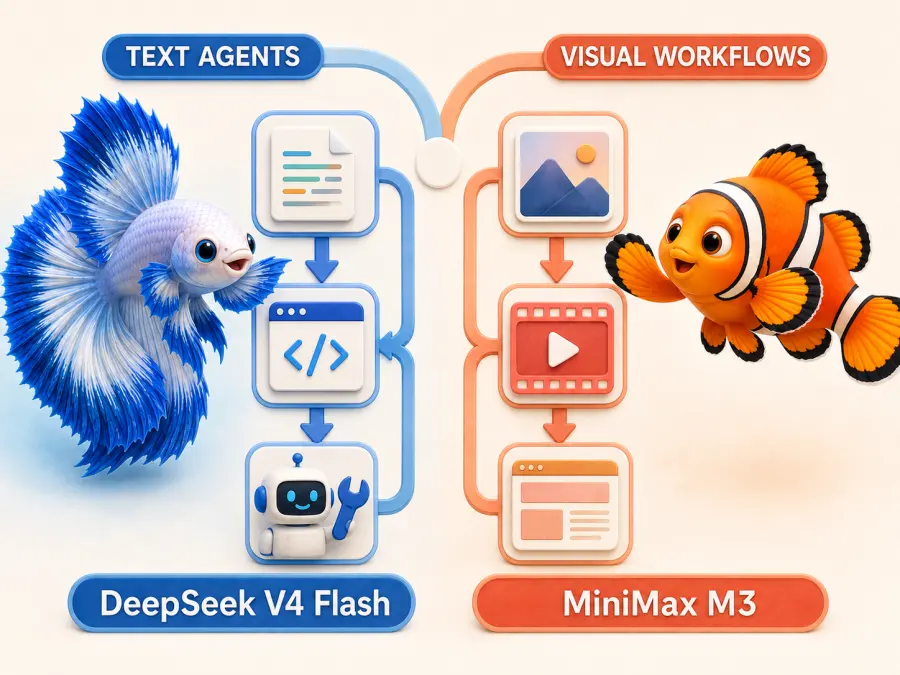
The design goals behind the table are different. MiniMax built M3 around MiniMax Sparse Attention and native text, image, and video training. DeepSeek built the smaller V4 Flash tier for efficient text inference, then used the 0731 post-training update to strengthen agents and add native Responses API support. MiniMax offers broader inputs; DeepSeek offers a narrower, text-focused route with cheaper cache reads and an MIT license.
Benchmark Comparison: Reasoning Mode Changes the Winner
The cleanest independent comparison comes from Artificial Analysis. With DeepSeek set to maximum reasoning, it leads MiniMax M3 on the Intelligence Index and is slightly faster.
| Independent metric |
MiniMax M3 |
DeepSeek V4 Flash 0731, max reasoning |
| Artificial Analysis Intelligence Index |
45 |
52 |
| Output speed |
114 tokens/s |
119 tokens/s |
| Time to first token |
1.17 seconds |
1.12 seconds |
| Context window |
1M tokens |
1M tokens |
The intelligence difference is meaningful; the speed gap is small and hosted throughput can change. The more revealing result appears when DeepSeek runs without reasoning: Artificial Analysis lists MiniMax M3 at 45 and DeepSeek V4 Flash non-reasoning at 29. “DeepSeek V4 Flash performance” is therefore incomplete unless the reasoning setting is named. Max reasoning is the relevant comparison for complex code and agent planning; non-thinking mode fits bounded work such as classification, extraction, and autocomplete.
Vendor charts add context but do not create a fair head-to-head test. MiniMax reports 59.0% on SWE-Bench Pro, 66.0 on Terminal-Bench 2.1, and 74.2 on MCP Atlas. DeepSeek reports 82.7 on Terminal-Bench 2.1, 54.2 on NL2Repo, and 70.3 on Toolathlon Verified. The companies used different infrastructure, scaffolding, evaluation frameworks, and settings, so comparing 82.7 directly with 66.0 would be misleading.
The defensible takeaway is narrower: the independent comparison favors DeepSeek at maximum reasoning. Launch charts do not tell us which model will complete a particular repository task with fewer corrections.
MiniMax M3 vs DeepSeek V4 Flash for Coding
For small, verifiable coding tasks, DeepSeek is the better starting point. Unit tests, schema conversion, code explanation, isolated bug fixes, and repetitive edits benefit from its reasoning score and cache rate—especially when tests, linters, or validators can check the result.
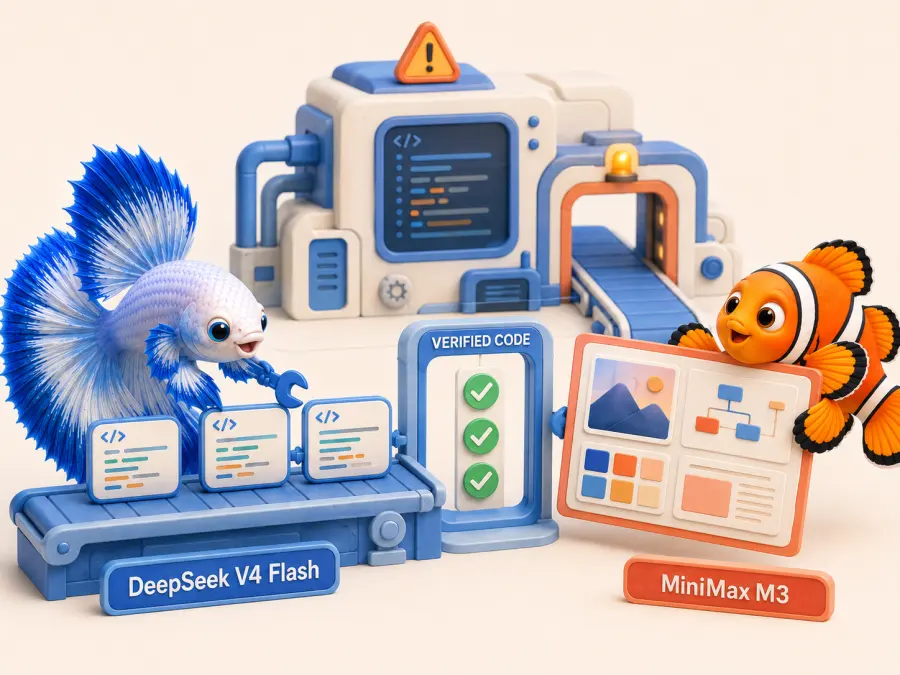
Repository-wide work is less straightforward. Capacity is not the same as reliable understanding: an agent must follow repository rules, avoid unrelated edits, recover after failed commands, and maintain a plan. I would still start with DeepSeek for text-only repository work because its max-reasoning result is stronger and cache reads are inexpensive. MiniMax becomes more attractive when the task includes screenshots, diagrams, design assets, or other visual input.
A cheaper first patch is not cheaper if it requires manual recovery. For high-risk changes, compare total calls, failed tools, corrections, tests, and time to an accepted deliverable.
Which Is Better for Frontend Coding?
“Frontend coding” can describe two different jobs, and many comparisons mix them together.
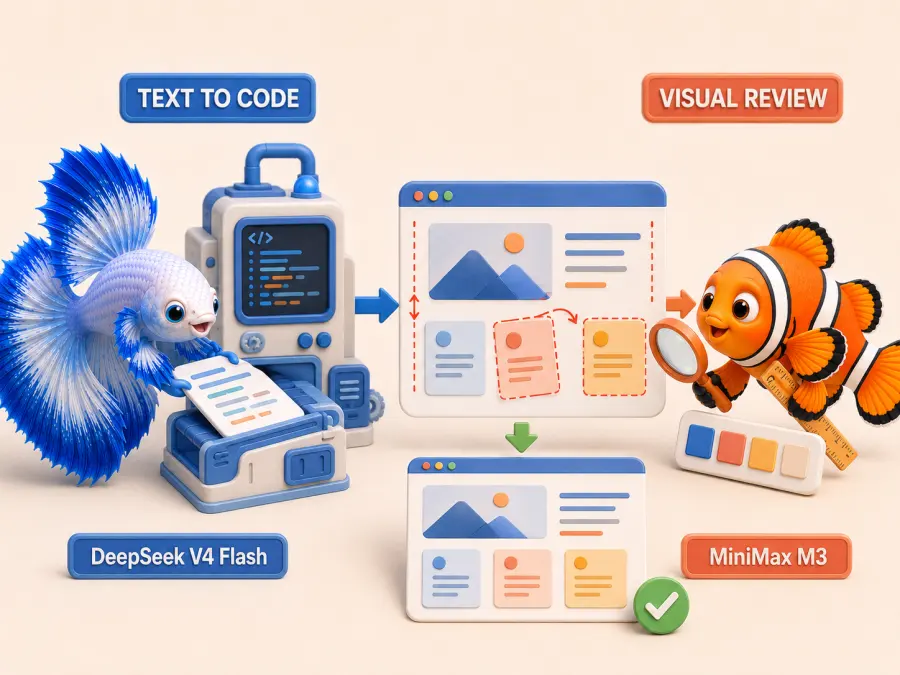
The first is text-to-code. A developer provides a written specification and asks for a React component, responsive CSS, state logic, accessibility fixes, or a page layout. There is no image for the model to inspect. For this workload, DeepSeek V4 Flash is the stronger default based on the current independent reasoning comparison and its fit with text-based coding agents.
The second is visual frontend iteration. The model receives a screenshot, rendered page, or screen recording and must identify spacing, color, or alignment errors. MiniMax M3 has the decisive capability here because standard DeepSeek V4 Flash cannot accept visual input.
That distinction produces a more accurate conclusion than “MiniMax is better for frontend.” MiniMax M3 is not automatically the better frontend coder. It is the better visual frontend model. DeepSeek remains the better text-only default, while MiniMax handles the feedback loop that starts after the page has been rendered.
Which Model Is Better for AI Agents?
Both models can call tools, return structured arguments, read results, and continue through a multi-step task. DeepSeek is the practical default for text agents that search repositories, inspect logs, generate tests, or run repeatable data workflows. Its cache rate matters because these systems resend the same instructions and tool definitions. MiniMax fits agents that must interpret charts, application screens, design references, or recordings before choosing the next action.
Instruction following is the less comfortable part of both stories. In one MiniMax M3 community discussion, users reported having to fight the model over rules and instructions, although other users described good results in coding-agent workflows. DeepSeek 0731 has received similar criticism: developers have reported problems following rules, skills, and subtle non-coding instructions in one coding-focused thread and a separate reliability discussion.
These are anecdotes, not controlled evaluations. They explain why the final migration test should use your actual system prompt, repository rules, tool schema, and error-recovery instructions. A sensible mixed workflow sends text implementation and repetitive subtasks to DeepSeek, then routes screenshot analysis and visual debugging to MiniMax.
Pricing: Which Model Is Actually More Cost-Effective?
Token price alone gives the wrong answer because these models have different input, output, cache, and time-based rates. The following calculations use GPT Proto rates displayed on August 28, 2026.
MiniMax M3 has flat rates of USD 0.48 per million fresh input tokens and USD 0.96 per million output tokens. Cache writes and reads are currently USD 0.10 per million each.
DeepSeek V4 Flash has peak rates of USD 0.44 per million fresh input tokens, USD 0.014 per million cache-read tokens, and USD 1.32 per million output tokens. Off-peak calls are billed at half those rates. GPT Proto currently defines off-peak windows in Beijing time as 18:00–09:00 and 12:00–14:00; actual billing follows the request time.
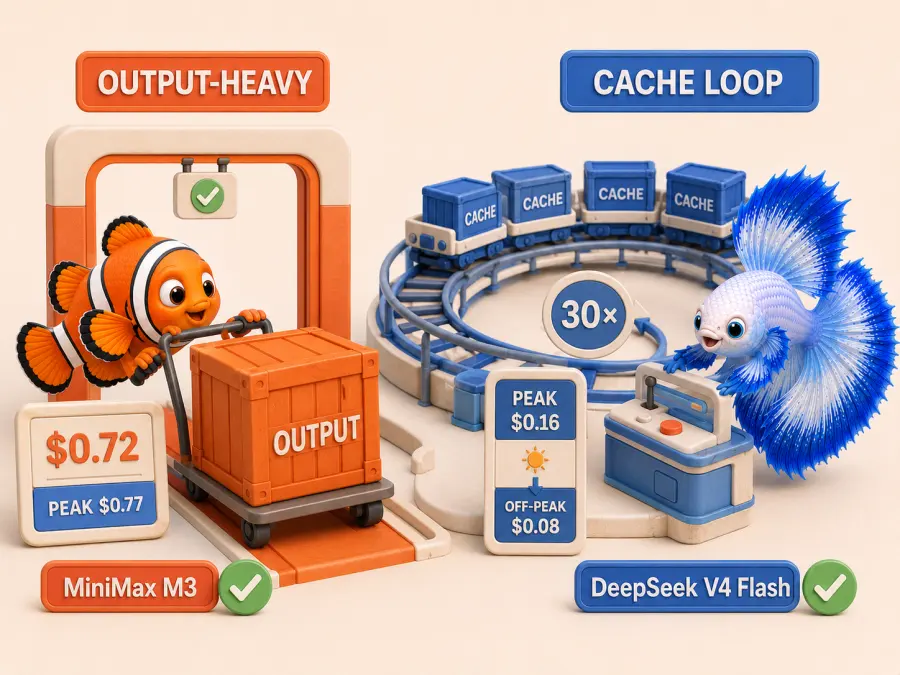
Example 1: Output-Heavy Request Without Cache
Assume one request uses one million fresh input tokens and produces 250,000 output tokens.
| Model and timing |
Estimated cost |
| MiniMax M3 |
USD 0.7200 |
| DeepSeek V4 Flash at peak |
USD 0.7700 |
| DeepSeek V4 Flash off-peak |
USD 0.3850 |
MiniMax is about USD 0.05 cheaper during DeepSeek's peak period because its output rate is lower. Once the same DeepSeek call moves off-peak, DeepSeek costs nearly half as much as MiniMax.
Example 2: Cache-Heavy Coding Agent
Now assume a 30-turn coding-agent session. Each turn reads 100,000 cached tokens, adds 3,000 fresh input tokens, and produces 2,000 output tokens. The MiniMax estimate also includes an initial 100,000-token cache write.
| Model and timing |
Estimated 30-turn cost |
| MiniMax M3 |
USD 0.4108 |
| DeepSeek V4 Flash at peak |
USD 0.1608 |
| DeepSeek V4 Flash off-peak |
USD 0.0804 |
This is the pricing distinction most simple comparison tables miss. MiniMax M3 can win on uncached, output-heavy requests. DeepSeek V4 Flash usually wins on cache-heavy agent loops, even at peak rates. Scheduling deferrable jobs off-peak widens the difference again.
These are estimates, not bills from a matched live test. Teams should recalculate with their own token ratio, cache-hit rate, retries, and accepted-task rate.
Context Window, Multimodality, and Deployment
Both models advertise approximately one million tokens of context, but that is a combined operating budget. For DeepSeek, input, history, tool results, reasoning, and output share the 1,048,576-token window; maximum output is up to 384K. MiniMax lists the same headline context, a 512K guaranteed minimum, and maximum output around 512K. Long-context agents should still reserve output headroom and select relevant files rather than sending an unfiltered repository.
Multimodality is not a tie. MiniMax accepts text, images, and video; DeepSeek V4 Flash accepts text. A DeepSeek workflow that needs screenshots must route the visual step to another model, such as the separately hosted Vision Exp model.
Licensing creates the final difference. DeepSeek publishes its V4 Flash weights under the MIT License, which is easier for commercial self-hosting, redistribution, and modification. MiniMax publishes M3 under the MiniMax Community License, which adds attribution, notice, and revenue-dependent authorization conditions. Hosted API users may care mainly about route availability and data terms; self-hosting teams need to review the weight license before deployment.
Which Model Should You Choose?
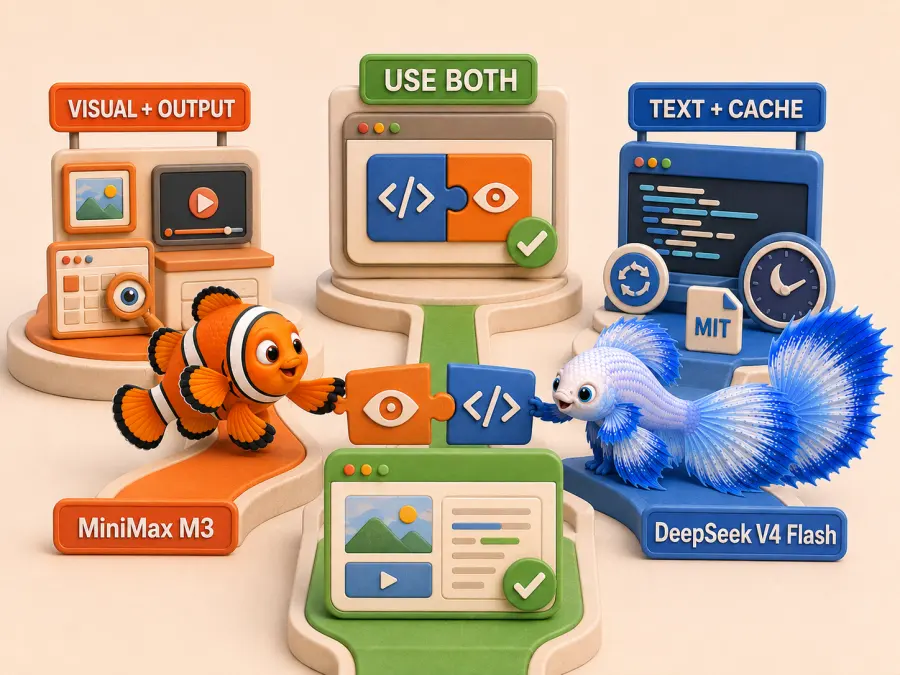
Choose MiniMax M3 when the agent must inspect images or video, frontend work includes rendered-page feedback, or peak-time calls generate substantial output. Choose DeepSeek V4 Flash when the workflow is text-based, caching matters, batch jobs can run off-peak, or an MIT license is required. Use both when the application divides naturally into text implementation and visual review.
Run MiniMax M3 and DeepSeek V4 Flash with One API Key
Testing both models should not require two separate account balances or two integration layers. GPT Proto provides access to MiniMax M3 and DeepSeek V4 Flash through the same account and shared balance.
For text calls, both fit an OpenAI-compatible application structure. Change the model ID, keep the task and acceptance criteria fixed, and record completion, failed tool calls, corrections, latency, token use, and total cost. Before migrating traffic, run canary tests for streaming, tool arguments, JSON parsing, reasoning settings, retries, and maximum-token behavior.
Try Both Models on GPT Proto
Use one key and one shared balance to compare both models on the work your application actually performs.
Final Verdict
DeepSeek V4 Flash 0731 is the better default for text-only coding and cache-heavy agents. It leads the current independent max-reasoning comparison, uses an MIT license, and becomes particularly inexpensive when an application reuses context or schedules calls off-peak.
MiniMax M3 is the better choice when the workflow needs image or video input, visual frontend feedback, longer output, or a lower peak-time output rate. Its advantage is breadth, not a blanket claim that it writes better code.
For production work, choose by accepted-task cost rather than token price alone: completion, instruction adherence, passed checks, and recovery effort.