Short Answer: GLM 5.3 Flash or Claude Haiku 5.5?
| Your main workload |
Better starting point |
Why |
| Classification, extraction, summaries, and short API calls |
Claude Haiku 5.5 |
Lower official input price below 100K tokens and fast generation |
| Bounded code changes with clear tests |
Claude Haiku 5.5 |
Strong coding ability without paying for a very large model on every request |
| Prompts above 100K input tokens |
GLM 5.3 Flash |
Haiku's entire request moves to a higher price tier after the threshold |
| Frontend coding from screenshots or visual references |
GLM 5.3 Flash |
Visual coding and rendered-result feedback are explicit parts of its product design |
| Long-running automation and tool use |
GLM 5.3 Flash |
Much stronger AutomationBench-AA result in the current comparison |
| Low-latency first response |
Depends on effort and agent setup |
GLM starts responding sooner in one max-effort test; Haiku finishes the full task sooner |
| Open-weight or private deployment |
GLM 5.3 Flash |
MIT-licensed model weights; Haiku is proprietary |
| One API for testing both |
GPT Proto |
Both model IDs can be called through the same OpenAI-compatible endpoint |
This is a starting recommendation, not a claim that one model wins every prompt. Coding-agent results depend heavily on reasoning settings, tools, context, tests, and permitted repair turns.
GLM 5.3 Flash vs Haiku 5.5 at a Glance
Both models advertise a one-million-token context window and up to 128K output, but their design choices differ.
| Specification |
Claude Haiku 5.5 |
GLM 5.3 Flash |
| Developer |
Anthropic |
Z.ai |
| API model ID |
claude-haiku-5-5 |
glm-5.3-flash |
| Context window |
1M tokens |
1M tokens |
| Standard maximum output |
128K tokens |
128K tokens |
| Inputs |
Text and images |
Text, images, video, and files |
| Reasoning control |
Adaptive thinking; medium by default |
Thinking enabled; low, high, or max effort |
| Weights |
Proprietary |
MIT open weights |
| Architecture disclosure |
Closed |
320B total parameters, 18B active |
| Best-fit positioning |
Fast general work and coding |
Visual coding, agents, and efficient long context |
Anthropic's Haiku 5.5 documentation presents it as the fastest Claude 5.5 model, with adaptive reasoning and a June 2026 reliable knowledge cutoff. Z.ai's GLM-5.3-Flash documentation emphasizes visual coding, screenshots, GUI interaction, tool use, and rendered-result checks. Its claimed attention and KV-cache savings are vendor measurements, not independent latency results.
One naming trap matters: GLM-5.3-Flash and GLM-5.3-FlashX are different routes. Do not apply FlashX throughput figures to GLM-5.3-Flash. Confirm the model ID behind every speed or cost claim.
Pricing and Cost: The Winner Changes at 100K Tokens
This is the most important difference in the Claude Haiku 5.5 vs GLM 5.3 Flash pricing comparison.
At official list rates, Haiku 5.5 costs $0.10 per million input tokens and $0.50 per million output tokens when the prompt contains no more than 100K input tokens. Above 100K, the price rises to $0.50 for input and $2.50 for output. The higher rate applies to the whole request, not just the tokens beyond 100K. GLM 5.3 Flash uses a flat $0.15 input and $0.50 output rate per million tokens.
| Official API price per 1M tokens |
Input |
Output |
| Claude Haiku 5.5, up to 100K input |
$0.10 |
$0.50 |
| Claude Haiku 5.5, above 100K input |
$0.50 |
$2.50 |
| GLM 5.3 Flash |
$0.15 |
$0.50 |
Here is what those rates mean without prompt caching:
| Example request |
Haiku 5.5 |
GLM 5.3 Flash |
Lower-cost model |
| 10K input + 2K output |
$0.0020 |
$0.0025 |
Haiku by 20% |
| 50K input + 5K output |
$0.0075 |
$0.0100 |
Haiku by 25% |
| 150K input + 10K output |
$0.1000 |
$0.0275 |
GLM by 72.5% |
| 500K input + 50K output |
$0.3750 |
$0.1000 |
GLM by 73.3% |
That discontinuity changes the architecture decision. Trimming a 150K-token repository prompt below 100K may save more money than switching models. If the full context is necessary, GLM is much cheaper at list price—especially when an agent resends it across many steps.
At the time of writing, GPT Proto displays $0.09 input and $0.45 output per million tokens for Haiku's standard tier, while its GLM 5.3 Flash page displays $0.15 and $0.50. Check the live GPT Proto pricing page before estimating production spend, especially for Haiku requests above 100K tokens. I would not assume that a discount shown for the base tier automatically carries over to the long-context tier.
Token rates are only one part of cost-effectiveness. A cheap call becomes expensive if it needs three repairs or writes invalid tool arguments. Measure accepted-task cost: total model spend divided by tasks that pass your tests or review gate.
Benchmark Comparison: Reasoning Effort Changes the Winner
The current Artificial Analysis comparison exposes several dimensions instead of only one score.
At the evaluated maximum-effort settings, the results include:
| Metric |
Claude Haiku 5.5 |
GLM 5.3 Flash |
Reading |
| Intelligence Index |
43 |
42 |
Near tie; slight Haiku lead |
| AutomationBench-AA |
35% |
60% |
Clear GLM lead |
| Terminal-Bench 4 |
33% |
33% |
Tie |
| SciCode |
55% |
52% |
Small Haiku lead |
| Long Context Reasoning |
83% |
80% |
Small Haiku lead |
| Evaluated cost per task |
$0.21 |
$0.28 |
Haiku lower |
| Output speed |
236 tokens/s |
62 tokens/s |
Haiku faster after generation begins |
| Total time per task |
421.93 s |
809.59 s |
Haiku completes sooner |
The latency row needs context. GLM's measured time to first token was about 2.89 seconds, versus roughly 309.8 seconds for max-effort Haiku. More useful “first answer” figures were about 35.17 seconds for GLM and 309.8 seconds for Haiku. Once Haiku began producing visible output, it generated much faster and completed the task in about half the time.
At medium effort, Haiku's overall index falls to 34, AutomationBench-AA to 29%, and Terminal-Bench to 15%. In return, evaluated cost drops to about $0.05 per task, total task time to 121.54 seconds, and first answer to 14.18 seconds. GLM remains at 42 overall in the compared run but costs more and takes longer.
The practical lesson is:
Use medium-effort Haiku when latency and cost matter more than squeezing out the last part of task success.
Use max-effort Haiku when you want its strongest general coding and reasoning result and can tolerate a long pause before the answer.
Test GLM for automation-heavy workflows, where its category result is materially stronger even though its broad aggregate score is one point lower.
These results do not reproduce your repository, tools, retry policy, or acceptance tests.
Which Is Better for Coding and Developers?
For routine developer work, Claude Haiku 5.5 is the safer default: code explanation, unit tests, focused bug fixes, SQL, and small refactors. Below 100K input tokens, its official input rate is lower, and medium effort gives a useful latency-cost profile.
If every turn includes a monorepo map, logs, design documents, and prior agent state, Haiku's 100K price step can dominate the bill. GLM then becomes more cost-effective even before considering open weights.
A small controlled Haiku 5.5 coding test shared by a developer illustrates why effort matters. On a mixed Rust codebase with hidden tests, medium effort completed the task in 29 API calls for about $0.08. Low effort missed verification and fallback behavior; high effort used 385 calls and about $1.03 without improving the result. It is one workload, but shows why more reasoning is not automatically better.
For a fair internal Claude Haiku 5.5 vs GLM 5.3 Flash benchmark, keep these fixed:
The same repository snapshot and prompt.
The same tools and permission boundaries.
The same maximum steps, timeout, and retry policy.
The same unit, integration, and lint checks.
The same rule for counting a task as accepted.
Track first-pass success, elapsed time, repairs, tokens, tool errors, out-of-scope changes, and accepted-task cost. A patch that fails the test suite is not complete.
Which Is Better for Frontend Coding?
For frontend coding, GLM 5.3 Flash has the stronger on-paper case. Z.ai positions it for visual coding, screenshots, GUI interaction, and rendered-result checks. It also accepts video and file input.
Haiku 5.5 accepts images and can write React, CSS, and component tests. It is a good fit for compact changes such as form validation, state-bug repairs, Storybook cases, or a contained refactor.
No credible controlled public benchmark yet settles this exact frontend comparison across real repositories. Run both models through a small evaluation containing:
screenshot fidelity at desktop and mobile widths;
state correctness for loading, empty, error, and success views;
build, type-check, console, and test failures;
keyboard navigation and accessible names;
changes made outside the requested components;
repair turns before the implementation is accepted.
Start with GLM for screenshot or browser-feedback loops, and Haiku for narrow typed-code tasks with deterministic tests.
Which Is Better for Agentic Work?
GLM 5.3 Flash is the stronger candidate for agentic work that depends on long tool sequences, GUI state, or automation. Its 60% AutomationBench-AA score versus Haiku's 35% at maximum effort is the clearest quantitative difference in this comparison. Its flat long-context rate also helps when an agent retains a large working state across repeated calls.
Haiku remains attractive for short-lived subagents: inspect one module, summarize one log, propose one patch, or validate one result. Keeping each subagent focused can preserve Haiku's low base rate and avoid the 100K tier. It also reduces the blast radius when an agent takes a wrong turn.
Do not confuse capability with reliability. In a community discussion of GLM-5.3-Flash agent behavior, users describe a meaningful capability gain alongside occasional instruction drift and long-tail failures. Reports also vary by agent setup. This is anecdotal, but shows how the surrounding system affects reliability.
For either model, use permission gates, schema validation, tool timeouts, step limits, verification, and rollback. Those controls matter more than a one-point aggregate score.
Speed and Latency: “Flash” Does Not Always Mean Faster
Both names imply speed, but “faster” can mean:
time to first token;
time to the first usable answer after hidden reasoning;
visible output tokens per second;
total time until the task is complete.
In the max-effort comparison, GLM began much sooner, while Haiku generated visible output faster and finished sooner. Users may prefer early feedback; a batch system may care only about completion time.
Measure the metric your product actually exposes. Also verify whether a published number belongs to glm-5.3-flash or glm-5.3-flashx; they are not interchangeable.
Open Weights and Integration Trade-Offs
Claude Haiku 5.5 is proprietary and managed. You consume an API instead of planning GPU capacity, quantization, serving, and updates, but have less deployment control.
GLM 5.3 Flash's MIT-licensed weights allow private deployment and serving optimization. But open weights do not mean free inference: a 320B-total, 18B-active mixture-of-experts model still demands serious infrastructure expertise.
If your actual requirement is one billing relationship and one integration, GPT Proto provides both routes through a compatible API. If your requirement is local weights, air-gapped inference, or control over the serving stack, GLM is the only option of the two.
Test Both Models with One GPT Proto API Key
The following Python script sends the same contained coding task to both models through GPT Proto's OpenAI-compatible chat-completions endpoint. Set GPTPROTO_API_KEY in your environment before running it.
import os
import time
import requests

API_KEY = os.environ["GPTPROTO_API_KEY"]
URL = "https://gptproto.com/v1/chat/completions"
MODELS = ["claude-haiku-5-5", "glm-5.3-flash"]

prompt = """You are reviewing a Python function.

Task:

1. Fix the function so it preserves order while removing duplicates.

2. Explain its time and space complexity.

3. Return only a unified diff followed by a short explanation.

File: unique.py

def unique_items(values):
    return list(set(values))
"""

headers = {
    "Authorization": f"Bearer {API_KEY}",
    "Content-Type": "application/json",
}

for model in MODELS:
    started = time.perf_counter()
    response = requests.post(
        URL,
        headers=headers,
        json={
            "model": model,
            "messages": [{"role": "user", "content": prompt}],
        },
        timeout=600,
    )
    response.raise_for_status()
    data = response.json()
    elapsed = time.perf_counter() - started

    message = data["choices"][0]["message"]
    print(f"\n=== {model} ===")
    print(f"Elapsed: {elapsed:.2f}s")
    print(f"Usage: {data.get('usage', {})}")
    print(message.get("content", ""))
This confirms connectivity, but cannot choose a production model. Replace the toy prompt with 20 to 50 representative tasks and test every patch. Record rejected outputs and retries, not only token usage. Review the live pages for Claude Haiku 5.5 and GLM 5.3 Flash before locking a model ID into production.
Final Verdict
Choose Claude Haiku 5.5 for short and frequent API calls, bounded coding tasks, and workloads that reliably stay below 100K input tokens. It has the lower official short-context input price, strong general coding results, and much faster visible generation in the independent max-effort comparison. Medium reasoning is a sensible default when latency and cost matter.
Choose GLM 5.3 Flash for prompts above 100K tokens, visual or frontend coding with screenshot feedback, automation-heavy agents, video or file inputs, and any deployment that requires open weights. Its automation result is the standout benchmark advantage, and its flat token price avoids Haiku's long-context cost jump.
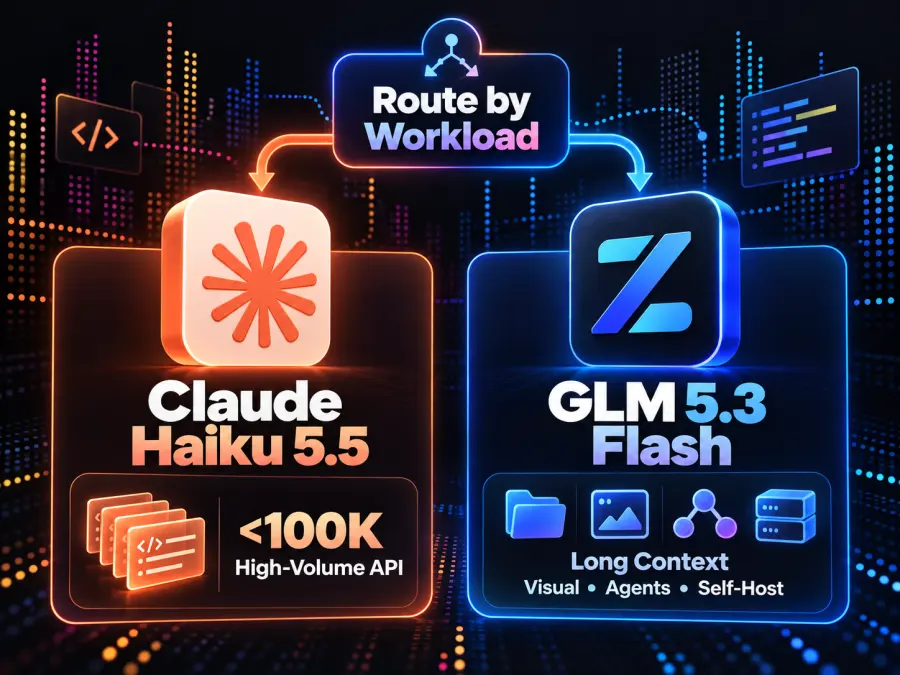
My practical recommendation is to route, not pledge allegiance. Use Haiku for compact worker tasks and GLM for visual, automation-heavy, or long-context jobs. Then promote whichever model achieves the lower accepted-task cost on your own evaluation set. If you are still deciding how Haiku fits into the Claude lineup, read What Is Claude Haiku 5.5? before comparing live API prices.