What is GLM-Legal?
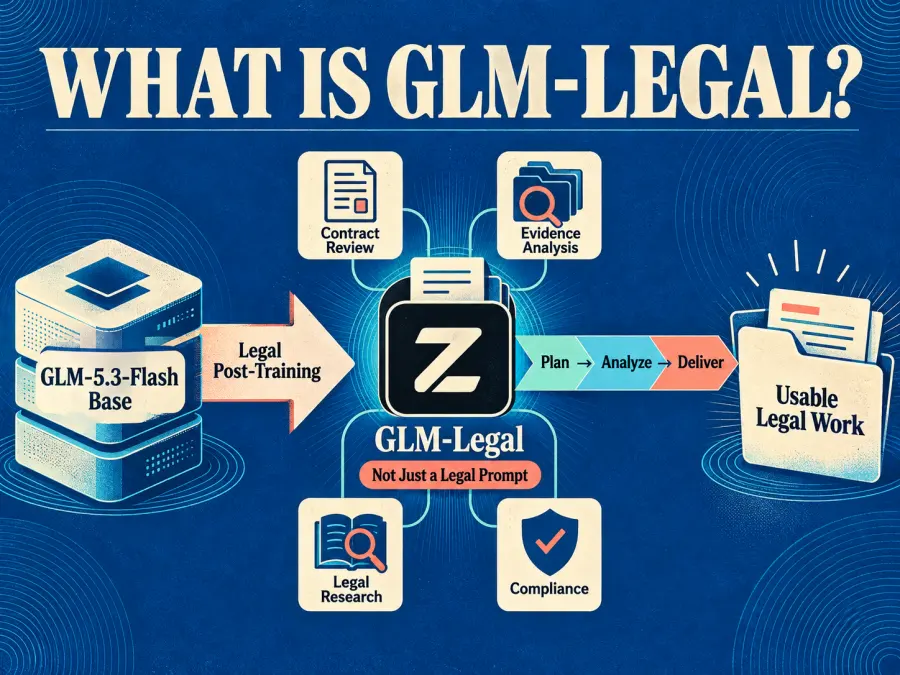
GLM-Legal is a domain-specialized large language model from Z.ai (formerly Zhipu AI), built for legal work: contract review, evidence analysis, legal research, and compliance planning. Z.ai positions it under the banner of agentic legal intelligence — meaning it is designed to execute multi-step legal tasks end to end rather than answer questions about law. It was announced on October 12, 2026, and it is not a general-purpose assistant with a legal system prompt: it is a separate post-trained model on top of Z.ai's GLM-5.3-Flash base, aimed at producing work product a legal team can use.
Searches for "zai GLM-Legal" and "Z.ai GLM-Legal" point at the same model — Zhipu AI rebranded to Z.ai, and both names appear across its documentation.
| Attribute |
Value |
| Developer |
Z.ai (Zhipu AI) |
| Release date |
October 12, 2026 |
| Base model |
GLM-5.3-Flash |
| Base architecture |
321B total parameters, mixture-of-experts |
| Context window |
1M tokens |
| Max output |
128K tokens |
| Observed token cost |
$0.07 in / $0.25 out per 1M tokens |
| Harvey LAB all-pass rate |
19.17% (rank 7 of 79) |
| LegalBench |
86.23% (rank 15 of 151) |
| Legal Research Bench |
41.83% (rank 24 of 78) |
| Availability |
Limited beta, application required |
| Public pricing |
Not announced |
Z.ai has not published GLM-Legal's own parameter count. The 321B figure describes the GLM-5.3-Flash base it was trained from, which carries roughly 18B active parameters per forward pass — a deliberately lean footprint for this score class, and the central design bet of the whole release.
One plain-language summary: GLM-Legal is a cheap, slow, legally-specialized model that drafts a credible first pass at real legal deliverables and still needs a lawyer to check every line.
Why a legal-specific model exists at all
It helps to understand the problem before the architecture, because "legal model" sounds redundant when general models already discuss law fluently.
Legal work has a property that breaks most general-purpose agents: the chain from facts to statutory rule to argument to deliverable has to hold at every link. A general model can produce a summary of a contract clause that reads perfectly and is useless, because it cited the wrong section, or missed the one carve-out that mattered, or formatted the output in a way nobody can file. Z.ai frames this as the real test for domain models — satisfying all the constraints of a professional task at once, not any single one of them well.
That framing matters for interpreting the benchmark. Harvey's Legal Agent Benchmark grades on an all-pass basis across 24 practice areas: a task counts only when the model identifies the correct issues, cites correctly, reasons defensibly, and matches the requested output format. One substantive miss anywhere and the task scores zero. There is no partial credit.
Which is why the two numbers at the top of this article diverge so sharply, and why you should distrust anyone quoting only one of them.
How to read the 19.2%
Z.ai reports 19.2%. Vals, the independent evaluator Z.ai pointed to for verification, measured 19.17% with a confidence interval of ±3.25. Those agree, and the independent confirmation is worth more than the first-party figure.
Here is the context the launch chart left out:
| Model |
All-pass rate |
Cost per task |
Latency |
| Muse Spark 1.2 |
25.42% |
$2.09 |
24m 16s |
| Muse Spark 1.3 Max |
23.75% |
$2.26 |
14m 43s |
| Muse Spark 1.3 |
22.92% |
$2.76 |
17m 04s |
| Wonder Full |
21.67% |
$5.41 |
53m 21s |
| Muse Spark 1.1 |
20.00% |
$0.80 |
12m 21s |
| Gemini 4 Argon |
19.58% |
$10.55 |
43m 55s |
| GLM-Legal |
19.17% |
$0.15 |
1h 12m |
| Kimi K3 |
12.92% |
$3.83 |
13m 58s |
| Claude Fable 5 |
11.25% |
$19.23 |
26m 53s |
| GPT-6 Astra |
5.42% |
$26.16 |
24m 49s |
Vals AI evaluation of Harvey's Legal Agent Benchmark, published October 12, 2026.
Three things follow, and I want to separate what the data says from what I think it means.
Fact: GLM-Legal ranks 7th of 79 systems. Six models score higher. The launch comparison chart showed GLM-Legal ahead of Kimi K3, Claude Fable 5, and GPT-6 Astra — all true — but omitted the six above it. If you only saw that chart, you saw a real result framed generously.
Fact: the base model, GLM-5.3-Flash, scores 6.7% on the same benchmark. Full-size GLM-5.3 scores 8.3%. Domain training moved a 6.7% model to 19.17%, which is a larger jump than scaling to the flagship produced.
My judgment: the 0.41-point gap to Gemini 4 Argon is not a real gap. GLM-Legal's confidence interval is ±3.25 and Argon's is ±3.31. Two intervals that wide, separated by 0.41 points, are statistically indistinguishable. Treat ranks 5 through 7 as a tie and the cost column becomes the only thing separating them — and there GLM-Legal costs $0.15 against Argon's $10.55, roughly 70× less for the same measured accuracy.
The trade-off is in the last column. GLM-Legal took 1 hour 12 minutes per task, the slowest in the top ten. Argon finished in under 44 minutes. You are buying a ~70× cost reduction with a ~1.6× wait.
The number that should actually worry you
92.5% of criteria passed, 19.17% of tasks passed. The implication is uncomfortable: most failed tasks were nearly right. The model satisfied the large majority of requirements and then broke one, which under all-pass grading is worth exactly as much as breaking all of them.
For legal work that distinction is the entire ballgame. A wrong date, a case that does not exist, a confused jurisdiction — any one of those turns a document that reads beautifully into one you cannot file.
🟡 There are secondary reports of an independent replication of this benchmark adding a dedicated hallucination gate — zeroing any deliverable containing a material fabrication — and of headline scores collapsing across the board under that rule. I could not retrieve the primary evaluation page to verify the figures, so I am flagging the direction rather than quoting numbers. It is consistent with the criteria-versus-task gap above, and if you are evaluating any legal model, the question "what happens to this score under a hallucination gate" is the right one to ask the vendor.
For independently verified context on legal hallucination rates generally, Stanford HAI's benchmarking of legal research tools remains the most-cited neutral reference point.
Where GLM-Legal is genuinely strong
Z.ai published side-by-side outputs against its own base model, which is a more honest comparison than cherry-picking a competitor, and the contract review example shows the difference clearly.
Given a software services contract to review for a client switching providers, GLM-5.3-Flash suggested shortening the termination notice period and requiring return of paid-for deliverables. Reasonable, generic, and something a paralegal would rewrite.
GLM-Legal returned specific terms: cut convenience-termination notice from 60 days to 30, remove the cure period for IP, confidentiality, and data-security breaches so the client can terminate immediately, require return of all deliverables and work in progress whether or not paid for, and add up to 90 days of transition assistance covering source code, documentation, data, and knowledge transfer.
That is the difference between a model that describes a contract and one that redlines it.
The evidence analysis example is the one that stuck with me. Across 40 documents from a software project dispute, the model lined up a September 30 report claiming "ON TRACK – 60% COMPLETE" against a September 8 internal warning that the milestone could not honestly be met, an internal snapshot showing ~41% completion, and an instruction to suppress the risk and keep invoicing. It then cited the master services agreement provisions stating that payment does not waive rights and warranties survive payment, assembled that into a concealment theory, and — the part I find most credible — explicitly flagged which claim elements still needed verification instead of asserting a conclusion.
Keeping facts separate from inferences is exactly what you want from a model doing document review, and it is the behavior most general models are worst at.
The cost: these are vendor-published demonstrations. They are not independent tests, they were almost certainly chosen to look good, and I have not run the model — nobody outside the beta has. Read them as evidence of what the model can do on a good day, not what it does on average. The average is the 19.17%.
How GLM-Legal was trained
Z.ai's approach is worth understanding because it is the reusable part of this release, and because it explains why a 321B-parameter base beat its own 753B flagship on legal tasks.
Training ran in two stages on top of GLM-5.3-Flash. Mid-training expanded high-quality legal corpora so the model learned statutory rules and interpretive frameworks inside dense domain context, strengthening the deductive link between facts, rules, and conclusions. Post-training applied reinforcement learning across tens of thousands of simulated legal environments.
The interesting detail is in that second stage. Z.ai trained the model and its harness — the runtime framework managing task context, tool access, and execution feedback — together, in lockstep. Edge cases surfacing during model training exposed architectural bottlenecks in the harness; harness changes then exposed the model to more realistic execution constraints. Practitioner feedback on whether deliverables were actually usable fed back in as engineering loss signals.
In plain terms: the unit being optimized was not the model. It was the model plus domain data plus workflow runtime plus practitioner feedback, as one system. That is why domain training beat raw scale here, and it is a transferable lesson for any high-stakes vertical.
Can you use GLM-Legal right now?
Short answer: almost certainly not, unless you are an organization that applies and gets approved.
GLM-Legal is in limited beta with no self-serve API access. You submit an application describing your organization and intended use. Z.ai's form targets four groups: law firms, legal tech companies, in-house legal teams, and independent practitioners. There is no consumer client entry point, and the model is not in Z.ai's general chat product.
Here is what Z.ai has not announced, as of October 15, 2026:
Pricing. No public rate card. The $0.07/$0.25 per 1M tokens figure above is what the independent evaluator observed during testing, not a published commercial price. Do not build a budget on it.
General availability date. "Soon" for AutoClaw integration is a statement of intent, not a timeline.
Weight release status. This one has conflicting signals, covered below.
The open-weights question
You will see GLM-Legal described as open-weight. This does not currently check out, and I want to be precise about the conflict because it is the single most consequential open question for legal users.
The independent evaluation page lists GLM-Legal's weights as open. But Z.ai's Hugging Face organization — which hosts 154 model repositories including GLM-5.3-Flash (321B), GLM-5.3 (753B), and BF16 variants of both, all actively updated — has no GLM-Legal repository. A direct search returns nothing. Z.ai's own launch post says nothing about releasing weights; it directs readers to a beta application form.
My read: the "open" label most likely reflects the base model's licensing, not GLM-Legal itself. Until a repository appears, treat GLM-Legal as a closed, access-controlled model regardless of how it is labeled elsewhere.
That matters more here than in most domains. Client confidentiality is a professional obligation, not a preference. Community discussion following the launch has pushed hard on exactly this point — the recurring objection being that without self-hosting, firms cannot put real case files through the model at all, no matter how it scores. One widely-shared comment on Z.ai's launch video reduced it to a single line: if it's not open, who would dare use it? Z.ai also entered this launch carrying unresolved questions about a separate data-handling incident involving its coding product, which has made legal-sector commenters notably less willing to extend benefit of the doubt on data retention.
My judgment: that objection is correct and currently unanswered. If you are a firm, your evaluation sequence is: run synthetic or fully redacted matters first, get the data retention, transmission, and audit terms in writing, and wait for a definitive weights answer before any real client file goes near it.
What about Codex and Claude Code?
A common question, so: no. GLM-Legal is not available in Codex, Claude Code, or any third-party coding agent. It is behind an application-gated beta with no public endpoint for those tools to call, and it is a legal-workflow model — not a coding model — so it would be the wrong tool for those harnesses even if you could reach it.
Z.ai does ship Anthropic-compatible and OpenAI-compatible endpoints for its general GLM models, which is why GLM-5.x models do work in Claude Code and similar tools. GLM-Legal is not part of that surface today.
GLM-Legal vs the models you can actually reach
Since the comparison keywords come up constantly, the honest version:
|
GLM-Legal |
Kimi K3 |
Claude Opus 5.5 |
GPT-6 Astra |
| Harvey LAB all-pass |
19.17% |
12.92% |
3.75% |
5.42% |
| Cost per task |
$0.15 |
$3.83 |
$21.38 |
$26.16 |
| Rank (of 79) |
7 |
12 |
41 |
34 |
| Self-serve API |
No |
Yes |
Yes |
Yes |
GLM-Legal leads all three on this benchmark at a fraction of the cost. It is also the only one you cannot sign up and call this afternoon. For a lot of teams that single row flips the entire decision, which is the uncomfortable thing about a benchmark win that ships behind an application form.
One further caveat on that table: these are legal-agent scores. Claude Opus 5.5 and GPT-6 Astra are general frontier models not tuned for this task type, and their low placement here says little about their performance elsewhere. Do not read this as a general capability ranking.
What you can run today: the base model
If you want to start building legal document workflows now rather than waiting on a beta queue, the practical move is to start from the model GLM-Legal was built on.
GLM-5.3-Flash is available through GPT Proto with a self-serve key, and it is the same base that scored 6.7% on Harvey LAB before legal post-training. To be explicit about what that means: it is the foundation, not the legal model, and it does not have GLM-Legal's domain training. What it does give you is the same 1M-token context window, native multimodal input for scanned documents, and a cost structure low enough to run across large document sets while you wait for the specialized model to open up.
GPT Proto does not carry GLM-Legal. Nobody resells it — there is no public endpoint to resell.
Here is a working first call. The GLM-5.3-Flash API runs on the OpenAI-compatible surface:
curl https://gptproto.com/v1/chat/completions \
  -H "Content-Type: application/json" \
  -H "Authorization: $GPTPROTO_API_KEY" \
  -d '{
    "model": "glm-5.3-flash",
    "messages": [
      {
        "role": "user",
        "content": "Review this clause and list every obligation that survives termination. Quote the text supporting each one, and mark anything ambiguous as UNCLEAR rather than guessing.\n\nClause: Upon termination, Provider shall return all Client Materials within thirty (30) days. Confidentiality obligations under Section 8 remain in effect for five (5) years. Provider retains the right to use anonymized performance data."
      }
    ]
  }'
Note the auth format: GPT Proto's /v1/ surface takes the raw API key in the Authorization header. The Bearer prefix is not used here.
The same call in Python, with the document-review pattern worth copying — asking for citations and an explicit uncertainty marker, which is how you make a general model's output auditable:
import os
from openai import OpenAI

client = OpenAI(
    api_key=os.environ["GPTPROTO_API_KEY"],
    base_url="https://gptproto.com/v1",
)

SYSTEM = """You are assisting a legal team with document review.
Rules:

1. Quote the exact source text supporting every statement you make.

2. Separate FACTS (what the document says) from INFERENCES (what it implies).

3. If a question cannot be answered from the provided text, write UNCLEAR and say what is missing.

4. Never cite a statute, case, or section number that does not appear in the source text."""

def review(document: str, question: str) -> str:
    response = client.chat.completions.create(
        model="glm-5.3-flash",
        messages=[
            {"role": "system", "content": SYSTEM},
            {"role": "user", "content": f"Document:\n{document}\n\nQuestion: {question}"},
        ],
        temperature=0.2,
    )
    return response.choices[0].message.content

if __name__ == "__main__":
    contract = """SECTION 4. WORK PRODUCT. All deliverables created under this
Agreement are assigned to Client upon creation. SECTION 7. TERMINATION.
Either party may terminate for convenience on sixty (60) days written notice.
Material breaches are subject to a thirty (30) day cure period.
SECTION 9. PAYMENT. Acceptance of payment does not waive any rights."""

    print(review(contract, "If the client switches providers, what are the gaps in the exit terms?"))
The temperature=0.2 and the explicit UNCLEAR instruction are doing real work. Given what the criteria-versus-task gap tells us about how these models fail — confidently, on one detail, inside otherwise-correct output — the useful engineering response is to force the model to mark its own uncertainty and quote its sources so a human can check them fast.
I have run this call pattern and endpoint shape against the documented OpenAI-compatible surface; the model string glm-5.3-flash and the raw-key auth header are from GPT Proto's current model page and quickstart docs. Smoke-test against your own key before putting it in a pipeline.
Current listed pricing for the base model is $0.1275 per 1M input tokens and $0.425 per 1M output tokens, with cache reads at $0.03 per 1M. Verified October 15, 2026 — check the model page before you budget, since rates change.
If you want the stronger reasoning tier for the same workflow, GLM-5.3 is the 753B flagship at $1.19 / $3.74 per 1M. Worth noting against the benchmark data: the flagship scored 8.3% on Harvey LAB versus Flash's 6.7% — a 1.6-point gain for roughly 9× the input cost. On legal agent tasks specifically, paying up for the flagship buys very little. Domain training was what moved the number, not scale. The full Z.ai model lineup is worth a look if you want to compare context windows and rates across tiers.
Who should care, and who should skip this
Legal tech teams and in-house selection committees: apply now, but feed the first proof-of-concept only synthetic or fully redacted matters. Define your evaluation criteria before you see any vendor chart — coverage, source attribution, factual accuracy, and whether the output needed rework. Fix those four first, then look at data.
Solo practitioners and small firms: there is nothing to do yet. No API, no client, no pricing. The two things worth watching are when the capability reaches a mainline product and what the published rate ends up being.
Developers building legal document tooling: start on the base model now. The workflow engineering — document chunking, citation verification, human review checkpoints — is where most of your time goes anyway, and none of it is model-specific. Swap in the specialized model when it opens.
Anyone waiting on GLM-5.5: this is not that. GLM-Legal is a vertical release and will not change your general coding or chat workflow.
My verdict
GLM-Legal is the most interesting legal model release of the month and it is not one you can use yet. Those are both true and neither cancels the other.
What it proves is real: a 321B base with 18B active parameters, trained on domain corpora and co-evolved with its runtime harness, matched a frontier model costing 70× more per task. That is a genuine result, independently verified, and the methodology transfers to other high-stakes verticals.
What it does not prove is that legal AI is ready to work unsupervised. A 19.17% all-pass rate means roughly four out of five complex legal tasks come back with at least one substantive defect — and the 92.5% criteria rate means those defects are buried in output that otherwise looks finished. That is a harder failure mode to catch than obvious nonsense, not an easier one.
Use it as a first-draft engine and a contradiction finder across document sets too large to read. The signature should stay with a human. On current evidence that is not a temporary limitation — it is the shape of the tool.