The Best Chinese LLM Models at a Glance
| Rank |
Model |
Best for |
Artificial Analysis Intelligence Index |
Measured output speed |
Context |
Input on GPT Proto |
Weight status |
GPT Proto price per 1M tokens |
| 1 |
GLM-5.3 |
Text-only coding agents, terminal work, long-horizon engineering |
60 |
90.0 tok/s |
1M |
Text |
Hosted API; public weights not yet available as of Aug. 25 |
$1.26 input / $3.96 output |
| 2 |
Kimi K3 |
Difficult multimodal coding and open-weight deployment |
60 |
35.5 tok/s |
1M |
Text, image, document |
Open weights, custom Kimi K3 License |
$2.70 / $13.50 |
| 3 |
Qwen3.8 Max |
Frontend coding, screenshot analysis, visual agents |
58 |
21.1 tok/s |
1M |
Text, image, video, document |
Hosted Max plus an open text-only checkpoint |
$1.80 / $5.40 |
| 4 |
DeepSeek V4 Pro |
Backend reasoning, terminal tasks, MIT deployment |
53 |
73.9 tok/s |
1M |
Text |
Open weights, MIT |
$1.32 / $3.96 |
| 5 |
MiniMax M3 |
Low-cost multimodal analysis and high-volume subtasks |
45 |
125.6 tok/s |
1M |
Text, image, document |
Open weights, MiniMax Community License |
$0.48 / $0.96 |
The intelligence scores and speed measurements come from the current Artificial Analysis model evaluations. The index combines coding, terminal, reasoning, knowledge, and mathematics evaluations. It is useful, but it is not a coding-only leaderboard and should not decide a production deployment by itself.
The modality column describes the routes currently exposed by GPT Proto. This matters because an upstream provider may offer capabilities that are not available through every endpoint. In particular, GLM-5.3 should be treated as text input and text output here.
How We Ranked the Chinese Coding Models
A large parameter count or a one-million-token context window does not tell you whether a model can finish a repository task. All five models in this ranking sit in roughly the same long-context class. Their practical differences appear elsewhere.
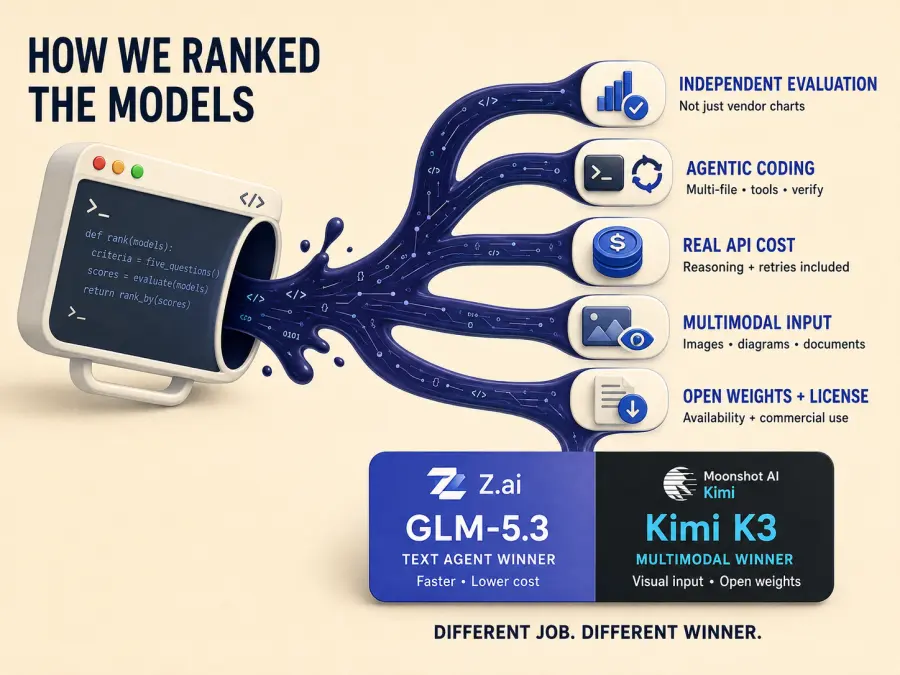
We considered five questions:
How does the model perform in independent evaluations rather than only its developer's benchmark charts?
Can it sustain multi-file coding, terminal work, tool calls, and plan–execute–verify loops?
How much does a realistic API task cost, including the output generated during reasoning and retries?
Can the model inspect screenshots, diagrams, documents, or video when the coding task is not text-only?
Are downloadable weights actually available, and what license governs commercial deployment?
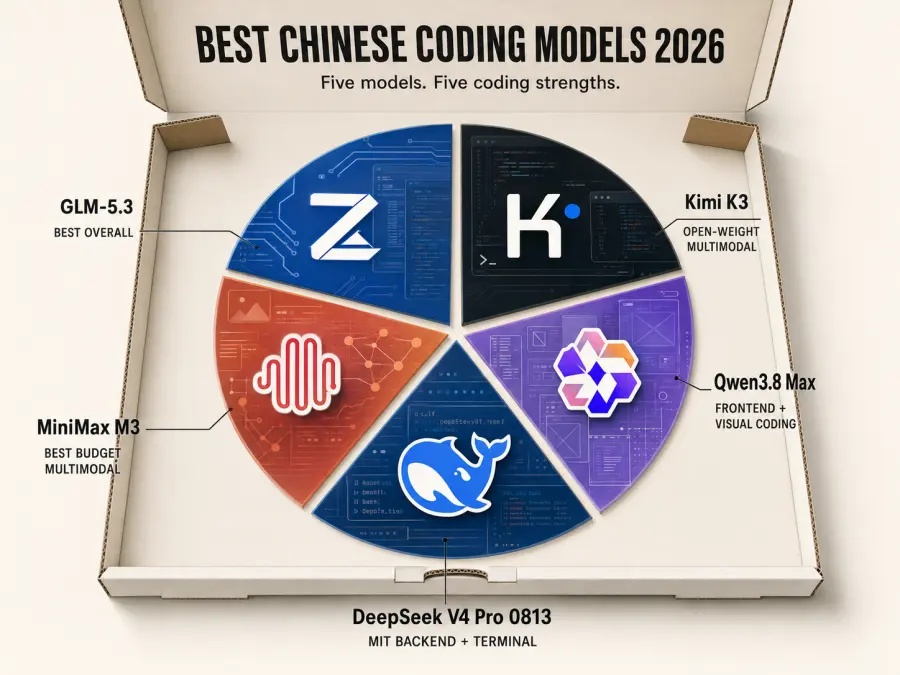
The final ranking is coding-focused. That is why GLM-5.3 takes first place even though it ties Kimi K3 on the broader intelligence index. GLM is faster and much cheaper for text-only agent work. Kimi counters with visual input and public weights. Different job, different winner.
1. GLM-5.3: Best Chinese Coding Model Overall
GLM-5.3 is the model I would test first for a new text-only coding agent.
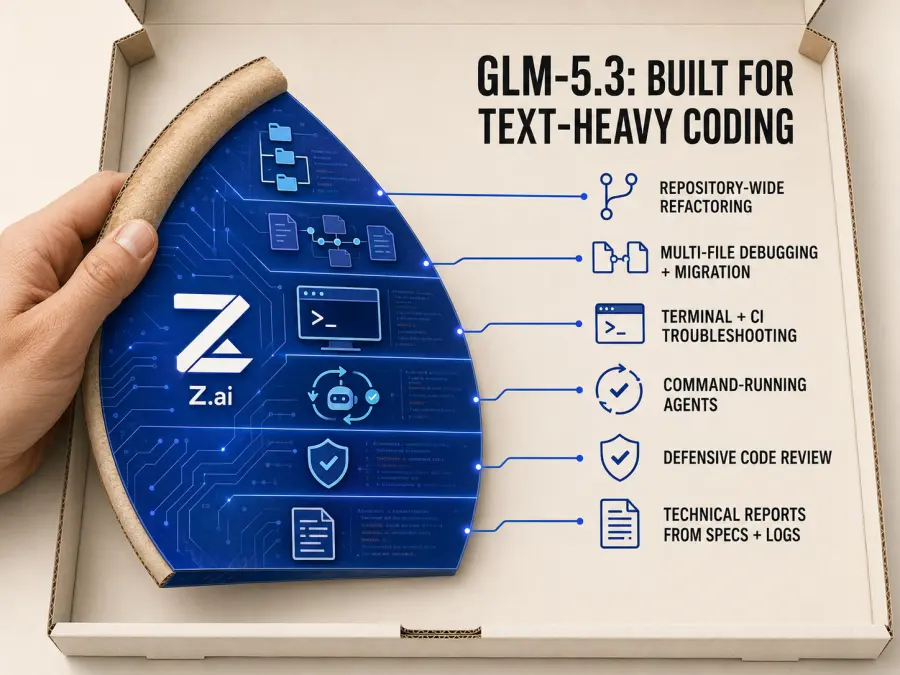
Z.ai did not build a larger base model for this release. GLM-5.3 uses the same base as GLM-5.2 and gets its gains from expanded post-training for software engineering, terminal work, long-horizon agents, and defensive code review. That is useful context: the upgrade targets how the model works through a task, not how much raw context it can hold.
The independent signal is strong. Artificial Analysis currently scores GLM-5.3 at 60, tied with Kimi K3 and ahead of Qwen3.8 Max and DeepSeek V4 Pro 0813. It also measures about 90 output tokens per second through Z.ai's API.
Z.ai's own coding results are more specific, although they remain vendor-reported. The company reports that GLM-5.3 improved from 4.6 to 28.3 on Terminal-Bench 3.0 and from 46.2 to 66.9 on DeepSWE v1.1. On its private Z.ai Code Bench, GLM-5.3 reached 34.5% at max effort while using about 75,000 output tokens per task, compared with GLM-5.2's 23.4% at roughly 96,000 tokens. The official GLM-5.3 documentation publishes the full comparison.
That combination fits work such as:
Repository-wide refactoring
Multi-file debugging and dependency migration
Terminal and CI troubleshooting
Agents that must run commands, inspect results, revise a plan, and continue
Defensive review of authentication, validation, and dependency changes
Long technical reports generated from text-based specifications and logs
On GPT Proto, GLM-5.3 costs $1.26 per million input tokens and $3.96 per million output tokens. It supports a one-million-token combined context window and up to 128K output tokens. Reasoning is always enabled, with low, high, and max effort levels.
There are three trade-offs.
First, it is text-only. It cannot directly inspect a broken layout screenshot, design file, or recorded user flow. Route that step to Qwen3.8 Max, Kimi K3, or another visual model.
Second, GLM-5.3's public weights were still not available on August 25. Z.ai announced a staged open-weight release after additional safety work, but an announced release is not the same as a downloadable checkpoint and confirmed license. Teams that need local deployment today should not inherit GLM-5.2's MIT status and apply it to GLM-5.3 without checking the final release.
Third, the model can be verbose. Artificial Analysis recorded 170 million output tokens across its Intelligence Index evaluation, well above the 72 million median for comparable reasoning models. Maximum effort on every request can waste time and money.
Verdict: Choose GLM-5.3 as the default for difficult text-only coding agents. Use lower reasoning effort for routine work, and keep a multimodal model available for visual steps.
2. Kimi K3: Best Open-Weight Multimodal Model
Kimi K3 remains one of the most capable Chinese models available, but it no longer wins this coding-focused ranking by default.
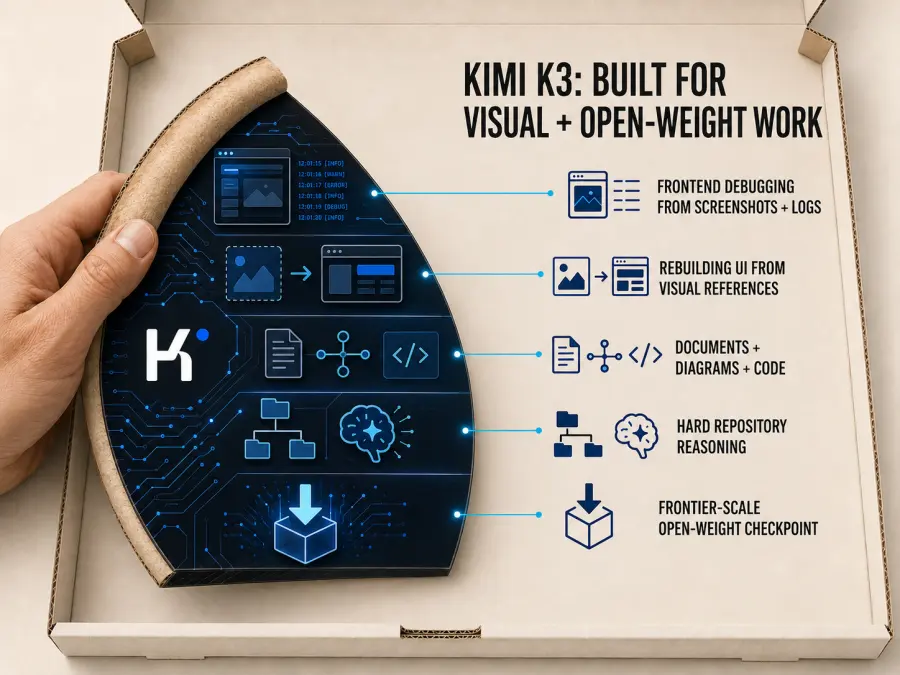
Moonshot AI built K3 for long-horizon coding, reasoning, knowledge work, and repeated tool use. Its architecture contains 2.8 trillion total parameters and activates 16 of 896 experts for each token. The model provides a one-million-token context window and can combine code with visual or document evidence through the hosted service.
Artificial Analysis scores Kimi K3 at 60, tying GLM-5.3 for the highest result in this list. The separation comes from cost, speed, modalities, and deployment.
Kimi K3 is relevant for:
Debugging a frontend from screenshots and runtime logs
Rebuilding an interface from a visual reference
Combining technical documents, diagrams, and code
Difficult repository tasks where general reasoning is the bottleneck
Teams that need access to a frontier-scale open-weight checkpoint
The cost is substantial. On GPT Proto, Kimi K3 is $2.70 per million input tokens and $13.50 per million output tokens. Artificial Analysis measures about 35.5 output tokens per second. A long agent that repeatedly plans, edits, reads tool results, and retries can therefore be both slower and much more expensive than GLM-5.3.
Self-hosting is not a casual alternative. The published checkpoint is about 1.56 TB, and Moonshot recommends a supernode deployment with 64 or more accelerators. Kimi K3 also uses a custom license rather than MIT, so large commercial deployments and Model-as-a-Service products need license review.
Verdict: Choose Kimi K3 when visual evidence, very difficult reasoning, or access to its open weights justifies the infrastructure and API cost. For routine text-only agents, GLM-5.3 is the more economical default.
3. Qwen3.8 Max: Best for Frontend and Visual Coding
Qwen3.8 Max is not a faster version of Qwen3.7 Max. It is a different product choice.
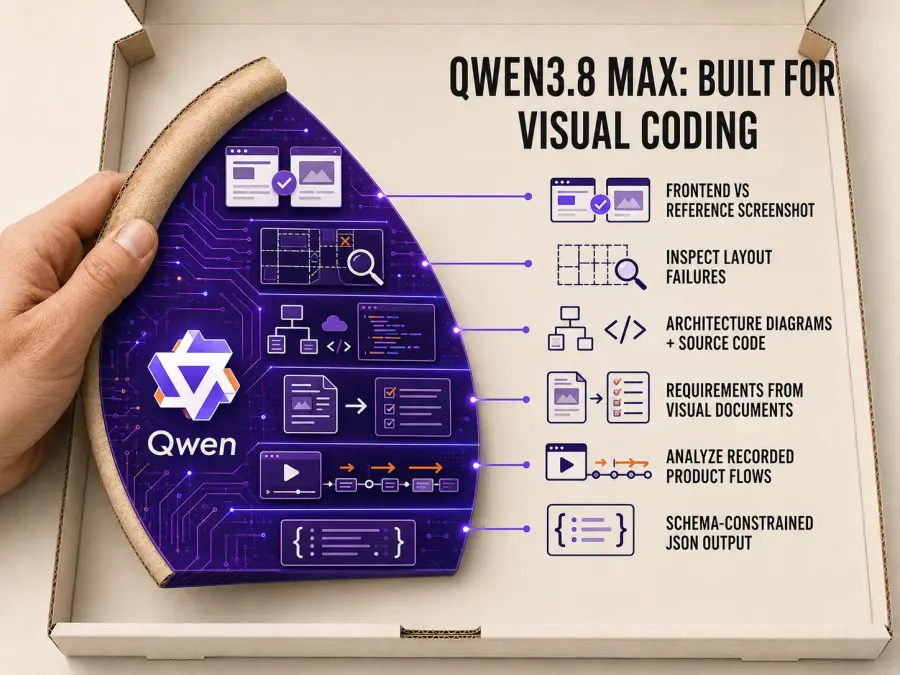
Alibaba's current hosted model is a 2.4-trillion-parameter Mixture-of-Experts flagship built for coding, professional work, and long-horizon tasks. It accepts text, images, and video and returns text. The API supports a one-million-token context window, up to 131,072 output tokens, function calling, structured output, context caching, and hybrid thinking. These specifications are documented in the Alibaba Cloud model guide.
The visual input changes what the model can do inside a coding workflow:
Compare a rendered frontend with a reference screenshot
Inspect layout failures that are difficult to explain in text
Read architecture diagrams alongside source code
Extract requirements from visual documents
Analyze a recorded product flow before proposing implementation changes
Return schema-constrained JSON for a downstream agent
The independent results are competitive. Qwen3.8 Max scores 58 on the Artificial Analysis Intelligence Index, behind GLM-5.3 and Kimi K3 but ahead of DeepSeek V4 Pro and MiniMax M3.
Speed is the catch. Artificial Analysis measures only about 21.1 output tokens per second through Alibaba's API, so the old description of Qwen as the “best fast hosted model” no longer holds. On GPT Proto, Qwen3.8 Max costs $1.80 per million input tokens and $5.40 per million output tokens—also much more than Qwen3.7 Max's former rate.
One distinction deserves its own warning. The hosted qwen3.8-max product and the downloadable Qwen3.8-2.4T-A95B checkpoint are related but not capability-identical. The open-weight model card describes the downloadable checkpoint as text-only with mandatory thinking. Do not promise hosted Max features such as image input, video input, optional reasoning, or a one-million-token default context when documenting a self-hosted deployment unless the specific artifact supports them.
Verdict: Choose Qwen3.8 Max for frontend generation, screenshot-to-code, visual debugging, or mixed text-and-video workflows. Do not choose it solely for low latency or the lowest token price.
4. DeepSeek V4 Pro 0813: Best MIT Model for Backend and Terminal Work
DeepSeek V4 Pro deserves a fresh evaluation because the current GA build is not the April Preview model.
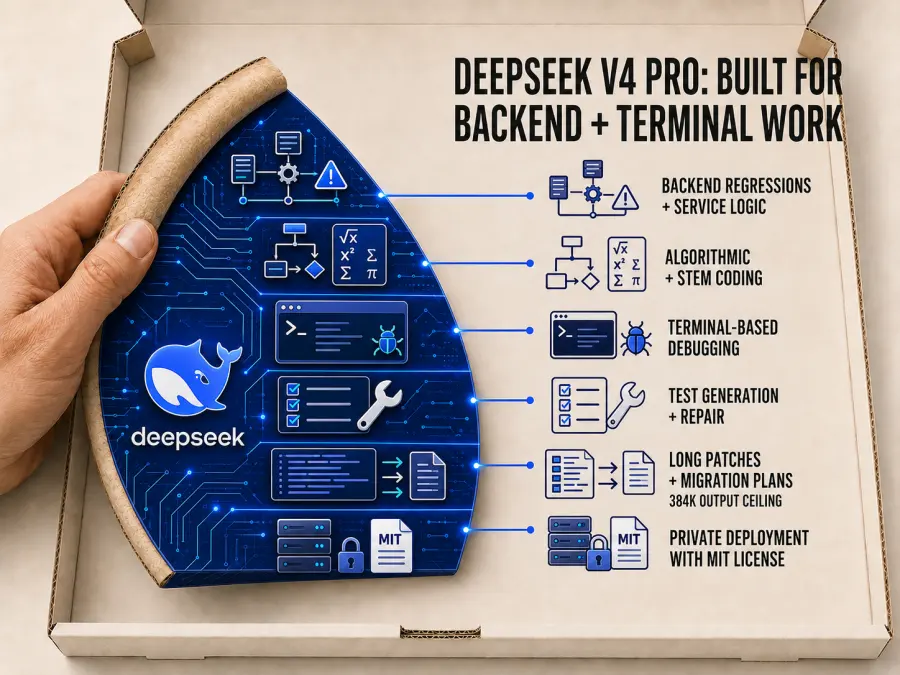
DeepSeek released DeepSeek-V4-Pro-0813 on August 13, replacing the Preview version. It keeps the 1.6-trillion-parameter Mixture-of-Experts architecture with 49 billion active parameters, a one-million-token context window, and MIT-licensed weights. The current API supports thinking and non-thinking modes, tool calls, JSON output, the Responses API, the Anthropic API format, and up to 384K output tokens.
The performance increase is real enough to change the article's numbers. Artificial Analysis scores the August build at 53, up from the Preview model's earlier result, and measures about 73.9 output tokens per second. DeepSeek's published V4 Pro 0813 model card reports 87.9 on Terminal-Bench 2.1, compared with 72.1 for V4 Pro Preview.
DeepSeek V4 Pro fits:
Backend regressions and service logic
Algorithmic and STEM-heavy coding
Terminal-based debugging
Test generation and repair
Long patches or migration plans that benefit from the 384K output ceiling
Private deployments that require a permissive MIT license
On GPT Proto, the current price is $1.32 per million input tokens and $3.96 per million output tokens. That makes a first-pass task almost identical in price to GLM-5.3 at the token volumes used below.
The trade-off is that DeepSeek V4 Pro remains text-only. It also scores only one point above DeepSeek V4 Flash in the current Artificial Analysis index while costing considerably more, so Pro should not automatically handle every routine request. Use it when the harder model improves the rate of accepted fixes; route simpler work to a cheaper model.
Verdict: Choose DeepSeek V4 Pro for backend-heavy or terminal-heavy work when MIT weights, selectable reasoning, and very long output matter. GLM-5.3 is the better hosted default for many agent workflows; DeepSeek is the cleaner current choice for permissive self-hosting.
5. MiniMax M3: Best Budget Multimodal Coding Model
MiniMax M3 ranks fifth on capability, but first on cost and measured speed.
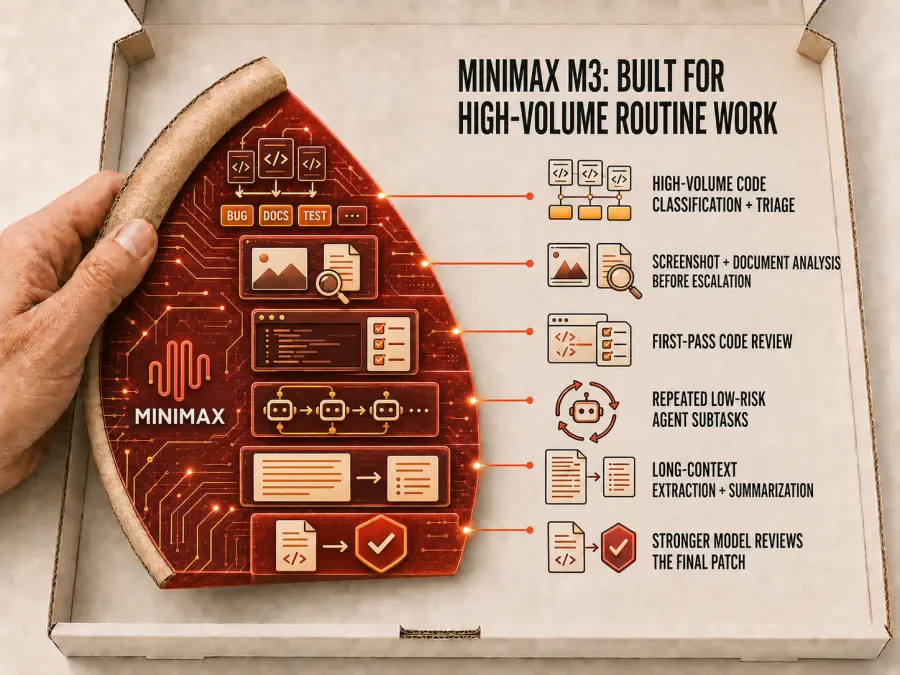
The model uses a Mixture-of-Experts architecture with approximately 428 billion total parameters and 23 billion active parameters. It supports a one-million-token context window and can process text, images, and documents through the relevant GPT Proto routes.
Artificial Analysis currently scores MiniMax M3 at 45, below the other four models. It also measures about 125.6 output tokens per second, the fastest result in this comparison.
On GPT Proto, MiniMax M3 costs $0.48 per million input tokens and $0.96 per million output tokens. That price makes it practical for:
High-volume code classification and triage
Screenshot and document analysis before escalation
First-pass code review
Repeated low-risk agent subtasks
Long-context extraction and summarization
Workflows where a stronger model reviews the final patch
The trade-off is quality on the hardest tasks. A cheap request is not a saving if the model needs several retries or creates a patch that a more capable model must rewrite. MiniMax M3 also uses the MiniMax Community License rather than MIT; teams planning redistribution or self-hosting should review its terms.
Verdict: Use MiniMax M3 as a low-cost worker or multimodal triage model. Escalate ambiguous repository changes and difficult terminal tasks to GLM-5.3, Kimi K3, Qwen3.8 Max, or DeepSeek V4 Pro according to the evidence involved.
One Real Coding Task, Five Different Choices
Consider a TypeScript SaaS application that starts failing intermittently during its OAuth callback after an authentication-library upgrade. The coding agent must inspect the repository, trace the callback and session flow, reproduce the regression, change the implementation, run the test suite, and prepare a pull-request summary.
A useful instruction could be:
Investigate the OAuth callback regression in this repository.

Before editing:

1. Map the callback, session, and token-refresh paths.

2. Identify the library upgrade that changed the behavior.

3. Reproduce the failure with a test.

4. Propose the smallest safe patch.

After editing:

1. Run the relevant unit and integration tests.

2. Report every file changed.

3. Explain remaining risks.

4. Do not claim success unless the tests pass.
The best model changes with the evidence and environment:
| Stage or requirement |
Recommended model |
Why |
| Maintain a long text-only repository and terminal loop |
GLM-5.3 |
Strong current agent results, 1M context, higher measured speed, lower cost |
| Inspect screenshots and difficult visual evidence |
Kimi K3 |
High overall score, multimodal input, open-weight option |
| Rebuild or debug a frontend from screenshots or video |
Qwen3.8 Max |
Text, image, and video input with structured output |
| Analyze backend logic inside private infrastructure |
DeepSeek V4 Pro |
MIT weights, strong Terminal-Bench result, selectable reasoning |
| Run cheap first-pass triage across many issues |
MiniMax M3 |
Lowest token cost and highest measured output speed in the list |
A production agent does not need to send every stage to the same model. MiniMax M3 can classify issues, Qwen3.8 Max can inspect visual evidence, GLM-5.3 can handle the long implementation loop, and DeepSeek V4 Pro can serve teams that require an MIT-licensed private deployment.
What Would the Same Coding Task Cost?
Suppose the OAuth task consumes:
Using the GPT Proto prices listed on August 25, 2026, the first-pass token cost would be:
| Model |
Calculation |
Approximate cost |
| GLM-5.3 |
(0.1 × $1.26) + (0.02 × $3.96) |
$0.21 |
| Kimi K3 |
(0.1 × $2.70) + (0.02 × $13.50) |
$0.54 |
| Qwen3.8 Max |
(0.1 × $1.80) + (0.02 × $5.40) |
$0.29 |
| DeepSeek V4 Pro |
(0.1 × $1.32) + (0.02 × $3.96) |
$0.21 |
| MiniMax M3 |
(0.1 × $0.48) + (0.02 × $0.96) |
$0.07 |
These figures do not claim that MiniMax will solve the task for seven cents or that Kimi will finish it in one attempt. They are first-pass token arithmetic. Reasoning tokens, cache hits, retries, tool output, and the number of agent turns change the final bill.
The metric that matters is cost per accepted fix, not price per million tokens.
Why the Benchmark Winner May Not Be the Best Coding Agent
A language model does not inspect files, execute commands, or merge a patch by itself. The surrounding agent decides:
Which repository files enter the context
How search results and terminal output are presented
Whether edits use exact patches or complete file rewrites
When tests run
What happens after a failed command
Whether the model sees the test result before claiming success
How much context survives between turns
Put the same model inside two different agent systems and the completion rate can change substantially.
The shared one-million-token context window creates another trap. Capacity is not a recommendation to paste an entire repository into every request. Generated files, dependency code, old logs, and unrelated documentation increase latency and can distract the model from the relevant execution path.
A better coding agent retrieves likely files first, keeps stable instructions near the beginning, stores checkpoints, summarizes old tool output, and expands context only when the investigation requires it.
One-sentence version: choose the model and the agent together.
Which Chinese Coding Model Should You Use?
Choose GLM-5.3 if you are building a text-only coding agent that must stay on task across repository searches, command execution, tests, and repeated correction. It is the strongest current default in this ranking, but it is not yet the choice for teams that require downloadable weights.
Choose Kimi K3 if the task is difficult, includes visual evidence, and justifies the highest API bill in the list. It is also relevant when your infrastructure team can support its enormous open-weight checkpoint and custom license.
Choose Qwen3.8 Max if frontend quality, screenshot-to-code, visual debugging, video understanding, or structured multimodal output changes the result. Expect higher latency than the old Qwen3.7 Max positioning suggested.
Choose DeepSeek V4 Pro if the work is backend-heavy or terminal-heavy and you need current MIT-licensed weights. Its 384K maximum output is also useful for unusually long patches and implementation reports.
Choose MiniMax M3 if cost and throughput dominate. It works best as a first-pass worker, triage model, or multimodal preprocessing step rather than the automatic owner of the hardest repository changes.
There is no permanent winner. The safer architecture is a routing layer that lets the preferred model change without forcing an application rewrite.
How to Call These Chinese LLM Models Through One API
GPT Proto exposes these models through the same OpenAI-compatible chat endpoint. The following cURL request uses GLM-5.3:
curl --request POST 'https://gptproto.com/v1/chat/completions' \
  --header "Authorization: Bearer $GPTPROTO_API_KEY" \
  --header 'Content-Type: application/json' \
  --data '{
    "model": "glm-5.3",
    "messages": [
      {
        "role": "system",
        "content": "You are a senior software engineer. Separate confirmed evidence from hypotheses and never claim a test passed unless you saw its output."
      },
      {
        "role": "user",
        "content": "An OAuth callback began failing after an authentication-library upgrade. Return a JSON object with diagnosis_questions, files_to_inspect, likely_failure_modes, and test_plan."
      }
    ],
    "stream": false
  }'
To test another model, change the model value:
| Model |
GPT Proto model string |
| GLM-5.3 |
glm-5.3 |
| Kimi K3 |
kimi-k3 |
| Qwen3.8 Max |
qwen3.8-max |
| DeepSeek V4 Pro |
deepseek-v4-pro |
| MiniMax M3 |
MiniMax-M3 |
Capitalization matters for MiniMax-M3. Review the live model page before adding provider-specific reasoning or multimodal parameters, because supported fields can differ by route.
Compare all GPT Proto models before assigning production traffic. One API key and balance can be used to test different supported models without maintaining a separate integration for each provider.