
Sora 2 Pro
curl --request POST "https://gptproto.com/api/v3/openai/sora-2-pro/text-to-video" \
    --header "Authorization: Bearer $GPTPROTO_API_KEY" \
    --header "Content-Type: application/json" \
    --data '{
        "prompt": "A tiny origami fox sailing a teacup across a moonlit puddle",
        "size": "720*1280",
        "duration": 4
}'Start from the cost of a single sample and pick a testing budget.
| Scenario | OpenAI list | OpenRouter | GPTProto | You save / mo |
|---|---|---|---|---|
| Short product ads30 × 4s / mo | $18.00 | $18.99 | $60.00 | −$0.00≈ $0.00 / yr |
| Social clips60 × 4s / mo | $36.00 | $37.98 | $120.00 | −$0.00≈ $0.00 / yr |
| Bulk generation100 × 4s / mo | $60.00 | $63.30 | $200.00 | −$0.00≈ $0.00 / yr |

OpenAI · $0.3 per second · 720p · 1080p


What is Sora 2 Pro
Sora 2 Pro is the Pro tier of OpenAI's Sora 2 video family. It targets higher resolution, longer clips, and stronger prompt adherence than the standard sora-2 model, with native audio produced alongside the video rather than added afterward.
What sets the Pro tier apart is consistency under motion. Fast camera moves and moving subjects hold detail where the standard model softens; 3D space and subject identity stay more stable from shot to shot. In blind testing by independent reviewers, Sora 2 Pro scored meaningfully higher than standard Sora 2 on realism and prompt accuracy — though the gap is narrower than the roughly 3× price difference between the tiers would suggest. The practical read: Pro earns its cost on output that ships, not on every draft.
| Spec | Value |
|---|---|
| Provider | OpenAI |
| Model string | sora-2-pro |
| Task | Text-to-video and image-to-video |
| Input | Text prompt; or starting image + prompt (i2v) |
| Output | Watermark-free MP4 with synchronized audio |
| Sizes (on GPTProto) | 720×1280, 1280×720, 1024×1792 |
| Durations (on GPTProto) | 4s, 8s, 12s, 16s, 20s |
| Resolution tiers | 720p; 1024p (1024×1792) |
| Audio | Native, synchronized |
| Generation mode | Asynchronous (submit job, poll for result) |
| Watermark | None — clean output via API |
| Image-to-video on GPTProto | Yes — subpage /model/openai/sora-2-pro/image-to-video |
Because generation is asynchronous, a request returns a job id rather than a finished file; you poll until the video is ready and then download the MP4. A 4–8 second clip typically renders in well under two minutes, though wall-clock time scales with duration, resolution, and queue load.
Sora 2 Pro use cases
Sora 2 Pro fits work where motion fidelity and synced audio matter more than per-clip cost:
- Marketing hero shots. Short, cinematic product or brand clips where the camera move and lighting carry the message. Render the final at 1280×720 (landscape) or step up to 1024×1792 when you need the higher-resolution finish.
- Social-first vertical video. 720×1280 at 8–12 seconds covers most short-form feeds, with synced ambient audio baked in so there's no separate sound pass.
- Concept and pitch boards. Turn a written scene into a moving reference in minutes — faster and cheaper than a live shoot for early-stage client buy-in.
- B-roll and establishing shots. Atmospheric filler (skylines, landscapes, interiors) that's expensive to film but quick to prompt.
A common pattern: draft and iterate prompts on the cheaper standard sora-2, then render only the keeper on sora-2-pro. You pay the Pro rate once, on the take that actually ships, instead of on every experiment.
Sora 2 vs Sora 2 Pro
Both models are live on GPTProto, so you can switch between them on the same key. Standard sora-2 is the cheaper draft tier; sora-2-pro is the higher-fidelity finish tier.
| sora-2 | sora-2-pro | |
|---|---|---|
| Resolution | 720p | 720p, 1024p |
| Audio | Synchronized | Synchronized |
| Relative quality | Strong for drafts & social | Higher fidelity, better motion stability |
| GPTProto price (720p, 4s) | $0.40 | $1.20 |
| Per second (720p) | $0.10 | $0.30 |
| Best for | Iteration, high-volume drafting | Client deliverables, hero shots |
Practical workflow: draft and iterate prompts on sora-2 at $0.10/sec, then render the final on sora-2-pro. The quality gap is real but narrower than the 3× price gap implies, so reserve Pro for output that ships.
→ See the standard model: Sora 2
Switching from the official Sora 2 API
If you already call OpenAI's Sora 2 API, here's what changes and what doesn't.
What's the same: per-second rates ($0.30/sec at 720p, $0.50/sec at 1024p), the async submit-then-poll pattern, and watermark-free MP4 output.
What changes:
- No OpenAI usage-tier gate. The official API only unlocks
sora-2-proonce your OpenAI account reaches a paid usage tier (minimum top-up required). On GPTProto, fund one balance and the model is available. - One key across 200+ models. The same credential runs
sora-2-pro, the standardsora-2, ByteDance Seedance 2.0, Kling, and your text models — one bill instead of separate accounts per provider. - Endpoints differ. Point requests at the GPTProto endpoints above, not OpenAI's. Auth is your GPTProto key.
The honest summary: you're not paying less per second — you're trading several provider accounts and a tier requirement for one balance and one key.
Sora 2 is being discontinued — plan your move
This matters more than any feature on the page, so here it is plainly: OpenAI discontinued the Sora consumer app on April 26, 2026, and the Sora API is scheduled to stop accepting requests on September 24, 2026, with no announced successor. GPTProto's Sora 2 and Sora 2 Pro access runs on top of OpenAI's, so it ends on the same date.
If you have a live integration, keep using this page through the wind-down — it's a clean bridge for a controlled migration rather than a hard cutover. If you're building something new, don't start it on Sora. The models that replace it run on the same GPTProto key, so moving is a one-line path change, not a rewrite: ByteDance Seedance 2.0 currently tops the independent quality benchmarks, Kling 3.0 leads on character consistency and 4K, and Vidu Q3 is the volume-and-cost play.
→ Read the full breakdown: Sora 2 Is Gone: 6 Real Alternatives for 2026
Sora 2 Pro Prompt Recipes
Sora 2 Pro rewards specific, camera-aware prompts. Three patterns that hold up:
Cinematic establishing shot
Wide aerial shot descending toward a coastal town at golden hour, warm low sunlight, gentle camera push-in, calm sea, soft ambient wind and distant gulls.
Why it works: a stated camera move ("descending", "push-in") plus a lighting cue ("golden hour", "warm low sunlight") gives the model a clear motion and mood target.
Product / object focus
Slow 360° orbit around a ceramic coffee cup on a marble counter, soft window light from the left, shallow depth of field, steam rising, quiet kitchen ambience.
Why it works: a single subject, an explicit motion path ("360° orbit"), and depth-of-field language keep the frame stable and the subject sharp.
Character action
A runner sprinting along a wet city street at night, neon reflections on the pavement, handheld camera tracking from the side, rain, synced footsteps and rain audio.
Why it works: naming the camera rig ("handheld", "tracking from the side") and the audio ("synced footsteps") leans into Sora 2 Pro's motion stability and native audio.
Tip: keep one primary subject and one primary camera move per clip. Stacking multiple subjects or cuts into a single prompt is where motion artifacts appear. These patterns also port directly to the alternative models — Seedance 2.0 and Kling 3.0 read the same camera and lighting cues.
Frequently Asked Questions
Key questions and technical answers about sora-2-pro/text-to-video. Learn model basics, use cases, pricing, API integration, and security considerations.
What is sora-2-pro/text-to-video?
Which company developed Sora 2 Pro?
How does Sora 2 Pro differ from Sora 2?
Is the Sora 2 Pro API unlimited?
Does Sora 2 Pro output have a watermark?
How much does the Sora 2 Pro API cost?
How do I call Sora 2 Pro via API?
Does Sora 2 Pro support image input?
Why is Sora 2 no longer available — can I still use it?
Can I use Sora 2 Pro videos commercially? Any copyright risk?
Related Articles
Guides, comparisons, and updates related to this model.
All Articles
Best AI Video Generation Models 2025: Top 5 Ranked
Discover the top AI video generation models in 2025. Compare pricing, explore free APIs, and find the best AI video generator for your needs with our guide.
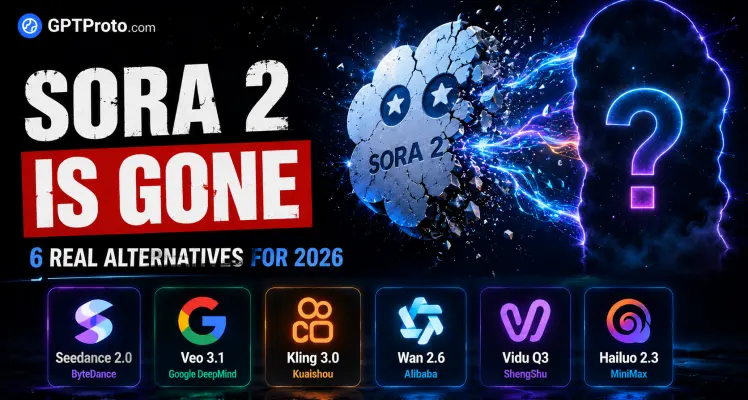
Sora 2 Is Gone: Your 6 Real Sora 2 Alternatives for 2026
OpenAI shut down Sora 2. Here are 6 real alternatives for 2026: Seedance, Veo, Kling & more — ranked by a neutral benchmark, all on one API key.

Best Recraft AI Alternatives (2026): When to Switch and What to Use Instead
Recraft still wins on vector/SVG—but most people leave for reasons it can't fix. The best Recraft AI alternatives for image, design & video, with runnable API code.