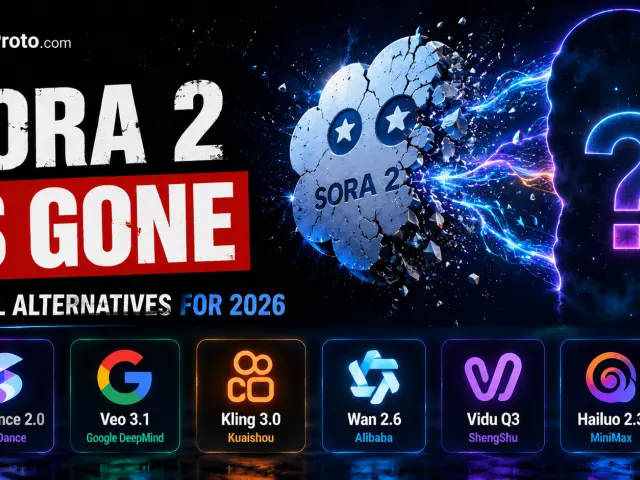
Why Is Sora 2 No Longer Available?
Quick answer: OpenAI wound it down on purpose. The Sora web and app experiences were turned off on April 26, 2026, and the API is set to shut off on September 24, 2026, ending the Sora brand. That's the official position, not a rumor.
You'll see posts claiming Sora 2 was "permanently shut down due to compute costs," or the opposite — that it's "still available, just behind a paywall." Both are stale or invented. OpenAI didn't publish a cost-driven reason, and as of mid-2026 the app is already gone while the API counts down. Treat anything more specific than "OpenAI is sunsetting Sora" with suspicion; most of it is guesswork written to sell you something.
One practical note: if you're maintaining a live Sora 2 integration, you can keep it running through GPT Proto's Sora 2 API during the wind-down — useful for a controlled migration rather than a hard cutover. But that access ends with OpenAI's API on September 24, so treat it as a bridge, not a destination.
The deeper lesson is the one worth keeping. Sora 2 launched in late September 2025, reached only the US and Canada, sat behind a $20–$200/month subscription, watermarked lower tiers, and then vanished inside seven months. The risk was never the price. It was building on one closed model that one company could switch off. Whatever you migrate to, plan for that.
What Makes a Good Sora 2 Alternative
Five things separate a real replacement from a demo that looks good on social:
- Quality you can verify. Not the vendor's highlight reel — an independent score. I lean on the Artificial Analysis Video Arena, which ranks models by blind human votes on identical prompts.
- Access without the friction. No invite waitlist, no US/Canada-only region lock, no forced watermark on paid tiers, no Chinese phone number to clear a verification wall.
- Native audio. Sora 2's synchronized sound was half its appeal. The best 2026 models generate audio and video together, not as a bolt-on.
- Per-second economics. Video gets expensive fast. The spread is enormous: on GPT Proto the cheapest model here costs $0.004/second and the priciest costs $0.50 — a 100x gap for the same length of clip.
- No single point of failure. After Sora, the smart move is reaching several models behind one integration, so the next shutdown is a one-line change, not a rewrite.
The 6 Best Sora 2 Alternatives in 2026
Ranked by where they land on the Artificial Analysis Video Arena, then adjusted for access and price. Benchmark positions move weekly, so re-check before you commit. All six are callable through one GPT Proto key.
1. Seedance 2.0 (ByteDance) — the one I'd pick first
Seedance 2.0 currently sits at #1 on the Artificial Analysis Video Arena for both text-to-video (with audio) and image-to-video — ahead of Kling 3.0 and Veo 3.1. That's the strongest neutral signal available, and it matched my testing: clean motion, coherent multi-shot sequences, and audio generated in the same pass rather than stitched on after.
What sets it apart is the reference system. A single call accepts up to nine images, three video clips, and three audio files, addressable inside the prompt — enough control to hold a character consistent across shots, which is where most models drift.
The catch: ByteDance's own access is a maze. Between Jimeng (China), Dreamina (international), CapCut quotas, and a Chinese-phone-number wall on the Doubao app, getting clean Seedance access directly eats an afternoon. That friction is the single best reason to reach it through an API. On GPT Proto it runs $0.2957 per second — mid-pack pricing for the model that currently tops the quality charts, which is the bargain here.
Best for: most people leaving Sora 2. Strong quality, native audio, real character control. → Seedance 2.0 on GPT Proto
2. Google Veo 3.1 — when audio and polish matter most
Veo 3.1 is the model to beat on production polish. It generates 4-, 6-, or 8-second clips at up to 4K, and it's the only one here producing genuine 48kHz synchronized dialogue — not just ambient sound. If your output is client-facing and someone in the video has to speak, this is the safe choice.
The trade-off is price and length. On GPT Proto, Veo runs $0.50 per second — the most expensive option in this lineup — and clips top out at 8 seconds before you stitch. It's the premium pick: you pay for the dialogue and the polish, not for volume.
Best for: cinematic, audio-heavy, brand-facing work. → Veo 3.1 Pro on GPT Proto
3. Kling 3.0 (Kuaishou) — character consistency and 4K
Kling 3.0, out in early February 2026, leans into resolution and continuity: native 4K at 60fps, clips up to 15 seconds, and up to six connected shots that keep the same subject recognizable across cuts. For character-driven or serialized content, its multi-subject consistency is among the best available, and it lands in the Arena's top five for text-to-video with audio.
At $0.2688 per second on GPT Proto it's actually a touch cheaper than Seedance, which makes it a strong pick when continuity across shots matters more than the top quality score. The catch: 4K and native audio push render times and the per-clip total up fast, so budget by the clip, not the month.
Best for: character series, e-commerce product video, high-resolution hero shots. → Kling v3.0 Pro on GPT Proto
4. Wan 2.6 (Alibaba) — open-weights flexibility
Wan is the open-weights option, and it's the one creators reach for when consumer apps over-filter — fewer blanket content blocks on legitimate work, and the flexibility that comes with an open model. It's reliable for short b-roll and rapid drafting.
One honest correction to the usual narrative: Wan is cheap to self-host, but it is not the budget pick on a managed API. On GPT Proto it runs $0.45 per second — near the top of this lineup, pricier than Seedance or Kling. Use it for its flexibility and content latitude, not to save money; if cost is the goal, Vidu is far cheaper.
Best for: open-model flexibility, content latitude, quick drafts where flexibility beats price. → Wan 2.6 on GPT Proto
5. Vidu Q3 (Shengshu) — the budget champion
Here's the value play, by a wide margin. Vidu Q3 generates 1080p clips around 12–16 seconds with native audio, and a reference-to-video mode that keeps a character consistent across a multi-shot sequence. On GPT Proto it costs $0.004 per second — roughly 100x cheaper than most of this lineup. For automated, high-volume, serialized social pipelines, nothing else here comes close on cost.
The weakness is a quality tier just under the leaders and less brand recognition. That's the trade: you're not getting Seedance-grade output, but at this price you can generate at a volume the premium models can't touch.
Best for: high-volume social, serialized content, anything cost-sensitive. → Vidu Q3 Pro on GPT Proto
6. Hailuo 2.3 (MiniMax) — stylized and animated work
Hailuo 2.3 earns its spot on style. It's strong on anime and illustration aesthetics with smooth motion and native audio, which makes it the pick when you don't want photoreal — you want a look.
At $0.441 per second on GPT Proto it sits in the upper-mid range, and clips run short. Reach for it when the style is the point, not the default.
Best for: anime, illustration, stylized motion. → Hailuo 2.3 Pro on GPT Proto
Side-by-Side Comparison
| Model |
Maker |
Best for |
Max res / clip |
Native audio |
GPT Proto rate |
AA Video Arena |
| Seedance 2.0 |
ByteDance |
All-round replacement |
~2K / 15s |
Yes (joint) |
$0.2957/s |
#1 T2V + I2V |
| Veo 3.1 |
Google |
Cinematic + dialogue |
4K / 8s |
Yes (48kHz speech) |
$0.50/s |
Top 4 |
| Kling 3.0 |
Kuaishou |
Character + 4K |
4K60 / 15s |
Yes |
$0.2688/s |
Top 5 |
| Wan 2.6 |
Alibaba |
Open-weights flexibility |
~720p / short |
Limited |
$0.45/s |
Open-weights tier |
| Vidu Q3 |
Shengshu |
Cheapest / high volume |
1080p / ~16s |
Yes |
$0.004/s |
Mid tier |
| Hailuo 2.3 |
MiniMax |
Stylized / anime |
1080p / short |
Yes |
$0.441/s |
Mid tier |
Rates are GPT Proto's per-second pricing. Arena standings reflect recent snapshots and shift over time. Full pricing is on the model page.
One API Instead of Six Signups
Here's the part most roundups skip. You can go straight to each vendor — and if you'll only ever need one model, do that. But the moment you want Seedance for the hero shot, Veo for the talking scene, and Vidu for cheap volume, you're juggling six accounts, six billing pages, six auth schemes, and six different region or phone-number walls. You've rebuilt the exact fragility that just burned every Sora user.
GPT Proto puts all six behind one endpoint and one key. You swap the model in the URL path; everything else stays the same. The call is async: POST a job, get an ID, then poll for the finished video URL.
A real image-to-video call against the recommended model, Seedance 2.0 (cURL):
curl --request POST "https://gptproto.com/api/v3/doubao/dreamina-seedance-2-0-260128/image-to-video" \
  --header "Authorization: Bearer $GPTPROTO_API_KEY" \
  --header "Content-Type: application/json" \
  --data '{
    "prompt": "A tired employee at a fast-food counter switches on a handheld fan; his world transforms into a roaring World Cup stadium, cinematic sports-ad style.",
    "image": "https://your-cdn.com/start-frame.png",
    "last_image": "",
    "aspect_ratio": "16:9",
    "duration": 5,
    "resolution": "720p",
    "is_upload_media": "true",
    "generate_audio": true,
    "camera_fixed": false,
    "seed": -1
  }'
The same job in Python, with the polling loop:
import time
import requests

API_KEY = "GPTPROTO_API_KEY"          # from your GPT Proto dashboard
BASE = "https://gptproto.com/api/v3"

# Swap this one line to switch models, e.g.:
#   google/veo3.1-pro/image-to-video     (Veo 3.1)
#   kling/kling-v3.0-pro/text-to-video   (Kling 3.0)
MODEL_PATH = "doubao/dreamina-seedance-2-0-260128/image-to-video"

headers = {"Authorization": f"Bearer {API_KEY}", "Content-Type": "application/json"}
payload = {
    "prompt": "A tired employee switches on a handheld fan; his world becomes a roaring stadium.",
    "image": "https://your-cdn.com/start-frame.png",
    "last_image": "",
    "aspect_ratio": "16:9",
    "duration": 5,
    "resolution": "720p",
    "is_upload_media": "true",
    "generate_audio": True,
    "camera_fixed": False,
    "seed": -1,
}

# 1) Submit the job
res = requests.post(f"{BASE}/{MODEL_PATH}", headers=headers, json=payload).json()
result_id = res["data"]["id"]

# 2) Poll until the video is ready
while True:
    out = requests.get(f"{BASE}/predictions/{result_id}/result", headers=headers).json()
    status = out["data"]["status"]
    if status in ("succeeded", "completed"):
        print("Video:", out["data"]["outputs"])
        break
    if status in ("failed", "canceled"):
        raise RuntimeError(f"Generation {status}")
    time.sleep(5)
This mirrors GPT Proto's official Seedance 2.0 image-to-video documentation field-for-field (Bearer auth, the doubao provider path, the async submit-then-poll shape). Run it once with your own key to confirm output in your environment. Every other model follows the same pattern with its own path segment and a body matching that model's doc page. See them all in the model catalog.
Access Without the Consumer-App Restrictions
The official apps lock more than price. Sora, Veo's consumer tier, and most hosted tools also layer on regional blocks, invite walls, forced watermarks, and content filters that reject plenty of legitimate work — a fight scene for a game trailer, a horror short, an edgy ad concept — because a blunt classifier can't tell context from violation.
Going through the API changes that. On paid API tiers you get clean, watermark-free output, no waitlist, no US/Canada gate, and commercial usage rights — plus content policies tuned for professional creative work rather than a mass-market app's lowest-common-denominator filter. To be clear, "fewer restrictions" means fewer false-positive blocks on legitimate creative and commercial work; you still operate inside each model provider's acceptable-use policy and the law. For teams whose work keeps tripping consumer-app filters, that difference is the whole reason to move to the API. → Browse the models
How to Migrate from Sora 2
- Grab a key. Sign up at GPT Proto and copy your API key from the dashboard.
- Pick by job, not by hype. General cinematic clips → Seedance 2.0. Talking-head or dialogue → Veo 3.1. Character series or 4K → Kling 3.0. High-volume cheap drafts → Vidu Q3.
- Port your prompts. Sora prompts mostly transfer as-is. Add a reference image on image-to-video models to lock composition.
- Wire the poll loop once. The async submit-then-poll shape above is identical across models, so the integration is written one time.
- Keep a fallback. Point your pipeline at two models. If one changes, you flip a string — no Sora-style scramble.
Check live rates on the pricing page before you batch-generate.
A Few Others You'll See Mentioned (Not on GPT Proto)
These come up in most comparisons but aren't in the GPT Proto catalog today, so there's no link to send you to — included for an honest picture:
- Runway Gen-4.5 — the filmmaker's control surface: best-in-class camera and motion direction, video-to-video editing. The trade-off is detail stability, and it has slipped down the raw-quality leaderboard against the 2026 Chinese models.
- Luma Ray3 / Ray3.14 — the only models with native 16-bit HDR and the most cinematically graded color; Ray3.14 is the faster, cheaper draft tier. Niche but real if color finishing is your priority.
- HappyHorse-1.0 — Alibaba's Token Hub model currently tops the Artificial Analysis text-to-video chart. On raw benchmark position it leads, but it launched in late April 2026 and is still effectively in beta without broad, stable API access. I wouldn't build a production pipeline on it yet; when it stabilizes, it's an obvious addition.
FAQ
Is there a free Sora 2 alternative?
Yes. Most models here offer free trial credits, and several (Seedance, Kling, Vidu) have genuine free tiers through their makers — usually watermarked and capped. For unwatermarked, uncapped output you move to a paid API. GPT Proto includes starter credits so you can test before paying.
Which Sora 2 alternative is the best?
By the independent Artificial Analysis Video Arena, Seedance 2.0 leads for both text-to-video and image-to-video right now. For dialogue-heavy cinematic work, Veo 3.1 is the stronger pick. There's no single winner — it depends on the job.
What's the cheapest Sora 2 alternative?
Vidu Q3, and it isn't close. On GPT Proto it runs $0.004 per second — roughly 100x cheaper than the rest of the lineup, where rates sit between $0.27 and $0.50. Despite Wan's open-source reputation, it's not the budget pick on a managed API; Vidu is.
Can I still use the Sora 2 API?
For now, but not for long. The Sora API is scheduled to be discontinued on September 24, 2026. You can keep a Sora 2 workflow alive through GPT Proto during the wind-down, but plan your migration before that date.
Is there a Sora alternative with no content restrictions?
Accessed via API, the models here apply more permissive content policies than the official consumer apps — fewer blanket blocks on legitimate creative content like action, horror, or mature ad concepts, plus no watermark and no region lock on paid tiers. That isn't "anything goes": you still operate within each provider's acceptable-use policy and applicable law. For professional work that consumer apps over-filter, the API path is the practical answer. → Browse models
Is there a Sora 2 alternative with no watermark?
On paid API tiers, the models here generate clean, unwatermarked output suitable for commercial use. Free consumer tiers typically watermark; the API path removes that.
Do these support image-to-video like Sora?
Yes. Seedance 2.0, Veo 3.1, Kling 3.0, Wan 2.6, and Hailuo 2.3 all support image-to-video — you supply a starting frame and a motion prompt, and the model animates it.
Ready to replace Sora 2? Browse the full model catalog to start generating with one API key.
Written by: GPT Proto
"Access the world's leading AI models with GPT Proto's all-in-one AI API platform."