Joyfun AI at a Glance
| Question |
Short answer |
| What is Joyfun AI? |
A browser-based collection of image generation, video generation, face-swap, and preset video-effect tools. |
| Is Joyfun AI free? |
Some pages say it is free and unlimited, but its pricing page sells credit packs. The public explanation of free usage is inconsistent. |
| Does Joyfun AI require registration? |
Joyfun says basic tools work without registration or login. Its public pages do not clearly explain how paid credits are attached to an anonymous user. |
| What does it cost? |
The pricing page lists one-time packs at $24.99, $79.99, and $149.99. Face Swap is described separately as subscription-based. |
| Does it support image-to-video? |
Yes. Joyfun advertises image-to-video generation up to 10 seconds and 1080p, depending on the plan or feature. |
| Does it have a kissing video generator? |
Yes. It can animate one or two uploaded photos, according to its feature page. Use only images you have permission to edit. |
| Does Joyfun AI support NSFW content? |
The homepage says yes, while the Terms of Service prohibit obscene and pornographic material. The policies conflict. |
| Is Joyfun AI safe to use? |
It may be acceptable for non-sensitive experiments, but I would not upload confidential, intimate, client-owned, or identifying media. |
My verdict: Joyfun AI is easy to approach, but the current documentation is too contradictory for privacy-sensitive or production work.
What Is Joyfun AI?
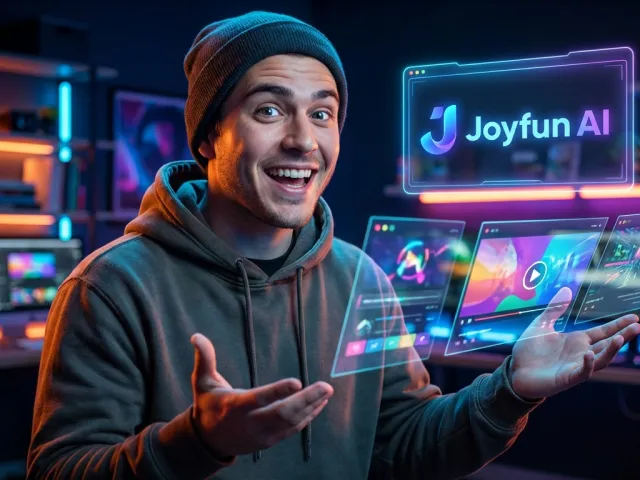
Joyfun AI is a web-based media generator rather than one single model. Its public site groups several workflows under the same brand:
- text-to-video;
- image-to-video;
- text-to-image and image-to-image;
- photo and video face swap;
- preset effects for kissing, dancing, hair changes, and other short animations.
The attraction is obvious. There is no software to install, and Joyfun says visitors can begin creating without an email address or password. Its image-to-video page advertises videos up to 10 seconds at up to 1080p. The kissing video page makes the same duration and resolution claims.
Those are vendor claims, not benchmark results. Joyfun does not publish a reproducible quality test, generation success rate, or a clear model-by-model price table on the pages reviewed. Output quality will also vary with the selected model, input image, prompt, server load, and paid tier.
That distinction matters. A long list of model names is not evidence that every model is available for every user, tool, resolution, or price.
Is Joyfun AI Really Free?
The honest answer is: Joyfun offers free access claims, but it also has a paid credit system. Its public pages do not reconcile the two clearly.
The homepage says Joyfun is “100% free,” has no credit system, and allows unlimited generations without watermarks. Its kissing video page makes a similar promise, describing the tool as free and unlimited with no hidden costs.
The pricing page tells a different story:
| Package |
Listed price |
Credits |
Video resolution |
Storage |
| Standard |
$24.99 one time |
3,000 |
Up to 720p |
7 days |
| Premium |
$79.99 one time |
20,000 |
Up to 1080p |
30 days |
| Deluxe |
$149.99 one time |
60,000 |
Up to 1080p |
60 days |
Premium and Deluxe list three parallel tasks, faster processing, no queue, no watermark, and credits that do not expire. The pricing FAQ says credits are used across Joyfun’s generative tools. It also says Face Swap is excluded from the one-time-payment system and uses a subscription.
Refunds have two conditions: the request must be made within 48 hours of purchase, and no more than 100 credits can have been used.
So, is Joyfun AI free? Possibly for selected basic generations. But “free” should not be read as “every feature, model, resolution, download, and priority level costs nothing.” The site needs a clearer table showing which actions are free, how many credits each generation consumes, and when payment becomes necessary.
Until then, I would test the exact workflow you need before paying. Check the selected model, resolution, watermark, storage period, and download requirements—not just the homepage promise.
Does Joyfun AI Require Registration or Login?
Joyfun repeatedly says that no sign-up or login is required to start. Its privacy policy goes further, stating that the service has no user accounts and therefore does not collect conventional profile data such as usernames and passwords.
That removes one source of friction. It does not make the service fully anonymous.
According to Joyfun’s privacy policy, the site may still collect:
- IP address and device information;
- browser, operating system, and time-zone data;
- feature usage and time spent using the service;
- prompts;
- uploaded images and videos;
- information voluntarily sent to support.
Payment introduces another layer. The pricing page includes an unsubscribe form that asks for the purchase email and the last four card digits for Face Swap subscriptions. At the same time, the public documentation does not clearly explain how purchased credit balances are recovered, transferred from the app, or connected to a user when no account exists.
The practical takeaway is simple: “no login” means you may not need a conventional profile for basic use. It does not mean no technical, usage, content, or payment data is processed.
Is Joyfun AI Safe to Use?
“Safe” can mean at least three different things here: is the website legitimate, are uploaded files private, and is generated content legally safe to use? Joyfun’s public documents answer parts of those questions, but not all of them.
Upload Privacy
Joyfun’s feature pages make strong privacy claims. The kissing video page says uploaded photos are discarded immediately after generation and are never stored or shared.
The privacy policy is broader. It says prompts and uploaded media are processed as user-provided content. It also says anonymized user content may be used to improve services and train AI systems, and that content may be retained for research and model-development purposes.
Both statements cannot describe every workflow in the same way without additional explanation. Perhaps some temporary files are deleted while anonymized derivatives are retained. Perhaps different tools use different pipelines. The public pages do not say.
My judgment: do not upload anything you would be uncomfortable losing control over. That includes identification documents, private photographs, unreleased campaign assets, confidential client work, intimate media, or images of children. Joyfun’s terms state that users must be at least 18.
Rights to Your Inputs and Outputs
The Terms of Service say users own their input and output and may use generated content commercially, subject to the terms. That sounds favorable.
The tradeoff appears in the next clause. Users grant Joyfun a worldwide, transferable, sublicensable, royalty-free, and irrevocable license to store, reproduce, modify, and create derivative works from their content to operate and improve the service and develop new technology. The license continues after the user stops using Joyfun.
Joyfun also warns that outputs may not be unique. It provides the service “as is,” gives no guarantee that it will be uninterrupted or error-free, and caps aggregate liability at $100.
For a casual synthetic image, that risk may be acceptable. For client work, recognizable people, proprietary designs, or commercially sensitive material, it deserves a deliberate review.
Consent and Face-Based Effects
Face swap and kissing effects create another risk that a normal text-to-video prompt does not. A technically successful result can still violate someone’s privacy or publicity rights.
Use images only when you have the subject’s permission and the right to upload them. Do not create misleading depictions of real people, and do not use the tools for harassment, impersonation, or non-consensual edits. Joyfun’s own terms require users to have the necessary rights and prohibit uploading images of people without consent.
Does Joyfun AI Support NSFW Content?
Joyfun’s public messaging is internally inconsistent.
The homepage describes the platform as largely uncensored and says it permits NSFW content while prohibiting illegal material. Joyfun also operates dedicated pages aimed at that search intent.
The Terms of Service prohibit content that is obscene or pornographic. That is not a minor wording difference. It changes what users can reasonably assume is permitted and whether access or purchased credits could be affected by enforcement.
Because the legal terms normally govern the service, users should not interpret “uncensored” as a guarantee that any adult prompt or upload is allowed. Joyfun needs a single content policy that defines the boundary consistently across its homepage, feature pages, moderation system, and terms.
This review does not recommend the service for non-consensual, exploitative, illegal, or explicit edits of identifiable people.
Joyfun AI Image-to-Video
Image-to-video is one of Joyfun’s central workflows. The advertised process is straightforward:
- Upload a still image.
- Add an optional motion prompt.
- Select the available model or settings.
- Generate and download the video.
Joyfun advertises outputs up to 10 seconds and 1080p. Its pricing page, however, lists the Standard pack as limited to 720p while Premium and Deluxe reach 1080p. That suggests maximum quality may depend on the selected plan, even though some feature pages describe 1080p as generally available.
Image-to-video will usually be more predictable when the source image is clear, well lit, and not heavily cropped. But Joyfun does not publish an independent consistency score or failure rate. Claims about lifelike motion, identity preservation, or generation speed should therefore be treated as marketing until tested with the exact workflow and model you intend to use.
Joyfun AI Kissing Video Generator
Joyfun’s kissing video generator accepts one or two images and says an optional prompt can control the mood and motion. It advertises 1080p output up to 10 seconds, no login, and unlimited free use.
The feature is easy to understand, but it carries more consent risk than a landscape animation. Two separate portraits can be combined into a scene that never happened. That makes permission and context essential.
Use fictional characters, synthetic images, or consenting adults. Do not use photographs of strangers, public figures, former partners, coworkers, or anyone who has not agreed to the edit. A visible disclosure that the result is AI-generated is also prudent; Joyfun’s terms specifically say users must not represent generated media as entirely human-made.
Joyfun AI Alternatives: Choose by the Job
There is no single best Joyfun AI alternative because users are looking for different things.
| Your priority |
Better approach |
| Casual experiments without creating an account |
Joyfun may be convenient, provided the input is non-sensitive and you verify the actual free limits first. |
| Confidential or identifiable media |
Use a service with explicit short-retention controls and a training opt-out, or a local workflow you control. |
| Model choice and repeatable production workflows |
Use a multi-model platform with documented pricing and API access. |
| Fashion, e-commerce, or outfit replacement |
Use a purpose-built clothing editor that excludes nude or explicit output. |
| High-volume application integration |
Choose documented APIs rather than automating a consumer website. |
GPT Proto does not claim to provide Joyfun AI itself. Instead, developers and creators can browse GPT Proto’s AI generator features or use the GPT Proto homepage to explore image and video workflows across multiple models.
For fashion restyling, lookbooks, and product-photo editing, GPT Proto’s AI Clothes Remover is positioned as an outfit replacement tool—not a generator for nude or explicit imagery. It requires an account and uses pay-as-you-go pricing, which adds friction but makes the commercial model clearer.
Who Should Use Joyfun AI?
Joyfun AI may suit someone experimenting with non-sensitive synthetic media who wants to see the interface before creating an account. Its collection of preset effects also reduces the prompt-writing needed for short social clips.
I would not choose it for confidential business assets, sensitive personal photos, client media with strict data terms, or any workflow that depends on a guaranteed moderation boundary. The problem is not simply that Joyfun collects data. Most hosted AI services do. The problem is that its homepage, pricing page, feature pages, privacy policy, and terms do not currently tell one consistent story.
That is fixable. Joyfun could publish a tool-by-tool pricing table, state exactly when login is required, separate temporary processing from training retention, and align its content marketing with its Terms of Service.
Until then, try it with disposable, non-sensitive inputs before trusting it with anything important.
Final Verdict
Joyfun AI offers an appealing front door: no conventional registration, several image and video tools, short preset effects, and claims of free access. The tradeoff is uncertainty.
The free claim conflicts with a paid credit page. The no-storage language on a feature page conflicts with a privacy policy that permits retention and training. The uncensored positioning conflicts with terms that prohibit pornographic content.
So, is Joyfun AI worth trying in 2026? For a low-stakes experiment using synthetic or non-sensitive images, perhaps. For private photographs, client work, or a dependable production pipeline, I would choose a service with clearer pricing, retention, and content rules.