TL;DR:
GPT Image 1.5は、従来モデルより4倍高速で、APIコストを20%削減したOpenAIの最新画像生成モデルです。高度な編集機能、優れたテキスト描画、指示への追従性の向上を特徴としています。ChatGPTとAPIから利用でき、進化を続けるAI画像生成市場でGoogleのNano Banana Proと直接競合します。
GPT Image 1.5の画期的な機能を紹介。4倍高速な生成、正確な編集、高度なテキスト描画のほか、実例、料金、性能を詳しく解説します。
GPT Image 1.5は、従来モデルより4倍高速で、APIコストを20%削減したOpenAIの最新画像生成モデルです。高度な編集機能、優れたテキスト描画、指示への追従性の向上を特徴としています。ChatGPTとAPIから利用でき、進化を続けるAI画像生成市場でGoogleのNano Banana Proと直接競合します。
GPT Image 1.5 has finally been released! Want to know what's new in this model? This article can help you find the answers. OpenAI recently released GPT Image 1.5, its latest image generation model that marks a significant turning point in artificial intelligence image technology. This release comes as OpenAI's direct response to Google's advancing Nano Banana Pro model, signaling intensified competition in the AI image generation field. The new model addresses critical needs for creators: generation speed, editing precision, and cost efficiency. Whether you're a designer, content creator, or business user, GPT Image 1.5 brings professional-grade tools within reach.
Key Points About GPT Image 1.5
Generate images up to 4 times faster than previous versions
Reduce API costs by 20 percent compared to GPT Image 1
Edit existing images with precise control and consistency
Render text accurately in images, infographics, and diagrams
Access through ChatGPT or integration via OpenAI API
Maintain lighting, composition, and facial likeness across edits
Support for complex layouts with 36+ elements in single image
GPT Image 1.5 represents OpenAI's latest evolution in image generation technology, building on GPT-5.2 reasoning capabilities to understand user requests with remarkable accuracy. Unlike earlier versions, this model translates creative intent into visual output with unprecedented precision.
Core Capabilities That Set It Apart
GPT Image 1.5 excels at understanding nuanced instructions and applying targeted changes. When you request specific modifications like changing clothing color or adjusting facial expressions, the model applies these edits precisely without reinterpreting the entire image. This breakthrough solves a long-standing problem in AI image editing.
The model handles text rendering at a professional level. Previously, generating legible text within images proved challenging, but GPT Image 1.5 renders clear typography, layouts, and complex information graphics accurately. You can now create posters, infographics, and diagrams with properly-placed text in various styles and sizes.
Performance metrics demonstrate substantial improvements. Generation speeds increased by 400 percent compared to its predecessor. This acceleration results from hardware efficiency improvements that allow faster processing without sacrificing quality.
GPT Image 1.5 fundamentally changes how creators interact with AI image tools, moving from passive generation to precise, iterative creation.
The new editing system enables "point-and-click" modifications that maintain visual consistency. Users can change specific elements—a person's clothing color, background details, or artistic style—while preserving original lighting, composition, and facial characteristics across multiple edits.
Real-world examples include:
Modifying a subject's outfit while maintaining natural pose and expression
Adding or removing background elements without disrupting the main scene
Applying artistic filters while preserving facial likeness
Multi-step sequential edits with guaranteed consistency
This capability transforms tedious manual editing workflows into intuitive, rapid iterations.
Creative flexibility has expanded dramatically with advanced style conversion capabilities. Users can transform ordinary photos into specific artistic contexts—converting everyday portraits into Hollywood Golden Age movie posters, transforming casual photos into vintage 1980s fitness magazine covers, or reimagining subjects in completely different environments.
The model understands complex creative briefs and executes them coherently, combining multiple style elements while maintaining subject recognition and quality.
The instruction-following capability represents a major technical breakthrough. The model successfully handles extraordinarily complex requests including:
6x6 grids containing 36 distinct elements (Greek letters, animals, objects, symbols)
Dense text rendering with multiple information layers
Complex programming interfaces and code display
Detailed scene composition with precise spatial relationships
This advancement means users can trust the model to execute sophisticated requirements without approximation.
OpenAI reduced API pricing by 20 percent, allowing developers and businesses to generate more images within the same budget. This pricing adjustment, combined with faster generation speeds, significantly improves operational efficiency for high-volume image creation workflows.
These four upgrades work synergistically to position GPT Image 1.5 as a comprehensive creative tool for both individual creators and enterprises.
GPT Image 1.5 represents a major leap forward from its predecessor through measurable improvements across key dimensions. The performance gains manifest in both technical metrics and user experience.
| Feature | GPT Image 1 | GPT Image 1.5 | Improvement |
| Generation Speed | Baseline standard | 4x faster | 300% improvement |
| API Cost | Full pricing | 20% reduction | Significant savings |
| Text Rendering | Limited accuracy | Advanced precision | Major upgrade |
| Image Editing | Basic edits only | Precise targeted edits | Much higher control |
| Instruction Following | Standard comprehension | Enhanced accuracy | Better prompt alignment |
| Detail Preservation | Moderate consistency | High consistency | Significant improvement |
The AI image generation field has become intensely competitive, with multiple providers offering increasingly sophisticated tools. OpenAI accelerated the release of GPT Image 1.5 specifically to respond to Google's Nano Banana Pro model, which achieved strong performance across multiple industry benchmarks.
The competitive landscape includes:
Google Nano Banana Pro: Advanced model with Gemini 3 Pro integration, strong photorealism
Qwen-Image: Supports readable Chinese and English text generation with multi-language capabilities
Black Forest Labs Flux.2: Open-source model with strong creative capabilities and accessibility
| Capability | GPT Image 1.5 | Nano Banana Pro | Qwen-Image | Flux.2 |
| Generation Speed | 4x faster | Standard | Standard | Varies |
| API Cost | 20% reduced | Standard | Competitive | Open-source |
| Text Rendering (English) | Excellent | Good | Good | Good |
| Text Rendering (Chinese) | Poor | Poor | Excellent | Poor |
| Photorealism | Good | Excellent | Good | Very Good |
| Complex Composition | Excellent | Good | Good | Very Good |
| Instruction Following | Excellent | Good | Excellent | Good |
| Detail Accuracy | Good | Excellent | Good | Very Good |
| E-Commerce Products | Good | Excellent | Good | Very Good |
| Facial Feature Preservation | Good | Excellent | Good | Very Good |
| Multi-Person Editing | Moderate | Good | Moderate | Good |
| Artistic Style Control | Good | Good | Good | Excellent |
| Overall Ease of Use | Excellent | Good | Good | Moderate |
GPT Image 1.5 excels in instruction following and complex element composition, making it ideal for users who need precise control. However, Google's Nano Banana Pro maintains superiority in photorealism and detail accuracy, particularly valuable for e-commerce and professional product photography. Qwen-Image stands out for multi-language text rendering, especially Chinese. Black Forest Labs' Flux.2 offers the strongest artistic style control and is available open-source for custom implementations.
This performance variation underscores an important truth: no single model dominates across all dimensions. Tool selection depends on your specific use cases rather than aggregate rankings.
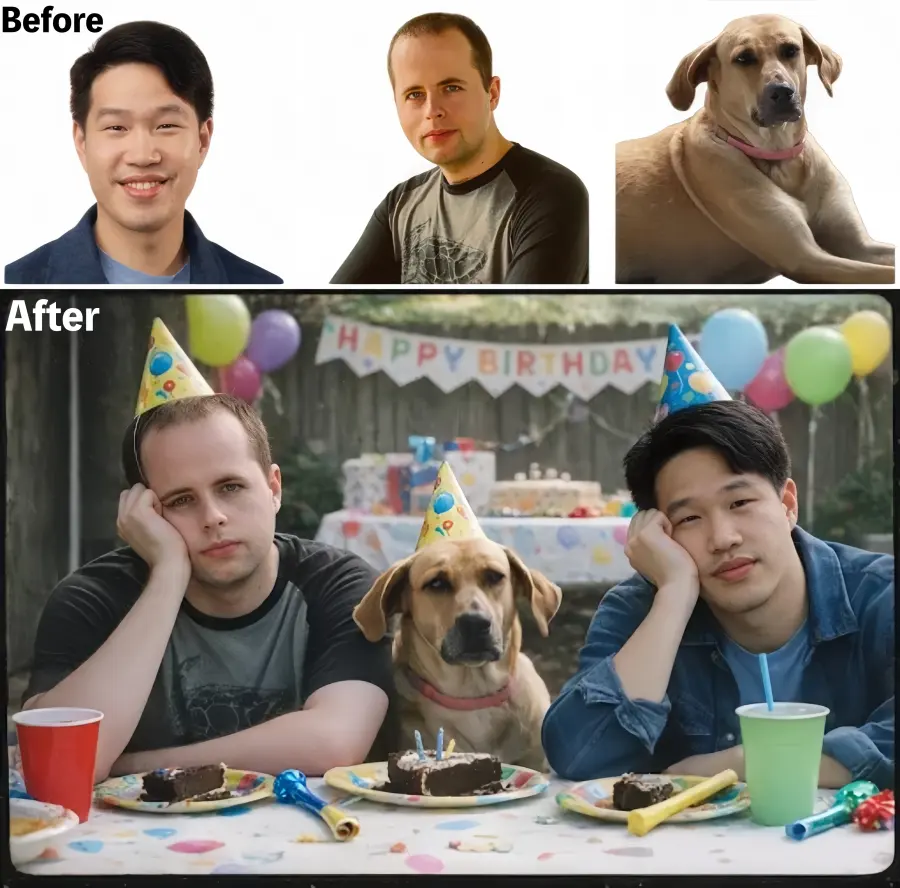
Users can transform a simple group photo through sequential edits. The model maintains consistency while:
Adding detailed background elements (multiple children, activity)
Changing individual outfits without affecting others
Converting artistic styles (cartoon vs. realistic)
Switching entire backgrounds while preserving subjects
Each edit builds on the previous version while maintaining visual coherence.
Prompt Example: Make a 2000s film-style photo, composite these two men and the dog into it, and capture them looking bored at a kid's birthday party.
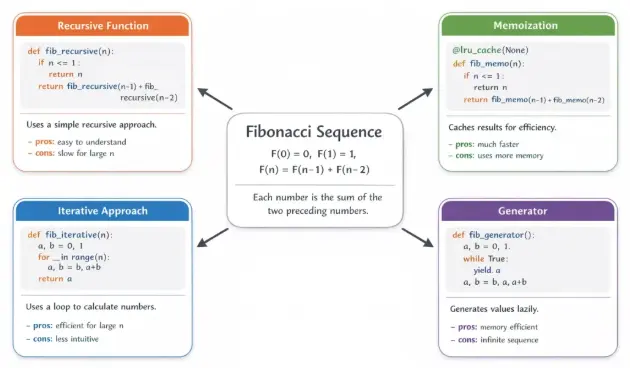
The model successfully renders sophisticated layouts including:
Calorie information tables with precise formatting
Programming code interfaces with proper syntax highlighting
Dense text layouts with varying font sizes and styles
Multi-language documentation (with English language advantage)
GPT Image 1.5 convincingly reimagines subjects across vastly different contexts:
Contemporary photos as vintage movie posters
Casual portraits as 1970s street photography
Modern clothing styled as 1980s fashion magazine covers
T-shirt design concepts rendered as wearable products
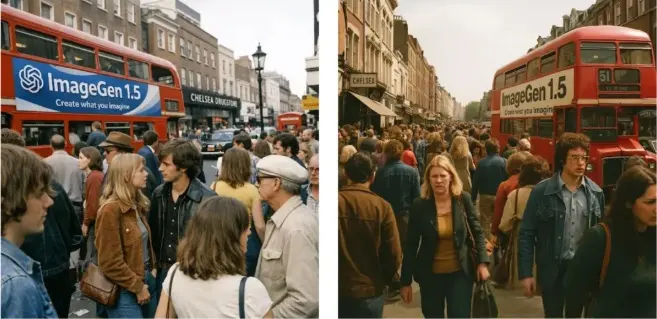
These examples demonstrate GPT Image 1.5's ability to handle both precise technical requirements and open-ended creative requests.
Despite impressive capabilities, GPT Image 1.5 has notable limitations that require honest assessment. Understanding these boundaries helps users apply the tool appropriately to suitable use cases.
When editing group photos with multiple subjects, the model struggles to maintain consistent facial features across all individuals. Simple modifications like adding matching clothing across a group can result in:
Facial proportion distortions
Feature misalignment or blurring
Unnatural appearance in processed subjects
Loss of likeness in group contexts
This limitation particularly impacts marketing teams needing consistent product photos across multiple models.
The model exhibits severe limitations with non-English languages:
Chinese text: Completely unusable, with garbled characters and unreadable output
Arabic and Hebrew: Inconsistent rendering with alignment issues
European languages: Better performance but still imperfect
English-language text rendering remains the clear strength, limiting global applicability.
The model sometimes struggles with specific artistic style requirements:
Japanese anime aesthetics lack authentic emotional depth and linework
Dark fantasy art styles produce inconsistent interpretations
Specific artistic movements difficult to replicate faithfully
Loss of artistic nuance compared to previous versions
OpenAI acknowledges that certain art style capabilities regressed compared to earlier versions.
Large group portraits (15+ people) become difficult to render accurately
Inconsistent handling of specific design requirements
Complex spatial reasoning sometimes requires multiple iterations
Some artistic filters produce less authentic results than competitors
These limitations don't negate the model's value but rather define its optimal use cases in professional and creative applications.
Content creators benefit from rapid iteration and consistency. The 4x speed improvement enables faster creative workflows. The 20% cost reduction makes experimentation economically viable for small teams and independent creators exploring visual content strategies.
Businesses can generate product variations at scale—different angles, backgrounds, and styling options from single source images. Brand consistency features ensure logos, colors, and product appearance remain reliable across generated assets.
Precise editing capabilities bring AI tools closer to professional design software workflows. Rather than starting over with minor adjustments, designers can request specific changes while maintaining composition and aesthetic integrity.
The 20% API cost reduction combined with faster response times makes image-based features economically feasible for applications. Unified access through OpenAI's platform simplifies integration and billing management.
Different user types benefit from distinct advantages, making GPT Image 1.5 versatile across creative and commercial applications.
Getting started with GPT Image 1.5 is straightforward for both casual users and developers. OpenAI provides multiple access methods depending on your needs and technical expertise.
ChatGPT Usage:
Free users: Limited free credits monthly
ChatGPT Plus: $20/month subscription includes generous image generation
For Free Users:
Visit ChatGPT - Go to chat.openai.com and sign in with your OpenAI account (create one if needed)
Locate the Images Feature - Look for the new "Images" tab or icon in the left sidebar of ChatGPT
Select Image Tools - Click on "Generate" or "Create images" option
Start Creating - Begin typing your image generation prompts or use pre-built style filters
Edit Your Images - Use the built-in editor to modify generated images with specific instructions
Save and Share - Download your images and share them directly
For ChatGPT Plus/Pro Subscribers:
ChatGPT Plus users get priority access and faster generation speeds. The process is identical to free users but with enhanced performance and higher usage limits.
Tips: Here is a Tips about How to get ChatGPT Plus Free.
API Pricing:
Image generation: Price varies based on resolution and quality
20% discount on GPT Image 1.5 compared to GPT Image 1
Volume discounts available for enterprise customers
Prerequisites:
OpenAI account with API access enabled
API key generated from your OpenAI account dashboard
Basic programming knowledge (Python, JavaScript, or your preferred language)
Familiarity with REST APIs or SDK usage
Step-by-Step Setup:
Step 1: Create OpenAI API Account
Visit platform.openai.com
Click "Sign up" or "Log in" if you have an existing account
Complete email verification and phone number confirmation
Accept terms of service
Step 2: Generate API Key
Navigate to "API keys" section in your account dashboard
Click "Create new secret key"
Copy the key immediately (you won't see it again)
Store it securely in an environment variable or secure vault
Never share your API key publicly
Step 3: Set Up Billing
Go to "Billing" section in your OpenAI dashboard
Add a payment method (credit card)
Set usage limits to control spending
Monitor your usage regularly
Step 4: Install OpenAI SDK
For Python:
bash
For JavaScript/Node.js:
bash
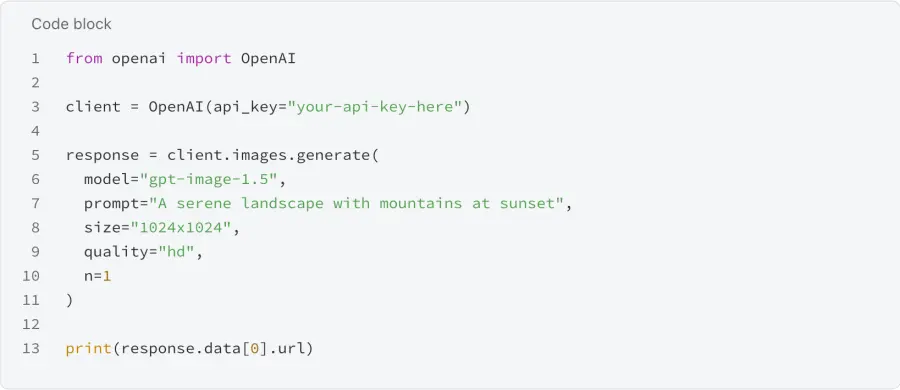
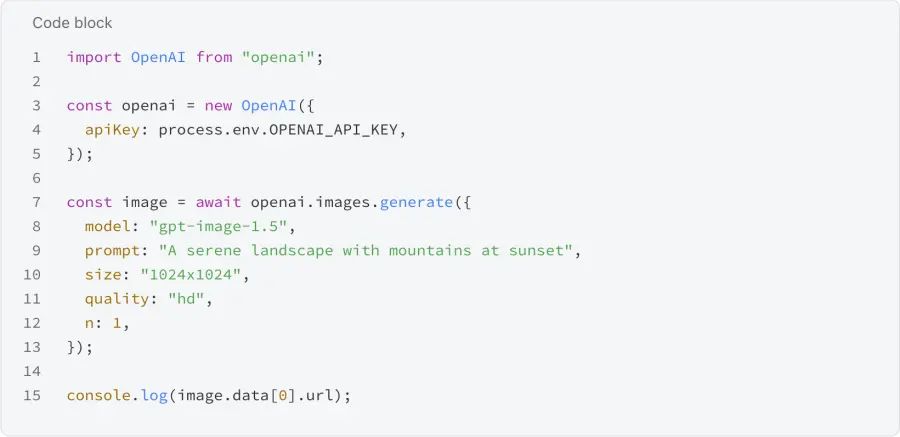
Step 5: Write Your First API Call
Python example:
JavaScript example:
Step 6: Handle API Responses
Check response status codes
Implement error handling for API failures
Store image URLs or download images for long-term storage
Implement rate limiting to avoid quota exhaustion
When major AI API platforms evolve with uncertain pricing, shifting capabilities, and changing roadmaps, developers and businesses face significant risks. GPT Image 1.5 offers impressive capabilities, but relying on a single provider creates vulnerability to sudden policy changes, pricing increases, or feature modifications. GPT Proto solves this dilemma by providing unified access to multiple leading image generation models, including GPT Image 1.5 itself, alongside Google's Nano Banana Pro and other alternatives.
GPT Proto functions as a comprehensive gateway to multiple leading AI models including GPT Image 1.5, Claude, Gemini, and specialized image generation tools. Rather than managing separate API keys, documentation, and billing systems for each provider, developers integrate once and access everything through a unified interface. This eliminates the need to choose between competing models—you can use them all strategically.
Core Advantages That Make GPT Proto Stand OutFeatureSingle Provider (GPT Image 1.5)GPT Proto Multi-Model AccessVendor Lock-in RiskHigh - dependent on one providerEliminated - multiple optionsPricing ControlSubject to changesNegotiated rates across providersModel FlexibilityLimited to GPT Image 1.5Access to 4+ image modelsResponse TimeStandard latencySub-200 millisecond guaranteeService UptimeProvider dependent99.9% guaranteed uptimeBilling ComplexitySeparate accounts/systemsUnified billing dashboardTechnical SupportStandard supportSpecialized expert assistanceFeature ComparisonManual testing requiredDirect A/B testing built-in
GPT Proto Pricing:
Aggregated discounts through volume partnerships
Custom pricing based on model combination and usage
Contact sales for enterprise quotes
For Organizations Wanting Multiple Models:
Visit GPT Proto Platform - Go to gptproto.com
Sign Up - Create an account or sign in with existing credentials
Configure API Keys - Input your GPT Image 1.5 API key and other model keys
Select Models - Enable access to GPT Image 1.5, Nano Banana Pro, and other tools
Generate Single Integration Key - Receive unified API credentials
Start Building - Use GPT Proto's unified interface to access all models
GPT Proto eliminates managing multiple API keys and billing systems, making it ideal for teams testing multiple models simultaneously.
Issue: "API Key Invalid" Error
Verify you copied the complete API key without extra spaces
Ensure the key hasn't expired
Check that you're using the correct API endpoint URL
Issue: Rate Limiting or Quota Exceeded
Implement exponential backoff in your code
Check your account's usage limits
Consider upgrading your billing tier
Issue: Image Generation Taking Too Long
GPT Image 1.5 generates 4x faster than previous versions
Wait time typically 1-3 seconds
If longer, check network connectivity and API status
Issue: Poor Quality Results
Provide more detailed, specific prompts
Use style references or artistic direction
Experiment with different parameter settings
Review prompt engineering best practices
Choose your access method based on your needs—ChatGPT for casual creative work, API for developer integration, or GPT Proto for organizations needing multi-model flexibility and cost optimization.
Hardware efficiency improvements and optimized inference pipelines enable faster processing. The model generates images using less computational overhead while maintaining quality standards. This results in the reported 4x speed improvement without sacrificing output quality.
Yes, images generated through GPT Image 1.5 can be used commercially. Review OpenAI's specific terms of service regarding commercial licensing and usage rights to ensure compliance with your particular business application and jurisdiction.
The model excels at preserving visual elements across edits and variations. When you provide brand assets like logos or color palettes, the model maintains consistency throughout generated variations. This makes it particularly valuable for enterprise marketing workflows requiring uniform visual identity.
GPT Image 1.5 delivers genuine improvements—4x faster generation, 20% lower costs, and precise editing capabilities. However, it excels at instruction-following and composition while lagging in photorealism and multilingual text rendering compared to alternatives like Nano Banana Pro and Qwen-Image.
The key is matching the tool to your needs. Content creators benefit most from its speed and precision. E-commerce teams prioritizing photorealism should evaluate Nano Banana Pro. Teams needing strategic flexibility can leverage GPT Proto's multi-model access without vendor lock-in.
Start with ChatGPT's free tier to test against your specific requirements. If GPT Image 1.5 fits your use cases, the API integration is straightforward. If limitations emerge, alternatives are readily available through unified GPT Proto AI API Platform.
The intensity of competition in AI image generation benefits everyone through lower prices and faster innovation. Success depends not on finding "the best" model, but on understanding each tool's strengths and applying them purposefully to your specific problems.
要約: GPT Image 1.5は、精密な編集と英語テキストの描画に優れています。Nano Banana Proは、速度、中国語対応、自然な出力で勝っています。ワークフローのニーズに応じて選びましょう。
Tiffany Layne | 2026-02-03
概要: 2025年4月に発表されたGPT-Image-1は、GPT-4oを基盤とするOpenAIのマルチモーダル画像生成モデルです。テキストプロンプトからフォトリアルな画像やスタイライズされた画像を作成でき、テキスト描画、指示への忠実な対応、反復編集に優れています。API料金は画像1枚あたり0.01~0.17ドルから利用できます。
Tiffany Layne | 2026-02-03
OpenAIは、 GPT-5 Image のリリースにより、生成アートの世界を一新しました。これは単なる段階的なアップデートではなく、人工知能が視覚的な意図を解釈し実行する方法を根本から変えるものです。高度な画像生成を通常のチャットの制約から切り離すことで、 GPT-5 Image は驚異的な92%のプロンプト精度と、プロフェッショナル向け8K解像度を実現します。本記事では、 GPT-5 Image が企業やクリエイティブの専門家にとって新たな標準になりつつある理由を詳しく解説し、中核機能、料金体系、従来のマルチモーダルシステムに対する独自の優位性を検証します。
Schuyler Stacy | 2026-03-02