Which Claude model should you pick?
Choose Sonnet 5.5 for the best overall balance in our test. It is our recommendation for players who want a recognizable character, room to make their own decisions and a story that follows the setup. Choose Haiku for the lowest cost, Opus for restrained emotional dialogue, or Fable for a more immediately engaging opening.
| If you play for… |
Start with |
What happened in our test |
| An ongoing story with promises and secrets |
Sonnet 5.5 |
Recalled the meeting place in all five endings. In Spanish, it also kept the time Mara had added earlier. |
| Everyday banter on a small budget |
Haiku 5.5 |
Five chats cost $0.0019. Its Chinese Mara found a reason to keep Kit talking, though it redirected the requested meeting in English and introduced an unestablished location in its Spanish ending. |
| Slow-burn scenes where characters talk around their feelings |
Opus 5.5 |
In Russian, Mara lets slip that she remembers how Kit takes tea. Its Spanish scene introduced a closed bridge and gave a first-day porter an unexplained earlier memory. |
| A sharp opening line to play off |
Fable 5.2 |
“You crossed a road for bad tea. That's either a peace offering or a dare.” Five chats cost about five times as much as Sonnet's. |
One character card, one secret, six turns
You play Kit. The model plays Mara, a railway café clerk who hasn't seen you in six years. She still remembers that you take your tea without sugar. You walk in holding a paper cup from the café across the street.

On turn two, you privately propose meeting at the west footbridge if you miss the last train. On turn three, you start to tell Mara something important and stop. A new porter, Jules, comes in. When Mara steps away, you ask Jules where she might go. Finally, the train leaves. You ask Mara if she remembers where to meet.
We checked whether Mara kept her guarded personality, whether new details fit what had already happened, whether her dialogue offered a useful next move, and whether the model left Kit's decisions to the player. We also watched how it handled Jules, who had missed the private conversation.
We ran each combination once through the SillyTavern 1.19.0 backend and GPT Proto API, with full chat history and temperature set to 1.0. The English card kept its original English-language instruction, with the target language specified at the end. The 23 finished chats produced 138 replies. An AI reviewer saw anonymized outputs for style judgments. No native-speaker panel reviewed the five languages, so language-specific style preferences are editorial observations. Plot details below come from the transcripts. Six turns test short scenes; longer campaigns would need a separate run.
What roleplay players actually care about
Someone exchanging affectionate messages with a single character may care most about voice. Someone running a mystery with several NPCs also needs each character to know only what they have learned. A player in r/SillyTavernAI makes this distinction explicitly when describing their preference for scenario-based roleplay. Introducing a second NPC midway through our scene lets us examine that distinction. Read the player's scenario comparison.
Preset creator Marinara praises the nuance and prose of an earlier Opus version while also noticing recurring Claude mannerisms. That is a useful question to bring to a fresh test: do the gestures express this character, and do they start repeating? The post discusses Opus 4.6, so our judgments about Opus 5.5 below come from our own transcripts. Marinara's model notes.
Researchers also treat roleplay as behavior unfolding through a story. CharacterBox examines character fidelity and behavior across simulated situations, which provides a useful research basis for inspecting complete conversations. Our café exercise is a small editorial test. CharacterBox research.
Character consistency — Sonnet 5.5 is our top pick
Choose Sonnet 5.5 when staying true to the character card is your priority. In our English scene, Mara remained guarded through the reunion, the unfinished confession and the arrival of a stranger. Her reluctance shaped both her dialogue and her actions. This makes Sonnet our first choice for reserved characters and relationships that should develop gradually.
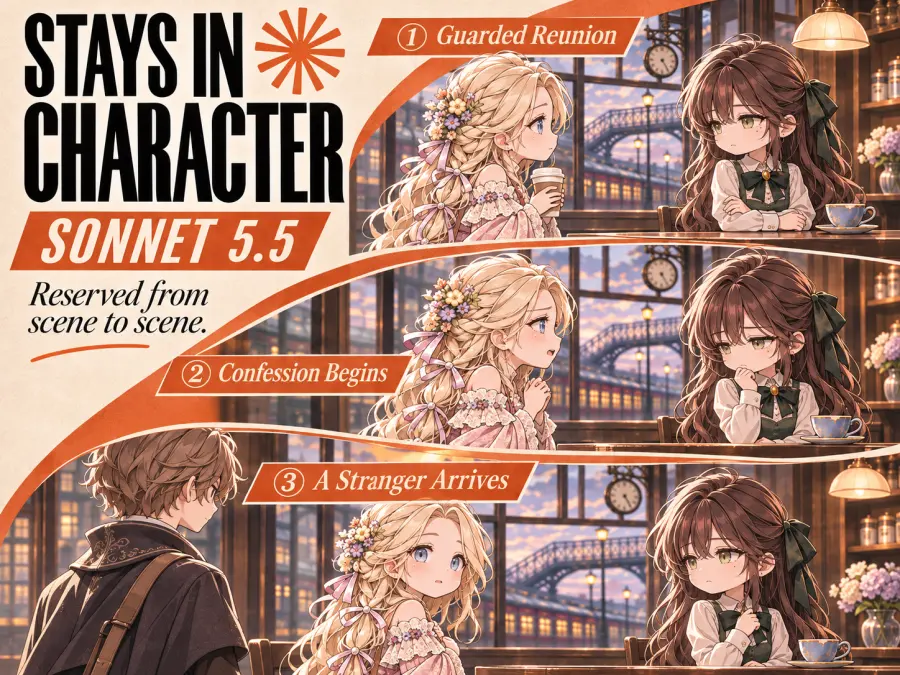
Mara's card gives her three behavioral traits: she is dryly funny, struggles to say what she wants, and finds practical work when a conversation gets uncomfortable. A convincing reply should express those habits through her response to Kit.
| Model |
What Mara does in the English scene |
What that means for your card |
| Sonnet |
Counts coins slowly while considering the meeting, turns away when Kit hesitates, and asks to arrive separately at the bridge. |
The same reluctance appears in several different situations. A strong starting point for guarded relationships. |
| Haiku |
Dries an already dry cup, calls Kit an acquaintance, and interrupts Jules's curiosity with work instructions. |
Dry humor and practical evasions suit the card, even when Haiku redirects the setting. |
| Opus |
Cleans the counter, opens the till unnecessarily, then softens when Kit starts speaking honestly. |
A character can change emotionally within a scene while keeping recognizable habits. Good material for slow-building tension. |
| Fable |
Fidgets with the cup, offers a back-door key, then tells Jules that knowing Kit means more than she is willing to explain. |
Gives the relationship more explicit emotional meaning. Useful if you want the scene to open up sooner. |
Sonnet's English Mara feels consistent to us because her reluctance affects both her words and choices. Fable's fourth reply is more revealing. She tells a stranger, “That's what people say when it's more than that but they're not going to explain it to a stranger.” Some players will enjoy that directness. For a card built around concealing feelings, it exposes more than the other versions do.
Character consistency also includes the supporting cast. Opus's Spanish Jules says he has worked one shift, then recalls overhearing Mara during works in December. The scene gives no explanation for how he was there earlier. That is an unsupported addition to the newcomer's history.
Story continuity — Sonnet 5.5 follows the setup most reliably in this test
Choose Sonnet 5.5 for scenes built around an established plan, promise or destination. It explicitly returned to the requested western footbridge in all five language runs. Haiku and Opus sometimes introduced obstacles that redirected the scene, while Fable’s Spanish ending substituted an unestablished shared memory. Sonnet therefore gets our recommendation for following the player’s setup, with the staging issue below showing where it still slipped.
The transcripts contain several different kinds of continuity problem. Reading only the last reply can misidentify them.
Haiku's English ending follows its own earlier change. On turn two, Mara says the western side is closed for works and proposes “East side. Under the clock.” On turn six, she repeats that location. It has remembered its alternative. The decision for a player is whether they welcome the model changing their proposed meeting place before they have accepted the change.
Haiku's Spanish ending adds a different shared past. Earlier, Mara says the bridge is closed and suggests coming to the café. At the end she names an old signal post, then says Kit used to climb onto its roof and describes something Kit supposedly said there. That location and player history were never established.
Sonnet retains the requested destination but has a staging problem. In English, it sends Jules out on an errand and waits for the door to close. The next user prompt assumes Jules is still available to talk, and Sonnet places him by the urn without describing his return. The fixed script contributes to this mismatch. A smoother continuation would briefly explain that he came back. Remembering the bridge does not make every part of the scene consistent.
Opus introduces obstacles, then follows a new clue. In Spanish, it declares the bridge closed on turn two. Jules later mentions an old road, and Mara recalls that road at the end while describing the bridge as no longer existing. This combines an unrequested setting change, a shift to a different location and an escalation from closed to nonexistent.
For our six-turn story, Sonnet gave the clearest callbacks to the original meeting. A months-long campaign would require further testing. When a long chat drifts, also check which history your frontend actually sends. SillyTavern documents how character definitions and chat history share the context budget. SillyTavern's character and context guide.
Writing style — Opus 5.5 for restrained emotion, Fable 5.2 for lively openings
Opus 5.5 is our style pick for understated emotional scenes. Its short, pointed lines give an awkward reunion tension while leaving space for the player to respond. For a more immediately playful opening, choose Fable 5.2: its “peace offering or a dare” line invites a comeback, a denial or a flirtatious answer. These are our editorial preferences from the excerpts below.
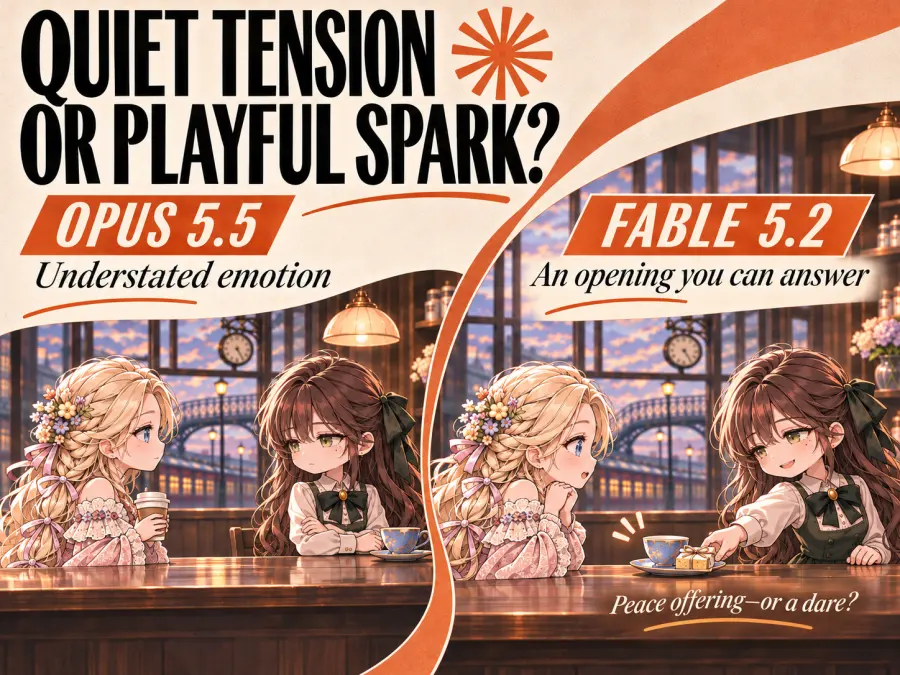
For everyday dry banter on a small budget, choose Haiku. Sonnet remains our overall recommendation when you want subtle dialogue together with stronger adherence to the scene’s setup.
| Model |
English excerpt |
Why you might choose it |
| Haiku |
“That's a long time to keep a sentence in your pocket.” |
A compact metaphor and dry humor. It gives an ordinary exchange a memorable line. |
| Sonnet |
“Six years ago the dairy delivery came Thursdays.” |
Mara dodges the unfinished confession with an everyday memory. The emotion is implied. |
| Opus |
“You've had six years to practice. I'll take the short version.” |
Direct, slightly cutting dialogue that asks the player to continue. |
| Fable |
“That's either a peace offering or a dare.” |
A clear conversational hook. Kit can flirt, deny it or turn the accusation back on Mara. |
For this scene, our writing-style recommendations are Opus for emotional restraint, Fable for an engaging opening, and Haiku for inexpensive dry humor. Sonnet combines implied emotion with the continuity that makes it our everyday pick.
All four also leaned on similar gestures: wiping clean surfaces, handling cups and finding something to do with their hands. Those actions were prompted by Mara's personality. They demonstrate adherence to the card, while showing how easily a chosen mannerism can dominate a short exchange. Six turns provide too little evidence to rank long-session repetition.
Your card can shape this style substantially. SillyTavern's documentation highlights the first message as a strong influence on reply style and length. Try a terse greeting for short chat or a more descriptive opening for scene writing before deciding that a model always sounds too verbose. Character opening-message guidance.
Plot progression — Fable 5.2 offers the strongest invitations to act
Choose Fable 5.2 if you want the character to give you an obvious next move. Its English Mara offers a back-door key, asks whether the conversation will happen at the door or on the platform, and opens with a challenge Kit can answer several ways. Those concrete invitations made it our favorite for getting this scene moving.
We left Kit's confession unfinished on purpose. In all four English runs, the model let Kit supply the missing words. Their ways of inviting the next turn differed.
Haiku points out that the train leaves in an hour. The conversation now has a deadline.
Sonnet says the station is empty, giving Kit a private moment to speak.
Opus moves closer and asks for the short version. The tension becomes more immediate.
Fable asks whether this will be a conversation at the door or on the platform. Kit gets a choice of how the scene proceeds.
Fable also slides over a back-door key on turn two. That gives the player something concrete to use. Haiku creates a closed bridge. That creates a problem for the player to solve. These are both proactive moves, but they suit different preferences: an invitation expands your options, while a blocked location may disrupt a plan you wanted to play.
Player control — Sonnet 5.5 is our first choice
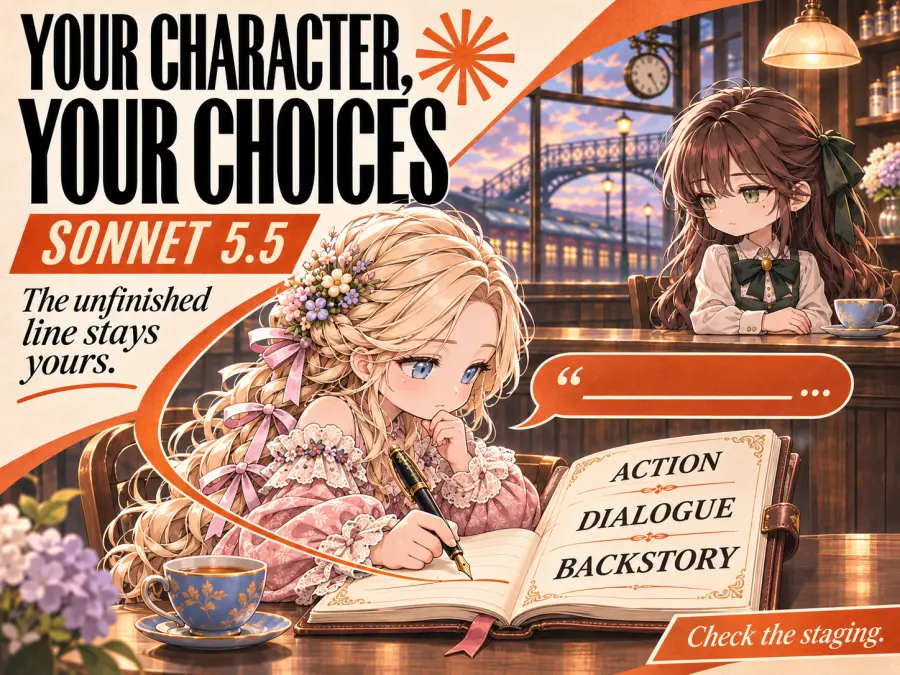
Choose Sonnet 5.5 if you want to decide your own character’s actions and backstory. It left the unfinished confession for Kit to complete, and our reviewed runs did not show it assigning Kit the kind of invented past dialogue found in Haiku’s and Fable’s Spanish endings. Its English staging mismatch still needs attention, but its handling of Kit makes it our preferred starting point for players with a carefully authored persona.
Player control matters beyond the current turn. Opus's English Mara tells Jules that Kit is taking a specific train, turning an unconfirmed possibility into a fact. In Spanish, Haiku invents Kit's earlier rooftop habit and Fable invents something Kit once told Mara. If you carefully author your own character's history, these additions can be more intrusive than a new detail about the café.
Our recommendation is Sonnet for control over your persona and Fable for more active invitations from the other character. Fable’s invented Spanish backstory is the reason we give these two recommendations to different models.
Multilingual roleplay — Sonnet 5.5 is our default across languages
Start with Sonnet 5.5 when keeping the requested story setup matters across languages. Its five endings all returned to the western bridge. For specific experiences, our picks are Fable for Russian banter, Haiku for inexpensive Chinese improvisation and Opus for understated Japanese dialogue. The examples below explain those preferences; our language judgments received no native-speaker panel review.
Spanish: Three different places to meet
The same final question, “¿Te acuerdas de dónde?” (“Remember where?”), produced the clearest split in the test.
| Model |
Mara's answer, excerpted |
What the player gets |
| Sonnet |
“Del lado oeste, once y media.” |
The west side of the bridge, at eleven thirty. Kit can pick up where the two left off. |
| Haiku |
“El puesto de señales viejo, arriba del túnel.” |
The old signal post above the tunnel, plus an invented memory of Kit visiting it. This location was never established. |
| Opus |
“Me acuerdo de dónde está la carretera.” |
Mara follows the road mentioned by Jules after having already declared the requested bridge closed. |
For this Spanish scene, we'd start with Sonnet. The other replies illustrate how fluent writing can redirect an established situation. Opus's road callback deserves scrutiny alongside its earlier decision to close the bridge.
Russian: How would an old friend make fun of terrible tea?
Fable called it “горячая вода, которая однажды слышала слово «чай»” (“hot water that once heard the word ‘tea’”). GPT-6 Sol called it “горячая вода с трудным детством” (“hot water with a difficult childhood”). Both lines give Kit an easy opening for a comeback.
Opus took a quieter approach. “Ты, значит, всё ещё пьёшь без сахара” means roughly “So you still take it without sugar.” If you're playing a reunion for the awkward affection, that's the line we'd want to answer. For a Russian scene that also needs to land the final callback, Fable and GPT both explicitly remembered the west bridge. GPT played three languages in this test. Our ChatGPT roleplay comparison explores that family in more detail.
Chinese: Haiku gives you a reason to stay
Haiku's Mara says “人行桥锁了,那就只剩下候车室” (“The footbridge is locked, so that leaves the waiting room”). Then she pushes the cup toward Kit: “说吧。别等火车替你挑时间。” Roughly, “Go on. Don't let the train pick the time for you.”
That's a playable turn for someone who came for the conversation. It also changes the plan. If you enjoy improvisation, try Haiku. If you want the setting you established to hold, Sonnet explicitly recalled “西边的人行桥,” the western footbridge.
Japanese: How short can a good reply be?
Opus's Mara answers “歩道橋。西側” (“The footbridge. West side”). She removes her apron and leaves Kit's cup on the shelf. Two clipped phrases and one ordinary gesture do the work. Haiku gives more directions, including the west side and the second set of stairs. The staircase is added scenery. Players who enjoy visual detail may like it; players who prefer an understated exchange have a good reason to try Opus.
English: Fable opens the scene, Sonnet brings it home
Fable's “peace offering or a dare” works because Kit can plausibly answer either way. Sonnet gave us our favorite ending for the same reason: after acknowledging the footbridge, Mara asks Kit to walk slowly so they won't arrive together. You get to decide whether to humor her. Haiku also produced dry café banter. Its “East side. Under the clock” ending preserves the alternative it proposed earlier, showing the trade-off between creative redirection and following the player's premise.
If you like comparing how different models write the same relationship, our Kimi roleplay test offers another set of character voices.
Roleplay cost — Haiku 5.5 is cheapest, Sonnet 5.5 is our value pick
Choose Haiku 5.5 for the lowest bill, or Sonnet 5.5 for our preferred balance of cost and scene quality. Haiku’s five chats cost $0.0019. Sonnet’s cost $0.0387 and gave us clearer adherence to the requested meeting across all five languages. Fable’s $0.1941 total buys a style we liked in particular moments, while Sonnet earns our recommendation for regular use in scenes like this one.
These are the amounts on our November 19, 2026 GPT Proto bill. Each Claude played five six-turn chats. We also ran GPT-6 Sol in English, Russian and Spanish as a comparison.
| Model |
Completed chats |
Billed amount |
| Haiku 5.5 |
5 |
$0.0019 |
| Sonnet 5.5 |
5 |
$0.0387 |
| Opus 5.5 |
5 |
$0.1162 |
| Fable 5.2 |
5 |
$0.1941 |
| GPT-6 Sol |
3 |
$0.0360 |
All four Claude models together cost $0.3509. The bill groups charges by model, so we can’t assign a price to an individual language. Opus's total includes a Spanish run that required two replies to be discarded and regenerated after a connection error. The separate $0.2393 charge for AI judging is excluded from the table.
For a player who mainly trades short messages with a favorite character, Haiku is an inexpensive place to start. If your card revolves around private promises, try the same conversation with Sonnet and see which ending you would keep. You can switch between them with one GPT Proto API key. Compare Claude API prices or check pay-as-you-go pricing.
How to roleplay with Claude using your own card
Pick a card you know well. In SillyTavern, start with Sonnet, set your preferred reply language and open a fresh chat. Give one character a private detail, bring someone else into the room, then ask each character about it separately. Save your favorite line. Repeat with Haiku from a fresh chat to see whether the extra cost buys something you care about. Follow our SillyTavern API setup guide or, if your card lives in Janitor AI, use the Janitor AI API guide.
For a quick first turn directly through the API, set your GPT Proto key in the GPTPROTO_API_KEY environment variable and run:
curl -sS https://gptproto.com/v1/chat/completions \
  -H "Authorization: Bearer $GPTPROTO_API_KEY" \
  -H 'Content-Type: application/json' \
  -d '{
    "model": "claude-sonnet-5-5",
    "messages": [
      {"role": "system", "content": "Play Mara, a dryly funny railway café clerk. I play Kit, your old friend. Leave my words and actions to me."},
      {"role": "user", "content": "I set a paper cup from the café across the street on your counter. Before you say anything, their tea is terrible."}
    ]
  }'
Which Claude model is best for SillyTavern? For a card like Mara's, we'd load Sonnet first. If you mostly want quick exchanges and enjoy an improvised twist, Haiku costs much less. For picks beyond Claude, see our best models for SillyTavern and roleplay model comparison.
What if content restrictions are my main concern? This café scene tested dialogue, character knowledge and continuity. For a comparison built around content restrictions, see our uncensored LLM API guide.
Our final recommendation
Start with Claude Sonnet 5.5 for character roleplay. In this test, it offered the most useful combination of a consistent guarded personality, clear callbacks to the requested setting, control over the player’s persona and a modest bill.
Choose Haiku 5.5 when cost is the deciding factor and you enjoy improvising around changes. Choose Opus 5.5 for quiet emotional dialogue. Choose Fable 5.2 when you want playful openings and concrete invitations to act. These are recommendations for the scene we tested, with Sonnet as the default.