Seedance 2.0 vs Seedance 2.5: Quick Verdict
| Question |
Better Choice |
Why |
| Which won our same-prompt story test? |
Seedance 2.5 |
More convincing emotion, continuity, and photographic atmosphere |
| Which followed the storyboard more literally? |
Seedance 2.0 |
Its opening angle and several close-ups stayed closer to the written shot list |
| Which is better for cinematic short films? |
Seedance 2.5 |
The scenes feel connected by human behavior rather than assembled around separate visual highlights |
| Which is better for subtle facial emotion? |
Seedance 2.5 |
The interaction feels less posed and the emotional response develops more naturally |
| Which is better for lower-cost iteration? |
Seedance 2.0 |
Its current GPT Proto starting price is lower |
| Which supports longer official output? |
Seedance 2.5 |
Up to 30 seconds in one generation, versus 15 seconds for Seedance 2.0 |
| Which accepts more official reference material? |
Seedance 2.5 |
Up to 30 images, 10 videos, and 10 audio clips |
| Which should ecommerce teams use? |
It depends |
Seedance 2.5 for lifestyle storytelling; use the route with the strongest available product-reference control for identity-sensitive product shots |
This verdict comes from one controlled case study, not a multi-prompt benchmark. Video generation is variable, and another run can change individual details. What this test does show is how the two models interpret the same 15-second narrative brief.
Same Prompt, Same 15-Second Storyboard Test
Most Seedance 2.0 vs Seedance 2.5 comparisons stop at model specifications. We wanted to test the difference that viewers actually notice: can the model turn a written storyboard into a believable emotional scene?
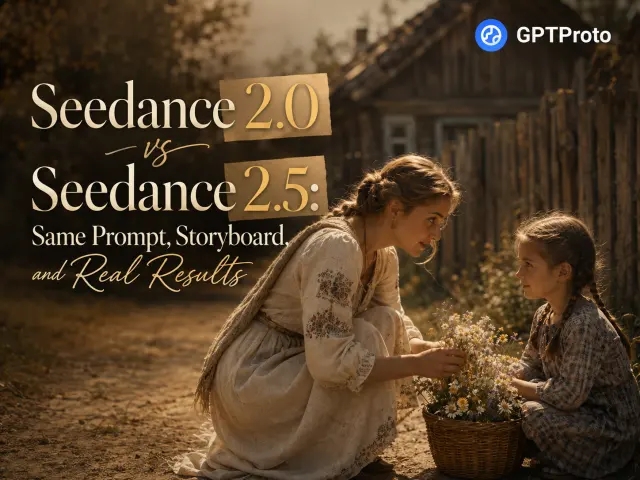
Both models received the same prompt for a silent 15-second vintage documentary. A young woman named Elena walks through a rural Russian village in 1983, notices a shy child selling wildflowers, buys a bouquet, and continues down the road. The prompt specifies the character, clothing, setting, camera behavior, film texture, emotional beats, and second-by-second action.
The task looks simple. It is not. The model must preserve one woman across several shots, stage a natural kneeling motion, render hands touching flowers and exchanging money, maintain the relationship between two people, and finish the story in 15 seconds without turning it into a fashion commercial.
Test Setup
| Test Variable |
Setting |
| Prompt |
Identical text prompt |
| Target duration |
15 seconds |
| Requested aspect ratio |
4:3 |
| Requested audio |
Completely silent |
| Story structure |
Four beats: village walk, discovery, flower choice, departure |
| Visual style |
Faded Kodak 16mm family documentary |
| Outputs reviewed |
One generation from each model |
| Exported files |
Approximately 15 seconds, 1280 × 720 |
Because this is one output per model, we use direct visual observations rather than invented 1–10 scores. A larger benchmark would need repeated generations, fixed settings, blind reviewers, and acceptance criteria defined before the test.
The Storyboard: A Summer Morning in Old Russia
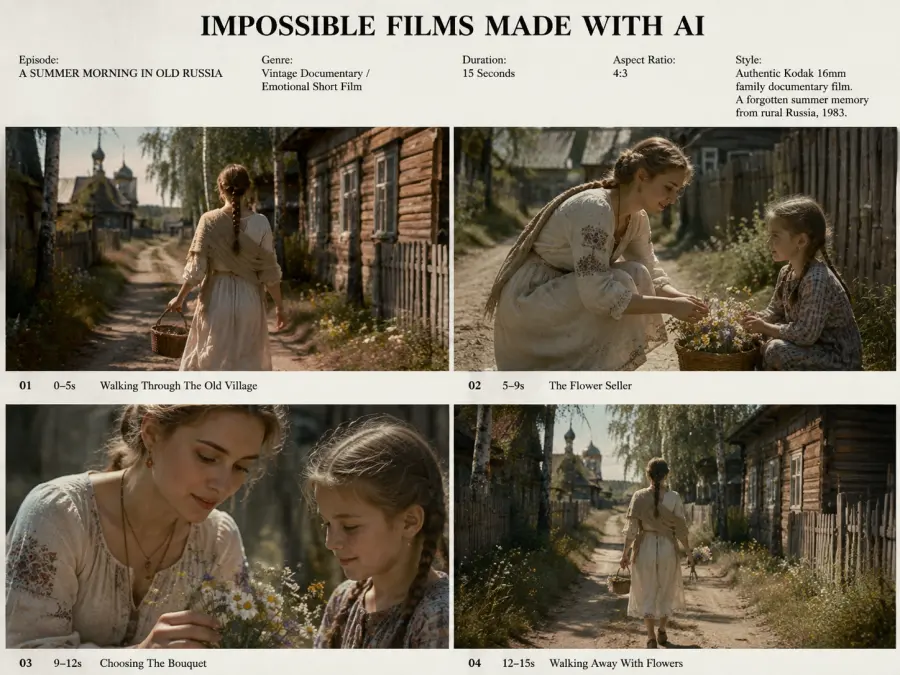
The storyboard divides the film into four parts:
0–5 seconds: Elena walks through the village while a handheld camera follows from behind.
5–9 seconds: She notices a seven-year-old flower seller, stops, smiles, and kneels beside her.
9–12 seconds: Elena selects and arranges several flowers while the child responds shyly.
12–15 seconds: Elena pays, stands, and walks away as the camera remains behind her.
Watch the Seedance 2.0 Result
Watch the Seedance 2.5 Result
Full Prompt Used for Both Models
View the complete 15-second prompt
Create a 15-second photorealistic vintage 16mm silent documentary film.

TITLE:
A SUMMER MORNING IN OLD RUSSIA

Duration:
15 seconds

Aspect Ratio:
4:3

STYLE:

Authentic Soviet-era family documentary footage.

Set in a small rural Russian town in the summer of 1983.

The video should feel like a forgotten family film shot on Kodak 16mm.

A silent visual memory captured by a family member.

Visual characteristics:

warm sun-faded colors,
soft analog film grain,
subtle film flicker,
tiny dust particles,
light scratches,
gentle light leaks,
soft halation around highlights,
slight film gate weave,
organic focus breathing,
imperfect handheld camera movement.

No modern cinematic polish.

The camera should feel like a real family member holding a 16mm camera.

Natural human pacing.

No staged fashion posing.

No commercial advertisement feeling.

---

AUDIO:

NO AUDIO GENERATION.

The video must be completely silent.

Do not generate:

dialogue,
speech,
voices,
narration,
music,
sound effects,
ambient sound,
background audio.

All storytelling must be communicated through:

facial expressions,
eye contact,
body language,
natural gestures,
and visual emotions only.

---

MAIN CHARACTER:

A naturally beautiful Russian woman in her early 20s.

Authentic Eastern European appearance.

She should look like a real woman living in rural Russia in the early 1980s.

FACE:

fair porcelain skin with a natural rosy undertone,
soft oval face shape,
high cheekbones,
delicate jawline,
straight elegant nose,
light blue-gray eyes,
natural thick eyebrows,
soft pink lips.

HAIR:

long ash-blonde to light honey-brown hair,
slightly wavy natural texture,
loosely braided with soft strands falling around her face,
small flyaway hairs moving naturally in the summer breeze.

EXPRESSION:

gentle,
warm,
quiet confidence,
natural kindness.

No modern beauty styling.

No heavy makeup.

Natural skin texture.

Visible realistic pores.

Real human imperfections.

---

CLOTHING:

Authentic early 1980s Russian countryside summer clothing.

She wears a traditional-inspired light linen midi dress.

COLOR:

soft cream and pale blue tones.

DETAILS:

small hand-embroidered floral patterns,
high neckline,
modest short sleeves,
slightly fitted waist,
natural linen texture,
small fabric-covered buttons.

A light beige knitted shawl rests naturally over her shoulders.

ACCESSORIES:

small amber earrings,
simple silver pendant necklace,
woven fabric hair ribbon,
small vintage leather belt.

SHOES:

classic brown leather low-heel Mary Jane shoes,
slightly worn natural leather texture.

She carries a traditional woven wicker basket filled with:

wildflowers,
fresh berries,
small bread loaf,
green herbs.

Everything should feel handmade and authentic to rural Russia in 1983.

---

LOCATION:

A small medieval Russian town street.

Ancient wooden houses mixed with old stone buildings.

Weathered wooden fences.

Colorful painted window shutters.

Wildflowers growing beside pathways.

Old church dome visible in the distance.

Birch trees lining the street.

Warm summer sunlight.

Quiet village atmosphere.

No modern buildings.

No cars.

No modern signs.

No contemporary objects.

---

STORY:

0–5 seconds:

The Russian woman slowly walks through a quiet medieval village street.

The handheld 16mm camera follows her naturally from a short distance.

She gently touches an old wooden fence covered with wild vines.

Her linen dress moves softly in the summer breeze.

Sunlight creates warm highlights in her hair.

The camera briefly loses focus and naturally refocuses on her face.

She never looks at the camera.

She feels like a real person accidentally captured in everyday life.

Camera feeling:

a family member recording a precious memory.

Natural handheld movement.

Small framing imperfections.

---

5–11 seconds:

She discovers a small child selling fresh wildflowers beside the road.

The child is a shy Russian village girl around 7 years old.

The child sits beside a simple wooden basket filled with wildflowers.

The woman stops.

She smiles warmly.

She slowly kneels down gracefully beside the child.

Her dress naturally folds as she moves.

Show detailed realistic human movement:

hands touching flower stems,
fingers carefully selecting flowers,
fabric wrinkles changing naturally,
natural body weight movement.

She chooses several flowers.

She gently arranges them into a small bouquet.

She looks at the child with a warm smile.

The child shyly smiles back.

No one notices the camera.

The moment feels completely natural and unstaged.

---

11–15 seconds:

The woman gently gestures asking the price.

The child shyly shows the price with a small hand gesture.

The woman gives the child money.

The child accepts it with a happy but quiet expression.

The woman holds the flower bouquet close.

She stands up naturally.

She continues walking down the old village street.

The camera stays behind her.

Her figure becomes smaller among:

birch trees,
warm sunlight,
old wooden houses.

The footage slowly ends with natural film flicker.

---

CAMERA DIRECTION:

Authentic handheld 16mm documentary camera.

Natural operator movement.

Small imperfections:

slight shaking,
minor framing errors,
focus hunting,
exposure adjustment,
organic camera breathing.

No smooth drone shots.

No impossible camera movement.

No cinematic crane shots.

---

QUALITY PRIORITIES:

Prioritize:

realistic Russian facial features,
consistent character identity,
natural eye movement,
subtle emotions,
realistic hands,
accurate finger movement,
fabric physics,
natural walking motion,
authentic 1980s Russian atmosphere,
true analog Kodak 16mm texture.

The woman must remain the same person throughout the entire video.

Maintain:

same face,
same hairstyle,
same clothing,
same body proportions.

---

NEGATIVE PROMPT:

Avoid:

audio,
voice,
dialogue,
speech,
music,
soundtrack,
narration,
modern clothing,
modern hairstyles,
modern makeup,
smartphones,
cars,
modern buildings,
modern accessories,
luxury fashion,
western fashion style,
fantasy elements,
CGI appearance,
plastic skin,
AI beauty filter,
perfect symmetrical face,
unrealistic eyes,
changing face,
changing hair color,
different character identity,
age changes,
extra fingers,
deformed hands,
floating objects,
unnatural walking,
robotic movement,
overacting,
looking directly into camera,
fashion photoshoot poses,
commercial advertisement style,
digital sharpness,
clean modern video look.

---

FINAL FEELING:

A lost family film from rural Russia in the early 1980s.

A quiet human moment that was never staged.

A beautiful memory preserved on old Kodak 16mm film.

A movie scene that never existed.
Same-Prompt Result Scorecard
| Comparison Area |
Seedance 2.0 |
Seedance 2.5 |
Winner in This Test |
| Cinematic texture |
Strong light, attractive close-ups, recognizable vintage styling |
Finer atmosphere and a more natural relationship between subject and setting |
Seedance 2.5 |
| Human emotion |
Expressions are readable but several moments feel presented as separate shots |
The approach, flower choice, payment, and departure form a quieter emotional progression |
Seedance 2.5 |
| Narrative continuity |
More visible hard cuts; the result reads like a montage |
The middle interaction holds together for longer and feels less interrupted |
Seedance 2.5 |
| Literal storyboard adherence |
Closer to the requested rear-follow opening and specified close-up coverage |
Reinterprets some camera positions, including a more side/front-oriented opening |
Seedance 2.0 |
| Hand–object interaction |
Flowers and facial close-ups are clear |
The exchange and payment action are easier to understand as one event |
Split |
| Ending completeness |
Completes the departure |
The woman recedes into the environment with a calmer visual resolution |
Seedance 2.5 |
| Requested 4:3 ratio |
Exported as 1280 × 720, or 16:9 |
Exported as 1280 × 720, or 16:9 |
Neither |
| Requested silence |
Exported file contains an audio track |
Exported file contains an audio track |
Neither |
The most important difference is not sharpness. Seedance 2.5 gives the interaction more emotional continuity. Seedance 2.0 shows the required ingredients; Seedance 2.5 makes them feel related.
Where Seedance 2.5 Looks Better
More Cinematic Detail Without Looking Over-Designed
Seedance 2.0 produces attractive individual frames. The warm light, flower details, and character close-ups all communicate the intended period mood. The limitation is how those images connect. Several transitions feel like the model is moving from one good composition to the next.
Seedance 2.5 is more restrained. Skin, fabric, sunlight, and the village background sit together more naturally, but the bigger improvement is photographic intention. The camera appears to notice the interaction rather than merely display it. That difference is hard to capture in a specification table, but it is visible when the clips play side by side.
Our judgment: Seedance 2.5 looks more cinematic because the camera language supports the human moment, not because every frame is more dramatic.
More Convincing Human Emotion
The prompt asks for kindness without posing or overacting. Seedance 2.5 handles that request better. Elena's approach, the child's hesitation, the flower choice, and the payment read as consecutive social signals. The emotion is carried through gaze, distance, timing, and body position.
Seedance 2.0 communicates the same plot, but its stronger close-up emphasis separates some of those signals. We understand what each shot means, yet the encounter feels more assembled.
This is why Seedance 2.5 is the better starting point for emotional short films, nostalgic memories, relationship-led scenes, and brand stories built around a person rather than a product spin.
Smoother Interaction and Narrative Flow
A 15-second multi-shot video has almost no spare time. Every cut must either advance the event or deepen the feeling. Seedance 2.5 spends more of the middle section on the relationship between Elena and the child, so the payment and departure feel earned.
Seedance 2.0 changes shots more visibly. That can be useful when a creator wants clear coverage—a wide shot, a flower close-up, a face, then an ending—but it also makes the result feel closer to a montage.
Put simply: Seedance 2.0 gives you more obvious coverage. Seedance 2.5 gives you a more coherent scene.
Where Seedance 2.0 Still Performs Better
More Literal Storyboard Following
The original opening says that the camera follows Elena from behind. Seedance 2.0 stays closer to that instruction. Seedance 2.5 chooses a more side- or front-oriented view, which may look good but is still a deviation.
This matters when a storyboard is not merely a suggestion. If a client has approved a specific angle, product reveal, or edit point, creative reinterpretation can become revision work. Seedance 2.5 may create the better overall film and still lose a shot-level compliance check.
Stronger Close-Up Coverage
Seedance 2.0 gives the flowers and faces more explicit visual emphasis. For editorial coverage or a cut that will be assembled manually, these isolated close-ups can be useful. The trade-off is continuity: a stronger insert shot does not automatically create a stronger complete scene.
Lower-Cost Drafting
The current Seedance 2.0 API page lists pricing from $0.2957 per run. The current Seedance 2.5 API page shows an entry configuration around $0.452, with the total changing by settings such as duration and resolution.
Those two entry prices are roughly 53% apart. They are not matched costs for the 15-second videos in this article, so they should not be treated as the bill for our test. Still, the gap is large enough to support a practical workflow: test several compositions with Seedance 2.0, then use Seedance 2.5 for the selected final direction.
Seedance 2.0 vs Seedance 2.5: Official Feature Comparison
ByteDance launched Seedance 2.0 on February 12, 2026, and Seedance 2.5 on July 31, 2026. The official upgrade is not just a quality refresh. It expands the length and amount of material the model can organize in one job.
| Official Capability |
Seedance 2.0 |
Seedance 2.5 |
| Release date |
February 12, 2026 |
July 31, 2026 |
| Maximum single generation |
Up to 15 seconds |
Up to 30 seconds |
| Image references |
Up to 9 |
Up to 30 |
| Video references |
Up to 3 |
Up to 10 |
| Audio references |
Up to 3 |
Up to 10 |
| Audio-video generation |
Unified audio-video generation; dual-channel audio |
Builds on the same joint-generation architecture |
| Extension |
Video extension supported |
Multi-round extension with longer narrative continuity |
| Editing |
Targeted changes to clips, characters, actions, and storylines |
Timestamp-level editing plus green-screen, camera-perspective, and reference-based editing |
| Main practical advantage |
Short multimodal generation with established reference workflows |
Longer stories, more references, and finer control over when changes occur |
These specifications come from ByteDance's Seedance 2.0 launch announcement and Seedance 2.5 launch announcement.
The official 30-second limit matters because longer generation changes the kind of prompt you can write. A 15-second clip can usually support one event with a beginning and an ending. A 30-second clip has room for setup, interaction, change, and resolution. The cost is complexity: more time also gives the model more opportunities to drift, so references and timestamped instructions become more important, not less.
Seedance 2.0 vs Seedance 2.5 Pricing
There is no honest one-number answer to “Which is cheaper?” unless the duration, resolution, audio setting, input mode, and retry count are the same.
| Pricing Question |
Practical Answer |
| Lower current entry price on GPT Proto |
Seedance 2.0 |
| Seedance 2.0 displayed starting price |
From $0.2957/run |
| Seedance 2.5 displayed entry configuration |
Around $0.452; final cost varies with settings |
| Is 2.5 automatically worse value? |
No. A higher-cost run can be cheaper if it reduces failed generations or manual repair |
| Best metric for production |
Cost per accepted clip, not price per submitted run |
For a real campaign, record the model, settings, number of attempts, total spend, usable seconds, and reviewer acceptance. If Seedance 2.0 needs four tries while Seedance 2.5 succeeds in two, the cheaper model may produce the more expensive accepted result.
You can review the live configuration before generating on the two model pages or check GPT Proto pricing. Live panels should be treated as the final source because video cost can change with output settings.
A Practical Hybrid Workflow
Use Seedance 2.0 to test story order, framing, pacing, and prompt wording. Generate enough drafts to identify the version worth finishing. Then move the approved prompt to Seedance 2.5 for the shots where emotion, atmosphere, and continuity carry the value.
This is especially sensible for a 30-second ad assembled from several generated segments. Not every transition or background shot needs the most expensive model. Spend more on the hero interaction, face, product reveal, or ending that viewers will remember.
Seedance 2.0 vs Seedance 2.5 for Ecommerce
“Best for ecommerce” is too broad to be useful. A lifestyle perfume film and a rotating product packshot have different failure conditions.
Choose Seedance 2.5 for Cinematic Lifestyle Ads
Start with Seedance 2.5 when the product is carried by a human story: a customer discovering a gift, a family using an object, a creator reacting to a product, or a brand film built around mood. Its advantage in our test is precisely the part these ads need—subtle interaction that remains coherent across several shots.
The official 30-second output and larger reference capacity also suit campaigns with several characters, environments, and creative references. More references do not guarantee perfect brand fidelity, but they give the model more information about the intended world.
Use the Strongest Available Reference Route for Product-Accurate Shots
If the label, logo, bottle shape, dial, packaging color, or product proportions must remain exact, do not choose a model from a text-to-video example alone. Use image-to-video or reference-to-video, lock the approved product image into the workflow, and inspect the result frame by frame.
Seedance 2.0 already has text-, image-, and reference-to-video routes documented on GPT Proto. Seedance 2.5 has much larger reference capacity in ByteDance's official specification, while the exact tasks exposed on a third-party API can change. Check the live Seedance 2.5 model page before building the workflow.
The key distinction is between model capability and currently exposed API capability. Do not promise a customer a 30-image reference workflow until the route you will actually call accepts it.
Which Is Better for Ecommerce Products?
| Ecommerce Task |
Recommended Starting Point |
Reason |
| Emotional lifestyle ad |
Seedance 2.5 |
Better human interaction and narrative continuity in our test |
| 15–30 second branded story |
Seedance 2.5 |
Longer official single-pass duration |
| High-volume concept drafts |
Seedance 2.0 |
Lower current starting price |
| Approved storyboard with fixed shot list |
Seedance 2.0 deserves a test |
More literal shot adherence in this example |
| Product packshot animation |
Reference-based route, then compare both |
Product identity matters more than general cinematic quality |
| Exact logo, label, or mechanical movement |
Neither without review |
AI video can alter text, geometry, or small components |
| Reference-heavy campaign |
Seedance 2.5 when the required route is available |
Larger official image, video, and audio reference limits |
For ecommerce, the winning clip is not the one with the prettiest lighting. It is the one that remains attractive without misrepresenting the product.
Two Prompt Settings the Test Exposed
Set Aspect Ratio in the Request, Not Only in the Prompt
Both prompts explicitly asked for 4:3. Both exported files were 1280 × 720, which is 16:9.
That does not prove the models cannot follow aspect-ratio language. It shows that prose inside the prompt should not replace the actual request control. Set aspect_ratio to 4:3 in the generation panel or API payload. Otherwise, a default such as 16:9 can override the creative brief.
Disable Audio With a Parameter
The prompt repeatedly says “NO AUDIO GENERATION,” yet both exported files contain audio tracks. Seedance 2.5's file also has more noticeable audio content.
We cannot attribute that solely to the model because platform defaults or export behavior may be involved. The reliable workflow is to set generate_audio to false and keep the no-audio instruction in the prompt as a secondary cue.
In other words: use prompt text for creative intent. Use request parameters for technical controls.
Test Seedance 2.0 and Seedance 2.5 With One API Key
The same text-to-video payload can be sent to either model by changing the model name in the route. The example below uses Seedance 2.5 and explicitly sets the two controls that the visual prompt failed to enforce by itself.
export GPTPROTO_API_KEY="your-api-key"
export SEEDANCE_MODEL="dreamina-seedance-2-5-260628"

curl --location \
  "https://gptproto.com/api/v3/bytedance/${SEEDANCE_MODEL}/text-to-video" \
  --header "Authorization: ${GPTPROTO_API_KEY}" \
  --header "Content-Type: application/json" \
  --data '{
    "prompt": "A quiet summer morning in a rural Russian village in 1983. A young woman walks down a wooden village street, notices a shy child selling wildflowers, kneels, chooses a bouquet, pays, and walks away. Authentic handheld Kodak 16mm family documentary, warm faded color, natural expressions, subtle focus breathing, no posing, no dialogue.",
    "aspect_ratio": "4:3",
    "duration": 15,
    "resolution": "720p",
    "generate_audio": false,
    "camera_fixed": false,
    "seed": -1
  }'
To send the same request to Seedance 2.0, change the environment variable:
export SEEDANCE_MODEL="dreamina-seedance-2-0-260128"
The request is asynchronous, so use the returned task identifier to check the result. The live model page and documentation are the source of truth for supported fields. Start from the Seedance 2.0 API page or Seedance 2.5 API page, then keep the prompt and settings fixed when comparing outputs.
Which Seedance Model Should You Use?
Choose Seedance 2.5 if the value of the video comes from emotion, longer narrative structure, connected multi-shot storytelling, or a larger set of creative references. It is the clear winner for the finished version of the village story tested here.
Choose Seedance 2.0 if you are generating many drafts, working within 15 seconds, need a currently documented image/reference workflow, or must test exact storyboard compliance at a lower starting cost.
For many teams, the best answer is not one model. Draft with Seedance 2.0. Finish the shots that carry the story with Seedance 2.5.
Final Verdict
Seedance 2.5 wins this Seedance 2.0 vs Seedance 2.5 comparison. In the same 15-second prompt, it produces the more convincing film: finer atmosphere, more natural interaction, stronger emotional continuity, and an ending that feels connected to the encounter before it.
Seedance 2.0 still earns a place in the workflow. It follows the written shot plan more literally in several places, supplies useful close-up coverage, and starts at a lower current price. For drafts and established reference-driven jobs, that can matter more than the final layer of cinematic feeling.
The boundary is simple. Seedance 2.0 is a strong tool for constructing the shots. Seedance 2.5 is better at making those shots feel like one memory.