TL;DR: Kimi K3 or Claude Opus 5.5?
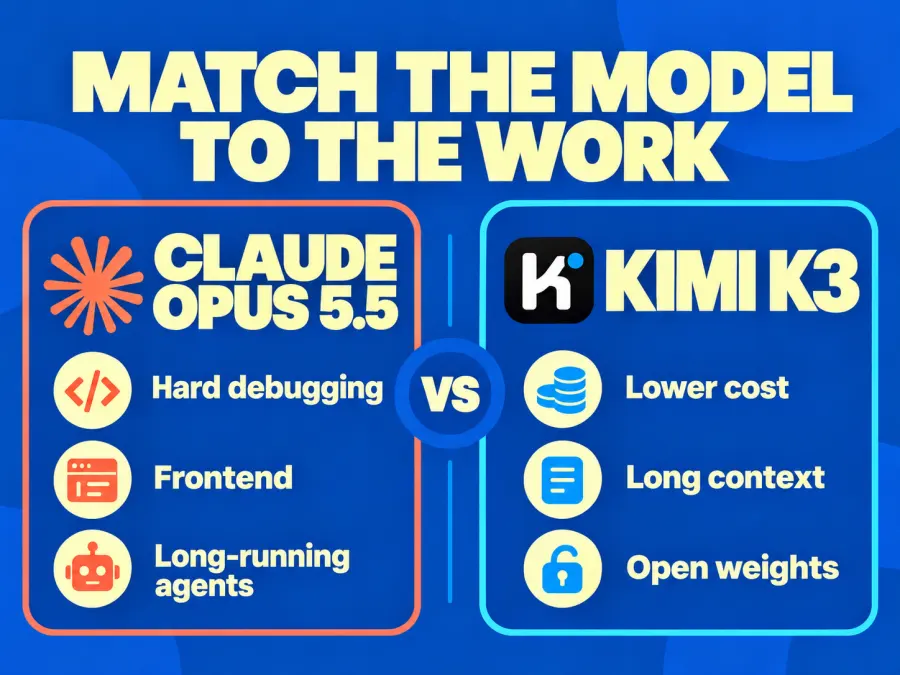
Choose Claude Opus 5.5 for difficult debugging, repository-scale changes, production code review, frontend development, and long-running agents where one bad decision can spoil the rest of the run.
Choose Kimi K3 for cost-sensitive generation, very long contexts, first-pass implementation, open-weight deployment, and workloads whose outputs can be checked with tests or reviewed before release.
My default recommendation is Claude Opus 5.5 for a production coding agent. Kimi K3 is the better budget option for repeatable, testable work. A mixed workflow is often more sensible: let Kimi handle high-volume implementation or analysis, then send the risky decisions and final review to Opus.
| Workload |
Better starting point |
Why |
| Complex debugging |
Claude Opus 5.5 |
Stronger current terminal and agent results |
| Production frontend or React |
Claude Opus 5.5 |
Leads current WebDev Arena rankings |
| Large-context analysis |
Kimi K3 |
Slightly larger context and a better AA-LCR result |
| High-volume first drafts |
Kimi K3 |
Lower input and output rates |
| Final code review |
Claude Opus 5.5 |
Better at implicit requirements and stricter review |
| Self-hosting or private deployment research |
Kimi K3 |
Released weights under the Kimi K3 License |
| Repeated reads of a cached repository |
Test both |
Opus has the lower official cache-read rate |
You can call both through the Kimi K3 API on GPT Proto and the Claude Opus 5.5 API on GPT Proto.
Kimi K3 vs Claude Opus 5.5 at a Glance
| Category |
Kimi K3 |
Claude Opus 5.5 |
| Developer |
Moonshot AI |
Anthropic |
| Release date |
July 16, 2026 |
September 22, 2026 |
| API model ID |
kimi-k3 |
claude-opus-5-5 |
| Context window |
1,048,576 tokens |
1,000,000 tokens |
| Standard maximum output |
131,072 tokens by default |
128,000 tokens |
| Reasoning |
Always on; low, high, or max; defaults to max |
Adaptive and always on; defaults to medium |
| Inputs |
Text and images; the direct Kimi API also documents video |
Text and images |
| Tool calling |
Yes |
Yes |
| Structured output |
Yes |
Yes |
| Weights |
Released under the custom Kimi K3 License |
Proprietary |
| Official input/output price |
$3 / $15 per 1M tokens |
$4 / $20 per 1M tokens |
| GPT Proto input/output price* |
$2.55 / $12.75 per 1M tokens |
$3.60 / $18 per 1M tokens |
| Best fit |
Cost-aware, long-context, and open-weight workloads |
Difficult coding, agents, and production review |
*GPT Proto prices shown in the live model modules on October 21, 2026. Check the model pages for current rates.
The context-window difference should not decide this comparison. Both can accept roughly one million tokens, which is far more than most single requests need. Retrieval quality, cache behavior, tool state, and whether the model can finish the task matter more than the extra 48,576 tokens.
The more meaningful technical difference is control. Moonshot has released Kimi K3's weights, although the model uses a custom license and requires serious infrastructure to host. Opus 5.5 is available only as a managed model. Kimi gives a sufficiently equipped team more deployment control; Opus removes the burden of running a 2.8-trillion-parameter mixture-of-experts model.
Pricing: Kimi K3 Is Cheaper per Token, but That Is Not the Whole Bill
The standard API rates favor Kimi on uncached input, output, and cache writes. Cache reads reverse the result.
| Official API charge |
Kimi K3 |
Claude Opus 5.5 |
| Input |
$3.00/M |
$4.00/M |
| Output |
$15.00/M |
$20.00/M |
| 5-minute cache write |
$3.00/M |
$5.00/M |
| 1-hour cache write |
$6.00/M |
$8.00/M |
| Cache read |
$0.30/M |
$0.20/M |
These figures come from the Kimi model-inference pricing documentation and Anthropic's Opus 5.5 model documentation. Kimi charges less when an agent keeps writing fresh context. Opus charges less when it repeatedly reads a cached prefix.
That distinction matters for coding agents. A long session repeatedly sends repository rules, system instructions, tool definitions, and earlier conversation state. Anthropic prices an Opus 5.5 cache hit at $0.20 per million tokens; Kimi prices the same category at $0.30. Kimi still has cheaper writes and output, but an agent dominated by cache reads can narrow or reverse the expected gap.
At the current GPT Proto rates, three simple uncached workloads look like this:
| Example workload |
Kimi K3 |
Claude Opus 5.5 |
| 150K input + 10K output code review |
$0.51 |
$0.72 |
| 1M input + 100K output agent run |
$3.83 |
$5.40 |
| 10M input + 2M output monthly workload |
$51.00 |
$72.00 |
Those calculations assume that both models process the same number of tokens and succeed in one attempt. Real agents rarely behave so neatly. Different tokenizers may count the same repository differently. Reasoning settings change how much a model writes. One model may stop after a clean patch while the other consumes a second run fixing its own errors.
The practical unit of account is therefore the accepted task:
Total task cost = API spend + retries + review time + the impact of a failed result.
Kimi buys more raw tokens for the same budget. Opus may buy a higher probability that the first serious attempt is usable.
Benchmarks: Opus 5.5 Leads Overall, While Kimi Wins Long-Context Reasoning
The current Artificial Analysis head-to-head comparison gives a clearer picture than launch-day claims. At maximum reasoning, Opus 5.5 leads most of the evaluated categories. Kimi K3 leads the long-context reasoning test and costs less per evaluated task.
| Evaluation |
Claude Opus 5.5 Max |
Kimi K3 Max |
| Intelligence Index |
58 |
44 |
| AutomationBench-AA |
70% |
58% |
| Terminal-Bench 4.0 |
60% |
13% |
| SciCode |
67% |
59% |
| Humanity's Last Exam |
61% |
47% |
| AA-Omniscience |
46 |
20 |
| AA-LCR v1.1 |
85% |
89% |
| Measured cost per task |
$5.98 |
$2.00 |
The broad conclusion is defensible: Opus 5.5 is currently the stronger model for difficult agentic and knowledge work, while Kimi K3 trades capability for a lower bill and a small lead on this long-context test.
The table still needs three qualifications. First, the Opus result is labeled “Max, Default Fallback,” so it is not a perfectly isolated single-model comparison. Second, the low Kimi Terminal-Bench score describes this particular evaluation setup; it does not mean Kimi cannot write useful code. Third, reasoning effort changes both quality and cost. On the same site, Opus 5.5 at low effort costs less per evaluated task than Kimi K3 at max while scoring 42 against 44. Comparing defaults or mismatched effort settings can produce a different winner.
That is why a benchmark should narrow your shortlist, then your own repository tests should decide it.
Kimi K3 vs Opus 5.5 for Coding
For repository-scale implementation and difficult debugging, Opus 5.5 is the safer choice. Its strongest advantage is not syntax. Most current models can produce a plausible function. The difference appears when a task contains an unstated dependency: a new field must flow through three layers, an old migration must stay compatible, or a test failure reveals that the original plan was wrong.
Opus currently performs better on the independent terminal, automation, and knowledge evaluations above. I would spend that premium on architecture changes, unfamiliar codebases, production incidents, and tasks where the agent must recover from failed tool calls without losing the original objective.
Kimi K3 makes more sense for first-pass implementation and repetitive work. Boilerplate generation, mechanical refactors, test-case expansion, documentation drafts, and transformations with clear acceptance checks do not always need the strongest available model. If CI, linting, types, and snapshot tests can reject a bad result automatically, the lower rate becomes more valuable.
The trade-off is review. Cheaper attempts help only if the validation loop is cheap too.
Code review: both models still miss things
A useful community example comes from Deepu K Sasidharan's controlled test on a real Rust feature. Kimi K3 gave the same grade as Opus on 63 of 84 review answers but was never stricter. It missed four documents that described the wrong behavior. Opus found more implementation problems, yet it missed that three pull requests failed to add a new configuration key to the README.
This is one project, not a universal ranking. It still reveals the right operational rule: use Opus as the stronger final reviewer, but do not let either model replace CI, targeted tests, or a human reviewing high-risk changes.
Kimi K3 vs Opus 5.5 for Frontend Coding
Kimi K3 earned attention at launch for combining code with visual reasoning. Moonshot specifically describes screenshot-guided frontend, game, and CAD work in the Kimi K3 technical introduction. That remains a real capability. The current leaderboard, however, no longer supports calling Kimi the better frontend model.
On the October 19, 2026 WebDev Arena frontend leaderboard, Claude Opus 5.5 Max ranks first with a score of 1850. Kimi K3 Max ranks 16th with 1670. The React leaderboard places Opus first and Kimi 15th. On the overall WebDev leaderboard, they rank first and 16th respectively.
That is a meaningful gap, but it does not turn Kimi into a poor prototyping model. It changes how I would use it:
| Frontend task |
Better choice |
| Generate several inexpensive design directions |
Kimi K3 |
| Build a complete interactive page |
Claude Opus 5.5 |
| React behavior and component structure |
Claude Opus 5.5 |
| Screenshot-guided first draft |
Test both |
| Responsive cleanup and production review |
Claude Opus 5.5 |
One same-prompt community demo helps make the distinction concrete. In Aditya's flight-simulator comparison, Opus 5.5 produced the more complete interface and added camera angles and voice, while Kimi still delivered a solid result at a lower cost. A single demo cannot settle the comparison. It does show what the higher Opus bill may buy: completion beyond the most visible part of the prompt.
Choose Kimi when you want to explore several cheap directions. Choose Opus when the page needs to behave correctly, cover the less obvious requirements, and survive review.
Kimi K3 vs Opus 5.5 for Agentic Work
Both models support tool calls, structured output, long contexts, and extended reasoning. Neither is a guaranteed drop-in replacement for the other.
The Kimi K3 API guide says that thinking is always enabled and reasoning_effort supports low, high, and max, with max as the default. In multi-turn conversations and tool loops, the application must return the complete assistant message, including reasoning and tool-call fields, rather than saving only the visible answer.
The Opus 5.5 documentation also says adaptive thinking is always on. It documents several migration details: forced tool use can return an error, thinking blocks are tied to the model and conversation, and older computer-use tool versions are not accepted on some routes. Applications that displayed text between tool calls may also need to account for that text appearing inside thinking blocks.
These details have two consequences.
First, “default versus default” is not a controlled comparison. Kimi defaults to max reasoning, while Opus defaults to medium. A fair internal evaluation should record the effort level, total tokens, tool calls, retries, and final acceptance result.
Second, changing the model string may not be the whole migration. Test message persistence, forced tool choices, streamed reasoning, and any computer-use definitions before switching a production agent.
For a long autonomous run, I would start with Opus 5.5. Its current terminal and automation results justify the premium when an early mistake would contaminate later steps. For document-heavy analysis, repository triage, or parallel low-risk tasks, Kimi K3 deserves a test. It has the slightly larger context, the stronger AA-LCR result, and the lower generation rate.
Which Model Is More Cost-Effective?
There are three different answers.
Kimi K3 wins on ordinary token rates. Its official input and output rates are $3 and $15 per million tokens, compared with $4 and $20 for Opus 5.5. GPT Proto's current live modules also price Kimi below Opus.
Opus 5.5 can win on difficult-task economics. A more expensive run can be the cheaper choice if it avoids a second attempt, catches an implicit requirement, or reduces senior-review time. The current coding and frontend results make that plausible, although only your own traces can quantify it.
Kimi K3 wins on deployment control, not necessarily self-hosting cost. The weights are available, but a 2.8T mixture-of-experts model is not a casual local deployment. Hardware, inference engineering, monitoring, and availability still cost money. “Open weight” means you have the option to operate it; it does not mean a small team will run it more cheaply than a hosted API.
For high-volume applications, route by task instead of choosing one model for everything. A simple policy might send routine transformations and first drafts to Kimi, then route architecture decisions, failed attempts, and final code review to Opus. That preserves Kimi's rate advantage without treating every task as low risk.
How to Test Kimi K3 and Opus 5.5 Through One GPT Proto API
The following Python script sends the same coding prompt to both GPT Proto model IDs through the OpenAI-compatible Chat Completions endpoint. It prints the response, elapsed time, and any usage fields returned by the API.
Install the OpenAI Python package and set your key first:
python3 -m pip install --upgrade openai
export GPTPROTO_API_KEY="your_api_key"
Then run:
import json
import os
import time

from openai import OpenAI

client = OpenAI(
    api_key=os.environ["GPTPROTO_API_KEY"],
    base_url="https://gptproto.com/v1",
)

prompt = """You are reviewing a Python function used in production.

Task:

1. Find the bug and any missing edge cases.

2. Return the smallest safe patch.

3. Add pytest tests for the corrected behavior.

4. Explain any assumption you had to make.

Code:
def average(values):
    return sum(values) / len(values)
"""

for model in ("kimi-k3", "claude-opus-5-5"):
    started = time.perf_counter()
    response = client.chat.completions.create(
        model=model,
        messages=[{"role": "user", "content": prompt}],
    )
    elapsed = time.perf_counter() - started

    usage = response.usage.model_dump() if response.usage else {}
    result = {
        "model": model,
        "elapsed_seconds": round(elapsed, 2),
        "usage": usage,
        "answer": response.choices[0].message.content,
    }
    print(json.dumps(result, indent=2, ensure_ascii=False))
This is a smoke test, not a model evaluation. A useful production test should use a fixed repository commit, identical tools, a written acceptance checklist, the same maximum number of attempts, and tests that can decide whether the result works. Run each task more than once because model outputs vary.
Also record human correction time. If Kimi saves $1 on inference but needs 20 extra minutes of review, the API bill is the least important part of the result.
Which Model Should You Choose?
Choose Claude Opus 5.5 if your workload involves:
difficult debugging or architecture decisions;
multi-file production changes;
frontend work that must be complete and maintainable;
final code review;
long-running tool loops where recovery matters;
tasks whose failure costs more than the model call.
Choose Kimi K3 if your workload involves:
high-volume first drafts or transformations;
long documents and large repository contexts;
automatically testable coding tasks;
multiple inexpensive prototype attempts;
open-weight deployment research;
workloads where API price is the hard constraint.
If you can only choose one production coding model, Claude Opus 5.5 is the stronger general recommendation today. Kimi K3 is the more economical choice when the work is testable, reviewable, or repeated at scale.
The best answer for a team with routing infrastructure is often both: Kimi for volume, Opus for risk.
Final Verdict
Claude Opus 5.5 wins this comparison for overall coding, frontend development, and long-running agents. The latest independent results support that conclusion, and community tests point in the same direction. Its higher rate is easiest to justify when the first attempt must be correct or when a human would otherwise spend time finding subtle omissions.
Kimi K3 wins on input and output price, open-weight availability, and one important long-context evaluation. It remains a credible coding model, especially when tests can catch failures and the workload is large enough for token cost to matter.
Do not choose from the rate card alone. Run the same real task through the Kimi K3 API and Claude Opus 5.5 API, then compare accepted results, total tokens, elapsed time, retries, and review effort.