GPT-6 Astra vs Claude Fable 5.1: Quick Verdict
| Decision |
Better choice |
Why |
| Coding agents that edit, test, and debug |
GPT-6 Astra |
Stronger terminal and automation results; lower independent cost per task |
| Deep scientific or knowledge-work reasoning |
Claude Fable 5.1 |
Leads SciCode, HLE, AA-Briefcase, and GDPval-AA v2 in the current independent comparison |
| Browser and computer-use agents |
GPT-6 Astra |
Built around computer use, asynchronous tools, and mid-turn steering |
| Design-sensitive frontend first draft |
Claude Fable 5.1, narrowly |
Community tests often prefer its interaction details and code readability; there is no definitive frontend benchmark |
| Frontend implementation plus browser QA |
GPT-6 Astra |
Better fit when the agent must implement, render, inspect, test, and repair |
| Cache-heavy long-running agent |
Claude Fable 5.1 |
Official cache reads cost $0.25 per million tokens versus Astra's $1.00 |
| Lowest GPT Proto standard token price |
GPT-6 Astra |
Current rates are $8 input and $40 output per million tokens |
| Lowest measured cost per independent benchmark task |
GPT-6 Astra |
$3.26 versus $7.63 in the current Artificial Analysis max-effort comparison |
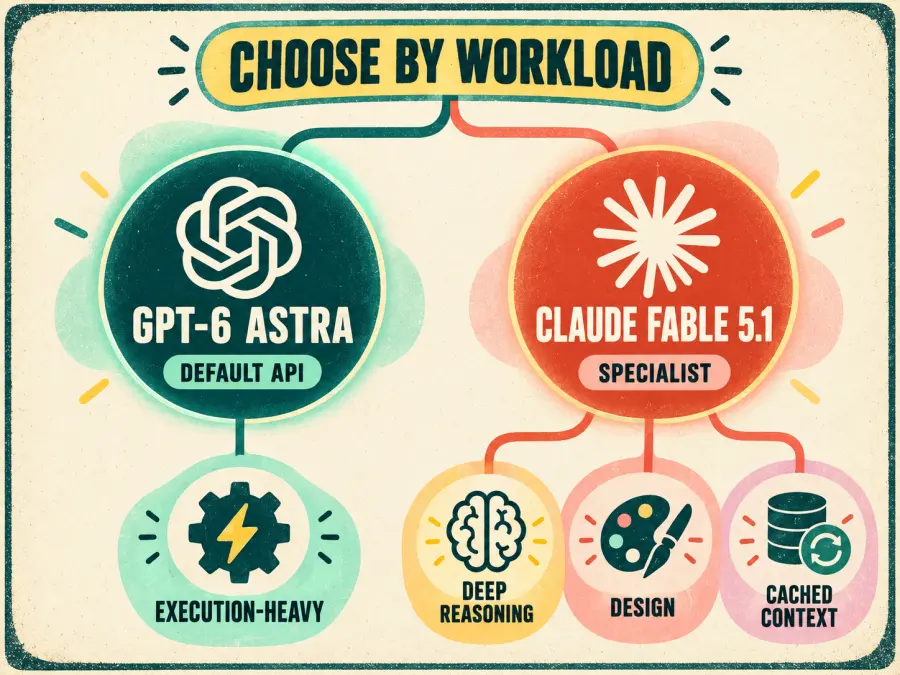
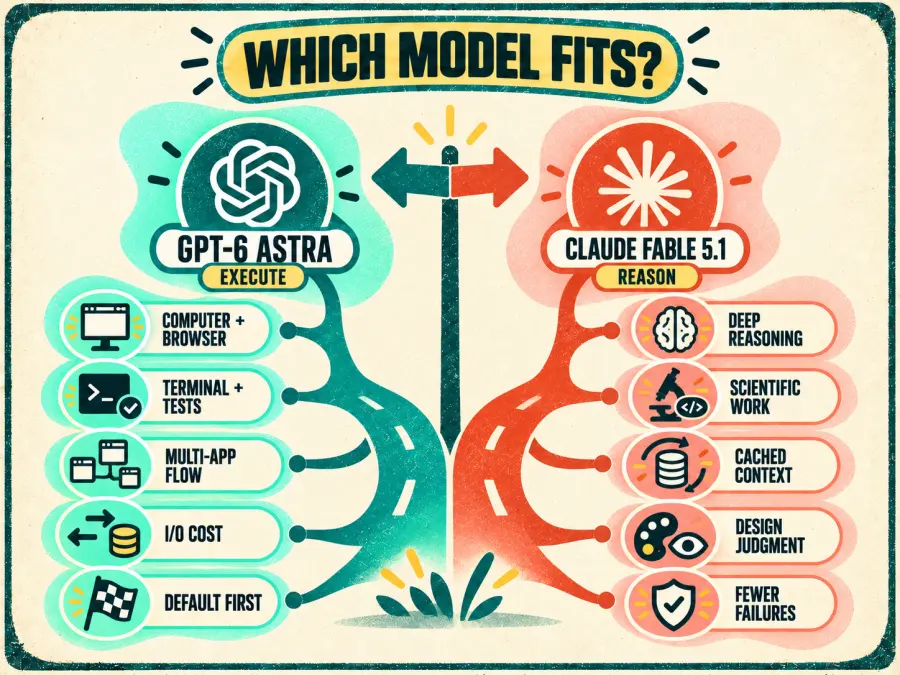
If you need one API default, start with Astra for action-oriented work and keep Fable 5.1 as an escalation route for difficult reasoning, scientific code, or design judgment. If the workload has a large stable prompt prefix, test Fable before deciding: cache economics can reverse the apparent price advantage.
Specifications and Developer Differences
| Specification |
GPT-6 Astra |
Claude Fable 5.1 |
| Provider |
OpenAI |
Anthropic |
| API model ID |
gpt-6-astra |
claude-fable-5-1 |
| Release date |
September 3, 2026 |
September 1, 2026 |
| Context window |
1,050,000 tokens |
1,000,000 tokens |
| Maximum output |
128,000 tokens |
128,000 tokens |
| Input / output |
Text and image input; text output |
Text and image input; text output |
| Knowledge cutoff |
April 30, 2026 |
June 2026 |
| Reasoning control |
low, medium, high, xhigh, max |
Adaptive thinking is always on; effort can be adjusted from low through max |
| Main agent controls |
Async tool calls, mid-turn steering, computer use, hosted tools |
Preserved thinking, per-message effort, turn-scoped system messages, progress updates |
| Fine-tuning |
Not supported |
Not listed as a standard Fable 5.1 feature |
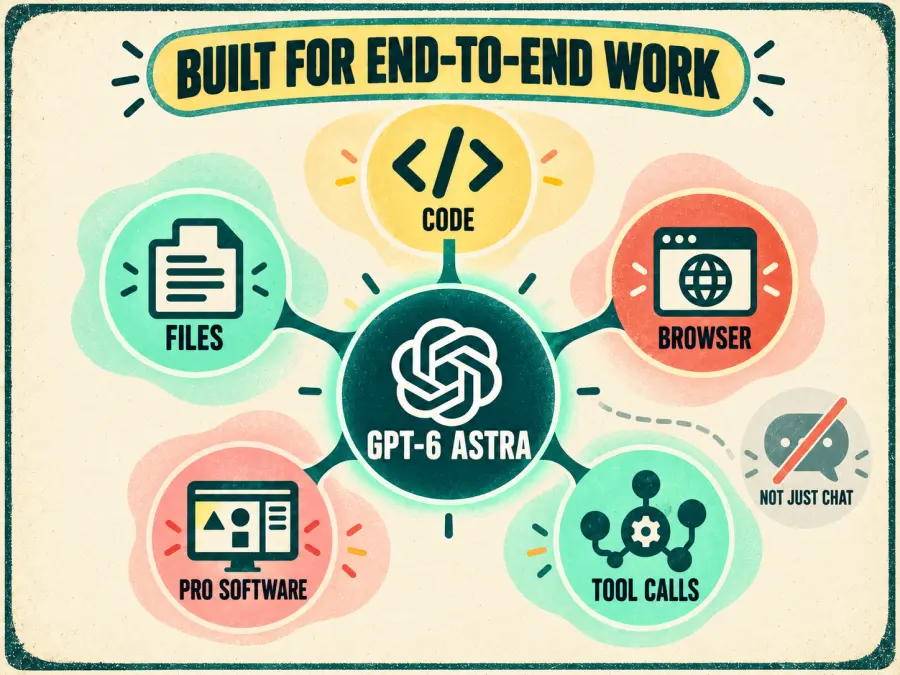
OpenAI positions Astra as a model for complex end-to-end work across code, browsers, files, and professional software. Its API controls matter when an agent is already in motion: a user can steer the task during execution, and asynchronous tool calls reduce idle time while external work completes. See the GPT-6 Astra model documentation and launch report.
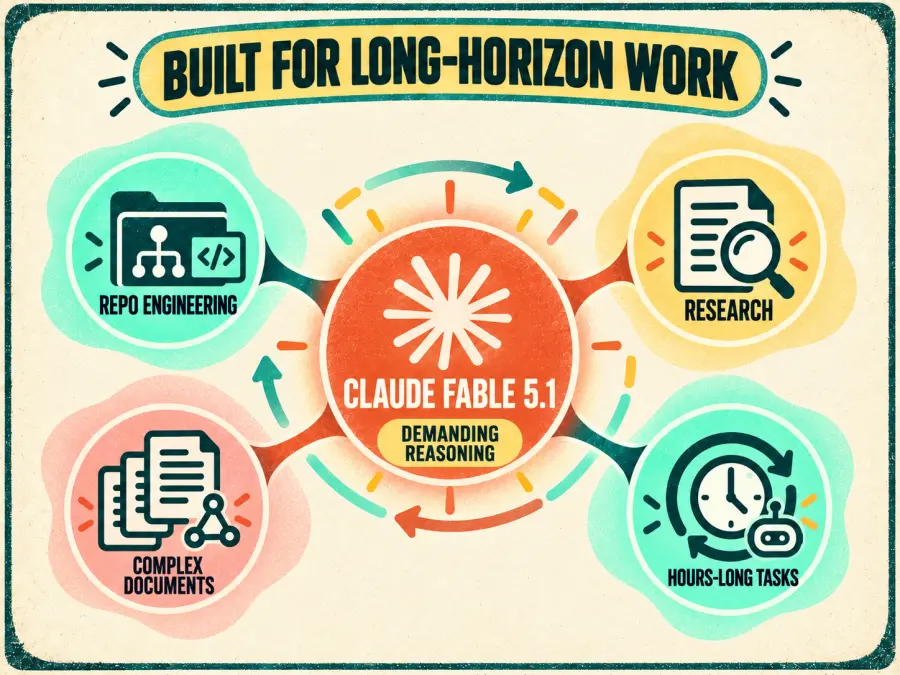
Anthropic positions Fable 5.1 for demanding reasoning and long-horizon agentic work. Its always-on adaptive thinking makes it less suitable when you want a genuinely non-reasoning fast path, but per-message effort and preserved thinking help long sessions retain continuity. The Claude Fable 5.1 documentation also notes API-specific migration details: forced tool_choice values any and tool are not supported, and some mid-conversation controls remain beta features.
Benchmarks: The Winner Depends on the Scoreboard
OpenAI-reported results favor GPT-6 Astra
OpenAI's launch comparison shows Astra ahead on most published coding, terminal, automation, mathematics, and science rows. These are provider-reported results, so they should be treated as evidence to investigate rather than a substitute for your own evaluation.
| Benchmark |
GPT-6 Astra |
Claude Fable 5.1 |
Leader |
| Terminal-Bench 4.0 |
57.9% |
55.8% |
Astra |
| DeepSWE v1.1 |
74.1% |
67.4% |
Astra |
| FrontierCode Main |
53.3% |
50.9% |
Astra |
| FrontierCode Extended |
64.5% |
63.6% |
Astra |
| AutomationBench |
41.4% |
31.4% |
Astra |
| Terminal-Bench Science 0.1 |
64.6% |
52.6% |
Astra |
| FrontierMath Tier 4 v2 |
97.6% |
87.8% |
Astra |
| GPQA Diamond |
96.0% |
93.7% |
Astra |
| Humanity's Last Exam with tools |
57.2% |
65.0% |
Fable 5.1 |
Source: OpenAI's GPT-6 Astra launch report. Tool access, prompts, reasoning effort, token budgets, and retry rules affect these scores.
The important exception is Humanity's Last Exam with tools, where Fable 5.1 leads. That is an early warning against reducing “better model” to a single vendor table.
The latest independent comparison is a 53–53 tie
Some search results published immediately after Astra's launch still cite an older Artificial Analysis result of 61 for Astra and 66 for Fable 5.1. The live comparison now uses Intelligence Index v4.3 and scores both at 53. This update is the biggest difference between this article and many first-wave comparisons.
| Artificial Analysis v4.3 evaluation |
GPT-6 Astra max |
Claude Fable 5.1 max |
Leader |
| Intelligence Index |
53 |
53 |
Tie |
| AA-Briefcase |
1,562 |
1,662 |
Fable 5.1 |
| GDPval-AA v2 |
1,580 |
1,763 |
Fable 5.1 |
| AutomationBench-AA |
68% |
59% |
Astra |
| Terminal-Bench v4.0 |
59% |
52% |
Astra |
| SciCode |
56% |
63% |
Fable 5.1 |
| Humanity's Last Exam |
55% |
59% |
Fable 5.1 |
| GDP.pdf |
31% |
26% |
Astra |
| CritPt |
32% |
30% |
Astra |
| AA-Omniscience |
43 |
43 |
Tie |
| AA-LCR v1.1 |
81% |
85% |
Fable 5.1 |
Source: Artificial Analysis's live GPT-6 Astra vs Claude Fable 5.1 comparison, accessed September 8, 2026.
The distribution is more useful than the tied headline. Astra leads automation, terminal work, PDF tasks, and critical-point reasoning. Fable leads professional knowledge work, scientific coding, HLE, and long-context reasoning. Choose the benchmark closest to the work you actually ship.
GPT-6 Astra vs Claude Fable 5.1 for Code
Choose Astra for execution and recovery
Astra is the better starting point when a coding agent must do more than produce a patch. It is particularly well matched to workflows that require the model to:
inspect a large repository and trace dependencies;
edit multiple files and preserve project conventions;
run shell commands and test suites;
diagnose a broken environment;
render the application in a browser;
inspect failures and keep iterating until acceptance criteria pass.
Its leads on Terminal-Bench, DeepSWE, and AutomationBench support this use case. More importantly, those capabilities align with the model's execution controls. A high coding score is less valuable if the surrounding system cannot keep the model oriented through a long plan–act–observe–repair loop.
Choose Fable 5.1 for code clarity and specialist reasoning
Fable 5.1 deserves an A/B test when the difficult part is understanding the problem, producing readable code, or reasoning through scientific and analytical details. Its independent leads on SciCode, AA-Briefcase, GDPval-AA v2, and HLE point in that direction.
This does not mean Fable is a weak agentic coder. Anthropic reports that early partners used it for multi-repository changes, incident investigation, browser agents, and end-to-end coding. Those partner reports appear on Anthropic's own Fable 5.1 announcement, so they are useful examples but not neutral head-to-head tests.
The practical developer split is:
Use Astra when success means the task ran, passed, and was verified.
Use Fable 5.1 when success means the design or reasoning is coherent, reviewable, and easy to maintain.
For a broader model-family view, see Claude vs ChatGPT for coding.
GPT-6 Astra vs Claude Fable 5.1 for Frontend Coding
There is no widely accepted benchmark that cleanly measures frontend taste. SWE benchmarks test repository work; they do not reliably score visual hierarchy, interaction polish, responsive behavior, accessibility, or faithfulness to a reference image.
The available hands-on reports suggest a useful division:
Fable 5.1 for the first design-sensitive implementation. It often produces readable code and polished small interactions.
Astra for full-stack execution and browser QA. It is better positioned to run the app, inspect the rendered result, reproduce motion or geometry, and repair failures.
In one public six-task comparison, Abel Baruwa gave Astra five wins, including smoother motion recreation and stronger 3D work, while still crediting Fable 5.1 with polished buttons, animations, and interaction details. That is a single creator's one-shot test, not a controlled benchmark.
A strong production workflow can use both: ask Fable for the component architecture and first visual pass, then use Astra with browser tools to test breakpoints, console errors, keyboard navigation, loading states, and pixel-level acceptance criteria. If you must choose only one, pick Astra when verification matters more than initial taste; pick Fable when a developer will review every change and visual nuance dominates.
GPT-6 Astra vs Claude Fable 5.1 for Agents
Model quality is only one layer of an agent. The tool harness, permissions, state management, retry policy, and evaluator often decide whether a run succeeds.
| Agent requirement |
Better starting point |
Reason |
| Browser or desktop operation |
GPT-6 Astra |
Native positioning around computer use and visual verification |
| Long terminal workflow |
GPT-6 Astra |
Stronger current terminal and automation evaluations |
| Async external tools |
GPT-6 Astra |
Supports asynchronous tool calling and mid-turn steering |
| Very large repeated context |
Claude Fable 5.1 |
Much cheaper cache reads |
| Deep research or scientific agent |
Claude Fable 5.1 |
Stronger relevant independent evaluations |
| Strict forced-tool orchestration |
GPT-6 Astra, or adapt the Fable harness |
Fable 5.1 rejects tool_choice: any and tool; use auto, none, or strict schemas instead |
| Sensitive retention requirements |
Verify before choosing Fable |
Fable 5.1 requires 30-day retention unless Anthropic expressly authorizes an exception |
For either model, place destructive actions behind approval gates, validate tool arguments, set iteration and spending limits, and define a fallback route. An agent that can operate a browser or terminal also needs a clear authorization boundary; benchmark strength does not replace application-level safety.
Pricing: List Price, Cache Price, and Task Cost
Official API pricing
Both models have the same standard official input and output prices. Cache reads create the major rate-card difference.
| Official price per 1M tokens |
GPT-6 Astra |
Claude Fable 5.1 |
| Input |
$10.00 |
$10.00 |
| Output |
$50.00 |
$50.00 |
| 5-minute cache write |
$12.50 |
$12.50 |
| Cache read |
$1.00 |
$0.25 |
| Batch input/output |
50% discount |
50% discount |
Sources: OpenAI API model documentation and Claude Fable 5.1 documentation.
Anthropic estimates that Fable 5.1's lower cache-read rate reduces typical workload cost by around 25% versus Fable 5 and can reduce highly agentic workload cost by up to around 45%. Those figures are Anthropic estimates based on its measured workload mix, not a guarantee for every application.
Astra has an additional long-context consideration. For direct OpenAI requests above 272,000 input tokens, the full request is billed at higher rates: 2× input and cached-input pricing and 1.5× output pricing. Price long-context tests separately instead of extrapolating from a short request.
GPT Proto pricing
As of September 8, 2026, the live GPT Proto calculators list these standard rates:
| GPT Proto price per 1M tokens |
GPT-6 Astra |
Claude Fable 5.1 |
| Input |
$8.00 |
$9.00 |
| Output |
$40.00 |
$45.00 |
| Cache write |
$10.00 |
$11.25 |
| Cache read |
$0.80 |
$0.225 |
For a request with 1,500 new input tokens and 800 output tokens, excluding cache activity, Astra costs approximately $0.044 and Fable 5.1 costs approximately $0.0495. Astra is cheaper in that simple request shape.
Now add 3,000 cache-write tokens and 25,000 cache-read tokens. The estimated totals become approximately $0.094 for Astra and $0.0889 for Fable 5.1. Fable becomes cheaper because its cache reads cost far less.
That is why “which model is more cost-effective?” has two valid answers:
Astra is cheaper per standard input/output token on GPT Proto.
Fable 5.1 can be cheaper for long, repetitive sessions with a high cache-hit ratio.
Check the current Astra pricing calculator and Fable 5.1 pricing calculator before production deployment.
Cost per task tells a different story
The current Artificial Analysis max-effort comparison reports:
| Independent efficiency metric |
GPT-6 Astra |
Claude Fable 5.1 |
| Blended price per 1M tokens |
$7.70 |
$7.175 |
| Cost per task |
$3.26 |
$7.63 |
| Output tokens per task |
27K |
78K |
| Reasoning tokens per task |
17K |
47K |
| Output speed |
59 tokens/s |
70 tokens/s |
| Time to first token |
322.48s |
277.47s |
| Total time per task |
467.25s |
724.10s |
Fable has the lower blended token rate and faster token generation in this setup, yet Astra's cost per task is about 57% lower because it uses far fewer output and reasoning tokens. Astra also completes the measured task sooner overall.
This is not proof that Astra will be cheaper in your repository. It is proof that token price alone is an incomplete buying metric. Track total spend divided by accepted tasks, including retries, fallback calls, tool-generated context, and human review time.
What Developers Are Reporting
Early community reports add texture, but they are anecdotes. Prompts, tools, model effort, subscription limits, and task environments are rarely controlled.
Dan Shipper's early Astra impression highlighted unusually strong computer use and 3D or visualization work, while warning that the model can overcomplicate tasks, especially at higher effort. See the original X post.
In a detailed side-by-side machine-learning workflow, one Reddit user found Astra more agentic and stronger at debugging and reproducibility, but preferred Fable 5.1's readable code, writing, direction following, and analytical report. The post also documents concrete mistakes from both models. See the full ML comparison.
Public frontend and 3D comparisons often favor Astra's execution or realism while giving Fable credit for interaction polish. These tests support a hypothesis for your evaluation set; they do not establish a universal winner.
The recurring pattern is more informative than any single viral demo: Astra tends to push the work forward aggressively; Fable often produces a cleaner or more deliberate artifact. Both can make confident, verifiable mistakes.
A Fair Evaluation Protocol for Your API Workload
Do not compare one model in a mature coding harness with the other in a bare chat box. Keep the system around the model as similar as possible.
Select 20–50 representative tasks from real production work.
Give both models the same repository state, prompt, tool permissions, and acceptance criteria.
Match reasoning effort as closely as the APIs allow.
Set identical time, token, iteration, and retry budgets.
Run each task more than once to reduce single-run luck.
Grade with executable tests or a blinded rubric where possible.
Record first-pass success, final success, wall time, tokens, cache reads, retries, and human review minutes.
Calculate cost per accepted result, not just cost per token.
Use a scorecard like this:
| Metric |
Weight |
Astra |
Fable 5.1 |
| Task success |
40% |
|
|
| Correctness / test pass rate |
20% |
|
|
| Human review time |
15% |
|
|
| End-to-end latency |
10% |
|
|
| Total cost per accepted result |
10% |
|
|
| Code or artifact maintainability |
5% |
|
|
Change the weights before you inspect the results. Otherwise it is easy to move the goalposts toward the model you already prefer.
Test Both Models Through the GPT Proto API
GPT Proto exposes both model routes through the same OpenAI-compatible Chat Completions endpoint. Use the same prompt and change only the model ID for an initial A/B test.
GPT-6 Astra request
curl --request POST "https://gptproto.com/v1/chat/completions" \
  --header "Authorization: Bearer $GPTPROTO_API_KEY" \
  --header "Content-Type: application/json" \
  --data '{
    "model": "gpt-6-astra",
    "messages": [
      {
        "role": "user",
        "content": "Review this implementation plan. Identify failure modes, then return a prioritized test plan."
      }
    ]
  }'
Claude Fable 5.1 request
curl --request POST "https://gptproto.com/v1/chat/completions" \
  --header "Authorization: Bearer $GPTPROTO_API_KEY" \
  --header "Content-Type: application/json" \
  --data '{
    "model": "claude-fable-5-1",
    "messages": [
      {
        "role": "user",
        "content": "Review this implementation plan. Identify failure modes, then return a prioritized test plan."
      }
    ]
  }'
For a meaningful coding or agent comparison, place these calls inside the same evaluator and give each route equivalent tools. Log usage and latency from every attempt, then grade the produced artifact rather than the fluency of the response.
Which Model Should You Choose?
Choose GPT-6 Astra if most of these statements are true:
Your agent works in a terminal, browser, repository, or professional application.
Completion and verification matter more than prose style.
You want the lower standard GPT Proto input/output rates.
Your workloads resemble automation, terminal, PDF, or multi-step execution tests.
You want async tool calls or mid-run user steering.
Choose Claude Fable 5.1 if most of these statements are true:
Your hardest tasks involve scientific coding, research, planning, or knowledge work.
Readable code and polished interaction details matter heavily.
Long sessions repeatedly read the same large context.
Your workload benefits from preserved thinking and adjustable per-message effort.
Your own evaluation shows fewer retries or less human review despite higher standard GPT Proto rates.
Use both if failure modes differ. A practical router can send execution-heavy tasks to Astra, analytical or design-sensitive tasks to Fable 5.1, and retry a failed task on the other model. Routing is often more cost-effective than forcing one frontier model to handle every request.
Final Verdict
For most API teams choosing between OpenAI GPT-6 Astra and Anthropic Claude Fable 5.1, Astra is the better first route for coding execution, browser or computer use, and agent workflows. It combines stronger execution-oriented benchmarks with lower current GPT Proto standard rates and lower measured cost per independent benchmark task.
Fable 5.1 remains the better specialist when scientific or knowledge-work reasoning, maintainable code, interface polish, or repeated cached context determines success. Its lower cache-read price can also make it the cheaper model even when its standard token rates are higher on GPT Proto.
The safest decision is a task-level A/B test. Start with GPT-6 Astra, compare the same workload on Claude Fable 5.1, and promote the model with the lower cost per accepted result.