The Watershed Moment in AI Coding: February 5, 2026
History rarely announces itself with a megaphone. Usually, it whispers through the hum of server racks and the clicking of mechanical keyboards.
But on February 5, 2026, the whisper became a roar. In the span of just twenty minutes, the landscape of AI Coding was permanently altered.
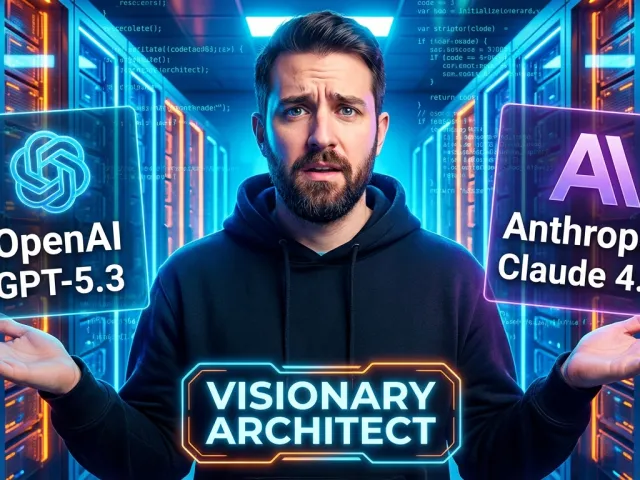
OpenAI and Anthropic released their latest heavyweights: GPT-5.3-Codex and Claude Opus 4.6. These aren't just incremental updates to existing software.
They represent two radically different philosophies of how we build technology. One focuses on the recursive power of a single mind.
The other focuses on the collaborative strength of a digital hive. Together, they have set a new gold standard for AI Coding.
For the first time, we aren't just talking about a tool that helps humans write code. We are talking about systems that can build themselves.
This is the story of how AI Coding stopped being an assistant and started becoming an architect. It is a story of survival and evolution.
GPT-5.3-Codex and the Self-Building AI Coding Loop
When OpenAI dropped GPT-5.3-Codex, the tech community held its breath. This model is the first of its kind to be self-referential.
The development team revealed that they used an earlier version of the model to build the final version. This is AI Coding in its purest form.
The model participated in debugging its own training scripts. It managed its own deployment pipelines. It even diagnosed its own performance failures.
We have officially entered the era of the "recursive loop." In this loop, the quality of AI Coding improves exponentially with every generation.
The stronger the model becomes, the better it gets at building its successor. This creates a feedback loop that humans simply cannot match.

GPT-5.3-Codex is built for the long haul. It features a massive 400,000-token context window designed for deep AI Coding sessions.
This means it can remember an entire software architecture at once. It doesn't forget the variable it defined 500 pages of code ago.
The Power of Perfect Recall in AI Coding
OpenAI introduced a mechanism they call "Perfect Recall." This is a game-changer for anyone involved in large-scale AI Coding projects.
Traditional models often suffer from "middle-loss." They remember the beginning and the end of a prompt, but they get fuzzy in the middle.
Perfect Recall ensures that every single token is given equal weight. Whether it is the first line or the millionth, the model sees it clearly.
In practical terms, this allows for autonomous AI Coding across multiple files. You can ask it to refactor a whole database, and it won't stumble.
During testing, GPT-5.3-Codex was able to build complex web games from scratch. It didn't need a human to fix the bugs between levels.
It identified the errors, wrote the patches, and redeployed the code on its own. This level of autonomy is the new baseline for AI Coding.
The model also boasts a 128,000-token output limit. This is significantly higher than previous versions, allowing for massive code deliveries in one go.
Claude Opus 4.6: Turning AI Coding into a Team Sport
While OpenAI focused on the individual brilliance of a single model, Anthropic took a different path with Claude Opus 4.6.
They introduced the concept of "Agent Teams." This allows a single prompt to trigger a whole department of AI Coding experts.
Imagine assigning a task to a project manager, three developers, and a tester. In Claude 4.6, all those roles are played by the AI.
The model can split a massive project into sixteen distinct sub-tasks. It then spins up sixteen "agents" to work on them simultaneously.
This is the most sophisticated implementation of parallel processing in AI Coding history. It mirrors how human engineering teams actually work.
One agent might focus on the front-end design. Another handles the API integrations. A third is purely dedicated to unit testing.

Managing Agent Clusters for Scalable AI Coding
The most shocking case study involved building a C compiler from scratch. Sixteen agents collaborated over two weeks to achieve this.
They produced over 100,000 lines of Rust code. The final product was capable of compiling the Linux 6.9 kernel without errors.
This wasn't just a simple script. It was a complex, multi-layered engineering feat performed entirely through autonomous AI Coding.
The agents used Git repositories just like humans do. They locked modules, committed changes, and performed peer reviews on each other's work.
For a business, this means the speed of development is no longer limited by human headcount. AI Coding is now a force multiplier.
Claude 4.6 also features an massive 1-million-token context window. This allows it to read an entire enterprise code library in seconds.
The "Context Compaction" technology ensures that the most relevant information stays at the forefront. It is efficient, lean, and incredibly powerful for AI Coding.
Users can even choose their "thinking depth." From simple tasks to max-level scientific problems, the AI adjusts its reasoning power accordingly.
Comparing the Giants of the AI Coding World
When we look at the benchmarks, the competition is fierce. Both models excel in different areas of the AI Coding spectrum.
| Feature |
GPT-5.3-Codex |
Claude Opus 4.6 |
| Context Window |
400K Tokens |
1M Tokens |
| Core Strength |
Self-Debugging/Reliability |
Multi-Agent Collaboration |
| Primary Use Case |
Autonomous Development |
Complex Project Management |
| Reasoning Depth |
Fixed High Performance |
4-Level Adaptive Thinking |
GPT-5.3-Codex dominated the Terminal-Bench 2.0 with a score of 77.3%. It proves that for direct execution, it is the king of AI Coding.
However, Claude 4.6 won in knowledge-based work. It leads in abstract reasoning, making it better for high-level AI Coding architecture.
In the ARC-AGI-2 test, Claude's score jumped from 37.6% to 68.8%. This suggests its ability to handle "unseen" problems is unmatched.
Choosing between them depends on your specific needs for AI Coding. Do you need a solo genius or an elite strike team?
The Economic Impact: How AI Coding Changes the Bottom Line
For enterprises, these advancements in AI Coding aren't just cool party tricks. They represent a fundamental shift in business economics.
The cost of building software is plummeting. What used to take a team of five people six months can now be done in weeks.
However, running these massive models isn't cheap. A 1-million-token context window consumes a significant amount of compute power and API budget.
This is where smart orchestration becomes vital. Companies are looking for ways to maximize their AI Coding output without breaking the bank.
Managing multiple API keys for different models is a logistical nightmare. You need a way to unify these powerful AI Coding tools.
How GPT Proto Simplifies AI Coding Integration
In this high-stakes environment, efficiency is everything. This is where GPT Proto enters the picture to transform your workflow.
When you are running a cluster of sixteen agents for AI Coding, the token consumption is staggering. Costs can spiral out of control quickly.
GPT Proto offers a unified interface for all major models. You can switch between OpenAI, Claude, and Google with a single line of code.
The most compelling advantage is the cost efficiency. GPT Proto provides up to 60% off mainstream API prices for AI Coding tasks.
It also features "Smart Scheduling." You can set the system to choose the cheapest model for simple tasks and the best for complex ones.
For any developer serious about AI Coding, this unified standard is a lifesaver. It handles the backend so you can focus on the logic.
Whether you need the "Perfect Recall" of Codex or the "Agent Teams" of Claude, GPT Proto makes it accessible through one portal.
The Dark Side: Security and Vulnerabilities in AI Coding
With great power comes great risk. As AI Coding becomes more autonomous, the potential for security breaches increases.
If an AI can build a compiler, it can also build a exploit. This is why OpenAI has labeled GPT-5.3 as a "high-capability" cyber model.
It was specifically trained to identify software vulnerabilities. This makes it a powerful tool for both defense and potential offense in AI Coding.
To combat this, OpenAI launched the "Trusted Access for Cyber" program. They want to ensure that AI Coding is used for good.
They are providing millions of dollars in API credits to security researchers. This helps them stay one step ahead of the bad actors.
Claude 4.6 is also playing its part in security. In tests, it discovered over 500 zero-day vulnerabilities in popular open-source projects.
It didn't just find them; it wrote the Proof of Concept (PoC) code to prove they existed. This is the double-edged sword of AI Coding.
"The same intelligence that builds the shield can also be used to forge the sword. Our goal is to ensure the shield is always stronger."
Businesses must now invest in AI-driven security to keep up with AI-driven development. The speed of the industry demands it.
Real-World Scenarios: AI Coding in Action
Let's look at how these tools are being used on the ground. Insurance giant AIG reported a massive shift in their operations.
By using Claude 4.6 for AI Coding, they reduced their underwriting time by 500%. The AI handled both data processing and report generation.
In the world of GitHub, teams are using these models to manage their issue queues. AI Coding agents now close bugs autonomously.
They don't just fix the code. They assign the task to the right "persona," write the test, and update the documentation.
Another team used GPT-5.3-Codex to build a full-scale drone navigation system. The model handled everything from physics to sensor integration.
The level of precision in AI Coding has reached a point where manual code review is becoming a secondary check, not the primary one.
We are seeing the rise of the "Solo-Tech-Giant." This is an individual who uses AI Coding to run a company that would normally require 50 people.
The Technical Shift: Context Windows and Adaptive Thinking
The jump to 1 million tokens in Claude 4.6 is more than just a number. It is a fundamental shift in how we approach AI Coding.
Previously, you had to "chunk" your code into small pieces. You had to explain the context over and over again to the machine.
Now, you can simply point the AI Coding model at your entire repository. It understands the dependencies. It sees the big picture.
This reduces errors significantly. Most bugs in AI Coding come from a lack of context—the model didn't know how a change here would affect something there.
With massive windows, that problem disappears. The AI Coding environment becomes a single, cohesive unit of intelligence.
The introduction of "Adaptive Thinking" also saves time and money. Not every task requires the model to think like Einstein.
Sometimes, you just need a quick syntax fix. Other times, you need a complex mathematical proof. AI Coding is now smart enough to know the difference.
Level 1 thinking is direct and fast. Level 4 thinking is deep and exhaustive. This granularity is essential for modern AI Coding workflows.
The Future of the AI Coding Ecosystem
Where do we go from here? The next six months will likely see more change than the last six years combined.
We are moving toward a world where "writing code" is no longer a manual labor task. It is a high-level strategic task.
The human's role in AI Coding is becoming that of a "Director." You provide the vision, the constraints, and the goals.
The AI handles the execution, the testing, and the deployment. This shift will create new jobs while making old ones obsolete.
Education will also have to change. We don't need to teach kids how to memorize syntax. We need to teach them AI Coding orchestration.
They need to understand how to manage a team of sixteen digital agents. They need to know how to verify the output of a recursive loop.
The barrier to entry for building a tech startup has never been lower. This is the true democratization of AI Coding.
How Companies Can Adapt to the AI Coding Revolution
If you are a business leader, you cannot afford to wait. Your competitors are already integrating AI Coding into their core pipelines.
The first step is to audit your current development costs. Where are the bottlenecks? Where is the repetitive work happening?
The second step is to choose the right tools. You need a mix of reliability and collaborative power for successful AI Coding.
Don't lock yourself into a single provider. The landscape of AI Coding changes every week. You need flexibility to stay ahead.
This is why platforms that offer multi-model access are so valuable. They provide a safety net in a rapidly evolving market.
Finally, focus on security from day one. AI Coding can move fast, but it can also break things fast. Guardrails are non-negotiable.
Conclusion: The Permanent Shift in AI Coding
February 5, 2026, was the day the training wheels came off. AI Coding proved it could think, collaborate, and replicate.
GPT-5.3-Codex showed us the power of a recursive mind. Claude Opus 4.6 showed us the power of a digital team.
Both models represent a future where software is no longer "written" in the traditional sense. It is grown, nurtured, and managed.
The economic and social implications are vast. We are entering an age of unprecedented productivity and innovation in AI Coding.
Whether you are a developer, a CEO, or a casual observer, the message is clear. The era of manual coding is fading.
The era of AI Coding is here. And it is moving faster than any of us could have imagined. It's time to adapt.
Original Article by GPT Proto
"We focus on discussing real problems with tech entrepreneurs, enabling some to enter the GenAI era first."