The Best AI Image Models for E-Commerce: Quick Verdict
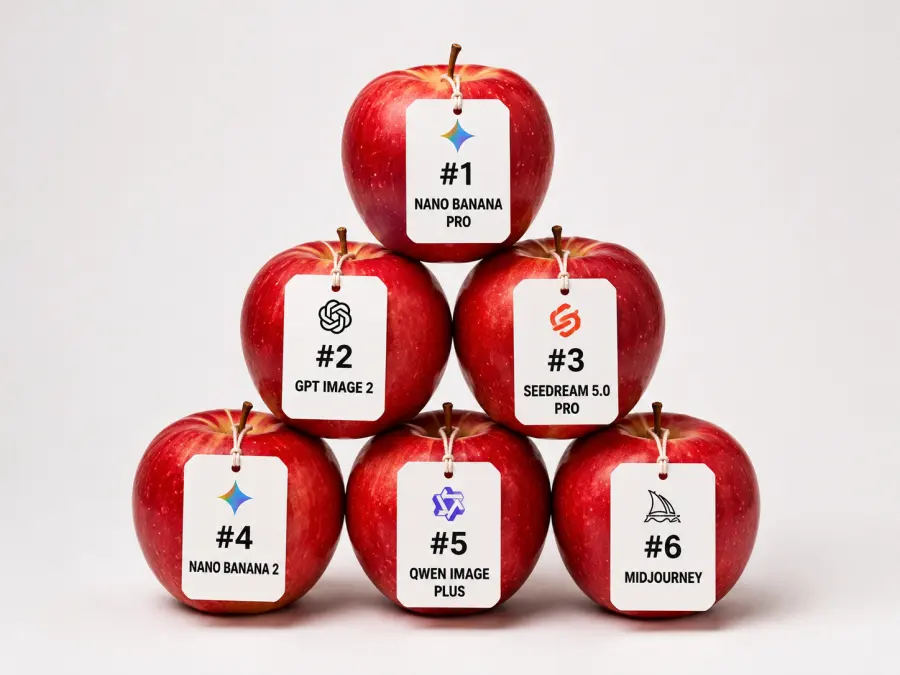
| Rank |
AI image model |
Best e-commerce use |
Clean wins in our 3 tests |
GPT Proto price checked August 27, 2026 |
Main trade-off |
| 1 |
Nano Banana Pro |
Best overall |
3/3 |
$0.0804 at 1K or 2K |
Costs more than Nano Banana 2 and Qwen Image Plus |
| 2 |
GPT Image 2 |
Ads with exact copy |
2/3 |
$6.40 input / $24 output per 1M tokens |
Complex product-use actions may need retries |
| 3 |
Seedream 5.0 Pro |
Preserving product appearance |
2/3 |
$0.0405 at 1K; $0.081 at 2K |
Good-looking results can still contain physical-logic errors |
| 4 |
Nano Banana 2 |
Price-to-quality balance |
2/3 |
From $0.0402 at 1K |
More likely to alter product proportions |
| 5 |
Qwen Image Plus |
Low-cost bulk drafts |
1/3 |
$0.0195 per edit |
Requires close QA for duplicated parts and copy |
| 6 |
Midjourney |
Lifestyle concepts |
1/3 |
$0.0608 per request |
May redesign the SKU or invent sales claims |
“Clean win” means the selected image had no material product, action, or copy error under the criteria of that test. It is our editorial judgment, not a vendor benchmark. Midjourney also needs a note: one request returned four candidates in our workflow, and we reviewed the best candidate rather than treating all four as separate wins.
GPT Image 2 uses token-based billing, so its line cannot be compared directly with flat per-image rates without recording the tokens consumed by a specific job. Image size, route, and settings can also change the other prices. Check the live model page before budgeting a large run.
How We Tested the AI Image Models
We did not ask each model to make its favorite kind of image. Every model received the same source asset and the same core instruction for each test.
The three scenarios covered different e-commerce failure modes:
Product-in-use beauty photo: Can the model preserve a nail-polish bottle while showing a believable hand applying the polish?
Lifestyle product placement: Can it place the exact floor lamp beside a sofa with believable scale, perspective, shadows, and room lighting?
Promotional product ad: Can it preserve a pair of wireless earbuds while reproducing a headline, battery claim, price, shipping message, and CTA exactly?
We judged five things:
That last measure matters more than the menu price:
Effective cost per accepted image = total generation spend / publishable outputs
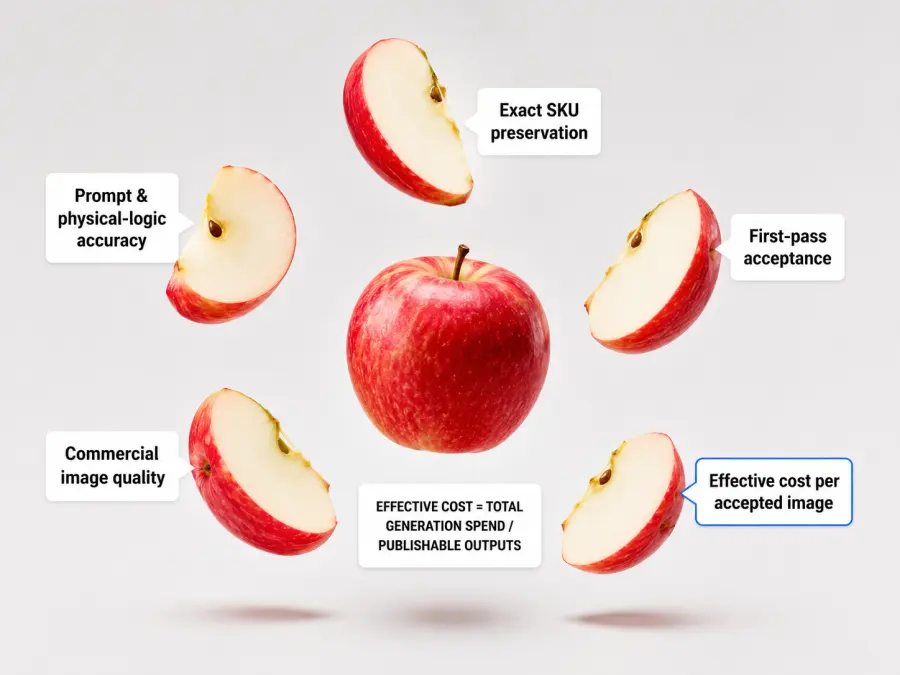
A model that costs $0.04 per call but needs three calls is not cheaper than a model that costs $0.08 and works once. Human review counts too. Four attractive options still take time to inspect, and a duplicated cap can disappear at thumbnail size while remaining a hard error in a product campaign.
All results discussed below came from our GPT Proto playground tests. In Test 1, Seedream 5.0 Pro and GPT Image 2 needed a second request. The remaining Test 1 results came from the first request, although Midjourney returned four candidates in that request. Every model completed Tests 2 and 3 in one request.
Test 1: Which Model Handles Product-in-Use Photos Best?
The first task used a pink nail-polish bottle as an immutable product reference. The output had to show one hand holding the bottle while another hand used the brush to apply the same shade to a fingernail. This tested hands, product preservation, and the physical relationship among the open bottle, cap, brush, and nail.
Nano Banana Pro won. Its first result kept the bottle open, placed the cap and brush in the other hand, and brought the brush to a fingernail. The hands were coherent, and the bottle remained recognizably the same product.
Nano Banana 2 also completed the task in one request. The brush reached the thumbnail and the bottle was open, although parts of the bottle were obscured and its proportions moved slightly away from the reference.
Seedream 5.0 Pro needed two requests before the hand details looked right. The second image kept the bottle’s color and general shape well, but close inspection revealed a different error: the bottle was still capped while the other hand held another cap with a brush. The hands improved; the product logic did not.
GPT Image 2 also needed a second request. Its product rendering was realistic, but the brush appeared to target the fingertip rather than apply polish cleanly to the nail. This was not a texture problem. The model misunderstood the action.
Qwen Image Plus looked convincing at normal viewing size and cost less than the other tested routes. Zooming in exposed a duplicated cap and a new mark on the bottle that did not exist in the source. It was a good draft, not a finished product image.
Midjourney produced four candidates, letting us choose the best-looking one. That selected image had strong beauty-editorial lighting, but it changed the pink cap to a metallic design, altered the bottle geometry, invented small label text, and failed to show the requested application action. For an imaginary cosmetics campaign, it looked expensive. For an exact SKU, it was wrong.
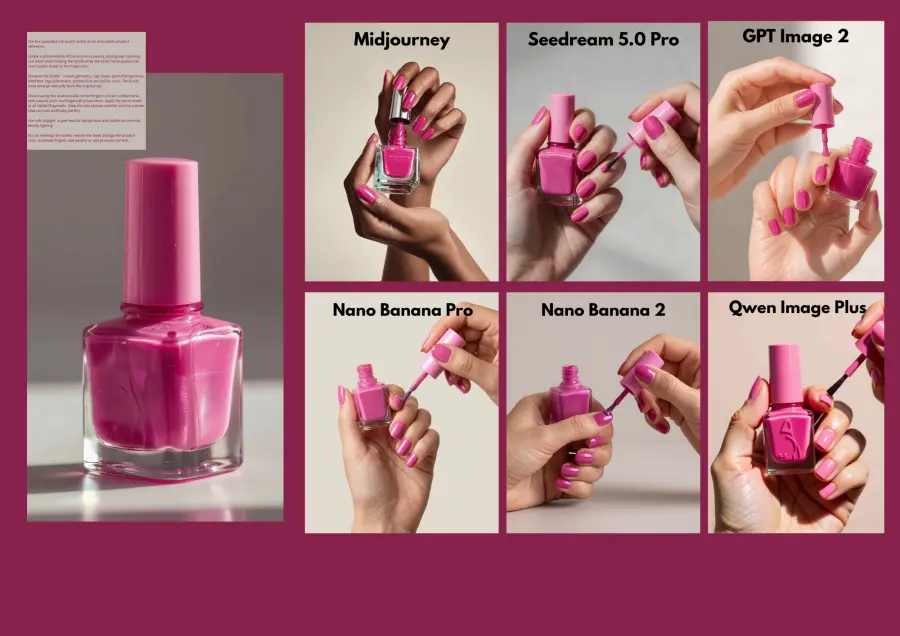
The cost lesson is equally useful. At the tested 2K rate, two Seedream 5.0 Pro calls cost $0.162 before manual review, compared with one $0.0804 Nano Banana Pro result. A lower rate per click would not have changed the winner here; acceptance did.
Test 2: Which Model Creates the Best Lifestyle Product Photo?
The second test used a tall orange floor lamp. Each model had to place the exact lamp beside a beige sofa in a believable living room while preserving the curved pole, dome shade, brass connector, base, and orange finish.
This task was much easier for every model. All six returned a usable-looking room on the first request. That contrast is one of the clearest findings in the test: model performance depends on the type of e-commerce edit, not just the product category. Static placement asks for perspective and lighting. Product use adds hands, contact points, and object-state logic.
Midjourney produced the strongest final lifestyle image. The window light, sofa texture, floor contact, and overall interior styling looked like a polished furniture campaign. The lamp also stayed much closer to the reference than the nail-polish bottle had in Test 1. The trade-off remained selection: we were judging the best result from a four-image request.
Nano Banana Pro was the safer single-result choice. The entire lamp remained visible, the room was restrained, and the product sat naturally beside the chair. It introduced a cable that was not visible in the source, but it did not materially redesign the lamp.
GPT Image 2 also handled the static spatial relationship well. The product, sofa, window, floor, and warm light agreed with one another. Its result was less product-dominant than Midjourney’s, but it required no repair.
Seedream 5.0 Pro kept the lamp recognizable and produced an inviting catalog scene. It made the shade slightly larger and added a white cable, so a seller would still need to confirm that those details matched the real SKU.
Nano Banana 2 made an attractive room, but enlarged the shade and added a long cable with an inline foot switch. The source did not establish that switch. This is a good example of a model generating a plausible product feature rather than preserving the actual product.
Qwen Image Plus kept the broad silhouette but delivered a flatter interior. It also added a black cable, and the large diffuse glow behind an opaque downward-facing shade was less physically convincing than the lighting in the other results. It remained acceptable as a low-cost draft.
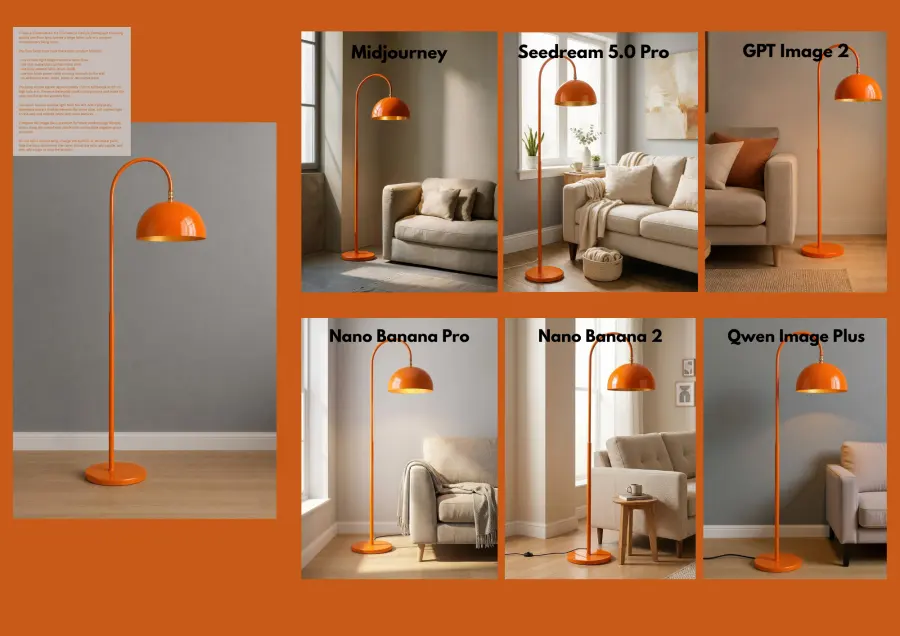
This test answers a common question—which image AI model is most realistic for product photos?—with a condition. Midjourney was the most photographic for this simple room placement. Nano Banana Pro was more dependable across product types. Realism and reliability are not the same ranking.
Test 3: Which Model Is Best for E-Commerce Ads and Text?
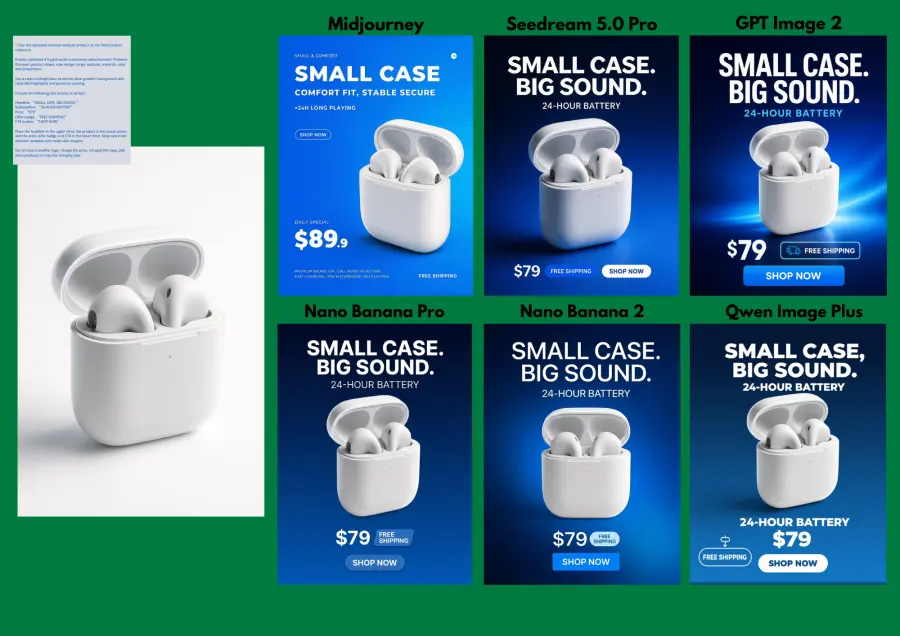
The third task turned a white wireless-earbuds reference into a blue promotional ad. The required copy was fixed:
SMALL CASE. BIG SOUND.
24-HOUR BATTERY
$79
FREE SHIPPING
SHOP NOW
GPT Image 2 won this test. It reproduced every required line, preserved the product’s main structure, and built the cleanest hierarchy around the headline, product, price, shipping message, and CTA. The extra delivery-truck icon supported the supplied message without inventing a new claim.
Seedream 5.0 Pro placed second. Its text was accurate, its product remained close to the source angle, and the design looked ready for a conventional product campaign.
Nano Banana Pro and Nano Banana 2 also reproduced all five required text elements correctly. Nano Banana Pro used a simpler layout; Nano Banana 2 shifted the earbuds into a more symmetrical front view. Both were publishable after normal product review.
Qwen Image Plus kept the correct price and CTA but changed the title punctuation and printed 24-HOUR BATTERY twice. An unexplained small icon also appeared above the shipping badge. These are easy fixes in an editor, but they prevent unattended publishing.
Midjourney’s typography was readable. That is precisely what made its failure risky. It changed the requested $79 price to $89.9, replaced the supplied headline, and invented claims including IPX5 waterproofing, noise reduction, and 30-hour playtime. The same ad also mentioned 24 hours elsewhere. A customer could read the text clearly—and receive false information clearly.
1. Nano Banana Pro: Best AI Image Model for E-Commerce Overall
Nano Banana Pro is our first recommendation when a store wants one model for several kinds of product photography. It did not win every individual category, but it was the only model without a weak test.
Its biggest advantage was physical and semantic consistency. In the nail-polish test, it understood that the cap had to leave the bottle, carry the brush, and meet the nail. In the floor-lamp test, it kept the product complete and made it sit naturally in the room. In the earbuds test, it reproduced the fixed copy without adding claims.
The price at the tested 1K/2K tier was $0.0804 per request. That is about twice the 1K starting price of Nano Banana 2 and more than four times the Qwen Image Plus edit route. The extra spend only makes sense when it avoids rejection or repair. In our first test, it did.
Choose Nano Banana Pro for: product-in-use images, mixed e-commerce workflows, campaign assets that combine a reference product with people or props, and teams that value first-pass reliability over the lowest menu price.
Do not choose it solely for: the cheapest possible background variations. Nano Banana 2 or Qwen Image Plus can make more drafts for the same budget if your team already has a review step.
2. GPT Image 2: Best for Product Ads With Exact Text
GPT Image 2 was the clearest choice for text-heavy promotional assets. It followed the supplied headline, battery claim, price, shipping message, and CTA exactly, then arranged them in the strongest finished layout of Test 3.
It was also good at static lifestyle placement. The weakness appeared when the image required a precise human action. Two requests did not fully solve the nail-polish brush placement. A model can understand a written instruction and still miss the physical contact point in the rendered frame.
GPT Image 2 uses token-based billing on GPT Proto—$6.40 per million input tokens and $24 per million output tokens when checked—so estimate costs from a real sample job rather than forcing it into a flat per-image comparison.
Choose GPT Image 2 for: sale banners, social ads, feature cards, promotional layouts, readable in-image copy, and product scenes without intricate hand-object interaction.
Watch for: action logic. Review where hands, tools, lids, cables, and product parts meet before approving the image.
3. Seedream 5.0 Pro: Best for Preserving Product Appearance
Seedream 5.0 Pro repeatedly kept the source product recognizable. The nail-polish color and bottle form remained close to the reference, the floor lamp retained its main silhouette, and the earbuds ad preserved both the product and supplied copy.
Its weakness was hidden logic rather than surface quality. The second nail-polish result fixed the hand details but showed a capped bottle alongside a separate cap and brush. This is the kind of error that survives a quick approval pass because each individual object looks well rendered.
The tested 2K request cost $0.081. Because the beauty test needed two calls, the generation spend reached $0.162 before review. The current 1K route starts at $0.0405, so resolution materially changes the comparison.
Choose Seedream 5.0 Pro for: product restaging, catalog scenes, polished product ads, and work where material and product appearance matter more than complex contact actions.
Watch for: duplicated removable parts, especially caps, lids, brushes, plugs, and accessories.
4. Nano Banana 2: Best Balance of Price and One-Shot Reliability
Nano Banana 2 completed all three tasks in one request and starts at $0.0402 for 1K output. That combination makes it the practical middle choice: more reliable than the cheapest route in our tests, but roughly half the 1K/2K price of Nano Banana Pro.
It handled the nail-polish action correctly and reproduced every line of the earbuds ad. The trade-off was product geometry. In the lifestyle test, it enlarged the lamp shade and invented a cable with an inline switch. In the earbuds ad, it changed the product to a more symmetrical front angle.
Choose Nano Banana 2 for: routine social assets, campaign variations, small-brand content calendars, and product images where minor perspective changes are acceptable.
Do not use it without comparison to the source: when exact dimensions, hardware, accessories, or packaging construction affect the purchase decision.
5. Qwen Image Plus: Best Budget Model for Bulk Drafts
Qwen Image Plus was the least expensive tested route at $0.0195 per edit when checked. It is an image-editing route in this workflow, so it needs a source image rather than serving as a direct text-to-image substitute for every task.
The model produced attractive first attempts, but each required closer inspection. It duplicated the nail-polish cap and invented a bottle mark, added less convincing lighting to the lamp scene, and repeated the battery line in the earbuds ad. The price, headline concept, product, and CTA were still recognizable. That makes it useful for drafts.
Choose Qwen Image Plus for: large batches of background changes, low-risk variations, internal concepts, and workflows where a human or automated QA stage already exists.
Budget for review: a two-cent draft that needs five minutes of repair may cost more operationally than an eight-cent result that ships. If the only problem is duplicated copy or a small local artifact, fix it in GPT Proto Canvas rather than regenerating the entire image.
6. Midjourney: Best for Lifestyle Concepts, Not Exact SKU Work
Midjourney had the highest aesthetic ceiling and the widest gap between its best and worst e-commerce outcomes. It won the floor-lamp lifestyle test with convincing interior photography. It failed the other two tests for business reasons, not because the images were ugly.
In Test 1, it redesigned the nail-polish bottle and invented label text. In Test 3, it changed the price and added unsupported specifications. Its four-candidate output can help an art director choose a mood, but selection does not correct a false claim shared by an otherwise polished composition.
Choose Midjourney for: campaign concepts, mood boards, editorial lifestyle scenes, and generic or fictional products where aesthetic direction matters more than exact SKU preservation.
Avoid it for: marketplace main images, exact packaging, regulated claims, fixed promotional prices, or any workflow that publishes generated copy without verification.
Which Image AI Model Is Best for E-Commerce by Use Case?
There is no honest one-line winner for every image. There is, however, a clear routing decision for each job.
| Your e-commerce task |
Use this model |
Why |
| One model for most product-photo work |
Nano Banana Pro |
Most consistent across all three tests |
| Product ads with prices, feature lines, and CTAs |
GPT Image 2 |
Best exact-copy result and strongest ad hierarchy |
| Preserve the source product’s appearance |
Seedream 5.0 Pro |
Strong surface, color, and form retention |
| Balance lower cost with one-request reliability |
Nano Banana 2 |
All three tests completed in one request |
| Generate many inexpensive drafts |
Qwen Image Plus |
Under two cents per edit when checked |
| Create a premium lifestyle concept |
Midjourney |
Best selected interior scene, provided exact SKU fidelity is not required |
For a small store, start with Nano Banana Pro if rejected images create more work than generation costs. For a promotion-heavy team, route text ads to GPT Image 2. If you already inspect every asset and need hundreds of low-risk variations, use Qwen Image Plus for drafts and reserve a higher-cost model for difficult products.
For API workflows, route by task rather than forcing one model across the whole catalog. The model that generates a sale banner does not need to be the model that places a cosmetic brush correctly.
How to Test and Generate E-Commerce Images on GPT Proto
You do not need to choose from screenshots in somebody else’s review. Open the GPT Proto AI image playground, upload one of your own product images, and run the same prompt through the models you are considering. Use an asset with details that matter: a readable label, removable lid, cable, unusual material, or a shape customers would recognize.
Once you select a model, you can continue generating from its model page or the image generator. If the result only needs a local correction—removing duplicated copy, adjusting composition, or fixing a small region—open it in GPT Proto Canvas instead of paying for a complete rerun.
For batches, use the API tab and Quick Start on the selected model page. Each route exposes its current endpoint, request fields, pricing unit, and a copyable example, so you do not need to design the integration from an empty file. The following request submits an image-edit job to Nano Banana Pro; replace the API key and image URL with your own values.
export GPTPROTO_API_KEY="your_api_key_here"

curl --request POST \
  --url "https://gptproto.com/api/v3/google/gemini-3-pro-image-preview/image-edit" \
  --header "Authorization: $GPTPROTO_API_KEY" \
  --header "Content-Type: application/json" \
  --data '{
    "prompt": "Place this exact product in a softly lit ecommerce lifestyle scene. Preserve its geometry, materials, colors, logo, label and every visible product part.",
    "images": [
      "https://example.com/your-product-image.jpg"
    ],
    "output_format": "jpeg",
    "size": "1K",
    "aspect_ratio": "4:5",
    "enable_base64_output": false,
    "enable_sync_mode": false
  }'
Before scaling, log four fields for at least 20 representative products: model, request cost, accepted/rejected result, and rejection reason. That small test will tell you more than a generic leaderboard. A jewelry catalog, a furniture store, and a cosmetics brand do not fail in the same places.
Final Verdict
Nano Banana Pro is the best AI image model for e-commerce in this comparison because it made the fewest consequential mistakes across three different product workflows. Its advantage was not that every image looked dramatically better. It was that fewer images concealed a reason they could not be published.
GPT Image 2 is the better specialist for structured ads with exact copy. Seedream 5.0 Pro is a strong product-preservation choice as long as removable parts receive close review. Nano Banana 2 offers the best middle ground for cost-conscious teams. Qwen Image Plus is the bulk-draft pick. Midjourney remains valuable when the brief asks for a mood rather than a faithful SKU.
Pretty is useful. Correct is billable.