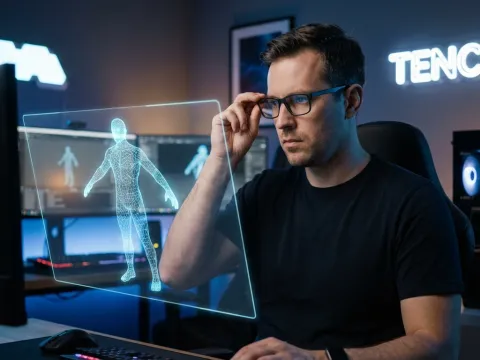
Generating 3D assets used to be the ultimate bottleneck for solo developers and small studios. You either spent weeks mastering Blender or thousands of dollars outsourcing. Then came the generative wave, and tencent hunyuan 3d 2.5 entered the frame. It's not just another model in a crowded space; it represents a specific shift toward high-fidelity, game-ready output that actually respects a developer's time.
But let's be real—the hype around tencent hunyuan 3d 2.5 is often separated from the reality of running it. If you've tried to spin up local instances of these models, you know the "out of memory" errors are practically a rite of passage. In this guide, I'm breaking down how this tool actually functions in a production environment.
We're moving past the surface-level marketing. We'll look at why tencent hunyuan 3d 2.5 is gaining traction, where it falls flat on its face, and how you can integrate it into a pipeline without losing your mind. This isn't just about what the model is, but how you can actually use it today.
The goal here is simple: by the time you're done reading, you'll know if tencent hunyuan 3d 2.5 belongs in your toolkit or if you should wait for the next iteration. It's a powerful AI tool, but like any tool, it has quirks that can either make or break your project workflow.
Why Tencent Hunyuan 3D 2.5 Matters Now
The landscape of 3D asset creation changed when tencent hunyuan 3d 2.5 hit the scene. Before this, we were stuck with models that produced "blobby" geometry. They looked okay in a static render but fell apart the moment you tried to put them in a game engine. This model changed that expectation significantly.

The Shift in 3D Asset Generation with Tencent Hunyuan 3D 2.5
When we talk about tencent hunyuan 3d 2.5, we're talking about a leap in texture quality. Most AI generators treat textures as an afterthought, giving you blurry vertex colors. However, tencent hunyuan 3d 2.5 focuses on generating detailed textures that look crisp even when you're up close in a first-person view.
It’s not just about the visuals, though. The speed of tencent hunyuan 3d 2.5 allows for rapid prototyping. I’ve seen developers go from a text prompt to a textured mesh in minutes. This speed makes tencent hunyuan 3d 2.5 a massive asset for game jams and conceptualizing environments where you need placeholders that don't look like trash.
The community response to tencent hunyuan 3d 2.5 has been telling. People aren't just looking at it; they're actively trying to break it. This level of engagement happens because tencent hunyuan 3d 2.5 offers a tangible improvement over previous open-weights models. It bridges the gap between "cool tech demo" and "useful production tool."
If you're managing multiple AI workflows, you might find that accessing these models through a unified platform is easier. For instance, you can browse tencent hunyuan 3d 2.5 and other models via GPT Proto to see how it stacks up against the latest LLMs and image generators without managing separate local environments.
The real power of tencent hunyuan 3d 2.5 isn't just in the 3D geometry, but in the way it handles the relationship between text prompts and spatial awareness.
Core Concepts of Tencent Hunyuan 3D 2.5 Explained
At its heart, tencent hunyuan 3d 2.5 is a multi-modal powerhouse. It takes either text or image inputs and translates them into a three-dimensional representation. But the "how" is where tencent hunyuan 3d 2.5 distinguishes itself from competitors like Tripo or Meshy. It uses a specialized diffusion process optimized for depth.
Understanding the Architecture of Tencent Hunyuan 3D 2.5
The architecture of tencent hunyuan 3d 2.5 is designed to solve the "multi-view consistency" problem. In older models, the front of a character might look great, but the back would be a nightmare. Tencent hunyuan 3d 2.5 uses a more sophisticated approach to ensure that all angles of the model remain coherent.
One of the standout features in tencent hunyuan 3d 2.5 is its remeshing option. This is a big deal for technical artists. Standard AI output is usually a mess of triangles. The tencent hunyuan 3d 2.5 remesher attempts to create a cleaner topology that is much closer to what a human would model for a game.
We also need to talk about the texture mapping in tencent hunyuan 3d 2.5. It doesn't just slap a color on a face; it generates a proper UV map. While it’s not always perfect, the UV layouts in tencent hunyuan 3d 2.5 are significantly more logical than what we saw in the 1.0 or 2.0 versions.
For developers, the API availability of tencent hunyuan 3d 2.5 is a game changer. Integrating tencent hunyuan 3d 2.5 into a custom app or a web service is becoming standard practice. You can read the full API documentation if you're looking to build tencent hunyuan 3d 2.5 directly into your internal game development tools.
So, why does tencent hunyuan 3d 2.5 feel different? It feels like it was built by people who actually use 3D software. The developers behind tencent hunyuan 3d 2.5 clearly focused on the output formats that matter to professionals, rather than just chasing high-resolution screenshots that are unusable in-engine.
Step-by-Step Walkthrough for Tencent Hunyuan 3D 2.5
Getting tencent hunyuan 3d 2.5 up and running can be a bit of a hurdle if you aren't prepared. You have two main paths: using the official web interface or running it locally via Docker. Most users will want to start with the web version of tencent hunyuan 3d 2.5 to test the waters first.
Getting Started with the Tencent Hunyuan 3D 2.5 Web Interface
To use tencent hunyuan 3d 2.5 online, you’ll head to the official international site. Here's a pro-tip: if you run into login friction, many users have found success using a temporary email address to get past the initial hurdle. Once you're in, the tencent hunyuan 3d 2.5 interface is fairly intuitive.
- Upload a clear, high-contrast image or type a descriptive text prompt into the tencent hunyuan 3d 2.5 dashboard.
- Select your generation settings—tweak the "remesh" option if you need better topology for your tencent hunyuan 3d 2.5 output.
- Hit generate and wait for the multi-view synthesis to complete.
- Preview the model in the tencent hunyuan 3d 2.5 3D viewer, checking for any obvious artifacts or "hallucinations."
- Download the .obj or .glb file directly from the tencent hunyuan 3d 2.5 export menu.
If you're a power user, running tencent hunyuan 3d 2.5 locally is where things get interesting. You’ll need a beefy GPU—think RTX 3090 or 4090. The tencent hunyuan 3d 2.5 local setup usually involves Docker, which simplifies the environment configuration but doesn't lower the massive VRAM requirements needed for the model.
For those who want to avoid the hardware headache, using a managed service is often smarter. You can monitor your tencent hunyuan 3d 2.5 API calls and handle all the heavy lifting in the cloud, saving your local machine for the actual 3D editing and scene assembly work.
When using tencent hunyuan 3d 2.5, I always recommend starting with an image prompt rather than just text. Image-to-3D in tencent hunyuan 3d 2.5 is generally more stable. It gives the AI a visual anchor, leading to fewer surprises in the final tencent hunyuan 3d 2.5 generated mesh.
Common Mistakes and Pitfalls with Tencent Hunyuan 3D 2.5
No tool is perfect, and tencent hunyuan 3d 2.5 has some specific "gotchas" that can ruin a workday if you're not careful. The biggest issue users report with tencent hunyuan 3d 2.5 is the hardware wall. If you try to run tencent hunyuan 3d 2.5 on a 12GB VRAM card, expect a crash on startup.

Overcoming Technical Hurdles in Tencent Hunyuan 3D 2.5
The "garbage geometry" problem is real in tencent hunyuan 3d 2.5. While the textures look great, the wireframe can sometimes look like a spiderweb on caffeine. If you plan on animating a tencent hunyuan 3d 2.5 model, you almost certainly need to run it through a third-party retopology tool like ZBrush or RetopoFlow.
Another pitfall with tencent hunyuan 3d 2.5 is the "international vs. Chinese" version split. The Chinese version of tencent hunyuan 3d 2.5 often gets features first. If you're using the international site and feeling limited, that might be why. Accessing the full tencent hunyuan 3d 2.5 suite sometimes requires navigating regional account restrictions.
Texture misalignment is another common tencent hunyuan 3d 2.5 headache. Sometimes the AI misinterprets where a seam should go. In my experience, the best way to fix tencent hunyuan 3d 2.5 texture issues is to export the texture map and touch it up manually in Photoshop or Substance Painter rather than re-generating.
Budgeting for these failures is key. Because tencent hunyuan 3d 2.5 generations aren't free (in terms of time or API credits), you need to be strategic. You can manage your tencent hunyuan 3d 2.5 API billing effectively to ensure you aren't burning through your budget on failed geometry experiments.
Lastly, don't expect tencent hunyuan 3d 2.5 to handle complex mechanical parts well. It’s brilliant for organic shapes—statues, characters, rocks—but tencent hunyuan 3d 2.5 struggles with precise "hard surface" modeling like engine parts or intricate machinery. For those, you're still better off with traditional CAD or manual box modeling.
| Issue |
Impact on Tencent Hunyuan 3D 2.5 |
Workaround |
| Low VRAM |
Model crashes on local startup |
Use cloud API or 24GB+ GPU |
| Messy Topology |
Unusable for skeletal animation |
Use tencent hunyuan 3d 2.5 remesher + manual cleanup |
| Login Friction |
Cannot access web dashboard |
Use temp email with @nm.edu.pl domain |
Expert Tips and Best Practices for Tencent Hunyuan 3D 2.5
To really get the most out of tencent hunyuan 3d 2.5, you have to treat it as part of a pipeline, not the whole pipeline. Real pros use tencent hunyuan 3d 2.5 as a "base mesh" generator. It gives you 80% of the way there, and then you apply your expert skills for the final 20%.
Optimizing Workflows in Tencent Hunyuan 3D 2.5
One trick is to use high-resolution "orthographic" images as inputs for tencent hunyuan 3d 2.5. If you provide a clean front, side, and back view, tencent hunyuan 3d 2.5 has a much easier time stitching the 3D volume together. This drastically reduces the "melting" effect seen in some tencent hunyuan 3d 2.5 outputs.
Also, lean into the tencent hunyuan 3d 2.5 community. Subreddits like r/aigamedev are goldmines for tencent hunyuan 3d 2.5 prompts that actually work. People are sharing "negative prompts" that help tencent hunyuan 3d 2.5 avoid common mistakes, like floating artifacts or asymmetrical limbs, which can save you hours of trial and error.
If you're integrating this into a team environment, standardizing your tencent hunyuan 3d 2.5 settings is crucial. Make sure everyone is using the same version of tencent hunyuan 3d 2.5 to ensure visual consistency across assets. Inconsistency in tencent hunyuan 3d 2.5 output can make a game level look like it was cobbled together from different worlds.
And here is a cost-saving tip: use tencent hunyuan 3d 2.5 for background assets first. These require less scrutiny than a main character. It's a great way to build up a library of tencent hunyuan 3d 2.5 props—barrels, crates, trees—before you tackle the more complex task of generating a hero asset with tencent hunyuan 3d 2.5.
Remember that the tencent hunyuan 3d 2.5 ecosystem is moving fast. Keeping an eye on the latest tencent hunyuan 3d 2.5 updates can help you stay ahead of new features, like improved rigging or better material support, as they are rolled out to the public.
- Always check the tencent hunyuan 3d 2.5 wireframe before committing to a high-res export.
- Use tencent hunyuan 3d 2.5 in conjunction with "AI" image upscalers to sharpen textures.
- Keep your tencent hunyuan 3d 2.5 prompt simple—overcomplicating it often confuses the spatial logic.
- Save your tencent hunyuan 3d 2.5 seeds so you can iterate on a style you like.
What's Next After Tencent Hunyuan 3D 2.5
The tech world doesn't stand still, and neither does Tencent. Even as we master tencent hunyuan 3d 2.5, the conversation is already shifting toward what comes next. We've seen glimpses of 3.0, but for many, tencent hunyuan 3d 2.5 remains the "sweet spot" of stability and performance for now.
The Evolution from Tencent Hunyuan 3D 2.5 to 3.0
While tencent hunyuan 3d 2.5 is a massive improvement, the next version promises even better handling of complex geometry. However, don't let that stop you from using tencent hunyuan 3d 2.5 today. The skills you learn in tencent hunyuan 3d 2.5—prompting, cleanup, and integration—will all carry over to future versions.
The ultimate goal for tencent hunyuan 3d 2.5 is likely full open-source availability. There is a lot of pressure from the community for Tencent to release the tencent hunyuan 3d 2.5 weights so we can run it on local hardware without the current software restrictions. If that happens, expect the tencent hunyuan 3d 2.5 ecosystem to explode.
In the meantime, tencent hunyuan 3d 2.5 is the best "game-ready" tool we have for many use cases. It beats out much of the competition when it comes to the sheer usability of the textures. Whether you are a solo dev or part of a larger studio, tencent hunyuan 3d 2.5 is a tool you can't afford to ignore if you care about efficiency.
So, is tencent hunyuan 3d 2.5 worth the setup time? Absolutely. Despite the VRAM hunger and the login quirks, the output you get from tencent hunyuan 3d 2.5 is miles ahead of where we were just a year ago. It's an exciting time to be in 3D development, and tencent hunyuan 3d 2.5 is right at the center of it.
If you're ready to start experimenting with tencent hunyuan 3d 2.5 and other high-end AI models, check out the unified platform options. You can use tencent hunyuan 3d 2.5 alongside other tools efficiently. Join the GPT Proto referral program to share these tools with your fellow developers and earn credits toward your next tencent hunyuan 3d 2.5 project.
Written by: GPT Proto
"Unlock the world's leading AI models with GPT Proto's unified API platform."