The technology landscape is standing on the precipice of a radical evolution that will make the chatbot era look like a mere rehearsal. By 2026, the dominant force in global business will be the AI Agent—an autonomous digital entity capable of planning, reasoning, and executing complex workflows without constant human supervision. Leading venture capital firm a16z predicts this shift will fundamentally rewrite the operating systems of industries ranging from healthcare to high finance. This isn't just about faster software; it is about deploying an AI Agent that acts as a true digital colleague. In this analysis, we explore the infrastructure, economic models, and cultural shifts driving this autonomous revolution.
Michael Johnson2026-02-24
AI Agent 2026: a16z Predicts The Autonomous Future
Explore the future of the AI Agent with expert insights from a16z. Discover how autonomous digital colleagues will transform infrastructure, creative tools, and traditional industries like finance and healthcare by 2026.
Table of contents
The Evolution from Reactive Chatbots to the AI Agent
To understand where we are going, we must look at the rapid trajectory of artificial intelligence over the last few years. In 2023, the world was captivated by the magic of conversation; we marveled at text appearing on a screen. By 2024, the novelty settled into utility as we began building custom tools and copilots. However, as we look toward 2026, the paradigm is shifting entirely. We are entering the age of the AI Agent.
The distinction is critical. A chatbot waits for you to type a prompt. A copilot assists you while you work. An AI Agent, however, operates with a degree of autonomy that allows it to pursue goals rather than just tasks. The experts at a16z have mapped out a future where these agents effectively become the new workforce. They don't just retrieve information; they act on it.
Imagine an AI Agent that doesn't just draft an email but identifies a supply chain bottleneck, negotiates a new delivery schedule with a vendor's agent, and updates the internal ledger—all before you've had your morning coffee. This is the promise of 2026. It is a transition from "human-in-the-loop" to "human-on-the-loop," where we govern the strategy while the AI Agent handles the execution.
Building Agent-Native Infrastructure
The infrastructure that powers the internet today was built for human speed. We click, we wait, we read. An AI Agent operates at the speed of silicon. When a sophisticated AI Agent begins a complex objective, it may trigger thousands of parallel requests, database queries, and API calls in a fraction of a second. To a traditional legacy server, this traffic pattern looks indistinguishable from a Distributed Denial of Service (DDoS) attack.
This reality necessitates the construction of "Agent-native" infrastructure. We need systems designed to handle high concurrency and massive throughput not for millions of humans, but for millions of agents acting simultaneously. The architecture of the web must be rebuilt to accommodate the non-linear, rapid-fire workflow of the modern AI Agent.

Jennifer Li, a partner at a16z, highlights a significant bottleneck in this transition: the state of corporate data. Currently, vast amounts of critical business intelligence are trapped in "messy" formats—PDF invoices, recorded Zoom calls, slack threads, and screenshots. While a human can parse this messy data with effort, an AI Agent requires structure to function reliably.
The companies that will win in 2026 are those that invest now in data cleaning pipelines. They are turning unstructured chaos into structured fuel. Without this clean data, even the most advanced AI Agent is effectively blind, unable to make accurate decisions or navigate corporate policies. The race is on to build the semantic layers that will translate human messiness into machine clarity.
The Context Economy: Vector Databases and Semantic Layers
In this new ecosystem, context is the ultimate currency. An AI Agent without context is a liability; it is a hallucination waiting to happen. To solve this, we are seeing a massive shift in the data stack toward vector databases and hybrid storage solutions that allow an AI Agent to retrieve not just keywords, but meanings.
A semantic layer acts as the bridge between the raw data and the AI Agent. It ensures that when an agent looks at a spreadsheet, it understands the business logic and the "why" behind the numbers, not just the cell values. Speaking of spreadsheets, legacy tools like Excel are evolving into interfaces for agents. Instead of memorizing complex formulas, users will describe their analytical goals to an AI Agent, which will then construct, verify, and execute the model, transforming the spreadsheet into a dynamic, living workspace.
Consumer Psychology: The Shift from "Help Me" to "See Me"
The relationship between humans and software is undergoing a profound psychological shift. The first wave of AI products was defined by the "Help Me" value proposition—tools designed to write faster, code faster, and organize better. The next wave, dominated by the AI Agent, focuses on a deeper human need: "See Me."
Consumers in 2026 will expect an AI Agent to do more than complete tasks; they will expect it to understand them. Retention metrics will no longer be driven by utility alone but by the depth of the connection. An AI Agent that remembers your history, understands your stress levels, and anticipates your preferences creates a moat of empathy that is difficult to break.
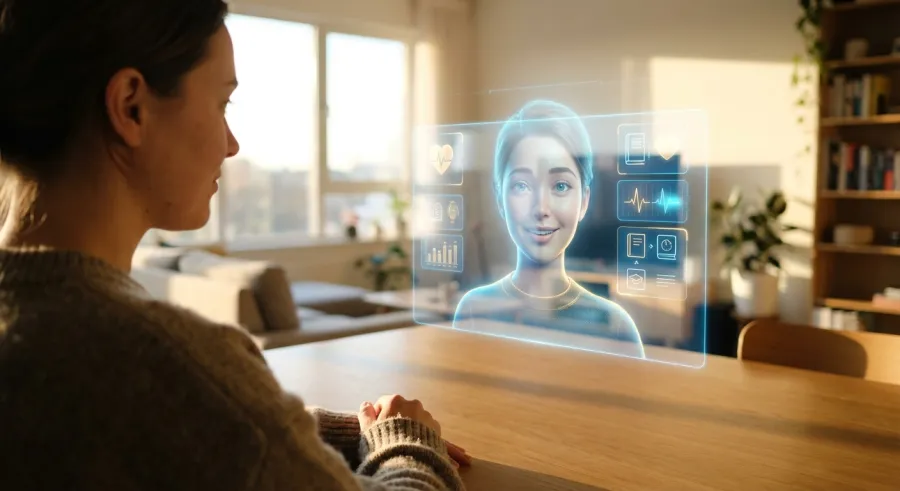
Multimodal capabilities are the technical enabler of this shift. An AI Agent can now see the world through your camera, hear the intonation in your voice, and read the sentiment in your texts. This creates a feedback loop of understanding where the AI Agent becomes a mirror of your digital self, offering advice and support that is hyper-personalized to your specific life context.
Hyper-Personalization in Education and Health
This shift to the "See Me" paradigm will disrupt standardized industries like education. For decades, we have relied on a one-size-fits-all curriculum. By 2026, every student could have a dedicated AI Agent tutor that adapts to their learning style in real-time. If a student struggles with calculus but loves astronomy, the AI Agent will dynamically rewrite the math problems to feature orbital mechanics and star trajectories.
Similarly, in healthcare, the AI Agent moves beyond generic advice. It becomes a proactive health monitor, analyzing real-time biometric data to offer suggestions tailored to your specific biology. The world is moving away from the average and toward the individual, powered entirely by the scalable intimacy of the AI Agent.
The Creative Director: Multimodal Control
For creative professionals, the AI Agent is evolving from a generator to a technician. We are moving past the slot-machine mechanic of simple text-to-image prompting. Future interfaces will allow for "director-level" control, where a user can provide an AI Agent with reference sketches, specific lighting diagrams, and camera motion paths.
Video is becoming a simulation environment for the AI Agent. By analyzing millions of hours of video, agents are learning the laws of physics and cause-and-effect. This has massive implications for robotics. Before a physical robot attempts a task in the real world, its controlling AI Agent can practice the movement thousands of times in a high-fidelity video simulation, drastically reducing the cost of training and hardware failure.
The Death of the Interface: Agents as the New App Store
The way we discover and use software is changing. The traditional "Prompt Box" is slowly disappearing, replaced by an AI Agent that observes and suggests. In this future, the AI Agent becomes the primary interface for the internet. Instead of searching for a travel app, downloading it, and creating an account, you will simply tell your AI Agent to book a trip.
The AI Agent will then utilize an SDK to communicate directly with travel providers, negotiating and booking without you ever seeing a third-party user interface. For developers, this is a distribution revolution. If your application isn't accessible to an AI Agent via API, it is effectively invisible. The battleground for developer attention is shifting from building pretty UIs for humans to building robust APIs for agents.
Economic Viability with GPT Proto
Running a sophisticated AI Agent that is always on, always thinking, and always processing multimodal data is expensive. The economic viability of the agentic future depends on reducing inference costs. This is where platforms like GPT Proto become essential components of the stack. By providing a unified interface to access various models at significantly reduced rates, GPT Proto allows developers to build complex multi-step agent workflows without bankrupting their startups.
An effective AI Agent needs to switch gears constantly—using a high-intelligence model for reasoning and a cheaper, faster model for rote tasks. GPT Proto facilitates this model routing, ensuring that the AI Agent operates at peak efficiency. This democratization of access is what will allow the agent ecosystem to scale beyond the enterprise and into the hands of everyday consumers.
Vertical AI: The Industrial Awakening
While Silicon Valley obsesses over digital code, the true value of the AI Agent may lie in the physical world. Traditional industries like logistics, manufacturing, and energy are data-rich but analysis-poor. An AI Agent can revolutionize these sectors by optimizing complex physical systems in real-time.
In a modern factory, an AI Agent does not just follow a pre-programmed loop. It manages a fleet of robots, adjusting to broken parts, supply delays, and energy spikes autonomously. This flexibility transforms the factory from a rigid assembly line into an adaptive organism. The AI Agent is the brain that allows old industries to compete with new speed.
In the legal sector, an AI Agent can analyze thousands of past rulings to predict case outcomes, allowing firms to price their services based on risk rather than hours. In finance, agents break down the data silos between departments, spotting fraud patterns that human analysts would miss and offering hyper-personalized financial planning that was previously reserved for the ultra-wealthy.
The End of the CRM and the Future of Work
For twenty years, the CRM (Customer Relationship Management) system has been the king of the sales floor. But in reality, it is often just a passive database of data entry chores for humans. By 2026, the CRM as we know it will die, replaced by the AI Agent.
In this new workflow, the AI Agent is the active participant. It listens to the sales call, updates the records, schedules the follow-ups, and even drafts the closing contract. The human salesperson is freed to focus on the emotional connection and strategy. We will see the emergence of new roles, such as "AI Agent Workflow Designers"—experts who don't manage people, but orchestrate the logic and permissions of digital agents.
This shift favors the startups building "AI-native" tools. Legacy giants like Salesforce face the innovator's dilemma, trying to bolt agents onto old architectures. Meanwhile, new agile companies are building platforms where the AI Agent is the first-class citizen, designed from day one to handle the autonomy and speed of the future workforce.
Conclusion: Embracing the Autonomous Colleague
The year 2026 is not a finish line; it is a starting gate. The rise of the AI Agent represents a fundamental restructuring of how value is created in the digital economy. We are moving from a world of explicit instruction to a world of implied intent. You won't tell the AI Agent exactly how to do its job; you will give it a goal, and it will find the best path.
This transition will be messy. It will require us to rethink privacy, data ownership, and the very nature of employment. But the potential upside is staggering. By offloading the cognitive load of coordination and execution to an AI Agent, humans are free to ascend to higher levels of creativity and strategic thinking. The companies and individuals who prepare their data and mindsets for this autonomous future today will be the leaders of the agentic era tomorrow.
Original Article by GPT Proto
"We focus on discussing real problems with tech entrepreneurs, enabling some to enter the GenAI era first."

Related models
All models


