What Is Hunyuan 4—or Hy4 Preview?
Hy4 preview is a large open-weight language model developed by the Tencent Hy Team. It is built primarily for long-running productivity work: software engineering, document analysis, financial modelling, game development, scientific research and agents that must plan, call tools and verify results across multiple steps.
It is a text model. Tencent’s broader Hunyuan family includes image, video and 3D systems, but those family-level capabilities should not be assigned to Hy4 preview itself. The current TokenHub listing covers text input and text output, along with reasoning, structured output, Function Calling and prompt caching.
| Specification |
Hy4 preview |
| Developer |
Tencent Hy Team |
| Release date |
August 28, 2026 |
| Release status |
Preview |
| Architecture |
Mixture-of-Experts |
| Total parameters |
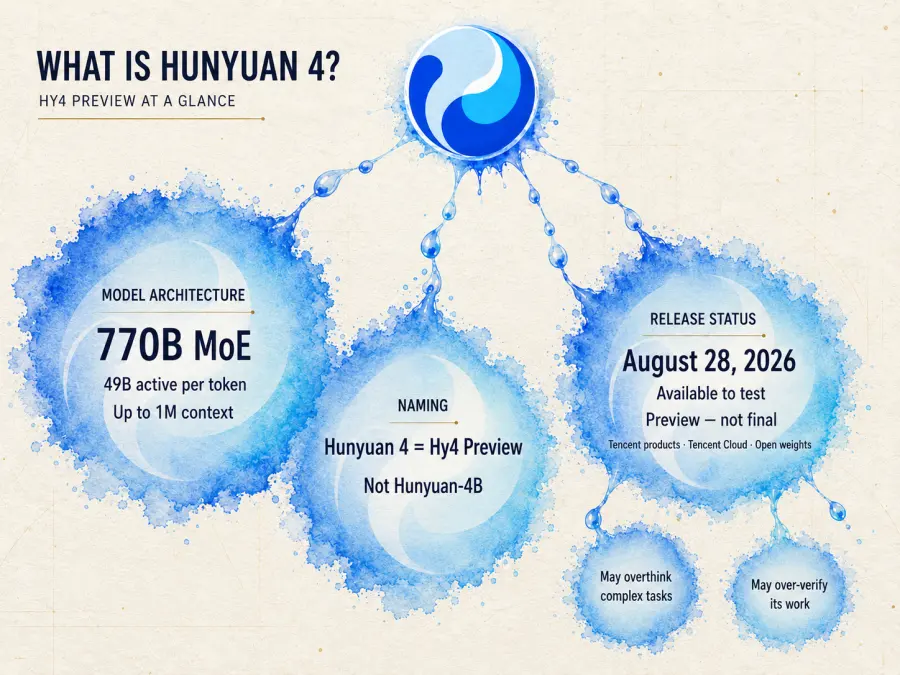
770B |
| Active parameters |
49B per token |
| Backbone layers |
78 |
| Context window |
1M tokens |
| Maximum API input |
960K tokens |
| Maximum API output |
64K tokens |
| Input modality |
Text |
| Output modality |
Text |
| API model ID |
hy4-preview |
| License |
Apache 2.0 |
| GPT Proto availability |
Coming soon |
Is Hy4 Preview the Same as Hunyuan-4B?
No. The names look similar but describe very different models.
Hunyuan-4B is a four-billion-parameter member of Tencent’s earlier dense-model family. The “4B” refers to parameter count. Hy4 preview is Tencent’s next-generation flagship with 770 billion total parameters and a Mixture-of-Experts architecture.
Using “Hunyuan 4” without the word “preview” is understandable for search purposes, but technical documentation should use Hy4 preview to avoid confusion.
Why Is It Called Hy4 “Preview”?
Tencent releases preview models before the final generation is complete so the team can collect feedback from real coding, research and productivity workflows. Hy4 preview is therefore more than a closed demonstration—the weights, documentation and hosted API are already available—but its behaviour and serving configuration may still change.
Tencent has not announced a final Hy4 release date. Its launch announcement only states that more models in the Hy4 series are expected to arrive soon. Any exact month currently circulating for the final version is speculation.
The preview label also comes with two disclosed limitations:
Those behaviours can improve reliability on a difficult engineering problem. The trade-off is more latency and potentially more output tokens on tasks that a smaller or faster model could answer directly.
My read is simple: Hy4 preview is ready for evaluation, not blind migration. A team can run it against a shadow workload today, but replacing an existing production model should wait until it passes that team’s own regression tests.
How Does Hy4 Preview Work?
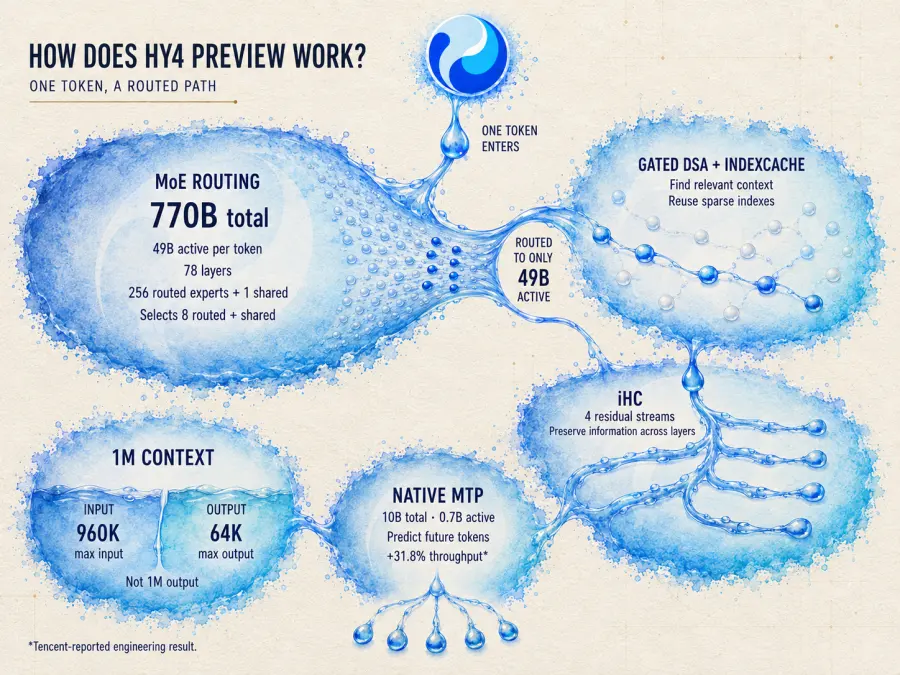
Hy4 preview is large even by current open-model standards, but its 770 billion parameters are not all used for every token.
770B Total Parameters, 49B Active
The model uses a Mixture-of-Experts architecture. A simple way to picture it is as a large technical organisation: many specialist teams exist, but only the specialists relevant to the current problem are called into each meeting.
Hy4 preview has a 78-layer backbone. The first layer uses a standard dense feed-forward network, while the other 77 layers use MoE blocks. Each of those blocks contains 256 routed experts and one shared expert. For each token, the model selects eight routed experts alongside the shared expert.
That selection reduces per-token computation compared with activating all 770 billion parameters. It does not make the model small, though. The full weights still need to be stored, transferred and distributed during self-hosting.
Gated DSA and IndexCache
Hy4 preview uses Gated DeepSeek Sparse Attention, or Gated DSA, with IndexCache. Instead of treating every earlier token as equally relevant, sparse attention tries to identify the parts of a long context that matter most for the current step.
IndexCache reuses sparse-attention indexes across layers. The goal is to reduce repeated work when the model processes very long documents or codebases.
iHC and Multiple Residual Streams
The model also uses identity Hyper-Connections, abbreviated as iHC. Its backbone maintains four residual streams to expand how information can move between layers.
For most API users, the name matters less than the intended result: the model is designed to preserve and transform information across long, multi-stage tasks rather than answering only short, isolated prompts.
Native MTP for Speculative Decoding
Outside the main backbone, Tencent includes a native Multi-Token Prediction layer with 10 billion total parameters and 0.7 billion active parameters. It can predict several future tokens for speculative decoding, which may improve generation throughput when the serving stack supports it.
Tencent also reports that Hy4 preview helped analyse and optimise parts of its own inference system. Changes involving operator fusion and communication increased end-to-end throughput by 31.8% against Tencent’s baseline. That is a vendor-reported engineering result, not yet an independently reproduced serving benchmark.
A 1M Context Window Does Not Mean 1M Output Tokens
The advertised context window is one million tokens, but the hosted limits are more specific:
Maximum input: 960K tokens
Maximum output: 64K tokens
Total context window: approximately 1M tokens
That is enough input capacity for large repositories, document collections or long agent histories. It does not mean the model can generate a one-million-token answer. Tencent’s own TokenHub documentation caps output at 64K tokens.
Key Hunyuan 4 Features
Long-Horizon Coding and Agent Work
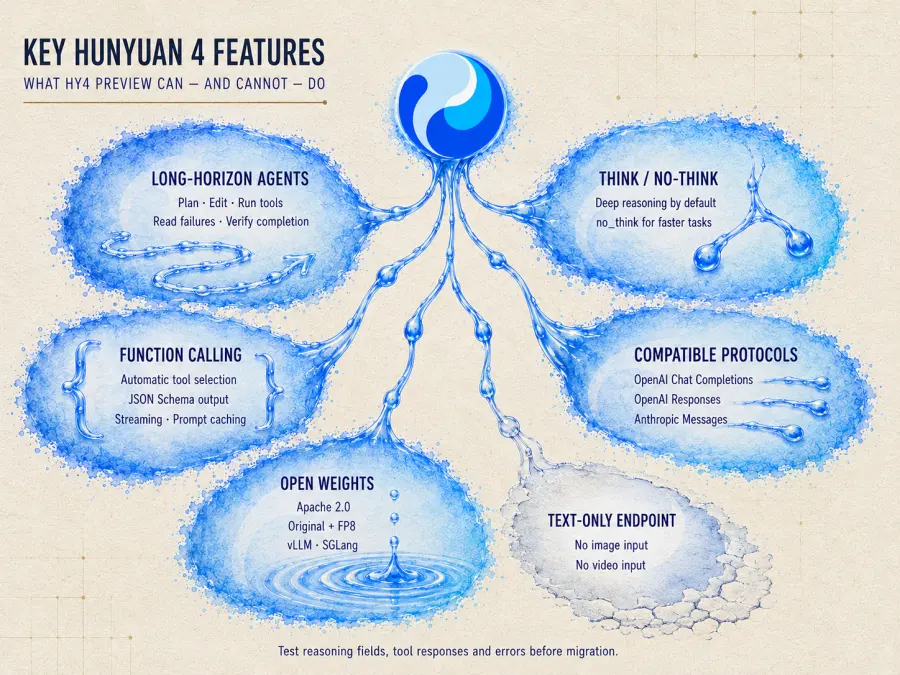
Tencent positions Hy4 preview for coding tasks that require more than generating a single function. Its intended workload includes understanding a repository, planning changes, editing files, running tools, reading failures and verifying whether a task is actually complete.
This is an important distinction. A model can perform well on isolated code questions while losing track of state after ten tool calls. Hy4 preview is being trained and evaluated around the full loop.
Tencent also co-designed the model with products including CodeBuddy and WorkBuddy. That gives its internal tests more practical relevance than a collection of multiple-choice questions, although they remain Tencent-run evaluations.
High and No-Think Reasoning Modes
Hy4 preview supports both deep reasoning and direct-response modes. Deep reasoning is enabled by default in the official deployment example and is intended for difficult coding, mathematics and research tasks.
For simpler work, developers can disable extended reasoning with no_think or the corresponding API parameter. This is useful for:
Leaving deep reasoning enabled for every request can waste time and output tokens. The model’s own known limitations make this routing decision especially important.
Function Calling and Structured Output
The hosted model supports Function Calling, automatic tool selection and JSON Schema-constrained output. These features make Hy4 preview suitable for agents that need to interact with search, databases, development environments or internal services.
It also supports streaming and prompt caching. Streaming improves the perceived response time for long generations, while cached input pricing can reduce the cost of repeatedly sending the same system prompt, repository context or reference documents.
OpenAI and Anthropic-Compatible Protocols
Tencent Cloud documents support for:
OpenAI Chat Completions
OpenAI Responses
Anthropic Messages
An existing application may therefore be able to test Hy4 preview by changing its base URL, authentication and model ID instead of rewriting the entire request structure.
That does not guarantee identical behaviour. Reasoning fields, tool-call responses, maximum output and error handling should still be tested before traffic is moved.
Open Weights Under Apache 2.0
Tencent released both the original model and an FP8 version under the Apache 2.0 license. Developers can inspect the model, deploy it with vLLM or SGLang, fine-tune it and create quantised versions.
The official FP8 recipes use eight-way tensor parallelism. Open weights remove dependence on a single hosted endpoint, but they do not remove the infrastructure requirement. A 770B model remains a serious deployment project.
Does Hunyuan 4 Support Images or Video?
The current Hy4 preview endpoint is text-only.
This is one of its clearest limits compared with newer multimodal coding models. It cannot directly inspect a screenshot, read a UI mock-up or reason over a video recording through the documented endpoint.
For a text-only repository or document workflow, that may not matter. For a frontend agent that must inspect visual output, it can decide the model choice before benchmark scores are considered.
Hunyuan 4 Pricing and Availability
Tencent’s official international pricing is:
| Token type |
Hy4 preview price |
| Input |
$0.834 per 1M tokens |
| Output |
$2.501 per 1M tokens |
| Cached input |
$0.042 per 1M tokens |
Cached input costs about 5% of the standard input rate. This can materially change the cost of an agent that repeatedly reads the same project instructions or documents.
Hy4 preview can currently be accessed through Tencent Cloud TokenHub and Tencent products including WorkBuddy, CodeBuddy, Yuanbao and ima. Tencent also offered a two-week launch-period trial through WorkBuddy and CodeBuddy. Because that is a temporary promotion, it should not be treated as the model’s permanent free tier.
Is Self-Hosting Cheaper?
Possibly at high sustained volume. Not automatically.
The original weights are large enough to require specialised infrastructure, and the official FP8 deployment examples distribute the model across eight GPUs. Self-hosting also adds engineering time, monitoring, upgrades, storage, networking and idle capacity.
AngelSlim has released a 229GB STQ1 quantised GGUF alongside a 467GB Q4 version. The smaller download makes local experimentation more realistic, but community members have correctly questioned whether average benchmark retention transfers to long-context coding and repeated tool calls. Small errors can accumulate across a long agent run even when short tests remain stable.
For many teams, the hosted token rate will be easier to evaluate than the infrastructure economics of an eight-GPU deployment.
Hunyuan 4 Benchmarks: How Strong Is Hy4 Preview?
Hy4 preview has an extensive benchmark appendix, but nearly all launch-day figures come from Tencent. That does not make them useless. It means they should be labelled correctly.
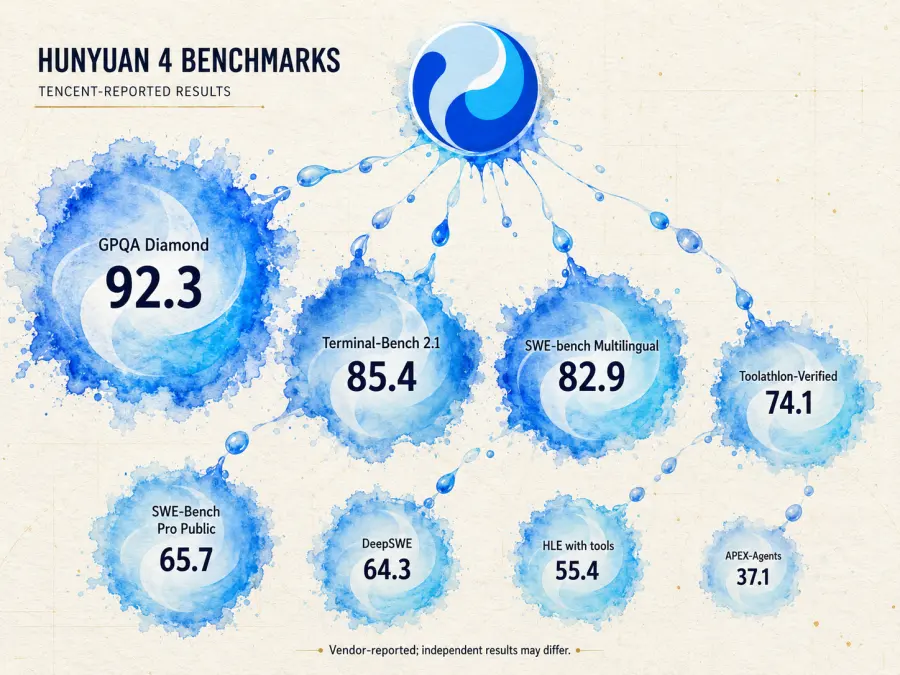
Selected Tencent-reported results include:
| Benchmark |
Hy4 preview |
Evidence status |
| GPQA Diamond |
92.3 |
Vendor-reported |
| Terminal-Bench 2.1 |
85.4 |
Vendor-reported |
| SWE-bench Multilingual |
82.9 |
Vendor-reported |
| Toolathlon-Verified |
74.1 |
Vendor-reported |
| SWE-Bench Pro Public |
65.7 |
Vendor-reported |
| DeepSWE |
64.3 |
Vendor-reported |
| HLE with tools |
55.4 |
Vendor-reported |
| APEX-Agents |
37.1 |
Vendor-reported |
These results suggest that coding, tool use and scientific reasoning are central to the model’s training. They do not prove the same ranking under a different agent framework, tool budget or serving configuration.
[Image Placeholder: Selected Hy4 preview benchmarks separated into vendor-reported and external evidence]
Tencent’s 203-Task Internal Blind Test
Tencent also asked 163 internal experts to rate model outputs across 203 engineering tasks.
| Model |
Average score |
| Hy4 preview |
2.99 / 4 |
| Kimi K3 |
2.94 / 4 |
| GLM‑5.3 |
2.92 / 4 |
Against GLM‑5.3, Hy4 preview recorded 46.8% wins, 12.8% ties and 40.4% losses. Against Kimi K3, it recorded 51.2% wins, 7.9% ties and 40.9% losses.
That is a narrow lead inside Tencent’s own productivity environment—not evidence that Hy4 preview is universally better.
There is also an easy naming mistake to avoid: Tencent compared Hy4 preview with GLM‑5.3 and Kimi K3. It did not compare it with GLM‑5.3 Flash or MiniMax M3 in this blind test.
Early Evidence from Arena WebDev
Arena’s early WebDev AutoEval placed GLM‑5.3 Flash at 1,634 points and Hy4 preview at 1,633. A one-point difference is effectively a tie at this stage.
Both scores were produced through AutoEval, where a reward model trained on human preferences casts the votes. They were not yet based on enough live human votes for a stable public rank. The useful conclusion is that Hy4 preview appears competitive in frontend generation—not that it has definitively won or lost.
What Are Early Users Saying About Hy4 Preview?
The early community response is more restrained than several launch headlines.
A highly discussed LocalLLaMA thread generally placed Hy4 preview around the GLM‑5.3 tier. Users noticed the large improvement over Hy3 but questioned whether Tencent’s own chart supported a broad “beats GLM and Kimi” conclusion. They also focused on the practical difficulty of running 770B weights outside a data-centre environment.
That reaction is reasonable. Hy4 preview looks like a serious open model, but the most dramatic claims still depend on Tencent’s own test setup.
A Small FlappyBench Comparison
One community test compared Hy4 preview, Kimi K3 and GLM‑5.3 on a Flappy Bird-style design task:
| Model |
Reported run cost |
Tester’s observation |
| Hy4 preview |
$0.0480 |
Most distinct UI and gameplay |
| Kimi K3 |
$0.0740 |
Hardest gameplay |
| GLM‑5.3 |
$0.0184 |
Smooth gameplay and lowest cost |
Commenters disagreed with the original interpretation. Some preferred Kimi K3 because the harder gameplay was closer to the original game, while another commenter noted that the prompt was not provided in enough detail to judge the comparison.
That disagreement is useful. It shows why “best frontend result” depends on the acceptance criteria. Visual distinctiveness, faithfulness, difficulty and cost are different metrics. One shared prompt cannot settle all four.
Hunyuan 4 vs GLM‑5.3 Flash, MiniMax M3, and DeepSeek V4 Pro
Hy4 preview enters a crowded group of Chinese models built for coding, agents and million-token workloads.
| Decision factor |
Hy4 preview |
GLM‑5.3 Flash |
MiniMax M3 |
DeepSeek V4 Pro |
| Release stage |
Preview |
Released |
Released |
Released |
| Context window |
1M |
1M |
1M |
1M |
| Documented max output |
64K |
Route dependent |
Up to approximately 512K |
384K |
| GPT Proto input |
Not available yet |
Text, image, video, document |
Text, image, document |
Text |
| Main strength |
Difficult text agents and research |
Fast multimodal coding |
Long multimodal agent runs |
Coding and STEM reasoning |
| Open license |
Apache 2.0 |
MIT |
MiniMax Community |
MIT |
| GPT Proto input price |
Coming soon |
$0.15/1M |
$0.48/1M |
See live model page |
| GPT Proto output price |
Coming soon |
$0.50/1M |
$0.96/1M |
See live model page |
GPT Proto prices in this table refer to the available GPT Proto routes, while the Hy4 price discussed earlier is Tencent’s official rate. Live prices can change and should be checked on each model page before deployment.
Hunyuan 4 vs GLM‑5.3 Flash
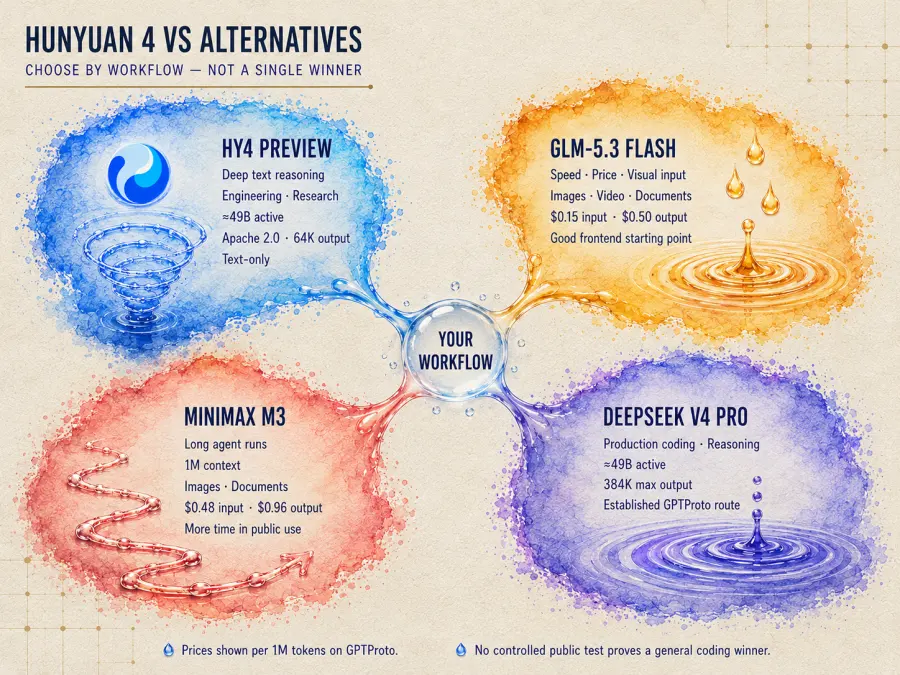
Hy4 preview is the more interesting candidate for difficult, text-only engineering or research tasks where a team is willing to trade response time for deeper reasoning.
GLM‑5.3 Flash is the more practical choice when price, response speed or visual input matters. Its GPT Proto route accepts images, videos and documents, while Hy4 preview currently accepts text. It also costs $0.15 per million input tokens and $0.50 per million output tokens on GPT Proto—far below Hy4’s current official rate.
The early Arena WebDev scores are nearly identical. For frontend coding, I would start with GLM‑5.3 Flash because it can inspect visual references and costs less, then test Hy4 on the hardest text-based planning and debugging cases.
Hunyuan 4 vs MiniMax M3
MiniMax M3 is another one-million-token MoE model built for long agent runs. On GPT Proto, it costs $0.48 per million input tokens and $0.96 per million output tokens. Image and document input are available through its multimodal route.
Hy4 preview offers an Apache 2.0 license and strong early results on tool-use and engineering benchmarks. MiniMax M3 has a lower hosted price on GPT Proto, longer documented output and more time in public use.
For a new text-only research agent, Hy4 is worth adding to the evaluation set. For a cost-sensitive production workflow or an agent that needs to inspect images and files, MiniMax M3 is currently easier to justify.
Hunyuan 4 vs DeepSeek V4 Pro
DeepSeek V4 Pro and Hy4 preview both activate approximately 49 billion parameters per token and target difficult coding and reasoning tasks. DeepSeek V4 Pro has a larger total parameter count and a documented maximum output of 384K tokens, compared with 64K for Hy4 preview.
Hy4 offers Apache 2.0 weights and Tencent’s WorkBuddy/CodeBuddy integration. DeepSeek V4 Pro already has an established GPT Proto route and is better suited to teams that need a production endpoint now.
There is no sufficiently controlled public head-to-head test to declare a general coding winner. Test repository editing, failure recovery and total cost on the same workload.
What Can You Use Hunyuan 4 For?
Hy4 preview is best matched to tasks that are difficult enough to justify its longer reasoning process.
Repository-Scale Coding
A development agent can use the large context window to read project documentation, source files, test failures and previous changes within one working session. The more useful test is not whether it writes a function correctly, but whether it preserves project state after repeated edits.
Long-Document and Financial Analysis
Tencent trained the model around office and analysis workflows involving documents, spreadsheets, equations and financial models. Its one-million-token context makes it relevant to large collections of text-heavy material.
Private or regulated data still requires a separate review of the chosen hosting provider’s retention, location and access policies.
Tool-Using Research Agents
Hy4 preview supports Function Calling and extended reasoning, allowing it to search, run experiments, inspect results and revise an approach. Tencent reports using it on AI research, molecular dynamics, condensed-matter physics and mathematics.
These are high-variance tasks. Human review remains necessary, particularly when the model generates scientific claims or interprets experimental results.
Game Prototyping
Tencent demonstrates Hy4 preview working with game engines to create and revise playable prototypes. This is a good Agent test because it combines code, interaction logic, state management and debugging.
A playable demo is not a production-ready game. Asset licensing, performance, platform compatibility and clean project hand-off still need separate checks.
Workloads Where Another Model Makes More Sense
Hy4 preview should not be the default choice when:
The agent must inspect screenshots, images or videos.
The task is a short classification or extraction request.
Low latency matters more than deep reasoning.
The team cannot tolerate Preview-stage behaviour changes.
Local hardware cannot support a very large model.
The production system lacks a model-specific regression suite.
Is Hunyuan 4 Worth Using Now?
Hy4 preview is worth testing, but it is too early to treat it as the automatic replacement for GLM‑5.3 Flash, MiniMax M3 or DeepSeek V4 Pro.
The model makes the strongest case for teams evaluating open-weight, text-only agents across long codebases, research material or complex tool workflows. Its Apache 2.0 license, one-million-token context and early engineering results are meaningful advantages.
The costs are equally real. It is a large model, its current hosted price is higher than several fast Chinese alternatives, its output is capped at 64K tokens, and Tencent has already acknowledged over-reasoning and excessive verification.
Use it now if you have your own evaluation set and can run it beside an existing production model. Wait if you need stable latency, multimodal input or a model that has already accumulated months of independent testing.
Hy4 preview is coming to GPT Proto. In the meantime, developers can compare GLM‑5.3 Flash, MiniMax M3 and DeepSeek V4 Pro through one account and shared balance.