Qwen 3.7 Plus vs Qwen 3.8 Max: Quick Answer
| Use case |
Better choice |
Why |
| Best overall answer quality |
Qwen 3.8 Max |
It leads by a wide margin in independent intelligence and coding-agent evaluations. |
| Routine API workloads |
Qwen 3.7 Plus |
Lower list price and substantially higher measured output speed. |
| Difficult repository-level coding |
Qwen 3.8 Max |
Better performance on independent software-engineering tasks. |
| Frontend coding |
Qwen 3.8 Max |
Strong WebDev Arena placement and better visual reasoning. |
| High-volume classification or extraction |
Qwen 3.7 Plus |
Max quality is often unnecessary for constrained, repeatable tasks. |
| Visual agents |
Qwen 3.8 Max |
Roboflow found a large accuracy advantage across six vision evaluations. |
| Lowest token cost |
Qwen 3.7 Plus |
Input starts at one-fifth of Max’s international list price. |
| Long answers and extended agent traces |
Qwen 3.8 Max |
Maximum output is 131,072 tokens, twice the Plus limit. |
Our verdict: Qwen 3.8 Max wins the capability comparison. Qwen 3.7 Plus wins as the economical default. For many production systems, the most sensible setup is to route normal requests to Plus and escalate the hard cases to Max.
What Changed From Qwen 3.7 Plus to Qwen 3.8 Max?
Qwen 3.7 Plus is positioned as a lower-cost, faster production model. Qwen 3.8 Max is the flagship option for complex reasoning, coding, agents, and multimodal work.
The official Qwen 3.7 Plus documentation lists a 1-million-token context window, hybrid thinking, function calling, structured output, web search, and prompt caching. The Qwen 3.8 Max documentation retains the same input scale but raises the maximum output length and adds more direct control over reasoning effort.
| Specification |
Qwen 3.7 Plus |
Qwen 3.8 Max |
| Model ID |
qwen3.7-plus |
qwen3.8-max |
| Release period |
May/June 2026 |
August 2026 |
| Architecture |
397B total parameters, 17B active |
2.4T total parameters, 95B active |
| Inputs |
Text, image, video |
Text, image, video |
| Output |
Text |
Text |
| Context window |
1,000,000 tokens |
1,000,000 tokens |
| Maximum input |
991,808 tokens |
991,808 tokens |
| Maximum output |
65,536 tokens |
131,072 tokens |
| Maximum thinking length |
262,144 tokens |
262,144 tokens |
| Function calling |
Yes |
Yes |
| Structured output |
Yes |
Yes |
| Fine-tuning |
No |
No |
| Open weights |
No corresponding open release |
Qwen3.8 2.4T-A95B weights released separately |
The managed qwen3.8-max API and the separately released Qwen3.8-2.4T-A95B weights belong to the same family, but may differ in serving, limits, and features. A self-hosted deployment will not necessarily reproduce every cloud result.
Qwen 3.7 Plus vs Qwen 3.8 Max Pricing
Alibaba Cloud pricing varies by region, context length, caching, and temporary discounts. The table below uses the durable international list prices shown for the Singapore deployment rather than a short-term promotion.
| Model and request size |
Input per 1M tokens |
Output per 1M tokens |
| Qwen 3.7 Plus, up to 256K input |
$0.40 |
$1.60 |
| Qwen 3.7 Plus, over 256K to 1M input |
$1.20 |
$4.80 |
| Qwen 3.8 Max |
$2.00 |
$6.00 |
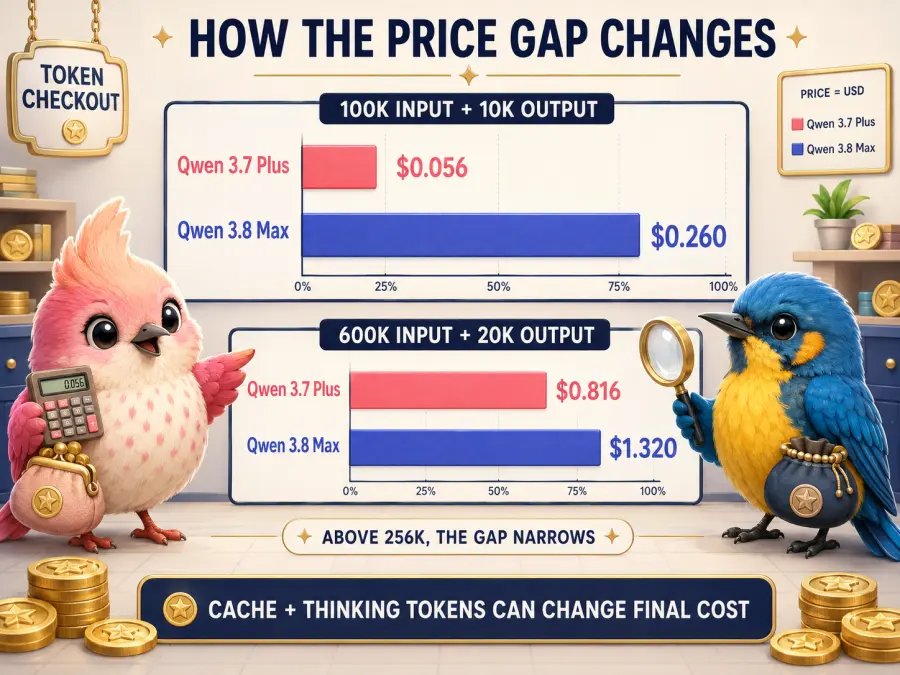
Plus is five times cheaper for input only in its lower context tier. Above 256K input tokens, its international price rises and the gap narrows.
Here are two simplified examples before caching, thinking tokens, or platform-specific charges:
A request with 100K input tokens and 10K output tokens costs about $0.056 on Qwen 3.7 Plus and $0.260 on Qwen 3.8 Max.
A request with 600K input tokens and 20K output tokens costs about $0.816 on Qwen 3.7 Plus and $1.320 on Qwen 3.8 Max.
Request length, output, cache hits, and retries all change the effective bill. Check the official Model Studio pricing page for your region.
 GPT Proto currently lists Qwen 3.8 Max at $1.80 per million input tokens and $5.40 per million output tokens, with separate cache-write and cache-read rates. Confirm the current numbers on the
Performance: Qwen 3.8 Max Is Stronger but Slower
The clearest independent comparison comes from Artificial Analysis. Its direct model comparison reports:
| Independent measurement |
Qwen 3.7 Plus |
Qwen 3.8 Max |
| Intelligence Index |
39 |
58 |
| Output speed |
56.1 tokens/s |
20.7 tokens/s |
| Time to first token |
2.17 s |
2.51 s |
Max produces better results across a broad evaluation mix, but Plus generates responses much faster. Time to first token is relatively close; the bigger difference appears after generation begins.
For chat or an IDE assistant, 56 tokens per second can feel much more responsive than 21. For an offline review that prevents a serious error, Max may justify the wait. Latency also depends on provider load, prompt length, and location, so test the production endpoint.
Which Is Better for Coding?
For coding, Qwen 3.8 Max is the better model overall. Qwen 3.7 Plus remains the practical choice for shorter, well-scoped work.
Use Plus for function explanations, unit-test scaffolding, data conversion, repetitive API clients, and narrow edits with explicit requirements. Use Max to trace multi-file bugs, plan migrations, review security-sensitive logic, resolve ambiguity, or operate an agent over a repository.
Artificial Analysis’s Coding Agent Index v1.4 used the same Claude Code test setup for both models. Its published results show a substantial lead for Max:
| Coding-agent result |
Qwen 3.7 Plus |
Qwen 3.8 Max |
| Coding Agent Index |
38 |
61 |
| DeepSWE |
19% |
52% |
| Terminal-Bench v2.1 |
72% |
84% |
| SWE-Atlas-QnA |
24% |
48% |
| Recorded cost per task |
$6.30 |
$3.23 |
| Recorded time per task |
10.7 min |
29.9 min |
Plus has the lower token price and finished faster, yet Max recorded a lower cost per completed task in this evaluation. Success rate, caching, output mix, and retries can outweigh list price. This does not prove that Max is always cheaper; it shows that token price is a poor proxy for the cost of completing hard software work.
In an independent hidden-bug test shared by Paweł Huryn, 11 models faced 105 hidden bugs in two repositories and were judged blind. Qwen 3.8 Max fixed 19 in about 148 minutes at a reported cost near $31. It was not the overall winner, but uniquely fixed one bug. Plus was not tested, so this is evidence about Max, not a direct comparison.
Max is more likely to justify its cost when a failed patch creates another review cycle. Plus is more efficient when the task is already decomposed and easy to verify.
Which Is Better for Frontend Coding?
Qwen 3.8 Max is the stronger choice for frontend coding, especially when the prompt includes screenshots, layout constraints, or visual acceptance criteria.
As of August 21, 2026, the preliminary WebDev Arena frontend leaderboard placed Qwen 3.8 Max fourth with a score of 1675 ± 14. Arena rankings move as votes accumulate, so this should be read as a dated snapshot rather than a permanent rank.
Roboflow’s six-task vision comparison also found a meaningful difference:
| Vision result |
Qwen 3.7 Plus |
Qwen 3.8 Max |
| Average across six evaluations |
67.4% |
84.0% |
| OCR |
86.5% |
92.8% |
| Visual reasoning, low effort |
39.7% |
73.5% |
| Average response time |
7.0 s |
18.0 s |
| Reported cost per sample |
$0.0008 |
$0.0074 |
Max’s visual advantage matters when an agent compares a rendered page with a reference, reads text in a screenshot, or diagnoses layout problems. Plus remains preferable for straightforward component generation from a text-only design system.
Visual rankings depend on the voting view. Arena placed Max second in one style-controlled view on August 21 and sixth without style control on August 27. Its exact placement therefore depends on the evaluation setting.
Which Is Better for Developers Building Agents?
Both models support function calling and structured output. Both can accept images and video. Qwen 3.7 Plus uses hybrid thinking: reasoning is on by default, but developers can disable it or set a thinking budget where supported. Qwen 3.8 Max exposes reasoning_effort levels such as low, medium, and xhigh in Alibaba Cloud’s API, with xhigh documented as the default.
Longer reasoning can consume more tokens and add latency. Start with the lowest setting that passes your evaluation, then raise it for difficult requests. Verify provider support because an Alibaba Cloud parameter is not automatically available through every compatible endpoint.
Max scores higher in the coding-agent comparison, and its 131,072-token maximum output is twice the Plus limit. Plus remains a good coordinator for frequent, low-risk tool calls such as classification, schema checks, or simple tool selection.
Batch support needs a region check. Plus batch interfaces can have a lower context cap. Max batch is documented for Beijing but not Singapore or global deployments.
Which Model Is More Cost-Effective?
Qwen 3.7 Plus is more cost-effective for predictable, easy requests. Qwen 3.8 Max can be more cost-effective for difficult tasks if it reduces failures, retries, and human review.
Use three measurements: cost per token, where Plus wins; cost per successful task, which depends on difficulty and retries; and cost of a wrong answer, which can favor Max for code changes and consequential tool actions.
If Plus needs several attempts and a developer review, Max may be cheaper despite its higher rate. Sending every extraction or formatting request to Max, however, pays for quality the application may not use.
Build a representative test set with a clear pass condition, then record latency, tokens, retries, and final success. Compare the completed workflow, not just the first invoice line.
Long Context, Video, and Multimodal Work
Both models advertise a 1-million-token context window. Plus suits extraction from large document sets when answers are short and well specified, although its international rate changes above 256K input. Max is better for cross-document synthesis, conflicting evidence, and long reports.
Both official pages list image and video input. Max is safer for visual interpretation that guides actions; Plus is cheaper for simpler OCR or metadata extraction. Test media limits and formats on the actual provider.
A Practical Production Routing Strategy
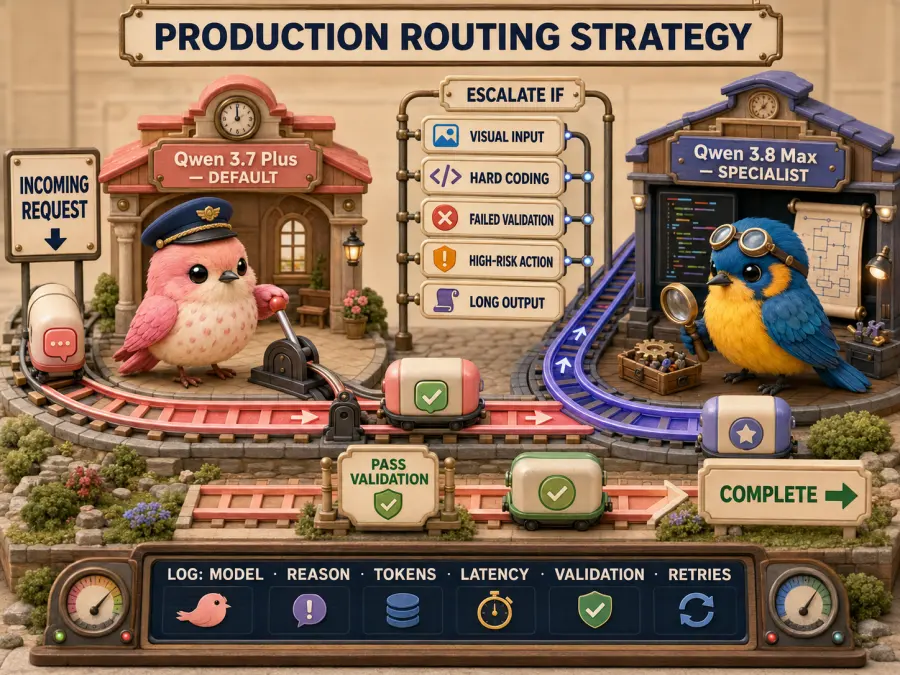
The best Qwen 3.7 Plus vs Qwen 3.8 Max decision may be to use both.
Route to Qwen 3.7 Plus by default when the request is short, constrained, low risk, or easy to verify. Escalate to Qwen 3.8 Max when one or more of these conditions apply:
The request includes a screenshot, diagram, or video that must be interpreted accurately.
A coding task spans multiple files or requires debugging an unknown root cause.
A first Plus attempt fails validation or returns low confidence.
The agent can take an irreversible or expensive action.
The task needs a very long generated answer.
Human review costs more than the model-price difference.
Log the selected model, routing reason, tokens, latency, validation result, and retries. Real traffic will show which rules save money.
How to Call Qwen 3.8 Max on GPT Proto
Editorial note before publishing: GPT Proto has prepared the Qwen 3.8 Max model page, but the endpoint must pass a live smoke test before this section is published as an available API. Until then, change the heading to “Qwen 3.8 Max Is Coming to GPT Proto,” keep the model-page link, and remove the command below.
After the model is active, the following OpenAI-compatible request can be used as a basic connectivity test:
curl --request POST "https://gptproto.com/v1/chat/completions" \
  --header "Authorization: Bearer $GPTPROTO_API_KEY" \
  --header "Content-Type: application/json" \
  --data '{
    "model": "qwen3.8-max",
    "messages": [
      {
        "role": "user",
        "content": "Review this implementation plan and identify the highest-risk failure points."
      }
    ]
  }'
Start with text and confirm the model ID, usage fields, latency, and errors. Test reasoning controls, media, batch inference, and provider-specific fields separately.
Visit the Qwen 3.8 Max API page for current availability and pricing.
Final Verdict: Qwen 3.7 Plus or Qwen 3.8 Max?
Choose Qwen 3.8 Max if you want the best model in this comparison. Its lead is clearest in independent intelligence results, coding-agent tasks, frontend evaluation, visual reasoning, and maximum output length.
Choose Qwen 3.7 Plus if your workload is routine, high volume, latency sensitive, or easy to validate. It produces tokens much faster in the Artificial Analysis measurement and has a far lower starting list price.
Use Plus as the default and Max as the escalation path. If only one model can be deployed, Max is the safer quality-first choice; Plus is the better budget-first choice.