Kurz gesagt: Für die meisten alltäglichen API-Workloads – Chat, Content-Generierung, einfaches Programmieren und Aufgaben mit hohem Batch-Volumen – ist DeepSeek V4 Flash die bessere Wahl, da es nahezu Pro-Qualität zum ungefähr einem Drittel des Preises bei einem 5× höheren Parallelitätslimit bietet. DeepSeek V4 Pro ist den Aufpreis nur dann wert, wenn du frontier-nahe agentenbasierte Programmierung, komplexe mehrstufige Schlussfolgerungen oder Refactorings auf Repository-Ebene benötigst, bei denen ein erfolgloser erster Versuch mehr kostet als der dreifache Preisunterschied pro Token. Wenn du als Entwickler Programmieragenten oder Frontend-Tools entwickelst, beginne mit Flash und wechsle für die schwierigsten 10–20 % der Aufgaben zu Pro.
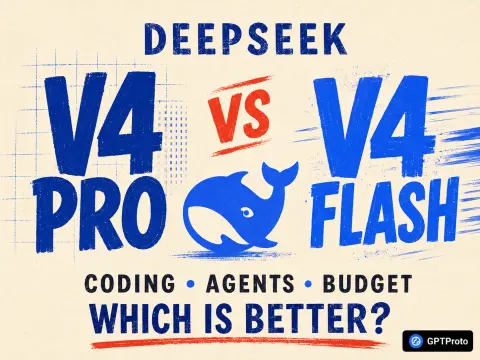
DeepSeek V4 Pro vs. DeepSeek V4 Flash: Was ist besser für Programmierung, Agenten und Ihr Budget?
DeepSeek V4 Pro vs V4 Flash im Vergleich: API-Preise, Benchmarks für Coding und Agenten, Limits für gleichzeitige Anfragen und Kosten pro Aufgabe. Finde heraus, welches Modell zu deinem Workload passt.
Inhaltsverzeichnis
DeepSeek V4 Pro vs V4 Flash: Specs at a Glance
| Spec | DeepSeek V4 Flash | DeepSeek V4 Pro |
|---|---|---|
| Release date | April 24, 2026 (preview); July 31, 2026 (GA) | April 24, 2026 (preview); August 13, 2026 (GA) |
| Architecture | Mixture-of-Experts | Mixture-of-Experts |
| Total parameters | 284B | 1.6T |
| Active parameters | 13B per token | 49B per token |
| Context window | 1M tokens | 1M tokens |
| Max output | 384K tokens | 384K tokens |
| Concurrency limit | 2,500 requests | 500 requests |
| Reasoning modes | Non-think / Think High / Think Max | Non-think / Think High / Think Max |
| API compatibility | OpenAI + Anthropic formats | OpenAI + Anthropic formats |
| License | MIT (open weights) | MIT (open weights) |
Both models share the same 1M-token context window, 384K max output, and hybrid thinking modes. The real difference is under the hood: Pro activates nearly 4× more parameters per token, which translates to stronger world knowledge and more reliable multi-step reasoning.
Pricing Comparison: How Much Does Each Model Really Cost?
DeepSeek introduced peak/off-peak pricing on August 16, 2026. Off-peak hours (Beijing time 18:00–09:00 and 12:00–14:00) are exactly half the peak rate. Here is the current official API pricing:
| Price component | V4 Flash (off-peak) | V4 Flash (peak) | V4 Pro (off-peak) | V4 Pro (peak) | Pro/Flash ratio |
|---|---|---|---|---|---|
| Cache-hit input | $0.007 / 1M | $0.014 / 1M | $0.022 / 1M | $0.044 / 1M | ~3.1× |
| Cache-miss input | $0.22 / 1M | $0.44 / 1M | $0.66 / 1M | $1.32 / 1M | 3× |
| Output | $0.66 / 1M | $1.32 / 1M | $1.98 / 1M | $3.96 / 1M | 3× |
What this means in practice:
A typical chat turn (1K input + 500 output) costs $0.00055 on Flash vs $0.00165 on Pro at off-peak rates.
A cache-heavy agent loop (200K cached + 20K fresh input + 10K output) costs $0.011 on Flash vs $0.033 on Pro.
Pro is always 3× more expensive per token — the ratio never changes based on workload shape.
GPT Proto pricing note: If you access DeepSeek V4 through GPT Proto, you pay a flat rate of $0.44 / $1.32 per 1M tokens (input/output) for Flash and $1.3914 / $2.7838 for Pro, with off-peak discounts applied automatically. GPT Proto also gives you one API key for 200+ models, so you can route between DeepSeek, Claude, GPT, and Gemini from a single balance.
Performance: Where Pro Actually Pulls Ahead
Independent benchmarks from Artificial Analysis (August 2026) show the two models are closer than the names suggest:
| Benchmark | V4 Pro 0813 | V4 Flash 0731 | Gap |
|---|---|---|---|
| Intelligence Index | 53 | 52 | Pro +1 |
| Agentic Index | 49.6 | 48.4 | Pro +1.2 |
| Terminal-Bench v2.1 | 78.65% | 78.65% | Tied |
| GPQA Diamond | 92.83% | 90.81% | Pro +2 |
| SciCode | 49.19% | 49.88% | Flash +0.7 |
| Output speed | 83.2 tok/s | 122.2 tok/s | Flash 47% faster |
DeepSeek's own benchmarks show a wider gap on knowledge-heavy and agentic tasks:
| Benchmark | V4 Pro 0813 | V4 Flash 0731 | Gap |
|---|---|---|---|
| SWE-bench Verified | 80.6% | 79.0% | Pro +1.6 |
| LiveCodeBench | 93.5 | 91.6 | Pro +1.9 |
| Codeforces rating | 3206 | 3052 | Pro +154 |
| Terminal Bench 2.0 | 67.9% | 56.9% | Pro +11 |
| BrowseComp | 83.4% | 73.2% | Pro +10.2 |
| SimpleQA | 57.9% | 34.1% | Pro +23.8 |
| MRCR 1M (long context) | 83.5% | 78.7% | Pro +4.8 |
The pattern is clear:
Flash matches Pro on bounded, well-defined coding tasks (Terminal-Bench v2.1, SciCode, simple debugging).
Pro pulls ahead on knowledge-intensive tasks (SimpleQA), long-horizon agent workflows (Terminal Bench 2.0, BrowseComp), and complex reasoning (HLE, GPQA).
Flash is significantly faster — 47% more tokens per second — which matters for interactive applications and high-throughput pipelines.
Which Is Better for Coding and Frontend Development?
For most frontend coding tasks, V4 Flash is the better starting point.
Flash handles single-file components, CSS fixes, utility functions, and test generation with speed and accuracy that matches Pro. In controlled tests, Flash completed a TypeScript pricing bug fix in 18.5 seconds vs Pro's 84.9 seconds — though Pro caught more edge cases.
Upgrade to Pro when:
You are doing repo-scale refactors that touch 10+ files.
You need multi-turn agentic coding where the model must plan, execute, and self-correct across long horizons.
You are working with ambiguous requirements where wrong assumptions are expensive.
You need strict JSON/schema compliance without markdown wrappers.
Real-world developer experience:
"V4 Flash is my daily driver for React components and API integrations. I only switch to Pro when I am debugging a race condition across three services or need it to refactor a legacy codebase without breaking the public API." — Full-stack developer, Guangzhou
For frontend coding specifically, Flash's 122 tok/s output speed makes it feel more responsive in IDE integrations and CLI tools. Pro's deeper reasoning is overkill for most UI work but essential for complex state management logic or performance optimization tasks.
Which Is Better for AI Agents?
V4 Flash is the default for simple, bounded agent tasks. V4 Pro is for long-horizon, high-stakes workflows.
DeepSeek explicitly optimized both models for agent frameworks like Claude Code, OpenClaw, OpenCode, and CodeBuddy. But the "simple vs complex" distinction matters:
| Agent task type | Recommended model | Why |
|---|---|---|
| Web search + summarize | Flash | Fast, cheap, low failure cost |
| Single-tool API calls | Flash | Bounded scope, easy to verify |
| Multi-step research agent | Pro | Higher first-pass success rate |
| Code migration across services | Pro | Fewer retries, better planning |
| High-volume classification | Flash | 5× concurrency, 1/3 cost |
| Customer-facing chatbot | Flash | Lower latency, human review fallback |
The break-even math:
Pro is cheaper per successful task only when Flash's retry rate exceeds roughly 3.1×. For most production workloads, Flash's lower cost and higher throughput outweigh Pro's slightly better reliability. But for mission-critical agents — financial analysis, legal document review, autonomous deployment scripts — Pro's higher first-pass success rate prevents costly downstream errors.
Which Is More Cost-Effective?
V4 Flash is more cost-effective for 80% of use cases. V4 Pro is cost-effective only when failure is expensive.
Here is the decision framework:
Choose Flash if:
Your workload is high-volume and latency-sensitive.
Tasks are bounded and easy to verify.
A human reviews outputs before they reach users.
You can schedule batch jobs during off-peak hours.
You need 2,500 concurrent requests.
Choose Pro if:
A wrong answer costs more than 3× the token price.
You are running long-horizon agents with 10+ tool calls.
Tasks require deep world knowledge or complex reasoning.
You need the highest possible benchmark scores for coding or math.
Your concurrency needs stay under 500 requests.
Hybrid routing strategy:
Many teams run both models behind a single API gateway. Route simple queries to Flash and escalate complex ones to Pro. With GPT Proto, you can implement this routing logic in your application layer while billing both models from one balance — no separate DeepSeek account required.
What's New in DeepSeek V4 Pro?
If you are wondering "what's DeepSeek V4 Pro upgrade now", here is what changed from preview to the current 0813 GA release:
Agent capability leap: DeepSWE score jumped from 12.8 to 62.7 — a 390% improvement that moves Pro from "barely functional" to "competitive with frontier closed models."
Terminal Bench 2.1: Score rose from 72.1 to 87.9, nearly matching the top-ranked model.
New API protocols: Added OpenAI Responses API and Anthropic API compatibility, making migration from Claude or GPT-5.5 easier.
Reasoning effort control: You can now dial
reasoning_efforttolow,high, ormaxper request, balancing speed vs accuracy without swapping model endpoints.1M context as standard: Both Pro and Flash now ship with 1M-token context windows, up from 128K in earlier versions.
The old deepseek-chat and deepseek-reasoner model names were retired on July 24, 2026. If your integration still uses them, update to deepseek-v4-pro or deepseek-v4-flash immediately.
How to Access DeepSeek V4 Pro and Flash
You can call both models through DeepSeek's official API or through a unified platform like GPT Proto.
Official DeepSeek API:
from openai import OpenAI

client = OpenAI(
    api_key="YOUR_DEEPSEEK_KEY",
    base_url="https://api.deepseek.com",
)

response = client.chat.completions.create(
    model="deepseek-v4-flash",  # or "deepseek-v4-pro"
    messages=[{"role": "user", "content": "Refactor this React component..."}],
)
GPT Proto (recommended for multi-model teams):
GPT Proto gives you one API key for DeepSeek V4 Pro, V4 Flash, Claude, GPT, Gemini, and 200+ other models. Billing is unified, and you get automatic off-peak discounts without managing multiple provider accounts.
Final Verdict
DeepSeek V4 Flash is the pragmatic choice for developers, startups, and enterprises running high-volume, cost-sensitive workloads. It is faster, cheaper, and matches Pro on most everyday tasks.
DeepSeek V4 Pro is the specialist tool for frontier coding agents, deep research, and complex reasoning where quality cannot be compromised.
The smartest strategy is not choosing one — it is using both. Start with Flash, monitor your failure rates, and escalate to Pro only when the cost of a wrong answer exceeds the 3× token premium. With GPT Proto, you can run both models from a single API key and balance, making hybrid routing simple to implement and easy to bill.
Last updated: August 19, 2026. Pricing and benchmark data reflect the August 16, 2026 rate change and the V4 Pro 0813 GA release.
Ein Schlüssel, mehr KI-Modelle
Entdecke den kostengünstigen Zugang zu führenden KI-Modellen über eine OpenAI-kompatible API.
API-Modelle durchsuchen
Verwandte Funktionen
Alle Funktionen
KI-Verpackungsdesign-Generator
Erstellen Sie Verpackungskonzepte und Produkt-Mockups anhand von Text oder einem hochgeladenen Bild. Entdecken Sie online Boxen, Flaschen, Beutel, Etiketten und E-Commerce-Visuals.

KI-Altersfilter
Lade ein Foto hoch, um dich älter, jünger oder als Baby zu sehen. Der KI-Altersfilter erstellt in Sekunden realistische Altersprogression-Fotos und reproduziert den viralen TikTok-Alterungstrend.


KI-Wasserzeichenentferner
Laden Sie ein Bild hoch und entfernen Sie mit KI sichtbare Logos, Text oder Datumsstempel. Sehen Sie sich das bereinigte Ergebnis online an – ganz ohne Prompt oder Bearbeitungssoftware.


KI-Bildverbesserer online
Verbessere die Bildqualität online mit KI. Lade ein verschwommenes oder niedrig aufgelöstes Foto hoch und unser KI-Bildverbesserer schärft, entrauscht und skaliert es mit einem Klick auf 4K hoch.
Verwandte Modelle
Alle Modelle


FAQ
Ist DeepSeek V4 Flash gut genug fürs Programmieren?
Ja. V4 Flash erreicht bei klar abgegrenzten Coding-Aufgaben wie Korrekturen in einzelnen Dateien, Testgenerierung und SQL-Abfragen das Niveau von Pro. Schwierigkeiten gibt es nur bei Refactorings auf Repository-Ebene und mehrdeutigem Debugging über mehrere Dateien hinweg.
Welches Modell ist besser für Frontend-Entwicklung?
V4 Flash eignet sich aufgrund seiner um 47 % höheren Ausgabegeschwindigkeit und der geringeren Kosten besser für die meisten Frontend-Aufgaben. Verwende Pro nur für komplexes State-Management, Performance-Optimierung oder architektonische Änderungen über mehrere Dateien hinweg.
Wie viel günstiger ist Flash als Pro?
Flash kostet pro Token bei Spitzen- und Nebenzeiten genau ein Drittel von Pro. Für einen typischen Agenten-Loop kostet Flash 0,011 $ gegenüber 0,033 $ für Pro pro Aufgabe.
Kann ich beide Modelle in derselben Anwendung verwenden?
Ja. Viele Teams leiten einfache Abfragen an Flash und komplexe Abfragen an Pro weiter. Mit GPTProto kannst du dies mit einem API-Schlüssel und einem Guthaben erledigen.
Wie groß ist der Unterschied beim Limit für gleichzeitige Anfragen?
Flash unterstützt 2.500 gleichzeitige Anfragen, Pro unterstützt 500. Flash ist die einzige praktikable Wahl für Batch-Workloads mit hohem Durchsatz.
Liefert Pro immer eine bessere Qualität?
Nein. Bei unabhängigen Benchmarks liegen Pro und Flash bei den meisten Metriken innerhalb von 1–2 Punkten. Der Vorteil von Pro konzentriert sich auf wissensintensive Aufgaben und Agenten mit langem Planungshorizont.
Welches Modell sollte ich für KI-Agenten wählen?
Beginne mit Flash für einfache, klar abgegrenzte Agentenaufgaben. Wechsle zu Pro für Workflows mit langem Planungshorizont, wichtige Entscheidungen oder wenn die Wiederholungsrate von Flash das Dreifache überschreitet.
Lohnt sich das Upgrade auf DeepSeek V4 Pro?
Nur wenn dein Workload komplexes Schlussfolgern, Coding auf Repository-Ebene oder unternehmenskritische Agenten umfasst, bei denen Fehler mehr kosten als der dreifache Token-Aufpreis.
Verwandte Artikel
Weitere Blogbeiträge
DeepSeek V4 Pro vs. GLM 5.2: Welches ist 2026 besser?
Zwei chinesische Open-Weight-Flaggschiffe liegen inzwischen innerhalb der Rundungsfehlergrenze der westlichen Spitzenmodelle – zu einem Bruchteil des Preises. DeepSeek V4 Pro und GLM 5.2 (von Z.ai, ehemals Zhipu) sind die beiden Modelle, die Entwickler 2026 immer wieder gegeneinander antreten lassen – und das aus gutem Grund: Beide bieten ein Kontextfenster mit 1 Million Token, sind Open-Weight-Modelle und unterbieten Claude und GPT um das 5- bis 10-Fache. Doch "welches ist besser" hat keine eindeutige Antwort – es hängt davon ab, ob dir Frontend-Coding , algorithmisches Schlussfolgern , Zuverlässigkeit bei agentischen Aufgaben oder reine Kosten pro Aufgabe wichtig sind. Die meisten Vergleiche bleiben beim Listenpreis stehen. Dieser geht weiter: Wir betrachten die tatsächlichen Ausgaben pro Aufgabe , DeepSeeks kürzlich aktivierte Surge-Preisgestaltung , die Token-Effizienz und die Fehlerbilder, die jedes Modell verbirgt. Wenn du eines der beiden Modelle direkt testen möchtest, kannst du sie hier nebeneinander ausführen: DeepSeek V4 Pro → gptproto.com/model/deepseek/deepseek-v4-pro GLM 5.2 → gptproto.com/model/z-ai/glm-5.2
Michael Johnson | 2026-08-17
DeepSeek Peak Pricing ist jetzt live: Wann kostet die API mehr?
Falls Sie am 17. August aufgewacht sind und Ihre DeepSeek-API-Rechnung plötzlich anders aussah, bilden Sie sich das nicht ein. DeepSeek hat offiziell Peak Pricing eingeführt – ein zeitbasiertes Abrechnungsmodell für Spitzen- und Nebenzeiten, das bestimmt, wie viel Sie pro Token zahlen, je nachdem, wann Ihre Anfragen die API erreichen. Kurz gesagt: Wenn Sie Ihre Workloads in Stoßzeiten ausführen, zahlen Sie den vollen Preis. Verlagern Sie sie auf ruhigere Zeiten, zahlen Sie die Hälfte . Dieser Leitfaden erklärt genau, was DeepSeek Peak Pricing ist, wann die API mehr kostet, wie viel es in jeder Stufe kostet und worauf Sie achten sollten.
Michael Johnson | 2026-08-17
DeepSeek V4 Pro vs. Kimi K3: Was hat sich nach dem 0813-Update geändert?
Der Vergleich zwischen DeepSeek V4 Pro und Kimi K3 hat sich am 13. August 2026 verändert. DeepSeek hat die V4-Pro-Vorschau hinter dem bestehenden API-Alias durch DeepSeek V4 Pro 0813 ersetzt und dabei den Modellnamen beibehalten, den Entwickler bereits verwenden. Hier die kurze Antwort: Kimi K3 führt weiterhin bei der insgesamt gemessenen Intelligenz und unterstützt visuelle Eingaben. DeepSeek V4 Pro 0813 ist schneller und für textbasiertes Codieren sowie Agent-Workloads erheblich günstiger. Für die meisten Teams, die Repositories verarbeiten, Code-Reviews durchführen oder Agents mit hohem Volumen betreiben, ist DeepSeek jetzt die bessere Standardwahl. Kimi rechtfertigt seinen höheren Preis, wenn multimodale Eingaben oder die höchstmögliche verfügbare Reasoning-Leistung wichtiger sind als die Kosten. Ein Implementierungsdetail wird leicht übersehen: Auf GPTProto benötigen Sie kein 0813 -Suffix. Rufen Sie weiterhin deepseek-v4-pro auf; die Route verwendet automatisch die aktuelle Version.
Tiffany Layne | 2026-08-13
Grok 4.6 vs. DeepSeek V4 Pro: Programmierung, Preise und welches Modell besser ist
rok 4.6 und DeepSeek V4 Pro wurden beide für anspruchsvolle Reasoning- und Programmieraufgaben entwickelt, sind jedoch nicht austauschbar. Grok 4.6 ist die bessere Wahl, wenn eine Aufgabe Screenshots, Interface-Mockups, visuelles Debugging oder besonders schwierige agentische Programmierprobleme umfasst. DeepSeek V4 Pro ist attraktiver, wenn Kosten, langer Kontext und umfangreiche textbasierte Programmierung im Vordergrund stehen. Die kurze Antwort ist einfach: Grok 4.6 ist das bessere Allround-Modell, während DeepSeek V4 Pro das kosteneffizientere Programmiermodell ist. Dieser Vergleich von Grok 4.6 und DeepSeek V4 Pro behandelt Programmierung, Frontend-Entwicklung, Kontextfenster, öffentliche Benchmark-Ergebnisse, API-Preise und das aktuelle Upgrade von DeepSeek V4 Pro. Außerdem wird erklärt, welches Modell für verschiedene Entwickler-Workloads sinnvoller ist. Kurzes Fazit: Wählen Sie Grok 4.6 für visuelle Frontend-Arbeit, schwieriges Debugging und anspruchsvolle Programmieraufgaben. Wählen Sie DeepSeek V4 Pro für große Repositories, textlastige Workflows und niedrigere API-Kosten. Für das Routing in Produktionsumgebungen kann DeepSeek V4 Pro den Standard-Workload übernehmen, während Grok 4.6 visuelle oder besonders schwierige Aufgaben bearbeitet.
Tiffany Layne | 2026-08-13