First, untangle what "copying motion" means
Most comparisons blur two capabilities that feel similar and behave nothing alike.
The first is motion synthesis: you describe an action in words and the model invents the physics — joint angles, weight shift, follow-through. This is where AI video historically fell apart. Fast human action is the single hardest thing to fake, because your eye is trained on it. A slightly wrong elbow reads as "wrong" instantly, even to non-experts. When people say a clip looks "AI," a broken human motion is usually why.
The second is motion transfer: you hand the model a reference — an image, a clip, sometimes a voice — and ask it to carry that exact movement or identity into a new generation. Here the model is not inventing motion; it is copying and re-targeting it. Different problem, different architecture, different winner.
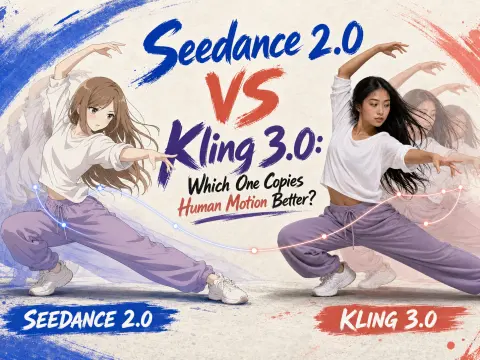
Keep those two apart and the whole comparison stops being mushy. Kling 3.0 is built to be strong at the first. Seedance 2.0 is built to be strong at the second. Everything below follows from that.
Side-by-side specs
Both models shipped within days of each other in early 2026 and both are genuinely capable, so the spec sheet is closer than the marketing suggests.
| |
Kling 3.0 |
Seedance 2.0 |
| Lab |
Kuaishou |
ByteDance (Dreamina / Doubao / CapCut) |
| Released |
Feb 5, 2026 (Kuaishou) |
Feb 2026; CapCut rollout Mar 26 (TechCrunch) |
| Max resolution |
Native 4K, 3840×2160 (Kuaishou) |
1080p at launch, 4K added later (BytePlus) |
| Frame rate |
Up to 60 fps (Kuaishou) |
Not officially specified |
| Max duration |
15 s (Kuaishou) |
15 s, six aspect ratios (TechCrunch) |
| Multi-shot |
Up to 6 shots in one clip, director-style (Kuaishou) |
Sequence building via multiple reference inputs |
| Native audio |
Music, SFX, lip-sync in 5 languages (Kuaishou) |
Native dialogue, SFX, music (BytePlus) |
| Reference inputs |
Text / image / video / audio (MVL architecture) |
Images + video clips + audio fused in one pass (BytePlus) |
| US availability |
Available |
Not in the US at rollout (copyright review) (TechCrunch) |
A note on the resolution row before anyone over-weights it: Kling's native 4K at 60 fps is the higher number on paper, and Kuaishou is clear that it is rendered, not upscaled. But almost nobody generating short social or ad clips needs 4K/60 — you are paying render time and money for pixels that get crushed by the platform's own compression. Treat 4K as a nice-to-have for the rare broadcast or big-screen job, not as the thing that decides this matchup.
Round 1: generating human motion from a prompt — Kling 3.0
This is Kling's home turf, and it is the reason the human-motion question is worth asking at all.
Kuaishou rebuilt Kling 3.0 on what it calls a Multi-modal Visual Language (MVL) architecture, handling text, image, audio, and video inside one system rather than stitching separate tools together. The claim I care about — and this is a vendor claim, so weigh it accordingly — is that the model holds human anatomy together through fast, complex action. The recurring theme in independent hands-on write-ups backs this up: complex actions like dancing, running, and martial arts come out with far fewer of the morphing-limb and extra-finger failures that plague this exact scenario.
My read, treating the reviewer consensus as a lead rather than gospel: if your prompt is "a dancer does a full spin and lands," Kling is the safer bet to give you a clean take on the first few tries. It also follows direction tightly — camera moves, lighting, on-screen text — so what you generate needs less cleanup before it is usable.
The cost of that control? Kling is more literal. Feed it a loose, ambitious, "surprise me" prompt with a chaotic scene and it tends to stay closer to the literal instruction than to the vibe you were reaching for. It rewards you for prompting like a director and punishes vague prompts with flat results.
Round 2: copying motion from a reference — Seedance 2.0
Now flip the job. You are not describing motion in words; you have a clip of exactly the movement you want and you need it transferred.
Seedance 2.0's defining feature is multimodal reference fusion. ByteDance's own framing is that you combine images, videos, and audio as references in a single generation, plus in-place editing and video extension. TechCrunch's coverage adds the concrete part: you can drive a generation from a reference video, not just a still, and the model renders realistic texture, movement, and lighting from it. In plain terms — if the brief is "match this performance," this is the tool actually designed for it. Kling can animate from an image, but it does not offer the same depth of "lock this reference and respect it." On GPT Proto specifically, the reference-driven generation mode is documented as a Seedance-only capability — Kling exposes prompt-driven modes, not the same reference-fusion path.
That reference-driven design is also why Seedance tops the independent scoreboard. The Artificial Analysis video arena, which ranks models by blind human votes on identical prompts, puts Dreamina Seedance 2.0 at #1 for text-to-video with audio (Elo around 1,219) and #1 for image-to-video (around 1,344) as of mid-2026 — ahead of Kling 3.0 Pro, which sits around 1,105 on the with-audio text-to-video board. So on raw preferred-output quality, Seedance is measurably in front.
Two honest caveats, because that ranking is not the whole story. First, turn audio off and the board reshuffles hard — Seedance drops to around #4 and Kling to #5 behind other models entirely, which tells you a chunk of Seedance's lead is people preferring its baked-in sound, not purely its visuals. Second, and this is the big one for API builders: Seedance was not available in the US at rollout. ByteDance paused broader distribution over copyright disputes with Hollywood studios, and built in guardrails — it won't generate from real faces, and it embeds an invisible watermark. If your product serves US users directly on the consumer web, that availability gap is a real planning constraint, not a footnote.
Round 3: emotion and micro-expression
The variant of this question I get most is really about faces — can it do a believable smile that reaches the eyes, a flicker of doubt, a genuine laugh. Here I have to be straight about the evidence: neither lab publishes a "facial emotion" benchmark, and Artificial Analysis measures overall preference, not micro-expression specifically. So this section is judgment, flagged as such.
What I can say is grounded. Seedance's edge in blind-preference testing shows up most in believable small human behaviors — the kind of subtle, close-up realism that carries emotional shots. Kling's strength is the opposite end: big, physical, full-body action stays coherent. For a tight close-up where the whole shot rides on an expression, I would prototype Seedance first. For an emotional beat carried by body language across a room, Kling's motion coherence tends to sell it better. If facial performance is the make-or-break for your use case, do not trust either of us — generate the same shot on both and judge with your own eyes. The APIs make that cheap, which is the whole point of the next section.
Run both yourself: the code
Both models sit behind one endpoint on GPT Proto, which means you can A/B the exact same brief without juggling two vendors, two keys, or two billing accounts. Video generation is asynchronous: you POST a request, get an id back, then poll for the result.
Here is Kling 3.0 generating human motion from a text prompt — its strong suit:
import requests, time

BASE = "https://gptproto.com/api/v3"
HEADERS = {"Authorization": "GPTPROTO_API_KEY", "Content-Type": "application/json"}

def generate(path, payload):
    r = requests.post(f"{BASE}/{path}", headers=HEADERS, json=payload)
    r.raise_for_status()
    job = r.json()["data"]
    get_url = job["urls"]["get"]  # e.g. https://gptproto.com/api/v3/predictions/{id}/result

    # poll until the job leaves the queued/running state
    while True:
        res = requests.get(get_url, headers=HEADERS).json()["data"]
        status = res["status"]
        if status in ("succeeded", "failed", "expired"):
            return res
        time.sleep(5)

kling = generate(
    "kling/kling-v3.0-std/text-to-video",
    {
        "prompt": "A martial artist performs a fast spinning kick, "
                  "full body in frame, weight shifting naturally on landing.",
        "aspect_ratio": "16:9",
        "duration": 5,
        "resolution": "1080p",
        "generate_audio": True,
        "seed": -1,
    },
)
print(kling["status"], kling.get("outputs"))
And here is Seedance 2.0 in its reference-to-video mode, copying the motion from a reference clip onto a new character — exactly the job it owns. Same helper, different path and payload:
# reference-to-video: `videos` carries the motion to copy, `images` the character
seedance = generate(
    "bytedance/dreamina-seedance-2-0-260128/reference-to-video",
    {
        "prompt": "The character performs the exact routine from the reference video, "
                  "matching timing and body movement, new studio background.",
        "videos": ["https://your-cdn.com/motion-reference.mp4"],  # motion to replicate
        "images": ["https://your-cdn.com/character.png"],          # up to 10 references
        "aspect_ratio": "9:16",
        "duration": 5,
        "resolution": "1080p",
        "generate_audio": True,
        "seed": -1,
    },
)
print(seedance["status"], seedance.get("outputs"))
If you prefer cURL for a quick smoke test:
curl --location 'https://gptproto.com/api/v3/kling/kling-v3.0-std/text-to-video' \
  --header 'Authorization: GPTPROTO_API_KEY' \
  --header 'Content-Type: application/json' \
  --data '{
    "prompt": "A dancer completes a full spin and lands cleanly.",
    "aspect_ratio": "16:9",
    "duration": 5,
    "resolution": "1080p"
  }'
Swap GPTPROTO_API_KEY for your real key. Seedance's reference-to-video mode takes arrays — videos, images (up to 10), and audios — so you can lock a motion clip, a character, and a voice in one call; per GPT Proto's docs, that reference mode is a Seedance-only capability here, which is the practical reason it owns motion copying. Kling covers the generate-from-prompt side through its standard and motion-control modes. Parameter support varies by model, so check the exact fields on each model's page before a production run. The point is that the endpoint shape, auth, and polling loop are identical, so testing the same brief on both is a small change.
So which do you pick?
- You are generating human action from text — dance, sports, fight choreography, anything full-body and fast: Kling 3.0. Prompt it like a director and it repays you.
- You need to copy a specific performance from a reference clip onto a new character or scene: Seedance 2.0. Reference fusion is what it was built for, and the blind-vote arena agrees on output quality.
- Your shot lives or dies on a close-up facial expression: start with Seedance 2.0, but generate both and judge yourself — this is the one axis I would not decide from a spec sheet.
- You need 4K/60 for broadcast or big-screen: Kling 3.0 is the only one with native 4K at 60 fps today.
- You ship to US users on the open web and need clean availability: factor in that Seedance was restricted at rollout for copyright reasons — accessing it through an API platform is the practical route, and worth confirming for your specific case.
Both are online right now through one account: Kling 3.0 and Seedance 2.0. Browse the full video model lineup if you want to line them up against Veo or Hailuo too, and the pricing page has current per-generation costs.