GLM-5.2 vs Kimi K3 at a Glance
| Category |
GLM-5.2 |
Kimi K3 |
Practical winner |
| Architecture |
753B-parameter MoE, about 40B active per token |
2.8T-parameter MoE, 16 of 896 experts activated |
Kimi K3 on scale; size alone does not prove quality |
| Context window |
1M tokens |
1M tokens |
Tie |
| Maximum output |
128K tokens |
Up to 1M tokens when explicitly configured |
Kimi K3 |
| Input |
Text |
Text, images, and video |
Kimi K3 |
| Reasoning control |
Multiple modes; High and Max on GPT Proto |
Always-on thinking with low, high, and max effort; max by default |
Depends on the endpoint and task |
| Developer features |
Function calling, JSON, caching, MCP |
Function calling, JSON, caching, dynamic tool loading, vision |
Kimi K3 for multimodal agents; otherwise close |
| Open weights |
Available now under MIT |
Available under the custom Kimi K3 License |
GLM for permissive licensing and a smaller footprint; Kimi for the higher capability ceiling |
| Official API price per 1M tokens |
$1.40 input, $0.26 cached input, $4.40 output |
$3 input, $0.30 cached input, $15 output |
GLM-5.2 |
| Best fit |
Routine code review, repo refactoring, high-volume automation, self-hosting |
Hard agentic tasks, visual debugging, frontend, 3D and game development |
Depends on the task |
| Self-hosting footprint |
753B total / about 40B active |
2.8T total / 104B active; about 1.56 TB; 64+ accelerators recommended |
GLM-5.2 for most private deployments |
The specifications come from the GLM-5.2 documentation and model card, plus the released Kimi K3 model card, license, and technical report. Both models now publish weights. The practical difference is no longer open versus closed; it is MIT versus a custom license, and a 753B model versus a 2.8T model with a much larger deployment footprint.
Coding Benchmarks Favor Kimi K3, but Read the Footnotes
Moonshot's published comparison gives Kimi K3 a clean lead on the coding benchmarks most relevant to agents:
| Benchmark |
Kimi K3 |
GLM-5.2 |
Difference |
| DeepSWE |
67.5 |
46.2 |
+21.3 K3 |
| Terminal-Bench 2.1 |
88.3 |
82.7 |
+5.6 K3 |
| Program Bench |
77.8 |
63.7 |
+14.1 K3 |
| FrontierSWE |
81.2 |
67.3 |
+13.9 K3 |
| SWE-Marathon |
42.0 |
13.0 |
+29.0 K3 |
| Kimi Code Bench 2.0 |
72.9 |
64.2 |
+8.7 K3 |
Those numbers are vendor-published, not an independent lab's controlled head-to-head. Moonshot's own benchmark notes say the models sometimes ran under different agent frameworks, including Kimi Code, Claude Code, and Codex. FrontierSWE scores were also recomputed from raw results. That does not make the results useless, but it does mean a 10-point gap cannot be attributed to the base model alone.
Independent evidence points in the same direction, with a smaller and more believable conclusion. Artificial Analysis scores Kimi K3 at 57 on its Intelligence Index versus 51 for GLM-5.2 Max. It also estimates a blended price of $2.31 per million tokens for K3 and $0.90 for GLM, using a 7:2:1 mix of cached input, fresh input, and output.
My reading: Kimi K3 is the capability winner. The evidence is not clean enough to claim it is always better, but it is consistent enough that I would give K3 the first attempt on an unusually hard coding task. GLM-5.2's counterargument is economic, not academic.
A Real 3D Game Test Makes the Difference Visible
Coding scores are abstract. A 3D scene is not. It exposes whether the model can coordinate layout, camera behavior, lighting, interaction, state, and visual iteration rather than merely produce syntactically valid files.
A public X comparison gave Kimi K3, GLM-5.2, and Claude Opus 4.8 the same 3D-world prompt and showed the outputs for blind judging. This is a qualitative demonstration, not a benchmark: one prompt, one run, and an agent setup that can affect the result. Its value is that a reader can inspect the actual worlds instead of trusting a score.
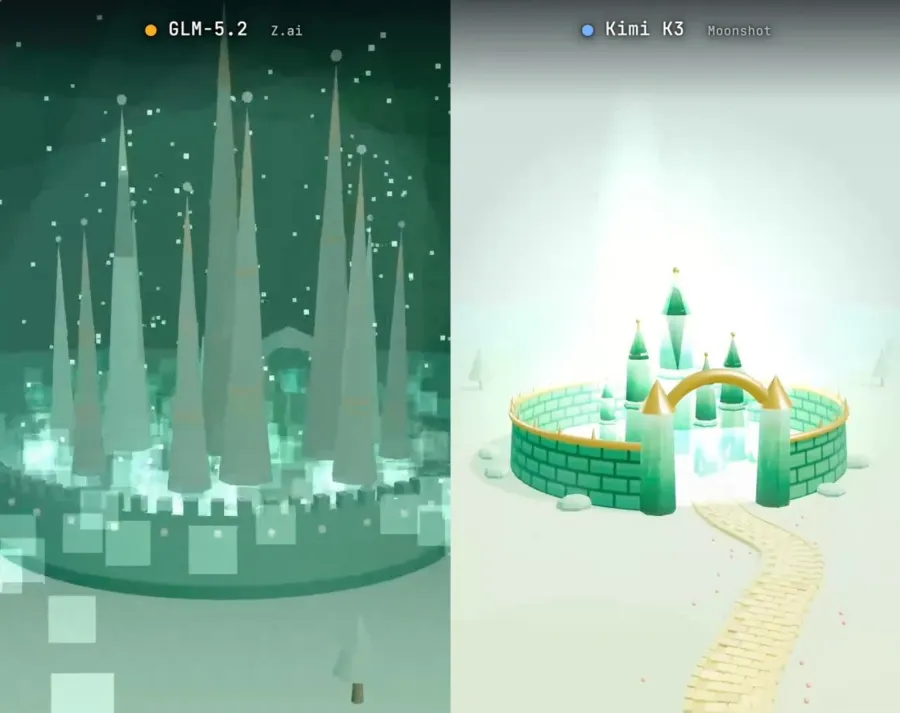
K3 has a structural advantage for this kind of work. It accepts images and video natively, so an agent can render the scene, feed the screenshot back to the model, and ask it to correct clipping, spacing, contrast, or camera framing. Moonshot calls this a vision-in-the-loop workflow in its K3 technical blog. GLM-5.2 is text-only. An external browser tool can describe screenshots or provide logs, but that adds another component and another place for information to be lost.
GLM should not be dismissed as a game coding model, though. In one community case on Reddit, a developer started from an empty folder and asked GLM-5.2, running through Claude Code plan mode, to build an Animal Crossing-style game in HTML, JavaScript, and Three.js. The result contained roughly 2,800 lines and connected movement, NPC dialogue, fishing, an economy, a shop, a museum, housing, furniture, and LocalStorage. The reported run used about 11.7 million input tokens and 138,000 output tokens, with 29 minutes 43 seconds of API time and 1 hour 21 minutes of wall time.
The author also reported bugs and balancing problems. Good. That roughness makes the example more useful than a polished vendor reel. It shows GLM-5.2 can assemble a coherent prototype; it does not show that the code is production-ready or that it beats K3.

For game code, interactive 3D, or screenshot-led frontend work, I would choose Kimi K3. For a text-specified gameplay loop where cost matters more than visual iteration, GLM-5.2 remains credible.
Which Model Is Better for Code Review and Bug Fixing?
Direct public GLM-5.2 vs Kimi K3 code-review A/B tests are still thin. That is worth saying plainly. Benchmark tables test issue resolution and agent execution, but they do not tell us whether either model will catch the authorization bug in your pull request without flooding the review with style comments.
For difficult bug fixing, K3 has the stronger evidence. Its lead on DeepSWE, Program Bench, and SWE-Marathon suggests better performance when a model must inspect a codebase, form a plan, edit files, run tools, and recover from failed attempts. Native vision also matters when the failure is visible in a browser, mobile screen, chart, or CAD viewport.
For everyday review, I would start with GLM-5.2. Z.ai explicitly recommends it for project audits, long-horizon refactoring, API migrations, and work constrained by lint, build, test, and dependency rules. Its official guide encourages developers to state boundaries such as “do not introduce dependencies” and “do not change API contracts,” then require build, lint, and test verification. That is close to a real review workflow.
Cost strengthens the case. Most pull requests are not SWE-Marathon problems. Paying K3's output premium to rename a method, add tests, or review a routine CRUD change is hard to justify. Route ordinary reviews to GLM; escalate only ambiguous failures, visual defects, or stubborn multi-file issues to K3.
API Pricing: Is Kimi K3 Worth More Than GLM-5.2?
At official list rates, GLM-5.2 costs $1.40 per million fresh input tokens, $0.26 for cached input, and $4.40 for output. Kimi K3 costs $3, $0.30, and $15 respectively. Kimi's fresh input is about 2.1 times the price, while its output is about 3.4 times the price.
Consider an aggregate coding job that consumes 1 million fresh input tokens and 100,000 output tokens across its agent loop:
| Workload |
GLM-5.2 |
Kimi K3 |
| 1M fresh input + 100K output |
$1.84 |
$4.50 |
| 1M cached input + 100K output |
$0.70 |
$1.80 |
These estimates exclude retries, external tool charges, and taxes. They also assume the provider recognizes the repeated prefix as cacheable. Moonshot reports cache-hit rates above 90% in coding workloads, but your result depends on stable prompts and preserved conversation history.
Is K3 worth the difference? For one hard task where a failed attempt costs an engineer two hours, yes. For continuous code review or bulk repository maintenance, usually no. A 6-point independent intelligence advantage does not automatically justify a 2.6-times higher blended token price.
API Features Developers Will Actually Notice
Both models offer a 1M-token context window, function calling, streaming, structured output, and context caching. Both can sit behind an OpenAI-compatible client. The differences show up in operation.
Kimi K3 accepts text, images, and video through its hosted service, supports dynamic tool loading, and can return very long outputs. It always thinks, but the current model card now documents `low`, `high`, and `max` reasoning effort, with `max` as the default. Agents must still preserve the complete assistant message, including thinking history, between turns; switching another model to K3 halfway through a session can destabilize output.
K3 can also be too proactive. Moonshot recommends stricter system instructions or an AGENTS.md file when the model must not make decisions outside a defined boundary. That warning matters in production. A model that fixes adjacent issues without permission may look diligent in a demo and become a liability in a regulated repository.
GLM-5.2 is simpler to budget. Developers can select reasoning modes instead of paying for maximum thinking on every request. It supports MCP and already ships under an MIT license, so teams can inspect, fine-tune, or self-host the weights today. The cost is multimodality: the base model accepts text only. If your coding loop depends on screenshots, you need another vision component or you choose K3.
Open-Weight Deployment: MIT vs the Kimi K3 License
Both models can now be downloaded, but they do not offer the same deployment bargain.
GLM-5.2 uses MIT. Kimi K3 uses a custom license that permits broad use, modification, fine-tuning, deployment, and redistribution, but adds conditions for large Model-as-a-Service businesses and very large commercial products. A startup building an internal coding assistant and a high-revenue inference platform do not face the same K3 license analysis.
The hardware gap is just as important. GLM-5.2 has 753B total parameters with about 40B active per token. Kimi K3 has 2.8T total parameters, 104B active parameters, and an official repository of about 1.56 TB. Moonshot recommends 64 or more accelerators. K3 offers the higher capability ceiling; GLM is the more practical self-hosting project for most teams.
This changes the verdict, but not the routing policy. Use GLM for routine, cost-sensitive, or private coding workloads. Escalate to K3 when visual reasoning or task difficulty justifies the heavier API bill or infrastructure footprint.
GLM-5.2 vs Kimi K3 Coding API Comparison on GPT Proto
GPT Proto exposes both models through one OpenAI-compatible endpoint. You can open the GLM-5.2 model page, the Kimi K3 model page, or browse the full model catalog. The practical benefit is not a new coding agent; it is the ability to run the same request through two models with one key and compare the outputs before you commit to routing rules.
Install the current OpenAI Python SDK, export your key, and run this script:
python3 -m pip install --upgrade "openai>=1.0"
export GPTPROTO_API_KEY="your-key-here"
import os
from pathlib import Path

from openai import OpenAI


client = OpenAI(
    api_key=os.environ["GPTPROTO_API_KEY"],
    base_url="https://api.gptproto.com/v1",
)

task = """Review this Python function for correctness and security.
Return: (1) confirmed bugs, (2) a corrected implementation, and
(3) three pytest tests. Do not report style-only issues.

from pathlib import Path

def read_user_file(root: str, filename: str) -> str:
    path = Path(root) / filename
    return path.read_text(encoding="utf-8")
"""

models = ["glm-5.2", "kimi-k3.0"]

for model in models:
    response = client.chat.completions.create(
        model=model,
        messages=[
            {
                "role": "system",
                "content": (
                    "You are a senior application-security reviewer. "
                    "State uncertainty and avoid speculative findings."
                ),
            },
            {"role": "user", "content": task},
        ],
    )
    output = response.choices[0].message.content or ""
    Path(f"review-{model}.md").write_text(output, encoding="utf-8")
    print(f"Saved review-{model}.md")
The example is runnable as written after you set GPTPROTO_API_KEY. It asks both models to find the path-traversal risk and produce tests, then saves separate Markdown reviews. If a model ID changes during rollout, copy the current ID displayed on its GPT Proto model page.
For production, do not pick a winner from one prompt. Build a set of 20 to 50 tasks from your own repositories, redact secrets, and score confirmed findings, false positives, test pass rate, total tokens, and wall time. The GPT Proto homepage is the starting point for creating the shared API key.
Which Should You Choose?
Choose Kimi K3 if your task combines coding with screenshots or video, if you are building a frontend or 3D experience, or if one difficult multi-step failure costs more than the extra tokens. Choose its weights only if your team can support the infrastructure and has reviewed the Kimi K3 License.
Choose GLM-5.2 for routine code review, repository audits, refactoring, migrations, and high-volume coding automation. It remains the stronger self-hosting default when MIT licensing, a smaller footprint, and predictable cost matter more than K3's higher capability ceiling.
For a mixed workload, route rather than pledge allegiance: GLM-5.2 first, Kimi K3 on escalation. The K3 weight release adds deployment control; it does not erase GLM's economic and operational advantage.