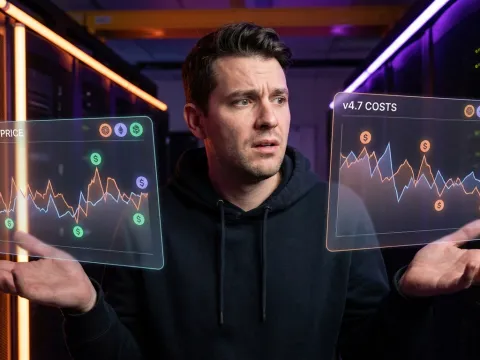
The Real Deal Behind the New Opus 4.7 Pricing Structure
Anthropic just dropped a major update, and everyone is talking about the money. We’ve seen the benchmarks, but the conversation on the street is centered on how the opus 4.7 pricing actually hits your wallet. It isn’t just about the numbers on the landing page anymore.
When you look at the landscape of high-end AI, cost and efficiency are the two pillars that matter most. If a model is brilliant but drains your credits in minutes, is it actually useful? That is the question users are asking as they migrate their workflows to this latest iteration.
The tech community is currently dissecting every token to see if the value holds up. Many developers are wondering if they should stick with older versions or jump into the new opus 4.7 pricing model. It’s a classic trade-off between intelligence and overhead that requires a careful look at the data.
Understanding the Shift in Opus 4.7 Pricing Dynamics
The shift here isn’t just about a price tag; it’s about how the underlying AI processes your requests. To really grasp what’s happening, you can check the technical nuances of the opus 4.7 pricing and thinking model to see how the logic has changed.
We are seeing a trend where AI models are getting "smarter" but also "hungrier." This hunger manifests in how tokens are calculated. If you've used previous versions, you know the drill, but the opus 4.7 pricing has a few surprises under the hood that might catch you off guard.
So, why does this matter now? Because budget predictability is the backbone of any serious API implementation. If your costs fluctuate wildly because of a background update, your whole business model for that specific tool or feature could be at risk.
"The model is performing better than the previous version, but it is burning through tokens like a madman." — General user sentiment from recent tech community discussions.
But before we get into the weeds of the "token tax," let’s look at the raw figures. You need to know exactly what you’re paying for before you can decide if the performance justifies the investment. Let's break down the actual costs involved in the opus 4.7 pricing model.
If you're looking to explore all available AI models, you'll find that Opus remains the premium tier. It’s designed for the most complex tasks where a smaller model simply fails. That premium status comes with a specific cost structure that hasn't changed on paper, but has changed in practice.
Breaking Down the Core Opus 4.7 Pricing Tiers
Let's get straight to the numbers. The opus 4.7 pricing maintains the same base rates we saw with the previous version, Opus 4.6. On the surface, this looks like a win for users. You get a more capable AI without a direct increase in the cost per million tokens.
For input tokens, you are looking at $5 per 1 million. For output tokens, the rate jumps to $25 per 1 million. These figures are standard for the "Opus" class of models, which are built to handle massive reasoning tasks and deep file analysis via the API.
It’s a straightforward "pay-as-you-go" system. However, "straightforward" is a dangerous word in the world of AI. While the rate is stable, how those tokens are counted is where the real opus 4.7 pricing story begins to unfold for most heavy users.
Comparing API Rates Within the Opus 4.7 Pricing Model
To help visualize this, let’s look at how the opus 4.7 pricing compares across different interaction types. Whether you are doing simple chat or heavy lifting with a search-enabled model, the costs remain anchored to these base rates, but the volume of tokens changes significantly.
| Token Type |
Rate per 1M Tokens |
Relative Cost Ratio |
| Input Tokens |
$5.00 |
1x (Base) |
| Output Tokens |
$25.00 |
5x (Premium) |
When you use advanced features, like the web search capabilities tied to opus 4.7 pricing, your input token count can spike. This is because the model has to process the search results as part of its context before giving you an answer.
Managing these costs requires a solid strategy. You can't just throw prompts at it and hope for the best. You need to monitor your usage carefully. Many developers use the GPT Proto dashboard to manage your API billing and keep these costs from spiraling out of control.
The API remains the primary way businesses interact with these models. Because the opus 4.7 pricing is predictable on a per-token basis, it’s easier to build into a SaaS product. But you have to account for the fact that this model is more "verbose" than its predecessors.
And here’s the kicker: even though the opus 4.7 pricing lists the same $5/$25 rates, users are reporting that their total bills are higher. This isn't a mistake in the billing system; it's a fundamental change in the model's architecture and how it "sees" text.
The Hidden Costs of the Opus 4.7 Pricing Tokenizer
Here is the thing no one tells you about opus 4.7 pricing: the tokenizer has been updated. A tokenizer is the tool the AI uses to turn your words into numbers it can understand. If the tokenizer changes, the number of tokens you get for a single sentence changes too.
In Opus 4.7, this updated tokenizer is more efficient at processing text, but the tradeoff is significant. For the exact same input, you are now looking at roughly 1.0 to 1.35 times more tokens than before. This is a critical factor in understanding the true opus 4.7 pricing.
Essentially, this means that while the "price per token" stayed the same, the "cost per word" went up. For many users, this has felt like a stealthy 50% price hike hidden inside a version update. It’s a common pain point discussed in developer circles lately.
How the Tokenizer Inflation Affects Your Opus 4.7 Pricing Budget
If you are doing heavy work, like deep file analysis influenced by opus 4.7 pricing, these extra tokens add up fast. Large documents that used to cost $2 might now cost closer to $2.70 or even $3 depending on the formatting.
This tokenizer inflation isn't uniform. It depends heavily on your content type. Code, for instance, might see a different multiplier than creative writing. This makes the opus 4.7 pricing harder to predict for developers who are used to the older, more compact token mapping of version 4.6.
But why would they do this? The goal is better reasoning and better instruction following. To get those "smarter" results, the AI needs to break down information into smaller, more precise chunks. That precision is what drives up the token count in the opus 4.7 pricing ecosystem.
- Input tokens are mapping to roughly 20-35% more units than in version 4.6.
- Output tokens remain high-cost, and the model tends to be more detailed (verbose).
- Pro users are hitting their hourly and weekly limits much faster than anticipated.
- The "token tax" is most visible when processing large batches of technical documentation.
It's important to note that this isn't necessarily a bad thing if the quality is there. But if you're on a tight budget, you've got to be aware of it. You might find that your previous prompt engineering needs a complete overhaul to stay within your desired opus 4.7 pricing limits.
For those worried about these rising costs, GPT Proto offers a way to mitigate the blow. With their smart scheduling and unified API, you can access the model with significant discounts. You can effectively cut your opus 4.7 pricing expenses while still getting the top-tier performance you need.
So, we've established that it costs more because it uses more "units." But does it actually perform better? If you're paying a premium in the opus 4.7 pricing model, you deserve premium results. Let's look at the benchmarks and the regressions that have users worried.
Performance vs. ROI in the Opus 4.7 Pricing Environment
When you pay for the highest tier, you expect the best performance. Anthropic claims this model is better at vision and coding tasks. For many, this makes the higher effective opus 4.7 pricing worth it. If it saves a developer two hours of debugging, the token cost is negligible.
However, the real-world experience has been a bit mixed. Some users have reported that while the model follows complex instructions better, it has actually regressed in other areas. This is a crucial consideration when evaluating the ROI of the opus 4.7 pricing for your specific use case.
One of the biggest concerns is long-context retrieval. If you're feeding the model a massive codebase or a 500-page PDF, you need it to remember what it read at the beginning. Some benchmarks show a significant drop in this area compared to the previous version.
Benchmarking the Quality of Results Under Opus 4.7 Pricing
Let's look at the data. In the MRCR v2 (Multi-Reasoning Context Retrieval) benchmark at 1 million tokens, the older 4.6 model scored a solid 78.3%. In contrast, the newer model under the current opus 4.7 pricing architecture scored only 32.2%. That is a massive difference.
This means if your workflow depends on digging through massive amounts of data, you might actually be paying more (due to the tokenizer) for a result that is objectively less reliable. This is where the opus 4.7 pricing value proposition starts to feel a bit shaky for certain users.
| Metric |
Opus 4.6 (Previous) |
Opus 4.7 (Current) |
| Base Input Cost |
$5 / 1M Tokens |
$5 / 1M Tokens |
| Effective Cost |
1.0x |
1.2x - 1.5x (Estimated) |
| Context Retrieval (1M) |
78.3% |
32.2% |
| Instruction Following |
Good |
Substantially Better |
So, is it a "better" model? For coding and vision, yes. You can dive deeper into the general performance of Claude Opus 4.7 to see how it handles specific creative tasks. The opus 4.7 pricing reflects a model that is pivoting toward higher logic rather than just rote memory.
And that brings us to the "Saying Hi" problem. Several Pro users have noted that even a simple greeting can consume 3% of their weekly limit. This suggests that the "overhead" of just initializing a conversation is higher in the opus 4.7 pricing structure than we've seen before.
But there is a silver lining. If you use the model correctly, the instruction-following improvements can lead to fewer mistakes. Fewer mistakes mean fewer retries, which could ultimately lower your total spend on opus 4.7 pricing over the long term. It’s all about how you manage the API usage.
For those who need to read the full API documentation for Claude, you'll see that there are ways to optimize your calls. By using system prompts more effectively, you can try to squeeze more value out of every cent spent on opus 4.7 pricing.
Strategies to Optimize Your Opus 4.7 Pricing Spend
You shouldn't just accept the higher costs as an inevitability. There are practical ways to navigate the opus 4.7 pricing landscape without breaking the bank. The first step is acknowledging that "business as usual" with your old prompts might be costing you too much money.
One of the best strategies is to use a multi-model approach. Why use the most expensive model for a task that a smaller, faster model could do? You can save the opus 4.7 pricing tier for the final, most complex reasoning steps of your workflow.
This is where GPT Proto really shines. Their platform allows you to switch between models seamlessly. You can use a cheaper model for data cleaning and then hit the opus 4.7 pricing tier only when you need that high-level logic for the final analysis.
Cutting Token Waste in the Opus 4.7 Pricing Model
Another trick is to leverage search and analysis tools more intelligently. If you use the web search feature integrated with opus 4.7 pricing, be very specific about what you need. Vague queries lead to massive input tokens as the model pulls in irrelevant data.
Also, watch your output lengths. Since output tokens are 5x more expensive than input tokens in the opus 4.7 pricing setup, asking for "concise" or "bullet point" responses can literally save you thousands of dollars if you are running thousands of calls per month.
Let's look at a few actionable steps to keep your costs down:
- Use "Performance-first" mode only when absolutely necessary; otherwise, stick to cost-optimized modes.
- Monitor your usage in real-time to catch "looping" prompts that might be burning through your quota.
- Consider using Midjourney or other vision models for image-heavy tasks if the opus 4.7 pricing for vision feels too steep.
- Join the GPT Proto platform to access up to 70% discounts on mainstream AI APIs, including these high-end models.
The beauty of a unified API is that it handles the "smart scheduling" for you. Instead of worrying about whether you are overpaying for opus 4.7 pricing, the platform can route your request to the most cost-effective path that still delivers the required quality.
And remember, the "hidden cost" is the tokenizer. If you are sending repetitive data, try to use variables or templates to minimize the raw text being sent. This is one of the most underrated ways to manage your opus 4.7 pricing budget effectively.
So, what's the bottom line? Is it worth the investment? Let's wrap this up with a final recommendation for different types of users. Whether you are a solo dev or an enterprise player, the opus 4.7 pricing has different implications for your bottom line.
Final Verdict: Who Should Invest in Opus 4.7 Pricing?
Look, the opus 4.7 pricing isn't for everyone. If you're just looking for a chat bot to write emails, this is overkill. You're essentially paying for a Ferrari to drive to the grocery store. There are much cheaper ways to get basic tasks done without the Opus overhead.
However, if you are doing high-stakes coding, complex legal analysis, or multi-modal research, the opus 4.7 pricing is a necessary cost of doing business. The improvements in logic and instruction following are real, even if the "tokenizer tax" feels like a bit of a sting.
For those doing detailed file analysis with opus 4.7 pricing, just be aware of the context retrieval issues. Don't dump a million tokens in and expect 100% accuracy right now. Break your tasks into smaller chunks for better reliability and better cost control.
Making the Most of Your Opus 4.7 Pricing Investment
For most professional users, the best move is to stop paying retail. The opus 4.7 pricing can be significantly mitigated by using an aggregator like GPT Proto. When you can access the same top-tier AI models with better management tools and lower rates, the decision becomes a lot easier.
The AI industry moves fast. Today's "expensive" model is tomorrow's baseline. If you want to stay ahead, you need to understand the nuances of things like opus 4.7 pricing so you can build sustainable, profitable tools. Ignorance of token costs is the fastest way to run a project into the ground.
Here’s a quick summary for your decision-making process:
- Enterprises: Invest in opus 4.7 pricing for coding and vision logic, but monitor context retrieval limits carefully.
- Solo Developers: Use a unified API like GPT Proto to access these models at a discount and avoid the Pro account usage limits.
- Research Teams: Be mindful of the tokenizer multiplier when budgeting for large-scale data processing.
- Hobbyists: Stick to the smaller models (Haiku or Sonnet) unless you hit a specific reasoning wall that only Opus can climb.
If you're still on the fence, you should learn more on the GPT Proto tech blog about how these models are evolving. The more you know about the underlying tech, the better you can navigate the complex world of opus 4.7 pricing.
And finally, keep an eye on the community. Users are constantly finding new ways to optimize their spend and share their experiences. The conversation around opus 4.7 pricing is far from over, but for now, the path forward is clear: be smart, be efficient, and use the right tools for the job.
Written by: GPT Proto
"Unlock the world's leading AI models with GPT Proto's unified API platform."