Qwen 3.8 Max vs GLM 5.3: the short answer
| If your priority is... |
Better starting point |
Why |
| Repository-scale coding and terminal agents |
GLM 5.3 |
Slight lead in independent coding preference, stronger vendor-reported agent results, lower token cost |
| Frontend coding and UI generation |
Qwen 3.8 Max |
Clear lead in Arena WebDev and Frontend |
| Screenshot-to-code or visual debugging |
Qwen 3.8 Max |
Accepts image and video input; GPT Proto GLM-5.3 is T2T only |
| Lowest API cost |
GLM 5.3 |
$1.26/M input and $3.96/M output on GPT Proto |
| Reasoning control |
Qwen 3.8 Max |
Supports thinking and non-thinking modes; GLM 5.3 always reasons |
| Long-context text agents |
GLM 5.3 |
1M context, 128K output, lower cost, and agent-oriented post-training |
| One model for mixed text and visual tasks |
Qwen 3.8 Max |
Broader input support with the same 1M context class |
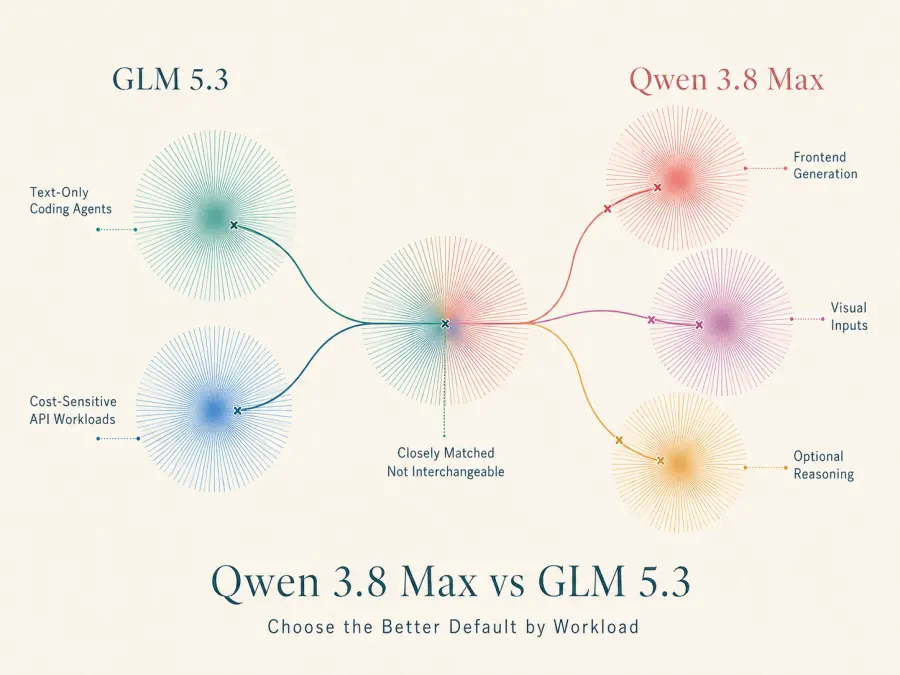
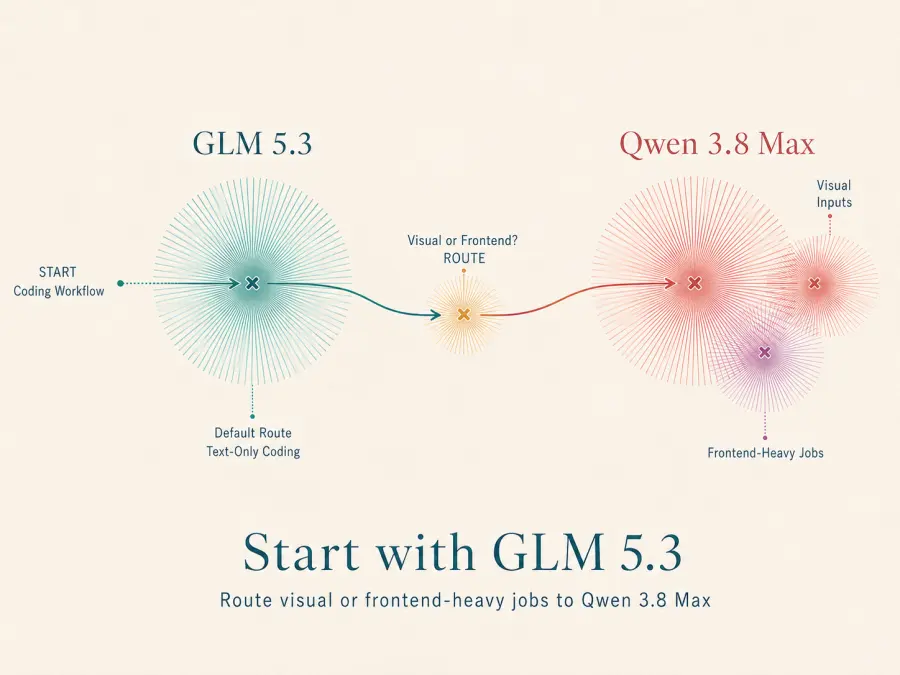
For a text-only coding workflow, start with GLM 5.3 and route visual or frontend-heavy jobs to Qwen 3.8 Max.
Qwen 3.8 Max vs GLM 5.3 at a glance
| Feature |
Qwen 3.8 Max |
GLM 5.3 |
| Provider |
Alibaba Cloud / Qwen |
Z.ai |
| API model ID on GPT Proto |
qwen3.8-max |
glm-5.3 |
| Input on GPT Proto |
Text, image, video |
Text only |
| Output |
Text |
Text |
| Context window |
1M tokens |
1M tokens |
| Maximum output |
131,072 tokens |
128K tokens |
| Reasoning |
Thinking or non-thinking |
Always on; effort can be low, high, or max |
| Function calling |
Yes |
Yes |
| Structured output |
Yes |
Yes |
| Prompt caching |
Yes |
Yes |
| GPT Proto input price |
$1.80 per 1M tokens |
$1.26 per 1M tokens |
| GPT Proto output price |
$5.40 per 1M tokens |
$3.96 per 1M tokens |
Alibaba's Qwen documentation describes Qwen 3.8 Max as a 2.4-trillion-parameter mixture-of-experts flagship with a one-million-token context window. It supports visual input, tool calls, structured output, and prompt caching. The hosted Max service should not be confused with every model carrying the Qwen 3.8 name.
Z.ai's GLM 5.3 documentation says the model retains the base architecture of GLM 5.2 and receives its main gains from post-training. Its focus is coding, agents, tool use, long-horizon tasks, and more efficient reasoning. On GPT Proto, its route is text-to-text only.
Benchmark comparison: the winner changes with the task
Independent intelligence and cost
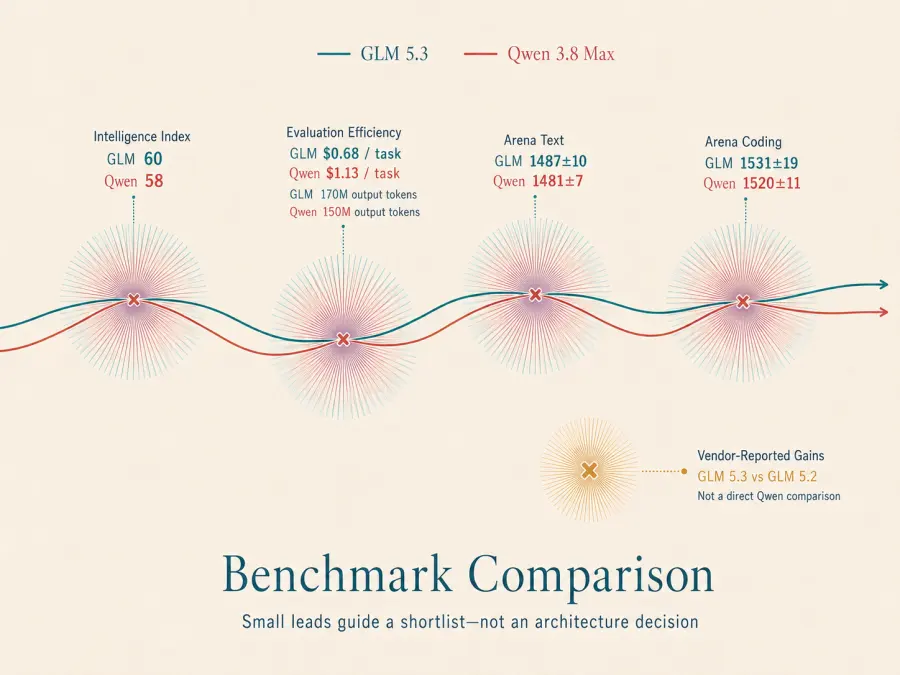
Artificial Analysis gives Qwen 3.8 Maxan Intelligence Index score of 58 and GLM 5.3 at maximum reasoning effort a score of 60. The gap is small, but the efficiency result is more interesting: its reported cost per evaluated task is $1.13 for Qwen and $0.68 for GLM.
GLM produced more evaluation output tokens—roughly 170 million versus 150 million—yet still cost less per task. That is useful evidence for agent workloads because a low token price can be cancelled out if a model needs long traces, retries, or repeated tool calls. Here, GLM kept the cost advantage even while generating more tokens.
These are controlled results, not a prediction of your production bill. Caching, tool errors, and retries can change the outcome.
Human preference for text and coding
On the Arena Text leaderboard, GLM 5.3 scored 1487±10 and Qwen 3.8 Max scored 1481±7 in the snapshot used for this comparison. On the coding subset, GLM scored 1531±19 versus Qwen's 1520±11.
That gives GLM a directional lead, not a knockout. The confidence intervals overlap, and GLM's coding interval is relatively wide. A six-point text gap or eleven-point coding gap should guide a shortlist, not settle an architecture decision by itself.
Vendor-reported coding and agent gains
Z.ai reports substantial improvements over GLM 5.2: Terminal-Bench 3 rises from 4.6 to 28.3, DeepSWE 1.1 from 46.2 to 66.9, and Agents' Last Exam from 23.8 to 28.5. Its private code benchmark reportedly improves from 23.4% to 34.5%, while output per task falls from about 96K to 75K tokens.
Those results support the model's positioning for longer coding and agent loops. They are also vendor-run comparisons against GLM 5.2—not direct, independent Qwen 3.8 Max versus GLM 5.3 tests. Treat them as evidence of progress, not proof that GLM wins every coding task.
Which is better for coding?
For general coding, GLM 5.3 is the better first choice when the input is text. It combines a modest lead in Arena's coding preference data with lower API prices and post-training aimed at repository work, terminal use, tool calls, and long agent trajectories.
That makes GLM a good fit for:
Exploring a large repository and proposing a multi-file change
Running a test-fix-test loop through an agent
Reviewing pull requests or tracing backend defects
Generating migrations, scripts, and service code
Handling long text specifications or logs inside a 1M-token context
Qwen 3.8 Max remains competitive for everyday development. Its practical advantages are optional reasoning and visual input. A developer can use non-thinking mode for short transformations or simple code generation, then enable deeper reasoning for architecture, debugging, or complex refactors. GLM 5.3's reasoning cannot be disabled, although its effort level can be reduced.
For short, latency-sensitive jobs—renaming symbols, writing a small unit test, translating a schema, or editing a configuration file—Qwen's non-thinking path may be easier to control. For long autonomous jobs where token cost and tool persistence matter, GLM has the stronger starting case.
Qwen 3.8 Max vs GLM 5.3 for frontend coding
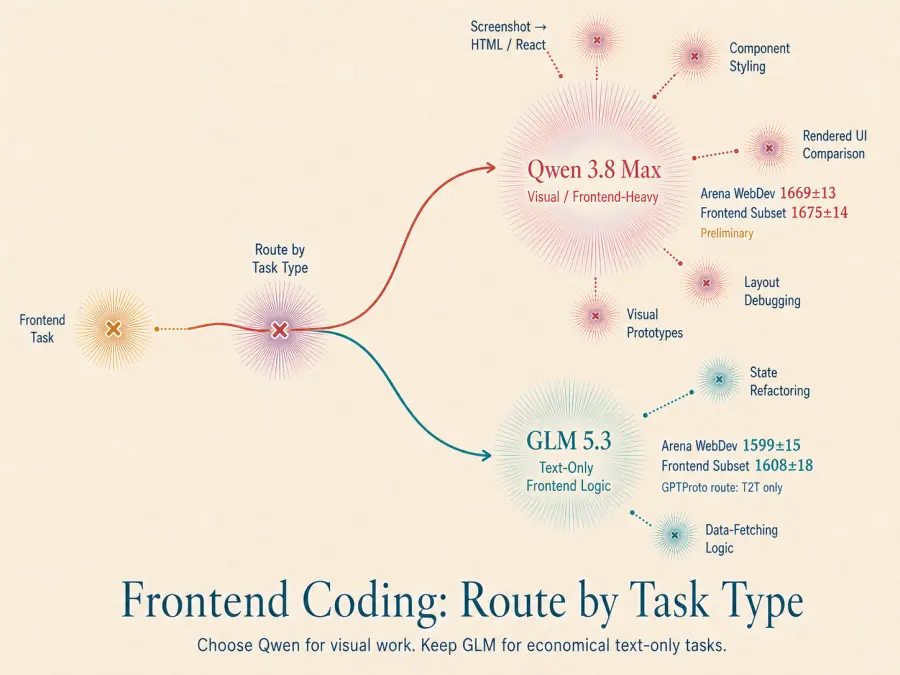
Frontend is the clearest exception to GLM's general coding advantage. On Arena WebDev, Qwen 3.8 Max scored 1669±13 compared with GLM 5.3's 1599±15. In the Frontend subset, Qwen scored 1675±14 versus GLM's 1608±18.
Qwen's result was marked preliminary in the leaderboard snapshot, so it may move as more votes arrive. Even with that caveat, the observed gap is much larger than the difference on the general text and coding leaderboards.
Qwen also accepts screenshots and video input. That changes what a frontend workflow can include: a screenshot can be paired with a design brief, a rendered page can be inspected for visual defects, or a short interaction recording can provide context for a UI bug. Because GPT Proto's GLM-5.3 route is T2T only, it cannot receive those visual artifacts directly.
Choose Qwen 3.8 Max first for:
Screenshot-to-HTML or screenshot-to-React tasks
Component styling and page composition
Comparing a rendered UI with a visual reference
Debugging layout, spacing, or responsive behavior from images
Generating prototypes where visual preference is the main acceptance criterion
If the frontend task is mostly text—such as refactoring state management or writing data-fetching logic—GLM may still be the more economical option. Route by task type rather than by repository label.
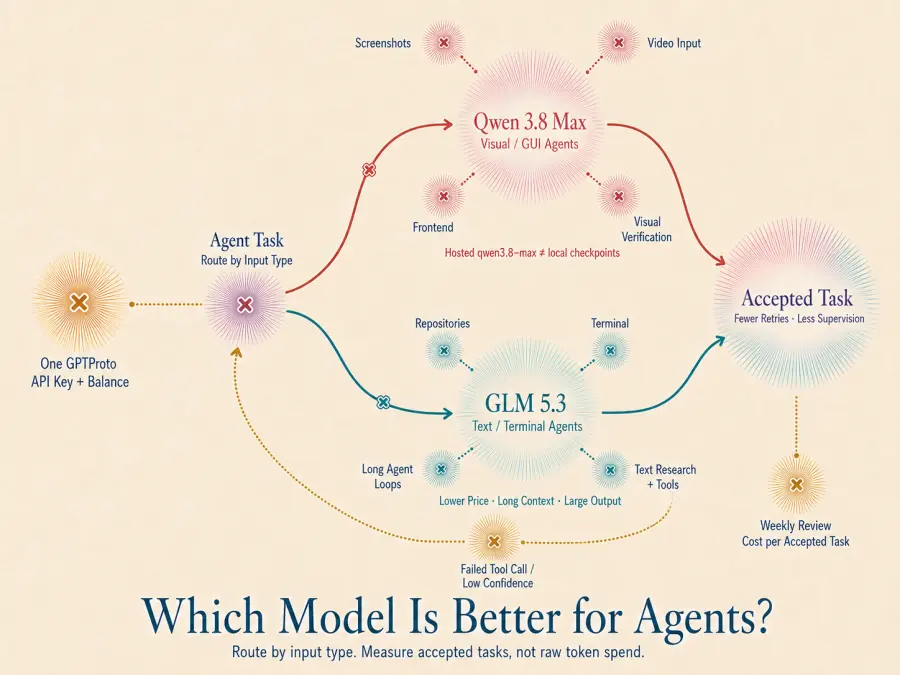
Which model is better for agents?
For text and terminal agents, GLM 5.3 has the edge. Its lower price, long context, large output allowance, function calling, structured output, and agent-oriented training make it a sensible default for autonomous coding, research over text corpora, and tool-driven workflows.
For visual or GUI-aware agents, Qwen 3.8 Max is the practical choice because it can receive image and video input. A browser agent that needs to inspect a screenshot, a support agent that receives an uploaded image, or a coding agent that compares a visual reference with a rendered page requires an input channel that text-only GLM does not provide on GPT Proto.
Developer discussions add an important qualification. A Hacker News discussion of Qwen 3.8 repeatedly returns to token consumption, retries, and the agent framework. The best model is the one that completes an accepted task with fewer failed attempts and less supervision—not simply the one with the lowest price per million tokens.
The same caution applies to social posts and local-model discussions. Results for Qwen3.8-27B or another downloadable Qwen checkpoint are not results for the hosted qwen3.8-max model. Similar names do not make the models equivalent.
A practical routing policy is:
Send text-only repository, terminal, and long-agent tasks to GLM 5.3.
Send screenshot, video, frontend, and visual-verification tasks to Qwen 3.8 Max.
Keep a fallback rule for failed tool calls or low-confidence outputs.
Review cost per accepted task every week, not just raw token spend.
Both models are available under one GPT Proto API key and balance, so this routing pattern does not require maintaining two provider integrations.
Pricing: which model is more cost-effective?
At the prices checked on August 24, 2026, GPT Proto lists:
| Model |
Input / 1M tokens |
Output / 1M tokens |
Cache read / 1M tokens |
| Qwen 3.8 Max |
$1.80 |
$5.40 |
$0.225 |
| GLM 5.3 |
$1.26 |
$3.96 |
$0.234 |
Qwen also lists cache writes at $2.25 per million tokens. The two GPT Proto routes are 10% below the vendors' direct list prices: Alibaba lists Qwen at $2 input and $6 output, while Z.ai lists GLM at $1.40 input and $4.40 output per million tokens.
Consider a workload using 10 million uncached input tokens and 2 million output tokens:
GLM saves $8.28, or about 28.8%, in this example. Its advantage grows when output is a large share of the bill. Qwen's cache-read price is slightly lower, however, so a workload that repeatedly reuses a large stable prefix may narrow the gap.
Do not stop at this arithmetic. For each production task, log the model ID, task category, input tokens, output tokens, cached tokens, attempts, test result, reviewer acceptance, and total latency. Divide total spend by accepted tasks. That number captures retries and failures that per-token pricing misses.
Reasoning, latency, and production control
Qwen 3.8 Max offers more explicit control over how much deliberation a request needs. Its thinking and non-thinking modes let a team separate fast transformations from tasks that benefit from deeper reasoning. Alibaba documents a maximum input of 991,808 tokens in standard mode and 983,616 tokens in thinking mode, with up to 131,072 output tokens.
GLM 5.3 always uses reasoning. Developers can set its effort to low, high, or max, with max as the documented default, but cannot turn reasoning off. This can improve persistence on difficult agent tasks while making trivial calls less predictable in latency and token use.
The operational decision is therefore simple:
Choose Qwen when you need a fast path and a reasoning path behind one model ID.
Choose GLM when most requests already justify deliberate reasoning and lower token prices matter.
Benchmark full workflows when latency is a hard requirement; model-generation speed alone does not include tool execution, retries, or queue time.
Try both through one OpenAI-compatible endpoint
The fastest way to decide is to run the same representative prompts through both routes. This cURL request uses GPT Proto's OpenAI-compatible Chat Completions endpoint:
curl --request POST "https://gptproto.com/v1/chat/completions" \
  --header "Authorization: Bearer $GPTPROTO_API_KEY" \
  --header "Content-Type: application/json" \
  --data '{
    "model": "glm-5.3",
    "messages": [
      {
        "role": "user",
        "content": "Review this Python function for correctness and return JSON with issues, fixes, and tests: ..."
      }
    ]
  }'
Change only the model value to qwen3.8-max to run the same text prompt through Qwen. Use a real task set rather than a few attractive demos: include easy edits, difficult repository changes, tool calls, long-context jobs, and frontend tasks. Score correctness, tests passed, human acceptance, latency, and total tokens.
Open weights and self-hosting are not the same question
Alibaba publishes the Qwen3.8-2.4T-A95B checkpoint, but that downloadable checkpoint is not identical to the hosted Qwen 3.8 Max service. The Max API adds a one-million-token context, visual input, non-thinking operation, and hosted tool capabilities. A local benchmark on a smaller Qwen3.8 variant should not be used as a direct Max comparison.
Z.ai has described a staged open-weight release for GLM 5.3, but the GLM 5.3 weights were not publicly downloadable at the time of writing. Teams making a deployment decision today should evaluate the API that exists today, not assume that promised weights, licenses, quantizations, or serving requirements are already settled.
Final verdict
Choose GLM 5.3 for text-only coding agents, repository work, long tool-driven tasks, and the lower API bill. Choose Qwen 3.8 Max for frontend coding, screenshot or video inputs, visual agents, and workloads that need optional reasoning.
If you need one default for a developer platform, GLM 5.3 offers the better cost-to-capability balance. If your product crosses from code into visual interfaces, Qwen's input support and frontend preference results are more important than GLM's small lead on general intelligence.
The best production setup may use both: start with GLM 5.3 for text agents, route visual and frontend jobs to Qwen 3.8 Max, and keep the model that delivers the lowest cost per accepted task for each category.