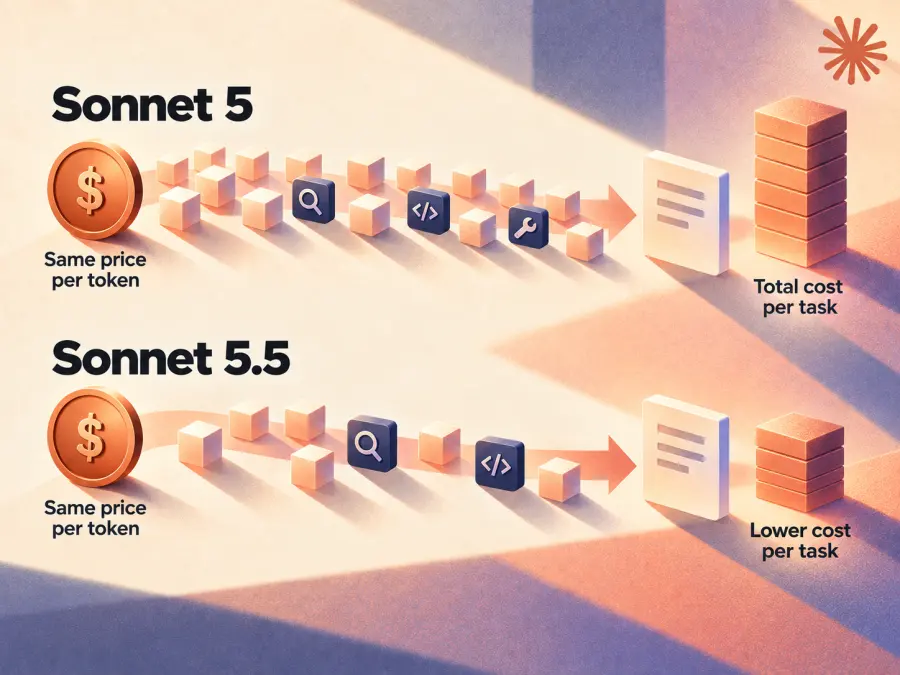
Claude Sonnet 5.5 has the same API price per token as Sonnet 5. Anthropic nevertheless says the new model can cost less to finish a task. That sounds contradictory until you separate the price of each token from the number of tokens and tool calls a job actually takes.
The short answer: Claude Sonnet 5.5 is Anthropic's September 28, 2026 update to its Sonnet model for coding, document work, and other tasks with a clear goal. It accepts text and images, returns text, and is available in Claude Code and through the Claude API. Anthropic reports faster output and better results than Sonnet 5 on several evaluations. Those results are reasons to test an upgrade, not guarantees for every codebase or workflow. The Claude Sonnet 5.5 model page on GPTProto is the place to check its platform availability and try it when the listing is active. Anthropic's announcement sets out the release and its claims.
What is Claude Sonnet 5.5?
Sonnet is the middle tier of Claude's current lineup. Sonnet 5.5 is meant to handle defined, repeatable work quickly: implementing a specified feature, fixing a bug, reviewing a document against source material, or producing a presentation from a brief. Anthropic positions Opus 5.5 for harder, open-ended work that needs sustained judgment. The distinction matters more than the version number. A high score on one coding test does not make Sonnet the better choice for every architecture decision.
| Specification |
Claude Sonnet 5.5 |
| Release date |
September 28, 2026 |
| Claude API model ID |
claude-sonnet-5-5 |
| Context window |
1 million tokens |
| Maximum output |
128,000 tokens on standard requests |
| Modalities |
Text and image input; text output |
| Thinking |
Adaptive, enabled by default |
These are Anthropic's published specifications. A 1-million-token context window is substantial, but it is not a new advantage over Sonnet 5, which also supports 1 million tokens. Nor does a large window prove that every detail in a long input will be used correctly. Sonnet 5.5 also keeps Sonnet 5's tokenizer, so an identical piece of text has the same token count on those two models. Anthropic's migration documentation makes that last point explicit.
What changed from Sonnet 5?
The useful change is how much work Sonnet 5.5 can complete for a given amount of time and computation. Anthropic says it generates output more than 30% faster than Sonnet 5. In its Terminal-Bench 4.0 agentic coding evaluation, Sonnet 5.5 scored 70.6%, compared with 10.3% for Sonnet 5. It also reports that the newer model batches tool calls more often, reducing the steps needed for some coding tasks. These are Anthropic's results, measured in particular test setups.
There is an outside check, though it asks a different question. On CursorBench 4.0, Sonnet 5.5 at High effort scored 47.8% at a reported $1.67 per evaluated task; Sonnet 5 at High scored 30.8% at $3.48. That supports an improvement in Cursor's coding environment. It does not predict the exact saving for an API customer using a different agent, prompt, or repository.
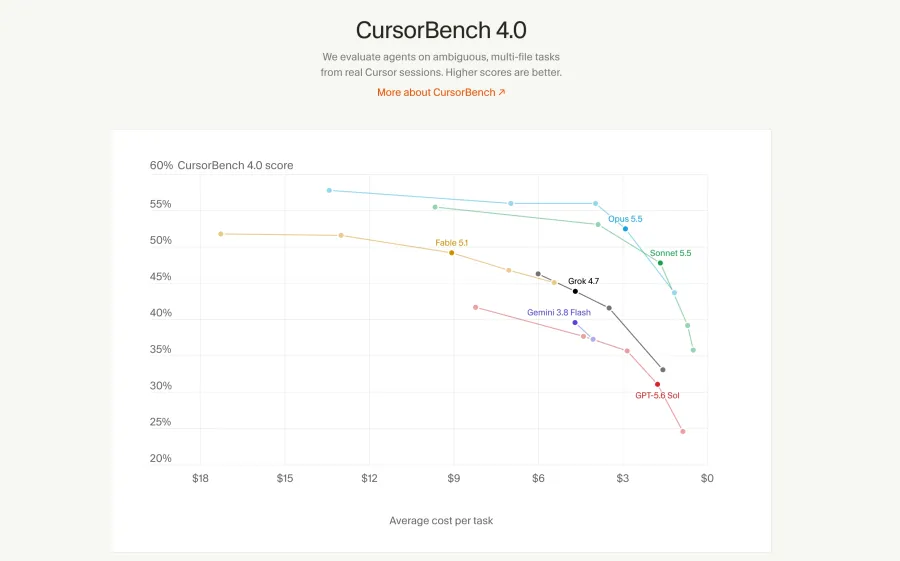
The upgrade is therefore more interesting than a routine version bump for coding teams. The tradeoff is that a strong benchmark result still needs to survive your own tests. If you want the earlier model's starting point, see our Sonnet 5 guide and Sonnet 5 API page.
Sonnet 5.5 pricing: same list rate, potentially fewer tokens per task
At Anthropic's published API rates, Sonnet 5.5 costs the same per million tokens as Sonnet 5. GPT Proto's Sonnet 5.5 rate is 10% below those input and output rates:
| Per 1 million tokens |
Anthropic list rate |
GPT Proto Sonnet 5.5 |
| Input |
$2.00 |
$1.80 |
| Output |
$10.00 |
$9.00 |
Anthropic lists cache reads at $0.20 per million tokens; cache writes and other charges have their own rates. Check the GPT Proto model page for its live billing details before estimating a cached workload. The Anthropic rates and the fact that they match Sonnet 5 come from the release announcement. The GPT Proto input and output rates above reflect its 10% model discount.
Here is a deliberately simple calculation. If one request uses 100,000 ordinary input tokens and 20,000 output tokens, with no cache or tool charges, the token cost would be $0.40 at Anthropic's list rates and $0.36 at GPT Proto's stated rates. That is a comparison for identical token usage. Separately, Anthropic says Sonnet 5.5 used fewer tokens to complete typical tasks in its testing, reducing cost per finished task by up to 30% versus Sonnet 5. Your result depends on the task and effort setting; 30% is not a cut to the token tariff, and it should not be added mechanically to GPT Proto's 10% rate discount. See GPT Proto pricing for account-level billing information.
Is Sonnet 5.5 good for coding and available in Claude Code?
Yes. Anthropic's Claude Code model guide lists Sonnet 5.5. Use /model inside Claude Code to select it, or start a session with claude --model claude-sonnet-5-5. Claude Code and the Claude apps default to Medium effort for this model; the Claude API defaults to High. Effort controls how long the model works through a problem, affecting quality, time, and billed output. The defaults therefore matter when someone quotes a score obtained at Max effort as though it describes an ordinary Claude Code session.
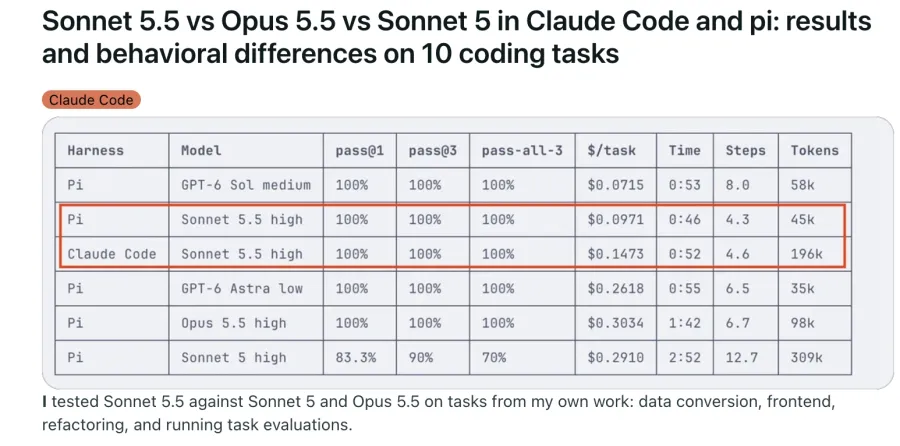
In one developer's early head-to-head test, the author ran ten personal coding tasks three times per configuration at High effort in Claude Code and pi-agent. Sonnet 5.5 used fewer turns and output tokens than Sonnet 5 in that setup. The author also noted that newer models were already passing nearly all the tasks, limiting what the test could say about difficult work. It is a useful observation about workflow, not a universal win rate.
For well-specified implementation and bug fixing, I would test Sonnet 5.5 first. For an ambiguous architecture change or a review where a subtle miss is expensive, also test Claude Opus 5.5. Anthropic itself says Opus remains stronger at complex, open-ended work, despite Sonnet 5.5's high scores on individual benchmarks. Its release discussion draws that boundary clearly.
Should you upgrade an existing Sonnet 5 integration?
Probably, if your own evaluation improves. But changing the model string is only the first step for an existing API integration. Anthropic's Sonnet 5.5 migration guide documents request settings that can return a 400 error after the switch:
| If your Sonnet 5 integration does this |
Check before switching |
Sends thinking: {"type":"disabled"} |
Sonnet 5.5 uses between_tools for its lowest thinking setting. |
Forces a particular tool with tool_choice |
Sonnet 5.5 rejects forced tool and any choices; review the documented auto approach. |
| Uses an older computer-use tool version |
The accepted toolset differs by platform; follow the migration table for yours. |
| Assumes the first response block is text |
Read blocks by type and preserve thinking blocks in tool loops. |
There is also a quieter change: effort levels have been recalibrated. High on Sonnet 5.5 need not consume the same amount of work as High on Sonnet 5. Anthropic recommends rerunning your own evaluations for quality, latency, and cost rather than carrying over a previous setting. This is particularly relevant if your agent makes repeated tool calls or if you parse model output in a fixed format.
For a basic GPT Proto chat request, use the model page's Try this model action and API Usage panel to confirm that Sonnet 5.5 is active and that the displayed model ID is claude-sonnet-5-5. Once it is active, the standard GPT Proto chat-completions request has this shape:
curl --request POST 'https://gptproto.com/v1/chat/completions' \
  --header "Authorization: Bearer $GPTPROTO_API_KEY" \
  --header 'Content-Type: application/json' \
  --data '{
    "model": "claude-sonnet-5-5",
    "messages": [{"role": "user", "content": "Summarize the risks in this project brief in three sentences."}]
  }'
Set GPTPROTO_API_KEY to your own key before running it. GPT Proto shows this request format on its existing Claude model pages; the Sonnet 5.5 model page is the final source for its live model string and availability. Provider-specific Claude Messages API options need separate compatibility checks when used through an OpenAI-compatible endpoint.
How does Sonnet 5.5 compare with other models?
An explainer cannot settle every “versus” search with a single leaderboard. The comparison changes with the task, agent setup, effort, and price being measured. These are three useful but narrow reference points:
| Question |
What a comparable test says |
What it cannot establish |
| Sonnet 5.5 vs GPT-6 Astra |
On Vals AI's Code Migration evaluation, Sonnet 5.5 scored 69.83% and Astra 67.74%. |
Which model is better for all coding, research, or writing tasks. |
| Sonnet 5.5 vs GLM-5.3 |
On CursorBench 4.0, Sonnet 5.5 High scored 47.8% and GLM-5.3 High 38.0%. |
Performance or cost in your own agent and repository. |
| Sonnet 5.5 vs Claude Fable 5.1 |
On the Vals Index, Sonnet 5.5 scored 69.22% and Fable 5.1 68.83%. |
A reliable overall winner from a small composite-score gap. |
The Astra and Fable results come from Vals AI's evaluation, which says it used Max effort for most tests. The GLM result comes from Cursor's own benchmark. Do not combine the scores from these two sources into one ranking. If a specific alternative is cheaper or already fits your stack, the relevant test is whether Sonnet 5.5 completes your task more accurately or with less total spend.
Who should try Sonnet 5.5?
Start with work that has a visible finish line: a defined code change, a bug with a failing test, a document with a source packet, or a repeatable analysis. Run the same small batch of real tasks through Sonnet 5 and 5.5 at explicit effort settings. Track whether the answer is correct, whether the model checked its work, how long it took, and how many tokens were billed. That gives you a much better upgrade decision than selecting the largest launch-day percentage.
Sonnet 5.5 is a strong candidate for those bounded jobs. It is less safe to assume that one benchmark makes it a substitute for Opus on open-ended work, or that Anthropic's maximum reported saving will appear on every bill. When the Sonnet 5.5 API page on GPT Proto is active, you can test it alongside the other models linked above with the same account and compare your own results.