The best AI image generation APIs at a glance
| Rank |
API |
Best for |
What stood out in our test |
Main limitation |
GPT Proto price at time of writing* |
| 1 |
Nano Banana 2.1 |
Best overall; SaaS and product workflows |
The best balance of instruction following, text, natural output, and reference fidelity |
Fine UI microcopy still needs review |
$0.0202 at 1K; $0.0302 at 2K; $0.0678 at 4K |
| 2 |
GPT Image 2.5 Sunburst |
Web, mobile, and marketing design |
Best visual hierarchy and most convincing interface concept |
Token billing makes per-image cost less predictable |
Token-based; $28.50 per 1M image-output tokens |
| 3 |
Seedream 5.0 Pro |
Text-forward posters and multilingual creative |
Strong large display text and good layout discipline |
Smaller text still broke; the live and static price displays currently differ |
From about $0.038 per 1K image on the live module |
| 4 |
Midjourney |
Stock-style people and art direction |
The most natural business photo and consistently strong composition |
Weak exact text and literal reference compliance |
$0.0608 per request |
| 5 |
Nano Banana Pro |
Rich color grading and complex Pro workflows |
Polished lighting and art-directed finish |
Costlier than 2.1 without winning these three tasks |
$0.0804 at 1K/2K; $0.144 at 4K |
*Prices were checked on October 14, 2026 and can change. Always confirm the live model page before putting a number into your own calculator.
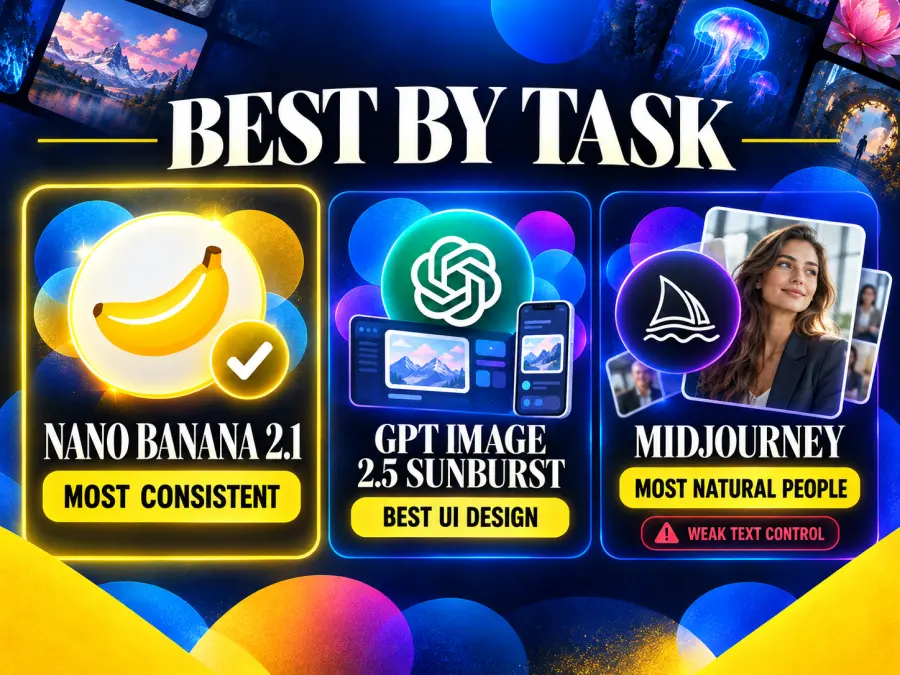
If you only want one answer, start with Nano Banana 2.1. It did not win every visual category, but it made the fewest expensive mistakes across all three.
Model API vs. image API provider: what are you actually choosing?
Search results often mix up models and providers. They are different decisions.
An image model is the generation engine: Nano Banana 2.1, GPT Image 2.5 Sunburst, Seedream 5.0 Pro, or Midjourney. It determines the output's visual character, instruction following, text rendering, reference fidelity, and available editing behavior.
An image API provider supplies the infrastructure around that model: authentication, one billing account, request schemas, job status, usage records, and access to multiple model families. GPT Proto's image model catalog, for example, lets a developer route different jobs to different image models without creating a separate vendor integration for every one.
That distinction matters because there is no single winner for every workload. A SaaS product could send interface concepts to Sunburst, people-heavy editorial scenes to Midjourney, and catalog images to Nano Banana 2.1 while keeping one provider integration.
There is also a disclosure worth making: GPT Proto's Midjourney endpoint is managed third-party access, not a first-party public Midjourney developer API. Midjourney's own community guidelines state that it does not generally provide an API. If procurement requires a direct vendor contract, that difference may decide the question before image quality does.
How we tested the APIs
We chose three tasks that expose different weaknesses.
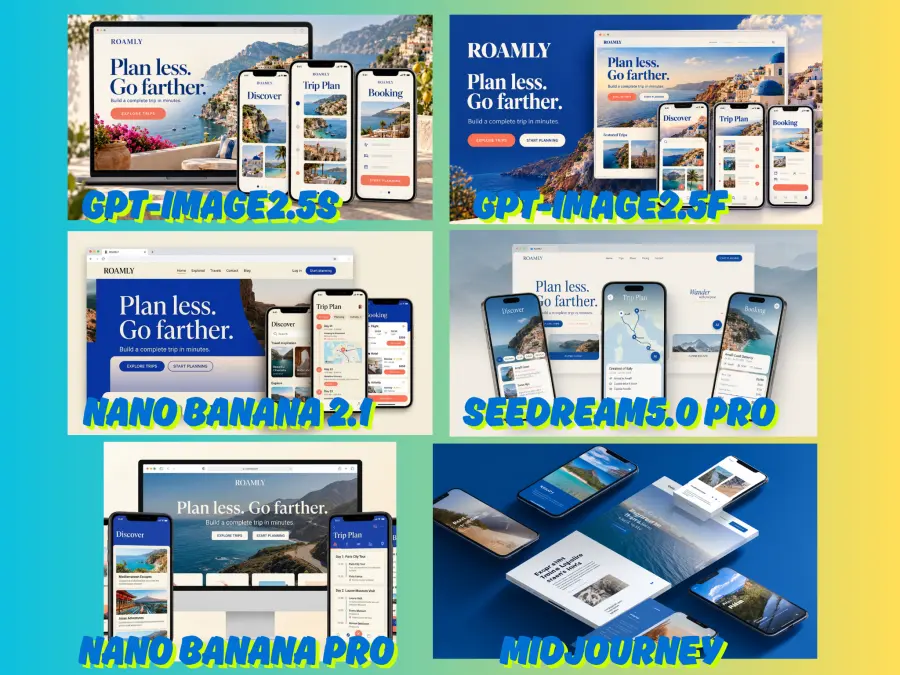
Test 1: responsive web and mobile design
The prompt asked for a coordinated SaaS landing page and mobile screens with a defined content hierarchy. We looked for sensible interface structure, visual consistency across devices, readable headline text, and details a designer could continue editing.
Result: Sunburst and Nano Banana 2.1 produced the strongest designs. Nano Banana 2.1 and Seedream handled prominent text well. None of the models made every line of microcopy production-ready.
Midjourney's output had appealing art direction, but the interface logic, device structure, shapes, and text did not follow the brief closely enough. It looked designed; it did not behave like a dependable UI specification.
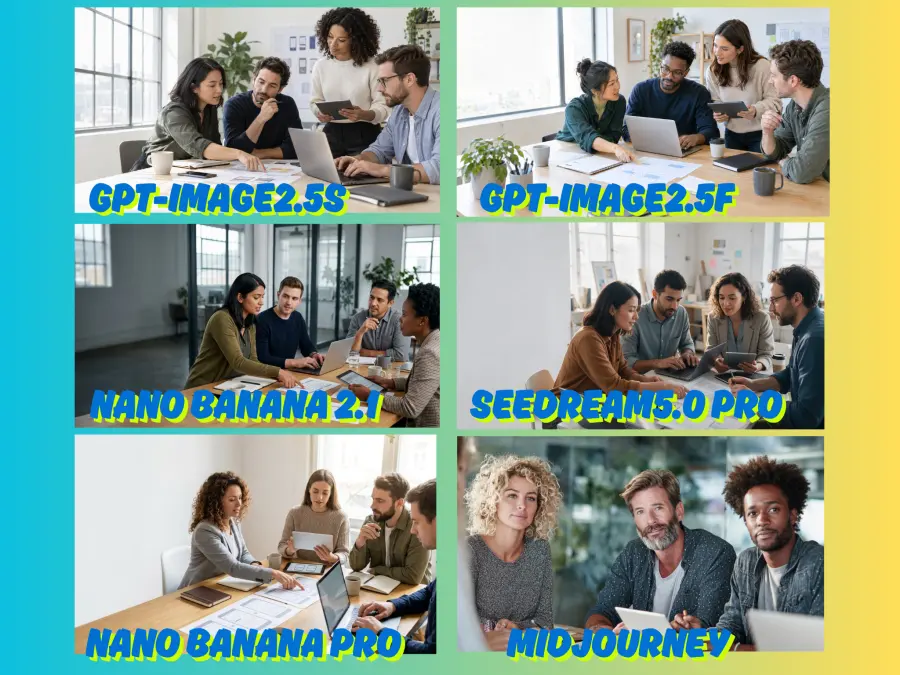
Test 2: natural business stock photography
The prompt asked for a believable workplace scene with multiple people. This is a useful stress test for faces, hands, gaze, body language, skin tone consistency, and the overly polished “AI stock photo” look.
Result: Every route produced a usable concept. Midjourney was the most natural of the group, especially in expressions and overall photographic feel. Nano Banana 2.1 was the best combination of naturalism and prompt alignment.
Flare's image was otherwise credible, but one person's skin tone changed inconsistently. That is the kind of defect that can slip past a thumbnail review and become a serious problem in a published campaign.
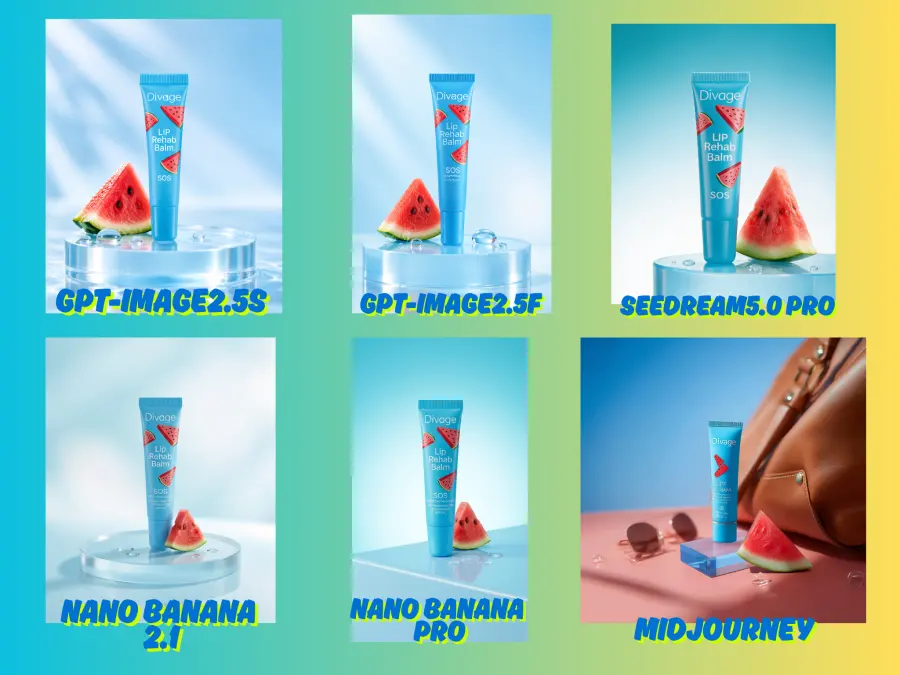
Test 3: reference-based product advertising
The final prompt supplied a product reference and asked each model to preserve the packaging identity while creating a redesigned ad. It also requested the removal of unrelated props. We evaluated product shape, label text, brand identity, cleanup, and layout.
Result: Nano Banana 2.1 was the clear winner for packaging text. The other five were broadly similar in text reliability, with Midjourney at the bottom: its composition was attractive, but the product name was wrong and props that should have been removed remained in the image.
This test illustrates why “best-looking” and “best API for production” are not the same category. A strong layout is valuable, but not if a developer has to mask the product, repair the label, and remove unwanted objects before publishing.
A note on aspect ratios and test limits
Most routes in this comparison expose aspect ratio as a structured request field. Midjourney handles it through a prompt suffix. Its official parameter guide says parameters belong at the end of the prompt. To reliably request a widescreen image through the Midjourney route, the prompt should end with the exact characters --ar 16:9. Other useful endings include --ar 3:2 for photography and --ar 4:5 for portrait ads.
Our initial Midjourney calls for Tests 2 and 3 used its default square output, so we evaluated their content and composition rather than aspect-ratio compliance.
We also did not run standardized latency measurements. Flare is positioned as the faster GPT Image 2.5 option, but we will not label it the fastest API based on a vendor claim instead of our own timing data.
1. Nano Banana 2.1 — best AI image generation API overall
Nano Banana 2.1 is the safest first integration for a SaaS team that needs more than one image workflow. It handled interface structure, people, product identity, and text more consistently than the other routes.
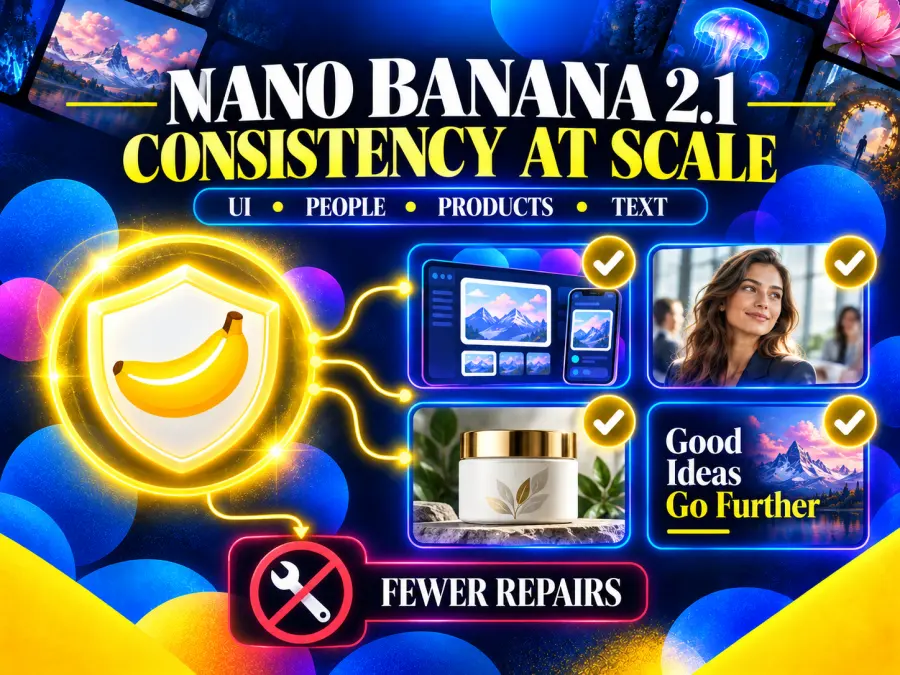
Its biggest advantage was not a single spectacular image. It was the absence of a catastrophic failure across the set. The UI was coherent, the business photo felt natural, and the package name survived the product transformation better than it did with the alternatives.
That consistency matters for automation. When a human is reviewing one hero image, a beautiful outlier can win. When an application generates 10,000 catalog images, the better model is usually the one that triggers fewer repair jobs.
The API supports 1K, 2K, and 4K output tiers. GPT Proto lists support for multiple reference inputs, including object and character references, which makes it relevant to catalog, character-consistency, and iterative editing workflows—not just text-to-image generation.
Best for: SaaS image features, product ads, reference-based generation, and teams that want one dependable default.
Watch out for: Small text. Its large packaging text was the best in our test, but tiny interface labels should still be treated as draft copy. For a closer comparison with the higher-priced version, see Nano Banana 2.1 vs. Nano Banana Pro.
2. GPT Image 2.5 Sunburst and Flare — best for web and app design
We are grouping GPT Image 2.5 Sunburst and GPT Image 2.5 Flare because they belong to the same product family but serve different priorities.
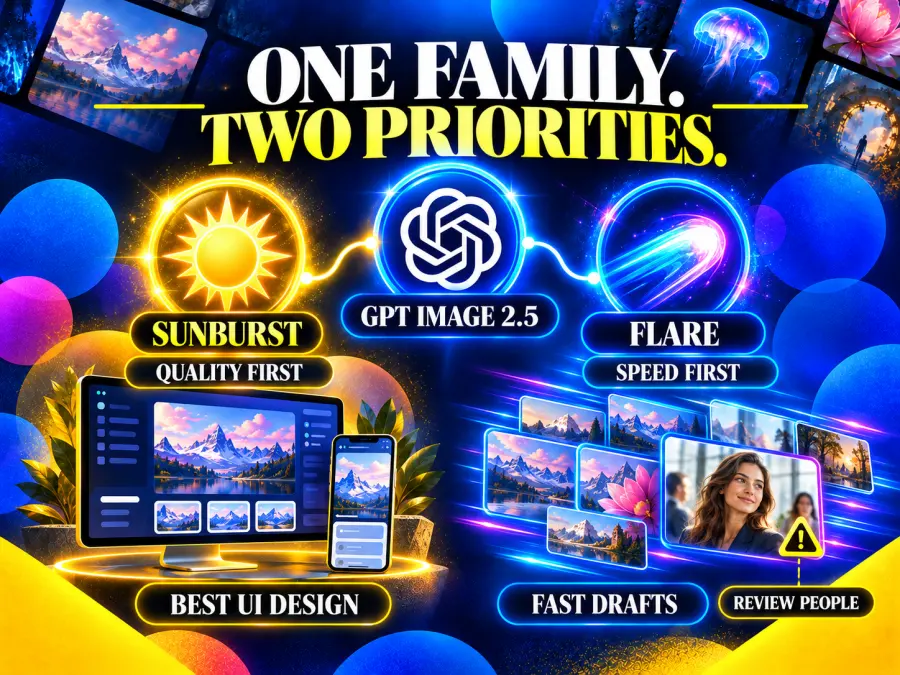
Sunburst is the quality-first route, and it won our UI task. The output had the strongest visual hierarchy, the most deliberate spacing, and the clearest sense that a real designer could use it as a concept board. It is our first choice for landing-page ideas, app-store creative, dashboard presentations, and campaign layouts where composition matters more than unit cost.
Flare is the speed-oriented sibling. Its results were generally good, and it makes sense for rapid draft generation or interactive experiences where a shorter wait is worth some quality risk. In our business-photo test, however, it introduced a skin-tone inconsistency that Sunburst and Nano Banana 2.1 avoided.
Both routes use token-based pricing rather than a simple fixed image price. GPT Proto currently lists text input, image input, cached input, and image-output token rates separately. That is flexible, but it means your real cost depends on output size, quality mode, and the amount of visual context in the request.
Best for: Sunburst for polished web, mobile, and marketing concepts; Flare for fast previews and high-iteration draft loops.
Watch out for: Cost estimation and final text QA. Run a representative batch before promising a fixed per-image price to customers.
3. Seedream 5.0 Pro — best for text-forward layouts
Seedream 5.0 Pro deserves attention from developers building posters, localized campaign assets, menus, social graphics, and other layouts where large display text is part of the image.
In the UI test, its prominent text was among the strongest. It also arranged information with more discipline than several competitors. The model page lists text rendering across 14 languages and support for both text-to-image and image editing, with up to 10 reference images.
The caveat is familiar: “good at text” does not mean “safe to publish every line.” The main heading can look correct while a smaller navigation label quietly mutates. We would use Seedream to establish layout and headline treatment, then validate every word or run an edit pass.
There is also a pricing-documentation wrinkle. At the time of checking, the live pricing module and static page copy showed slightly different 1K rates. We have used the live module's “from” price in the table above, but developers should check the model page before estimating a production run.
Best for: Posters, multilingual campaign concepts, and text-led layouts.
Watch out for: Microcopy and live-price verification.
4. Midjourney — best image API for natural stock-style people
Midjourney through GPT Proto produced the most natural people in our comparison. The business scene felt less staged, faces were convincing, and the image had the kind of editorial finish that usually takes more prompt iteration elsewhere.
Its product layout was also stylish. If the job were pure art direction, it would rank higher.
The problem is control. Midjourney performed poorly on exact UI structure and text. In the product-reference task it changed the label and retained objects the prompt explicitly asked it to remove. Those are costly mistakes for product catalogs, packaging, and templates populated with customer-supplied assets.
Its request syntax also needs special handling. Put --ar 16:9 at the very end of a widescreen prompt; describing “a 16:9 image” in prose is not a dependable substitute for the suffix.
Best for: Natural people, editorial photography, mood exploration, and high-level brand art direction.
Watch out for: Exact spelling, literal object removal, reference fidelity, and the distinction between managed access and a first-party Midjourney API. If control matters more than Midjourney's visual signature, compare the options in our Midjourney API alternatives guide.
5. Nano Banana Pro — best when the richer Pro workflow earns its price
Nano Banana Pro delivered polished light, color, and commercial art direction. It remains relevant for high-resolution creative work and edit-heavy workflows where its specific look or capabilities justify the higher rate.
It did not, however, beat the cheaper Nano Banana 2.1 in our three tasks. That makes 2.1 the better default for teams that care about cost per acceptable image.
“Pro” should therefore be a routing decision, not an automatic upgrade. Send a small evaluation set through both models. If reviewers consistently choose the Pro output—or it saves a later editing step—pay the premium. If not, keep it as a specialist route.
Best for: Rich color grading, premium campaign exploration, high-resolution assets, and teams already using its editing behavior.
Watch out for: Paying more without measuring acceptance rate.
Which image API should you use for each job?
| Use case |
Our pick |
Why |
| General SaaS image generation |
Nano Banana 2.1 |
Most consistent across all three tasks |
| Web and mobile mockups |
GPT Image 2.5 Sunburst |
Best design hierarchy and UI concept |
| Stock-style business photos |
Midjourney |
Most natural people in our test |
| Reference-based product images |
Nano Banana 2.1 |
Best packaging text and identity preservation |
| Text-heavy posters |
Seedream 5.0 Pro |
Strong large text and disciplined layout |
| Fast OpenAI-family drafts |
GPT Image 2.5 Flare |
Speed-oriented route for iteration |
| Artistic brand exploration |
Midjourney |
Strong composition and art direction |
| Richer color and premium finishing |
Nano Banana Pro |
Polished commercial treatment when the premium is justified |
For most web apps, a two-route setup is more practical than searching for one universal model. Use Nano Banana 2.1 as the default, then add Sunburst for design-heavy jobs or Midjourney for people and mood.
How to call an AI image generation API
The following request calls Nano Banana 2.1 through GPT Proto. It uses an environment variable for the key and omits optional output-format settings, so it does not depend on a file-format field.
curl --request POST \
  --url "https://gptproto.com/api/v3/google/gemini-nano-banana-2.1/text-to-image" \
  --header "Authorization: Bearer $GPTPROTO_API_KEY" \
  --header "Content-Type: application/json" \
  --data '{
    "prompt": "A clean SaaS analytics landing page shown on one desktop screen and three coordinated mobile screens, precise spacing, readable large headings, neutral background",
    "aspect_ratio": "16:9",
    "size": "1k",
    "enable_base64_output": false,
    "enable_sync_mode": false
  }'
The request is asynchronous when enable_sync_mode is false. Store the returned result identifier and use GPT Proto's documented prediction-result endpoint to retrieve the completed asset. In a production app, also store the model ID, prompt version, response status, and final asset URL for debugging.
Do not put a secret key in browser JavaScript. Send the request from your server or an authenticated serverless function.
What most “best image API” comparisons miss
Cost per accepted image beats list price
A $0.02 generation that needs three rerolls and a Photoshop repair is not cheaper than a $0.06 generation accepted on the first attempt. Track:
total generation spend;
rerolls per accepted asset;
manual editing minutes;
failed or timed-out jobs; and
approval rate by use case.
That gives you a cost per accepted image rather than an attractive but incomplete API price.
Large text and microcopy are different tests
Several models produced a correct headline and broken small labels in the same image. Score those separately. For UI concepts, the safest workflow is to generate structure and visual direction, then overlay final interface copy in HTML, Figma, or an image-composition service.
Reference fidelity is its own capability
An image can be beautiful and still fail the brief. Product color, logo placement, packaging text, object count, and explicit removal instructions should each be checked independently. This is especially important for catalog and customer-upload workflows.
Version pinning affects reproducibility
A versionless route can improve without code changes, but its style can also shift. Midjourney's GPT Proto route follows the latest supported version, while routes such as gemini-nano-banana-2.1 name a specific model generation. If visual consistency matters, record the route and date for every approved asset.
Sync vs. async changes application design
Image generation can outlast a normal web request. Async jobs are usually easier to operate at scale: submit, store an ID, poll or receive completion, then update the UI. Sync mode is convenient for prototypes but can tie up connections and make timeouts harder to manage.
Final verdict
Nano Banana 2.1 is the best AI image generation API for most developers in 2026. It offered the best mix of price, prompt adherence, readable product text, natural imagery, and reference control in our limited test.
Choose GPT Image 2.5 Sunburst when the job is design-led. Choose Midjourney when natural people and art direction matter more than exact words or object-level compliance. Use Seedream 5.0 Pro for text-forward layouts, Flare for quick OpenAI-family drafts, and Nano Banana Pro when its richer finish proves it can reduce downstream editing.
The strongest production architecture is not winner-takes-all. Start with the full GPT Proto image API catalog, route each task to a suitable model, and measure acceptance rate on your own assets. If your workflow continues from still images into motion, the same cost-and-control logic applies to these affordable AI video APIs for 2026.