Short answer: which model should you choose?
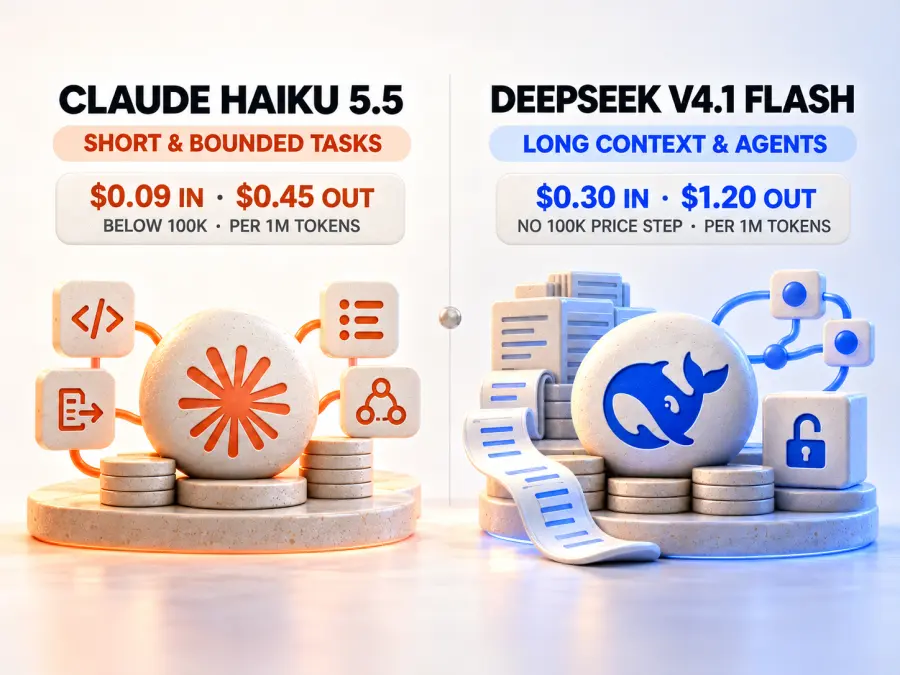
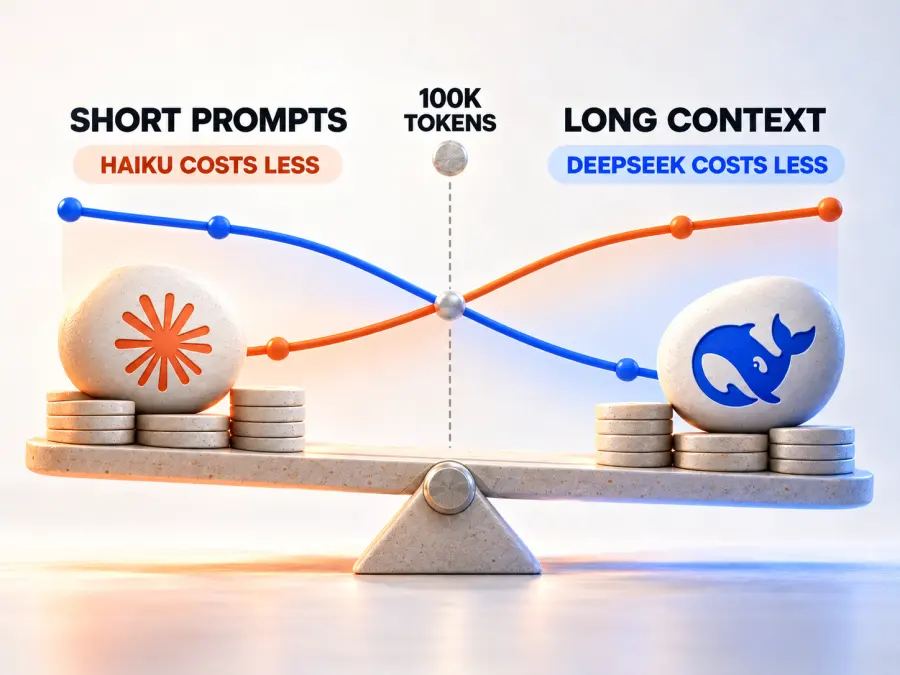
Choose Claude Haiku 5.5 on GPT Proto for short and medium prompts, bounded coding tasks, high-volume extraction or classification, and Claude-family subagents. Its GPT Proto rate below 100K tokens is $0.09 per million input tokens and $0.45 per million output tokens.
Choose DeepSeek V4.1 Flash on GPT Proto for repository-scale context, very long generations, open-weight deployment options, or automation-heavy agents. Its GPT Proto standard rate is $0.30 per million input tokens and $1.20 per million output tokens, with no 100K pricing step.
| Your priority |
Better starting point |
Why |
| Lowest API cost below 100K input tokens |
Claude Haiku 5.5 |
Lower GPT Proto input and output rates |
| Prompts above 100K tokens |
DeepSeek V4.1 Flash |
Haiku’s long-context tier changes the cost curve |
| Small, bounded coding edits |
Claude Haiku 5.5 |
Strong terminal results and lower short-request cost |
| Long repository analysis or huge output |
DeepSeek V4.1 Flash |
1M context and up to 384K output |
| Automation-oriented agents |
DeepSeek V4.1 Flash |
Strong independent AutomationBench-AA result |
| Claude-based subagent architecture |
Claude Haiku 5.5 |
Same model family and compatible behavior |
| Self-hosting or model modification |
DeepSeek V4.1 Flash |
MIT-licensed open weights |
Test both models with one API key. Run the same prompt through Claude Haiku 5.5 and DeepSeek Flash, then compare accepted output, latency, and billed tokens.
Claude Haiku 5.5 vs DeepSeek V4.1 Flash at a glance
Both models accept text and images, return text, and support a context window of up to one million tokens. The differences are in output limits, control, licensing, and how the models are sold.
| Specification |
Claude Haiku 5.5 |
DeepSeek V4.1 Flash |
| GPT Proto model string |
claude-haiku-5-5 |
deepseek-flash |
| Context window |
Up to 1M tokens |
Up to 1M tokens |
| Maximum output |
Up to 128K tokens |
Up to 384K tokens |
| Input / output |
Text, image, document / text |
Text, image / text |
| Reasoning control |
Adaptive effort from low to max |
Thinking and non-thinking modes |
| Weights |
Proprietary |
MIT-licensed open weights |
| GPT Proto rate below 100K |
$0.09 input / $0.45 output |
$0.30 input / $1.20 output |
| GPT Proto rate above 100K |
$0.45 input / $2.25 output |
$0.30 input / $1.20 output |
Is DeepSeek Flash the same as DeepSeek V4.1 Flash?
Yes. DeepSeek V4.1 Flash is the current model version; deepseek-flash is its GPT Proto API identifier. Older deepseek-v4-flash and deepseek-v4-flash-vision-exp names refer to retired routes or compatibility aliases. New integrations should use deepseek-flash. The DeepSeek V4.1 Flash release explainer covers the architecture and migration details.
Pricing and cost: the answer changes at 100K tokens
Anthropic’s Haiku 5.5 documentation lists direct rates of $0.10 input and $0.50 output per million tokens for prompts up to 100K. Above that threshold, the rates rise to $0.50 and $2.50. Cache reads are $0.01 below the threshold and $0.05 above it.
DeepSeek’s direct pricing varies by time. V4.1 Flash costs $0.15 input and $0.60 output per million tokens off-peak, or $0.30 and $1.20 during peak windows. Cache hits are priced separately. These direct-provider schedules should not be assumed to carry over to an aggregator.
GPT Proto currently lists Haiku at 10% below Anthropic’s corresponding rates and DeepSeek Flash at the standard $0.30/$1.20 rate. Using GPT Proto rates, no cache discount, and exact input/output counts:
| Workload per request |
Claude Haiku 5.5 |
DeepSeek V4.1 Flash |
Lower cost |
| 10K input + 2K output |
$0.0018 |
$0.0054 |
Haiku, 3× cheaper |
| 150K input + 10K output |
$0.0900 |
$0.0570 |
DeepSeek, 36.7% cheaper |
| 500K input + 50K output |
$0.3375 |
$0.2100 |
DeepSeek, 37.8% cheaper |
These examples explain why “which is cost-effective?” needs a workload definition. Also measure retries and rejected patches: a cheap call that needs three repairs may cost more than a better first pass.
Estimate your real workload, not one million abstract tokens. Record prompt length, completion length, retries, cache hits, and accepted-task rate before choosing a default. For more budget options, see affordable LLM APIs for AI agents.
Benchmark comparison: effort settings can reverse the ranking
The most useful public comparison comes from Artificial Analysis’s shared evaluation, because both models run through the same evaluator. At maximum reasoning effort, Haiku scores higher on the Intelligence Index, Terminal-Bench 4, and Humanity’s Last Exam. DeepSeek is far ahead on AutomationBench-AA.
| Independent measure, max effort |
Haiku 5.5 |
DeepSeek V4.1 Flash |
Lead |
| Intelligence Index |
43 |
39 |
Haiku |
| AutomationBench-AA |
35.4% |
68.9% |
DeepSeek |
| Terminal-Bench 4 |
32.8% |
26.8% |
Haiku |
| Humanity’s Last Exam |
44.4 |
39.2 |
Haiku |
| Estimated cost per task |
$0.21 |
$0.27 |
Haiku |
| Output speed |
235 tok/s |
214 tok/s |
Haiku |
| Time per task |
419.41 s |
277.57 s |
DeepSeek |
The cost and latency story changes when Haiku runs at high effort and DeepSeek remains at max. In that Artificial Analysis comparison, DeepSeek narrowly leads the Intelligence Index 39 to 38 and retains its automation lead, while Haiku’s estimated task cost falls to $0.08 versus $0.27.
This is why raw tokens per second is not task latency. A model can generate faster but emit more reasoning tokens, taking longer overall. Vendor model cards are still useful, but their scores should not be placed in a direct winner table when prompts, tools, and evaluation setups differ.
Which is better for coding and frontend work?
For bounded work—fixing a function, writing tests, explaining a stack trace, or reviewing a compact diff—Haiku is the stronger default. It combines the lower sub-100K price with the better independent Terminal-Bench 4 result at max effort. Anthropic also positions it for fast subagent work; the Haiku 5.5 overview explains where it fits in the Claude lineup.
DeepSeek becomes more attractive when the task requires large parts of a repository, long tool traces, or extensive generated code. Its maximum output is three times Haiku’s, and its architecture is designed to make input-heavy workloads more practical. Open weights also matter if a team needs local inference, fine-tuning, or deeper runtime control.
For frontend coding, there is not yet a credible public, like-for-like evaluation that proves either model is better. Test both against the same design and score screenshot fidelity, responsive behavior, state correctness, console and build errors, accessibility, unrelated file changes, repair turns, and accepted-patch cost. A one-shot visual demo is weaker evidence than a reproducible test suite and screenshot diff.
Which is better for agentic work?
Haiku fits agents that delegate many short tasks: classification, extraction, search-result triage, test generation, or a focused code review. Low per-call cost matters when an orchestrator launches dozens of workers, and keeping the stack in the Claude family may reduce prompt and response-format drift.
DeepSeek is the stronger candidate for agents that maintain long state, inspect repositories, or execute extended automation plans. Its AutomationBench-AA lead is substantial, but it should still be tested with your actual tools, permission boundaries, timeouts, and recovery logic.
Community results add useful caution. In one developer’s small comparison, DeepSeek won most research-brief and title-writing trials, while Haiku calls were often cheaper. The test used only a few runs and a Claude-family judge, so it is anecdotal, not a general benchmark. Its useful lesson is methodological: compare accepted results per dollar, not token prices alone.
Test both models through one GPT Proto key
This Python script sends the same prompt to both OpenAI-compatible routes and prints the answer, token counts, and elapsed time. Install the current OpenAI Python package, set GPTPROTO_API_KEY, and run it without changing providers.
import os
import time

from openai import OpenAI


client = OpenAI(
    api_key=os.environ["GPTPROTO_API_KEY"],
    base_url="https://gptproto.com/v1",
)

prompt = """Review this Python function for correctness and return:

1. A short explanation of every bug.

2. A minimal corrected version.

3. Three pytest cases.

def chunk(items, size):
    return [items[i:i + size] for i in range(0, len(items), size)]
"""

for model in ("claude-haiku-5-5", "deepseek-flash"):
    started = time.perf_counter()
    response = client.chat.completions.create(
        model=model,
        messages=[{"role": "user", "content": prompt}],
        temperature=0,
    )
    elapsed = time.perf_counter() - started
    usage = response.usage

    print(f"\n--- {model} ---")
    print(response.choices[0].message.content)
    print(
        f"prompt_tokens={usage.prompt_tokens} "
        f"completion_tokens={usage.completion_tokens} "
        f"elapsed_seconds={elapsed:.2f}"
    )
Run several representative prompts rather than one. Store exact prompts, resolved model versions, outputs, usage, latency, test results, and human acceptance decisions. Add reasoning controls only after the neutral baseline because similarly named effort levels may not represent equal compute.
Open weights and integration trade-offs
DeepSeek publishes V4.1 Flash weights under the MIT License; the official model repository documents its 552B-parameter backbone, 8B active parameters during prefill, and 16B during decoding. That permits self-hosting and modification, but the hardware and operations burden is far beyond a typical single-GPU deployment.
Haiku is proprietary and API-served. In exchange, teams get Anthropic’s managed model lifecycle and a straightforward fit with Claude-oriented prompts and agents. GPT Proto reduces the integration difference: both models can use the same base URL, API key, and chat-completions request shape.
Final verdict
Claude Haiku 5.5 is the better default for short, frequent, bounded developer tasks. It is cheaper below 100K input tokens on GPT Proto and leads several independent max-effort measures.
DeepSeek V4.1 Flash is the better default for long-context coding, extended automation, very large output, and teams that value open weights. It also becomes cheaper on GPT Proto once Haiku crosses its long-context pricing threshold.
The practical production choice is routing, not allegiance: send small tasks to Haiku, long-context or automation-heavy jobs to DeepSeek, and keep a measured fallback for cases where the first model fails acceptance tests.
Start with the model that fits the workload. Try Claude Haiku 5.5 for short, high-volume calls or DeepSeek V4.1 Flash for long-context and automation-heavy work.