Third-Party Midjourney API Providers at a Glance
| Rank |
Provider |
Access model |
Published price signal |
Best for |
Main trade-off |
| 1 |
GPT Proto |
Hosted, pay per run |
$0.06084 per run |
One key for Midjourney plus 200+ other models |
Not the lowest listed Midjourney rate; current auth example still needs a live smoke test |
| 2 |
APIFrame |
Hosted, dedicated workflow |
$0.02–$0.10 per job; four outputs per job; Basic plan $39/month |
Teams focused on Midjourney operations and concurrency |
Monthly plan cost; “per job” is not directly comparable with single-output request pricing |
| 3 |
TTAPI |
Hosted, pay per request |
Imagine: about $0.03 Relax, $0.05 Fast, $0.07 Turbo |
Low published request cost and selectable queue modes |
Cost and wait time vary by mode; no independent reliability test was completed |
| 4 |
LegNext |
Hosted or bring your own account |
About $0.08 Fast, $0.16 Turbo; BYO about $20/month plus a Midjourney plan |
Teams that want a hosted/BYO choice and six-job standard concurrency |
Hosted rates are higher; BYO adds account setup and subscription overhead |
| 5 |
UserAPI |
Bring your own Discord and Midjourney account |
$0.04/request or $25/month; 50-request test pack |
Developers comfortable managing their own Midjourney-linked account |
More moving parts and direct exposure to account or policy interruption |
| 6 |
CometAPI |
Hosted, operation-specific API |
About $0.056 Fast and $0.168 Turbo for Imagine |
Developers who want distinct operation IDs |
Public pricing estimates are inconsistent and need rechecking before budgeting |
| 7 |
302.AI |
Hosted, pay per operation |
$0.05 Imagine; $0.025 Upscale, Pan, or Describe |
Short experiments with separate operation prices |
Its own documentation labels the endpoints unstable |
Prices are snapshots, not promises. “Per run,” “per request,” and “per job” may represent different output counts, queue modes, and operations. Compare the workload you will actually ship—not the smallest number in a pricing table.

How I Ranked the Best Unofficial APIs for Midjourney
There is no neutral benchmark covering all seven services, so pretending this is a speed leaderboard would be false precision. I ranked the providers on five verifiable questions instead:
Can the current Midjourney offering be verified? Stale landing pages and old roundups do not count.
Is the access model clear? A hosted endpoint and a BYO Discord wrapper impose different costs and risks.
Can a developer estimate cost? Published units, modes, output counts, and subscription requirements all matter.
Is the integration surface specific enough to evaluate? An endpoint or operation list is more useful than a generic “API available” claim.
Are the limitations disclosed? Unstable endpoints, inconsistent prices, and policy exposure should affect the rank.
The resulting order is an editorial judgment based on documentation. It is not a claim that #1 has the lowest latency or that #7 produces worse images. Those questions require controlled testing that was not performed for this draft.
1. GPT Proto — Best Overall for Multi-Model Image Workflows
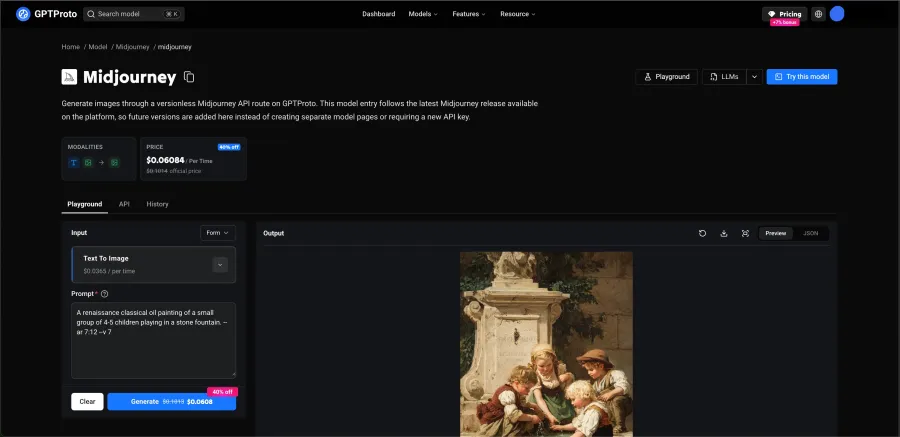
GPT Proto's Midjourney model page lists a versionless text-to-image route at $0.06084 per run. Text and image inputs are accepted, and the output modality is image. The versionless design is the main practical advantage: GPT Proto can move the route to the latest Midjourney release it supports without making developers adopt a new version-specific endpoint.
Midjourney is only one part of the account. The same API key and shared balance cover 200+ text, image, video, and audio models. That makes GPT Proto the best fit when a product might use Midjourney for art direction, another image model for precise editing, and a video model for animation. The benefit is account consolidation. The cost is that a multi-model platform may offer less Midjourney-specific workflow depth than a dedicated provider.
The listed price is not the cheapest in this ranking. TTAPI publishes lower Relax and Fast request rates, while APIFrame advertises a lower per-job floor. GPT Proto wins here because of workflow breadth, not because of a lowest-price claim.
Best for: Apps that need Midjourney alongside other generative models without separate provider accounts.
Skip it if: Midjourney is your only model and the smallest published per-request number matters more than account consolidation.
If prompt development is the bottleneck rather than API wiring, start with the Midjourney prompt examples, then move the prompts that survive review into the API workflow.
2. APIFrame — Best for a Dedicated Midjourney Workflow
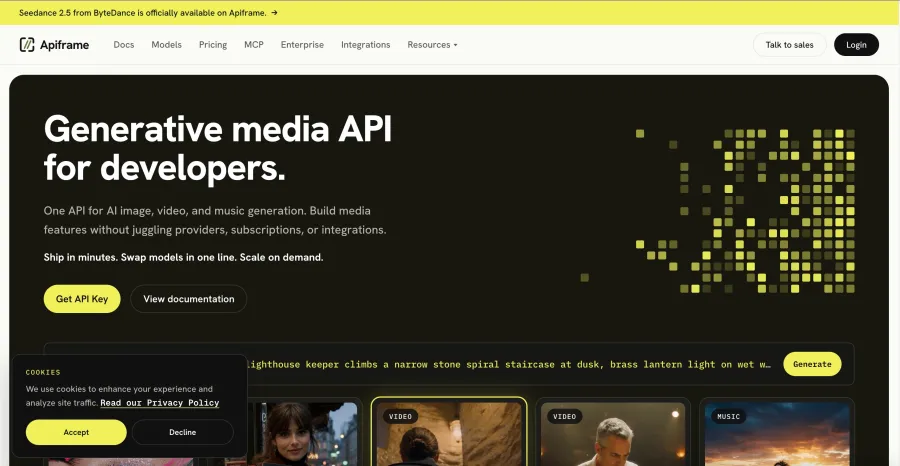
APIFrame publishes a range of $0.02–$0.10 per job, and each job returns four outputs. Its Basic plan is listed at $39 per month with five concurrent jobs. Those details make it easier to evaluate as a dedicated Midjourney system rather than a generic model gateway.
The four-output job is important. If all four images are useful, simple arithmetic puts the nominal output cost between $0.005 and $0.025. If your application keeps only one image, however, the useful-output cost is the full job price. A low per-job figure can look better than it behaves in a production workflow with aggressive rejection or reroll rates.
APIFrame ranks ahead of TTAPI because its published workflow is broader and its output bundle is explicit. TTAPI still wins on simple request pricing.
 Best for: Teams building around Midjourney-specific generation and parallel job handling.
Skip it if: You do not generate enough volume to justify a monthly plan or you need a wider catalog under the same account.
3. TTAPI — Most Affordable Published Request Pricing
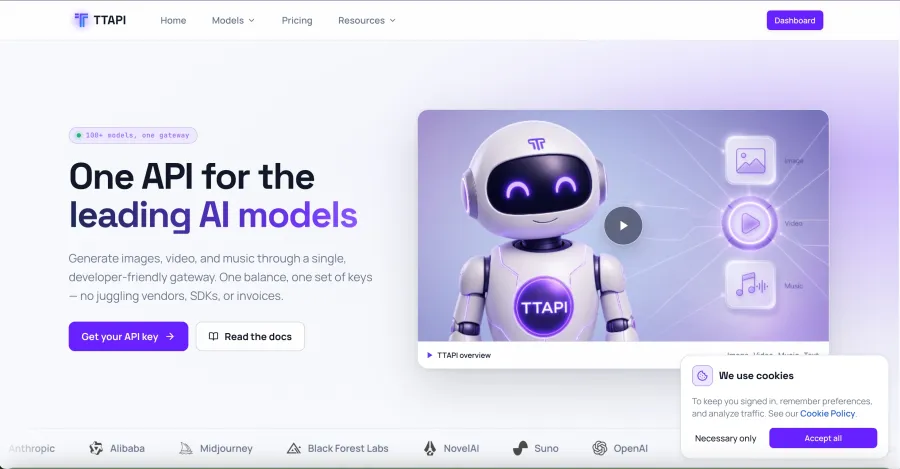
TTAPI lists Imagine requests at approximately $0.03 in Relax mode, $0.05 in Fast mode, and $0.07 in Turbo mode. Among the ranked services with directly comparable per-request figures, that makes Relax the lowest published entry point.
The trade-off is embedded in the mode names. The cheapest queue is not the same service level as Fast or Turbo, and a production budget should be based on the mode the application can tolerate. One hundred Imagine requests would be about $3, $5, or $7 at the three listed rates. That calculation is clean; expected completion time and reliability are not, because this review did not benchmark them.
Best for: Price-sensitive prototypes and batch jobs that can choose a slower queue.
Skip it if: You need independently measured latency or a contract-backed availability commitment before integration.
4. LegNext — Best Hybrid Choice for Hosted and BYO Access
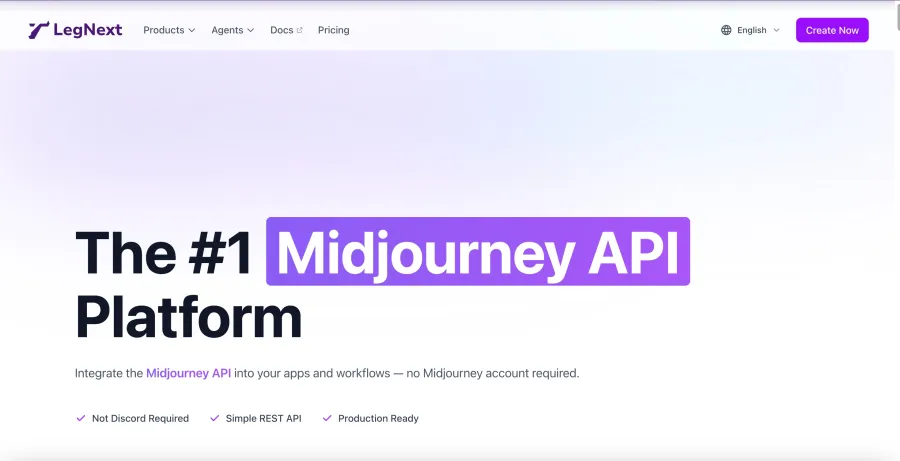
LegNext is the most flexible option in this group for teams choosing between provider-hosted usage and a bring-your-own setup. Published hosted rates are approximately $0.08 for Fast and $0.16 for Turbo, while its BYO option is about $20 per month plus the required Midjourney subscription. Standard concurrency is listed at six jobs.
That flexibility comes with a cost decision. Hosted access removes some account setup but carries the highest Fast and Turbo figures in this ranking. BYO lowers the middleware fee to a predictable subscription, but it shifts Midjourney account maintenance back to you.
Midjourney's official monthly plans are currently $10, $30, $60, and $120, according to its plan comparison. At the lowest plan, a LegNext BYO setup therefore begins around $30 per month before any other applicable costs. That is a budgeting example, not a recommendation: usage rights, available generation modes, and commercial terms still depend on the selected Midjourney plan.
Best for: Teams that want to choose between hosted billing and an account-linked setup while keeping moderate concurrency.
Skip it if: You want the lowest hosted rate or do not want to maintain a separate Midjourney subscription.
5. UserAPI — Best for a Discord-Linked BYO Setup
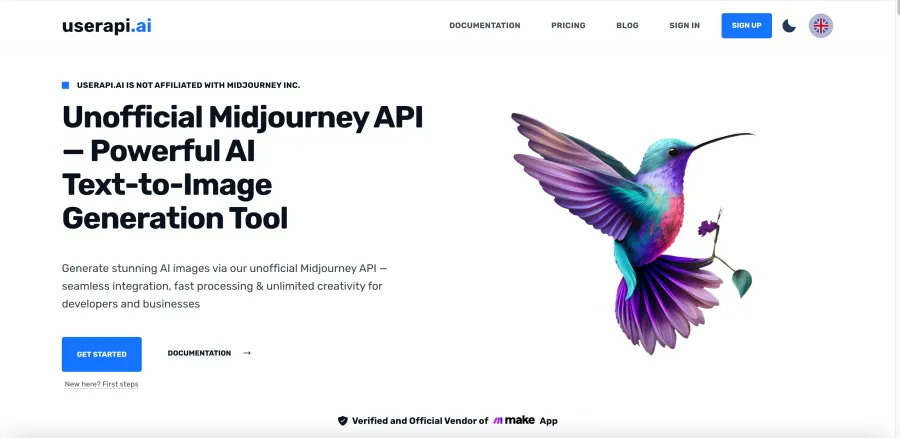
UserAPI takes the bring-your-own-account approach. It requires a Discord account and a Midjourney subscription, then charges $0.04 per request or $25 per month. A 50-request test pack gives developers a limited way to check the integration before committing to the subscription route.
The appeal is control over the account used for generation. The drawback is operational coupling: Discord access, the Midjourney subscription, the wrapper, and your application all have to keep working together. More pieces mean more failure points.
Using the current $10 entry Midjourney plan, the monthly UserAPI route starts at roughly $35 per month. That comparison excludes taxes, plan limitations, and any usage charged outside the monthly wrapper fee.
Best for: Developers who already operate a Midjourney account and prefer an account-linked wrapper.
Skip it if: You want a single hosted invoice or do not want application uptime tied to a Discord-linked account.
6. CometAPI — Best for Granular Operation IDs
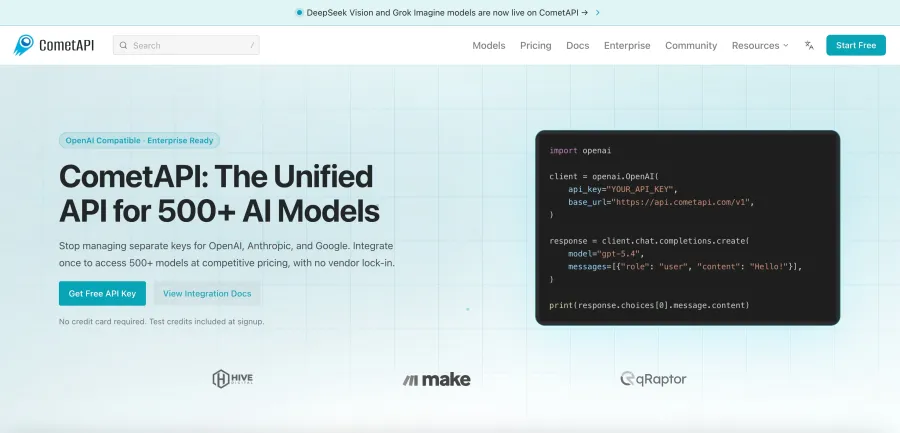
CometAPI exposes separate operation identifiers rather than treating every Midjourney action as one generic call. That can make it easier to map application controls to Imagine and related operations.
Its listed Imagine prices are approximately $0.056 for Fast and $0.168 for Turbo. The serious caveat is pricing consistency: different public pricing surfaces show estimates that do not line up cleanly. Use the figures as a research snapshot, not as a purchase-order number. Recheck the exact operation and billing unit immediately before launch.
Best for: Developers who value operation-level mapping and will validate each current price.
Skip it if: You need one unambiguous rate card for budgeting today.
7. 302.AI — Best Reserved for Experiments
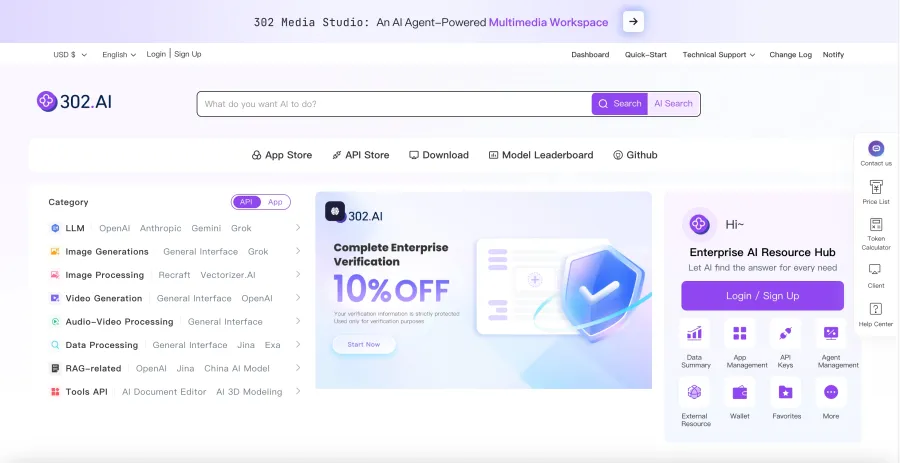
302.AI lists $0.05 for Imagine and $0.025 for Upscale, Pan, or Describe. The separate operation pricing is easy to understand and can be useful for a small proof of concept.
The provider's own page also marks the endpoints unstable. That disclosure is the reason 302.AI ranks last. Cheap, readable pricing does not compensate for a stated stability limitation when an image feature sits on a production path.
Best for: Short, disposable experiments where interruptions are acceptable.
Skip it if: Midjourney generation is a customer-facing dependency.
Hosted vs. BYO: The Difference Most Provider Lists Miss
A comparison of affordable Midjourney API providers is incomplete unless it separates the account model.
Hosted access
The provider handles the upstream account layer and charges you per request, per run, or per job. GPT Proto, APIFrame, TTAPI, CometAPI, and 302.AI fit this pattern based on their published offers.
Hosted access reduces setup work and often makes billing easier. The price is dependency: the provider controls the upstream connection, and an enforcement or product change can interrupt your route.
Bring-your-own access
You connect an account or subscription that you already control. UserAPI is the clearest BYO example here, while LegNext offers BYO as one of its paths.
BYO can make the account relationship more visible, but it does not make automation officially supported. You also pay the wrapper cost and the Midjourney subscription, and you inherit more account maintenance.
My judgment: use hosted access for a faster initial evaluation and BYO only when you understand the extra operational steps. Neither route removes the Terms of Service risk.
How to Call the GPT Proto Midjourney Route
The current GPT Proto page documents a two-step asynchronous flow: submit a text-to-image request, then query the result endpoint with a result ID.
The examples below are documentation-based and intentionally conservative. They print the complete JSON response instead of assuming undocumented fields. As of August 25, 2026, the live page shows Authorization: Bearer $GPTPROTO_API_KEY for both requests.
cURL: submit a request
export GPTPROTO_API_KEY="your_api_key"

curl --request POST \
  "https://gptproto.com/api/v3/midjourney/midjourney/text-to-image" \
  --header "Authorization: Bearer $GPTPROTO_API_KEY" \
  --header "Content-Type: application/json" \
  --data '{
    "prompt": "A tiny origami fox sailing a teacup across a moonlit puddle"
  }'
Copy the result ID from the returned JSON, then check it:
export GPTPROTO_RESULT_ID="result_id_from_the_submit_response"

curl --request GET \
  "https://gptproto.com/api/v3/predictions/$GPTPROTO_RESULT_ID/result" \
  --header "Authorization: Bearer $GPTPROTO_API_KEY"
Python: submit or check a known result ID
Install the only dependency:
python -m pip install requests
Then run:
import json
import os

import requests

api_key = os.environ["GPTPROTO_API_KEY"]
result_id = os.environ.get("GPTPROTO_RESULT_ID")

headers = {
    "Authorization": f"Bearer {api_key}",
    "Content-Type": "application/json",
}

if result_id:
    response = requests.get(
        f"https://gptproto.com/api/v3/predictions/{result_id}/result",
        headers=headers,
        timeout=60,
    )
else:
    response = requests.post(
        "https://gptproto.com/api/v3/midjourney/midjourney/text-to-image",
        headers=headers,
        json={
            "prompt": (
                "A tiny origami fox sailing a teacup across a moonlit puddle"
            )
        },
        timeout=60,
    )

response.raise_for_status()
print(json.dumps(response.json(), indent=2))
Run it once without GPTPROTO_RESULT_ID to submit. Set that variable to the returned ID and run the script again to query the result. The public page does not currently specify which response key contains the ID, the terminal status values, or the final image field. Parsing those fields without a live response would be guesswork.
Which Provider Should You Choose?
Use this short version:
Choose GPT Proto if Midjourney is one part of a broader image, video, or multimodal product.
Choose APIFrame if you want a dedicated workflow with four outputs per job and published concurrency.
Choose TTAPI if the lowest listed request price is the primary constraint and Relax mode is acceptable.
Choose LegNext if you want a hosted/BYO decision under one provider.
Choose UserAPI if you already have the required Discord and Midjourney accounts and accept the operational coupling.
Choose CometAPI if granular operation IDs matter and you can verify the current price manually.
Choose 302.AI only when the experiment can tolerate an endpoint the provider labels unstable.
For production, do not choose from a feature table alone. Run a small paid test that records the same prompt, operation, queue mode, number of returned images, total charge, completion time, error response, and retry behavior for every finalist. The provider with a rate that looks one cent lower can cost more if your application discards most outputs or repeats failed jobs.

Providers I Did Not Rank
This exclusion list is one of the biggest differences between this review and older search results.
PiAPI: Its current homepage states that it no longer provides a Midjourney API, even though stale product pages and roundups still appear in search.
ImagineAPI: The site returned an SSL error during verification, so I could not confirm a current product or rate card securely.
Kie.ai: I could not verify a current dedicated Midjourney product and pricing page during the research window.
useapi.net: Its current top-level service list does not present a dedicated Midjourney API. Midjourney appears only inside other connected service descriptions, which is not the same offer.
An exclusion is not a permanent verdict. It means the provider did not meet the current-verification standard on August 25, 2026.
The Policy Risk You Cannot Price Away
Midjourney's official plans cost $10, $30, $60, or $120 per month, but plan ownership does not create a public API entitlement. The current Terms prohibit automated access and generation, as well as resale or redistribution of service access.
That creates three practical risks:
Continuity risk: an unofficial route may stop after an upstream enforcement or product change.
Account risk: BYO integrations can expose the connected account to restrictions.
Contract risk: a provider's refund or uptime promise does not override Midjourney's terms.
This is not a claim that every provider will fail. It is a boundary on what the published evidence can support. If Midjourney is critical to revenue, keep a second image model ready and avoid designing a workflow that can only accept one provider's response format.
Final Verdict
GPT Proto is the best overall third-party Midjourney API provider for developers who need a wider model stack, while APIFrame is the better dedicated Midjourney choice and TTAPI has the strongest published price case. LegNext and UserAPI are more suitable when BYO access is intentional. CometAPI needs a price recheck; 302.AI belongs in experiments, not a critical path.
The decisive distinction is not one cent per request. It is whether you want hosted or BYO access, how many useful images a billed unit returns, and how much service-continuity risk your product can absorb.