The Great Energy Graduation: Why We’re Moving from Hunting Fossils to Farming the Sun
For most of human history, our relationship with energy has looked a lot like hunting. We stalked the earth for concentrated pockets of "old sunshine"—coal, oil, and gas—buried millions of years ago. We dug deeper, drilled further, and fought wars over these scarce commodities. But as we sit here in the mid-2020s, a profound shift is occurring. We are graduating from being energy hunters to energy farmers. We are moving from the era of burning things to the era of Electrotech.
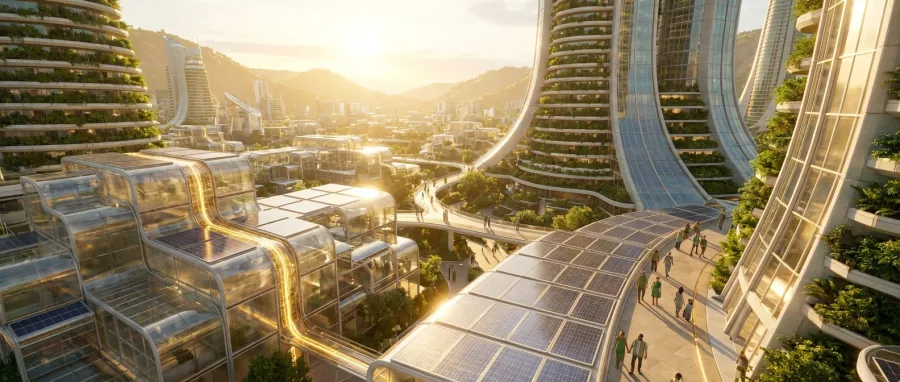
This isn't just a "green" transition or a marginal swap of one fuel for another. It is a full-scale industrial revolution. Think of it like the shift from the telegraph to the internet, or from horses to the Model T. The center of gravity is moving from molecules to electrons. This is the Electrotech Revolution, and if you aren't paying attention to the speed at which it’s moving, you’re already looking at a world that no longer exists.
In this feature, we’re going to peel back the layers of this transformation. We’ll look at the physics of why setting things on fire is a terrible way to run a planet, the economics of why technology always beats commodities, and why AI models are the secret ingredient that will manage this new, complex reality. Buckle up; the "decisive decade" is well underway.
"Humanity is graduating from burning fossil commodities to harnessing manufactured technologies—from hunting scarce fossils to farming the inexhaustible sun."
Chapter 1: The Three Pillars of Change
The debate about the future of energy usually gets stuck between two camps: the "Fossil Gradualists," who think oil will be king forever, and the "Net Zero Advocates," who focus on the moral obligation to save the climate. But there’s a third way to look at it: the Electrotech perspective. This view doesn't care about politics; it cares about physics, economics, and geopolitics.
First, the physics. Burning fossil fuels is incredibly inefficient. When you burn gas in a car engine, about two-thirds of that energy is lost as heat. It literally goes up in smoke. Electrotech, on the other hand, makes a mockery of this waste. An electric motor is roughly three to four times as efficient as an internal combustion engine. Why fight a battle with a fuel that loses 70% of its power before it even turns a wheel?
Second, the economics. This is the "brain over brawn" argument. Fossils are commodities; the deeper you dig, the more expensive they get. Electrotech is a manufactured technology. Like chips or smartphones, the more you make, the cheaper they get. This is known as a "learning curve." Solar prices have dropped 99% since the 1980s. Batteries have done the same. You can’t compete with a price curve that looks like a cliff.
Third, geopolitics. Three-quarters of the world’s population lives in countries that have to import fossil fuels. This creates a massive risk. If the supply chain snaps or a war starts, the lights go out. But 92% of the world has enough renewable potential to be self-sufficient. Electrotech isn't just cleaner; it’s a path to energy freedom. You can’t "turn off" someone else’s sun.
- Physics: Electrotech is 3x more efficient than burning stuff.
- Economics: Costs fall as deployment doubles (Learning Curves).
- Geopolitics: Domestic sun and wind replace imported risk.
- Digitalization: Software and AI models manage the flow.
Chapter 2: The Efficiency Gap ($4.6 Trillion Up in Smoke)
Most people talk about "Primary Energy"—the total amount of crude oil or coal we pull out of the ground. But that’s the wrong metric. We don't actually want barrels of oil; we want "Useful Energy." We want hot water, cold beer, and a car that moves. When you look at the system through the lens of efficiency, the fossil fuel era looks like a disaster.
Every year, the world loses roughly 380 Exajoules of energy to waste. To put a price tag on that, it’s about $4.6 trillion worth of energy that we pay for and then simply throw away as waste heat. It is one of the greatest market failures in history. Electrotech solves this by removing the middleman—the fire.
Take the example of a passenger car. If we electrified the entire global car fleet today, we could run it on less than 15% of the total electricity we currently generate. Why? Because electric vehicles (EVs) don't waste energy vibrating and getting hot; they just move. The same applies to heat pumps, which are 300-400% efficient because they move heat instead of creating it. This leap in efficiency is what makes the transition inevitable.
Fossil Inefficiency vs. Electrotech Efficiency
| Sector |
Fossil Tech (Efficiency) |
Electrotech (Efficiency) |
The "Leap" |
| Transport |
25-40% (Engine) |
80-90% (EV) |
3x more efficient |
| Heating |
85% (Gas Boiler) |
300-400% (Heat Pump) |
4x more efficient |
| Power Gen |
35% (Coal/Gas) |
100% (Solar/Wind) |
3x more efficient |
Chapter 3: The Child of Digital Tech
One reason people underestimate the Electrotech Revolution is that they think of it as "heavy industry." They think of it like big steel mills or coal mines. But Electrotech is actually the child of digital technology. It’s made of the same stuff: processors, sensors, and software. A modern battery plant has more in common with a semiconductor fab than a coal power station.
This means Electrotech inherits the momentum of the digital age. It’s small, modular, and fast to deploy. You can build a solar farm in six months; a nuclear plant takes ten years. You can install a home battery in a day; a gas pipeline takes a decade of legal battles. This modularity allows for "Learning by Doing." We are now producing billions of solar panels and millions of EVs. Every single one makes the next one better and cheaper.
And then there’s the software layer. As we move to a grid powered by millions of solar panels and batteries, we need massive amounts of compute to balance it all. This is where AI models come into play. We are moving from a "dumb" grid where power flows one way, to a "smart" grid where AI models predict weather patterns, manage EV charging times, and optimize battery storage in real-time. Without sophisticated AI models, the Electrotech revolution would be a traffic jam of electrons.
The AI and Energy Synergy
As startups and enterprises rush to integrate AI models into this new energy landscape, the cost of running those models becomes a critical business factor. This is where specialized infrastructure like GPT Proto becomes a game-changer. For a developer building an AI model to optimize a regional power grid, every penny saved on API costs translates into more frequent data updates and better grid stability.
GPT Proto offers up to 60% off mainstream API prices, allowing energy-tech startups to run complex AI models for predictive maintenance and smart scheduling without breaking the bank. Whether you're integrating text-based grid reports or image-based satellite analysis of solar farms, GPT Proto's unified interface makes it a "write once, integrate all" solution for the GenAI era.
Chapter 4: Peak Fossil Demand is Not a Future Event
The biggest news of 2025 is something most people haven't processed yet: we have likely reached Peak Fossil Fuel Demand. For decades, the story of energy was a story of "more." More coal, more oil, more gas. But that era has hit a ceiling. In half the world, fossil fuel use for electricity has already peaked and is now in decline. Even in China, the world's manufacturing engine, fossil demand is plateauing.
Think of it as a "bumpy plateau." We aren't going to zero tomorrow, but we are no longer growing. And in the world of investment, if you aren't growing, you’re dying. Capital is moving. Two-thirds of all energy expenditure globally is now going into Electrotech. The "Old Guard" is fighting a rearguard action, but the numbers are against them. Solar capacity is doubling every three years. Battery storage is doubling nearly every year.
The "soft underbelly" of the oil system is road transport. Cars and trucks account for 75% of all transport oil demand. As EV sales continue their exponential climb—hitting 50% of sales in China already—the demand for gasoline is starting to structurally decline. This creates a "skewed demand" that will disrupt refineries. If nobody wants gasoline, but the world still needs jet fuel, the economics of a $1 billion refinery start to fall apart.
- Industrial Peaks: Fossil demand for industry has been flat since 2014.
- Building Peaks: Fossil use in buildings peaked in 2018.
- Transport Peaks: EVs are displacing millions of barrels of oil daily.
- The Pivot Nation: China accounted for 95% of fossil growth since 2018; now that China is peaking, the world is peaking.
Chapter 5: The Geography of Abundance (The Sunbelt)
The fossil fuel era was defined by a few lucky regions—the Middle East, Texas, Russia—that sat on top of "old sunshine." This created a world of "haves" and "have-nots." But Electrotech is democratizing energy. The sun shines everywhere, but it shines particularly bright in the "Sunbelt"—a region that is home to 80% of the global population and the majority of emerging markets.
For a country like Vietnam, India, or Namibia, the Electrotech Revolution isn't just about the environment; it’s about leapfrogging the West. Just as these countries skipped landline phones and went straight to mobile, they are now skipping centralized coal grids and going straight to distributed solar and batteries. In 2023, the ASEAN region leapfrogged the US in electrification rates.
This creates a massive economic opportunity. Countries in the Sunbelt will soon have the lowest electricity costs in the world. Imagine a world where energy is virtually free during the day. This changes everything from how we manufacture steel to how we desalinate water. It moves us toward a "Zero Marginal Cost" economy. When your fuel is free (the sun) and your tech is paid for, the cost of your next kilowatt is nearly zero.
In this high-growth environment, the demand for AI models to manage these new local economies will skyrocket. From automated crop management to smart city logistics, AI models will be the operating system of the Sunbelt. Businesses in these regions will need cost-effective access to the best AI models (like GPT-4 or Claude 3) to remain competitive, which is exactly why the multi-modal, cost-first approach of GPT Proto is so vital for global entrepreneurs.
Chapter 6: Why the "Old Models" Are Wrong
If you look at the forecasts from the International Energy Agency (IEA) or major oil companies from five years ago, they all missed the mark. Why? Because they use "linear models" to predict "exponential change." They assumed solar would grow by a tiny percentage every year. Instead, solar grew like a virus.
Successful technologies don't grow in a straight line; they grow along S-curves. Think of the adoption of color TV, the internet, or smartphones. For a long time, nothing seems to happen. Then, you hit a "tipping point," and the market flips in a decade. We are currently at the steepest part of the S-curve for solar, wind, and batteries. If you are still using a linear forecast, you’re basically trying to predict the internet's growth by looking at the number of fax machines.
This is why the "decisive decade" is so jarring. Change is happening faster than we can record it. In many emerging markets, there is a massive gap between "official" statistics and actual solar imports. Why? Because people are buying solar panels and plugging them in "behind the meter." They aren't waiting for the government to build a power plant; they are building their own. The energy system is being disrupted from the bottom up.
"Complex models are missing the reality of exponential change. We are no longer in the era of gradual substitution; we are in the era of technological disruption."
Chapter 7: The Winners and Losers of the New Era
In any revolution, there are winners and losers. The winners of the Electrotech era will be the "Builders"—the countries and companies that embrace the modular, digital nature of electrons. China is currently the first major "Electrostate," leading the world in patents, manufacturing, and deployment. But the race is far from over. Any nation that can lower the price of electricity and electrify its end demand will see its GDP soar.
The losers will be those who cling to the "unbearable heaviness" of the fossil system. The fossil system requires 50x more raw materials than Electrotech. Every day, we have to ship 17,000 million tonnes of coal, oil, and gas around the world just to set it on fire. It is a massive, heavy, fragile logistics chain. As demand for those fuels slips, the "Petrostates" that haven't diversified will face a fiscal crisis. Their expensive oil fields will become "stranded assets"—trillions of dollars of infrastructure that is no longer worth running.
Furthermore, the "Information Cost" of the old world was high. Finding oil required massive geology teams and risky bets. In the new world, the cost of information is falling alongside the cost of energy. As AI models become cheaper to run, the ability to find new battery materials or optimize a grid becomes a "commodity" itself. We are moving toward a world of abundant energy and abundant information.
Summary of the Decisive Decade
- 2020-2024: Manufacturing capacity is built; prices hit the "tipping point."
- 2025-2027: Fossil demand plateaus and begins its first structural decline.
- 2028-2030: Electrotech becomes "irresistible" on cost; S-curves hit 50-80% penetration in lead markets.
- Beyond 2030: The Zero-Marginal-Cost economy begins to take shape.
Conclusion
The Electrotech Revolution is not a "choice" we are making to be nice to the planet. It is an evolutionary step in how humans harness the universe. We are moving from a fragile, inefficient, and expensive system of burning "old sunshine" to a robust, efficient, and cheap system of using "real-time sunshine."
This transition will be bumpy. Incumbents will lobby to keep their subsidies (which currently total hundreds of billions of dollars). Markets will be volatile. But the fundamental forces of physics and economics are on the side of the electron. The "Age of Electrotech" is here, and it is powered by silicon, software, and AI models. Whether you’re an investor, a policymaker, or a consumer, the message is clear: surf the wave, or be dragged under by the tide of history.
The sun supplies the Earth with as much energy every five days as all fossil fuel reserves combined. We finally have the technology to harvest it. The only question left is: how fast can we plug in?
Original Article by GPT Proto
"We focus on discussing real problems with tech entrepreneurs, enabling some to enter the GenAI era first."