
TL;DR: Notion founder Ivan Zhao recently compared the emergence of AI agents to the invention of structural steel in the 19th century. Just as steel allowed architects to build skyscrapers that stone and wood could never support, AI agents are enabling businesses to scale beyond the limits of human coordination. This article dissects the transition from human-driven tool usage to the orchestration of autonomous digital workforces. We explore how AI agents are redefining productivity, dismantling bureaucracy, and acting as the fundamental building blocks for the future of the knowledge economy.
2026-02-22
AI Agents: The New Structural Steel of Business
Explore how AI agents act as the new structural steel of global business, moving from simple automation to autonomous digital workforces. Learn why the shift from human-scale coordination to infinite minds will define the future of the knowledge economy.
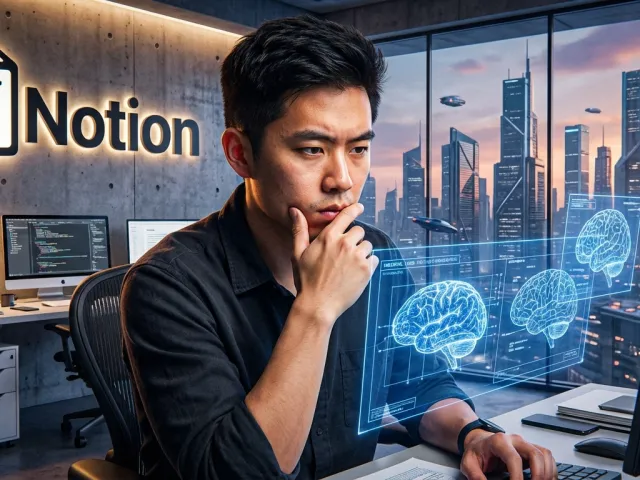
Table of contents
The Iron Age of Bits: Why AI Agents Are the New Structural Steel
To understand the monumental shift currently underway in the technology sector, we must look back to the industrial constraints of the 19th century. Before the widespread adoption of steel, human ambition was physically capped by the materials available. You could pile stone only so high before it crushed its foundation; you could span a bridge with wood only so far before it collapsed under its own weight. The introduction of steel didn't just improve existing structures—it fundamentally rewrote the rules of architecture. It birthed the skyscraper and the suspension bridge. Today, AI agents represent this same leap in capability for the digital economy.
Ivan Zhao, the visionary founder of Notion, argues in his reflection "Steam, Steel, and Infinite Minds" that we are currently operating in the "cast iron" era of software. We use powerful Large Language Models (LLMs) to perform tasks that are still rooted in manual human workflows—summarizing emails, drafting documents, or generating code snippets one at a time. While helpful, these applications do not change the fundamental architecture of the business. The true revolution begins when we transition to AI agents: autonomous systems that act as the structural steel of modern organizations, allowing us to build taller, faster, and more complex enterprises than ever before.
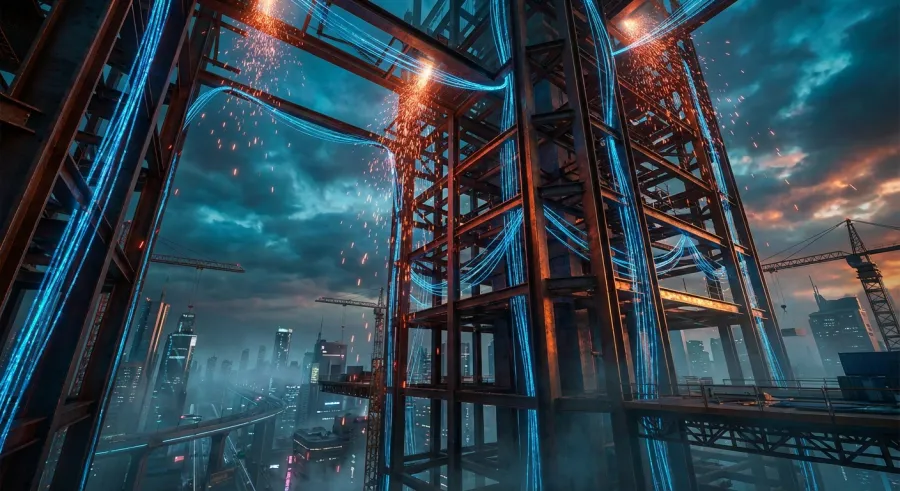
This architectural shift is driven by the capability of AI agents to handle context and execute multi-step workflows without constant supervision. Unlike a standard chatbot that waits for a prompt, AI agents are designed to pursue goals. They can plan, reason, access external tools, and iterate on their work until the objective is met. For business leaders, this means the bottleneck of "human bandwidth" is about to be shattered. The organizations that successfully integrate AI agents into their structural core will no longer be limited by headcount or management capacity, but only by their ability to design effective systems.
Breaking the Coordination Barrier
The primary limit to organizational growth has always been the cost of coordination. As a company adds more employees, the number of communication channels grows exponentially, creating a "bureaucracy tax." AI agents solve this by acting as an infinite, friction-free layer of coordination. By deploying AI agents to handle data synchronization, project tracking, and routine communication, businesses can bypass the traditional headwinds that slow down large enterprises.
From Bicycles to Autonomous Engines: The Evolution of Productivity
Steve Jobs famously described the computer as a "bicycle for the mind." It was a tool that amplified human effort, but it still required the human to pedal. If the user stopped typing, the work stopped. For the past forty years, the software industry has focused on building better bicycles—faster processors, slicker interfaces, and cloud connectivity. However, the introduction of AI agents marks the end of the bicycle era and the dawn of the autonomous engine.
In an ecosystem driven by AI agents, the human no longer provides the motive power. Instead, the human acts as the architect and the pilot. A software engineer, for example, ceases to be a "writer of code" and becomes a "commander of agents." They might instruct a fleet of specialized AI agents to write the boilerplate, run the test suites, document the API, and deploy the application. The engineer's value shifts from typing speed to system design and architectural oversight.
The Anatomy of an AI Agent
To fully grasp this shift, we must define what constitutes a true agent. AI agents differ from standard LLMs in three critical ways:
- Agency and Autonomy: AI agents have a loop of "Thought, Action, Observation." They can decide which steps to take to achieve a goal without human micromanagement.
- Tool Access: AI agents can interact with the outside world via APIs, browsing the web, querying databases, or sending emails.
- Long-term Memory: Unlike a fresh chat session, AI agents retain context over time, learning from past interactions and maintaining institutional knowledge.
This transition is not without its challenges. The primary hurdle preventing total autonomy is "verifiability." In coding, a compiler can verify if the work of AI agents is correct. in subjective fields like marketing or law, verification is harder. This is why we are currently in the "Human-in-the-Loop" phase. However, as AI agents become more sophisticated and self-correcting, we will move to a "Human-on-the-Loop" model, where humans provide high-level direction and ethical guardrails rather than constant oversight.
"We are moving from a world where we use software to a world where we manage digital workforces. The most successful employees of the next decade will be those who can effectively orchestrate fleets of AI agents to execute complex tasks."
The Architecture of the Future Organization
When AI agents become the structural steel of the enterprise, the shape of the organization changes. The traditional pyramid hierarchy—broad at the bottom with junior executioners and narrow at the top with decision-makers—begins to flatten. AI agents take over the bottom of the pyramid. They handle the data entry, the scheduling, the basic research, and the initial drafts. This lifts the human workforce into higher-leverage roles.
Consider the "water cooler" problem. In traditional companies, vital institutional knowledge is trapped in the minds of employees. When they leave, that knowledge evaporates. In an organization built on AI agents, the agents themselves become the repository of knowledge. They analyze every Slack thread, every Notion document, and every customer interaction. When a new human employee joins, they are supported by AI agents that can instantly answer questions about the history of any project, creating a level of continuity that was previously impossible.
The Economics of Intelligence
As companies look to deploy thousands of AI agents, the cost of intelligence becomes a strategic variable. You cannot build a business on AI agents if the compute costs exceed the value generated. This is creating a new market for "smart routing" and API orchestration. Platforms that allow businesses to switch seamlessly between expensive, high-reasoning models (like GPT-4) for complex tasks and cheaper, faster models for routine work are becoming essential utilities.
| Workflow Component | Traditional Method | AI Agent Method |
|---|---|---|
| Data Aggregation | Manual Copy/Paste across tabs | Autonomous scraping and synthesis by AI agents |
| Decision Speed | Delayed by meetings and emails | Real-time execution based on pre-set logic |
| Scalability | Linear (Hire more people) | Exponential (Spin up more AI agents) |
| Availability | 8 hours/day, 5 days/week | 24/7 continuous operation |
The Supercity: From Florence to Tokyo
Ivan Zhao uses a compelling urban planning analogy to describe the scale of this revolution. Renaissance Florence was a human-scale city; you could walk across it in under an hour. It was beautiful, but limited by physical constraints. Tokyo, by contrast, is a supercity—a sprawling, multi-layered machine that defies human scale. AI agents are moving the business world from the era of Florence to the era of Tokyo.
In the "Florence" model of business, productivity is capped by how many meetings a human can attend and how many emails they can read. In the "Tokyo" model, AI agents operate in the background, making thousands of micro-decisions per minute. This creates a "Supercity of the Mind," where the organization operates continuously, optimizing supply chains, adjusting marketing spend, and personalizing customer support in real-time. The pace of the business is no longer dictated by the biological limits of the CEO but by the throughput of its AI agents.
However, building a digital Tokyo requires massive energy. In the world of AI, that energy is compute. Just as a city needs an electrical grid, an AI-powered enterprise needs a reliable, cost-effective infrastructure for its models. Companies that fail to optimize their API usage and model integration will find their "city" going dark due to exorbitant costs. The strategic deployment of AI agents requires a keen focus on the unit economics of automation.
Real-World Applications of Infinite Minds
The concept of "Infinite Minds" isn't just theoretical; it is already transforming industries. AI agents are being deployed in sectors ranging from logistics to creative design, fundamentally altering the competitive landscape.
1. Customer Experience and Support
Gone are the days of rigid, script-based chatbots. Modern AI agents in customer support act as empathetic problem solvers. They can access a user's shipping history, cross-reference it with real-time logistics data, and autonomously issue refunds or reroute packages. They understand sentiment and nuance, escalating to humans only when emotional intelligence is strictly required. This allows support teams to scale indefinitely during peak seasons without hiring temporary staff.
2. High-Velocity Marketing
In marketing, AI agents serve as research analysts and content producers. A fleet of agents can monitor competitor pricing and messaging across the web 24/7. When a competitor launches a campaign, the AI agents can instantly draft a counter-strategy, generate creative assets, and present them to the human director for approval. This reduces the "observe-orient-decide-act" (OODA) loop from weeks to hours.
3. Supply Chain Logistics
AI agents excel in the complex, logic-heavy world of logistics. They can monitor weather patterns, port congestion data, and supplier inventory levels simultaneously. If a delay is predicted, AI agents can automatically negotiate with alternative carriers to reroute shipments, ensuring the production line never stops. This level of predictive autonomy is impossible for human teams to maintain manually.
Crucially, these applications often require AI agents to be multi-modal. They must "see" images of damaged goods, "read" invoices, and "write" API requests to ERP systems. The unification of these modalities into a single agentic workflow is what transforms a simple script into a digital employee.
The Shift from Doing to Designing
As we embrace this new era, the definition of "work" is being rewritten. We are transitioning from a culture of "doing"—where value is measured by hours spent keyboarding—to a culture of "designing." The most valuable skill in the future economy will be the ability to design the systems in which AI agents operate. We are becoming the urban planners of our own digital supercities.
This shift empowers the "one-person unicorn." We are already seeing startups achieve billion-dollar valuations with teams of fewer than ten people. How? Because each human is leveraged by hundreds of AI agents. These entrepreneurs have mastered the art of context management, ensuring their digital workforce has the data it needs to execute autonomously. They have built their businesses with steel, while their competitors are still stacking stones.

Ownership and The Future of the Stack
The winners of this new era will be those who own the infrastructure of intelligence. Just as the steel barons of the 19th century defined the industrial age, the platform providers who facilitate the orchestration of AI agents will define the information age. For businesses, the imperative is clear: stop treating AI as a feature and start treating it as architecture.
This requires a unified standard. If your AI agents are siloed in different apps—one for email, one for code, one for CRM—they lose their power. They need a unified interface, a shared context, and a standard way to communicate. This is why integration layers that connect models from OpenAI, Google, Anthropic, and others are becoming critical. They provide the "zoning laws" for the digital supercity, ensuring that all AI agents can work together harmoniously.
Conclusion: Building Your Digital Tokyo
The reflection by Ivan Zhao serves as a wake-up call. We are standing at the precipice of a material revolution in business. AI agents are not just tools for efficiency; they are the fundamental building blocks of a new kind of organization—one that scales infinitely, operates continuously, and frees human intelligence for higher-order creativity.
The transition will not happen overnight. We are still in the early days, laying the tracks and smelting the steel. But the direction of travel is undeniable. The companies that cling to the "water wheel" of manual workflows will eventually be outpaced by those who embrace the steam engine of AI agents. The digital Tokyo is waiting to be built. The only question is: will you be one of its architects?
Original Article by GPT Proto
"We focus on discussing real problems with tech entrepreneurs, enabling some to enter the GenAI era first."
All-in-One Creative Studio
Generate images and videos here. The GPTProto API ensures fast model updates and the lowest prices.
Start Creating
Related Models

gemini-3.5-flash/text-to-text
Gemini 3.5 Flash is a high-throughput multimodal model from Google, featuring a 1M token context window and native audio/video reasoning. Built for speed and efficiency, it delivers elite performance for long-document QA and real-time analysis.
$ 5.4
40% off
Market: $ 9
gemini-3.5-flash/image-to-text
The Gemini 3.5 Flash API delivers a massive 1M token context window with native multimodal reasoning. Built for speed, this Gemini 3.5 model excels at video analysis, high-speed document QA, and low-latency agentic workflows at a fraction of the cost.
$ 5.4
40% off
Market: $ 9
gemini-3.5-flash/web-search
google gemini 3.5 flash is a high-throughput multimodal model from google. It features a massive 1M token context window and native audio reasoning, making it the premier choice for fast, cost-effective, and long-form data processing tasks.
$ 5.4
40% off
Market: $ 9
gemini-3.5-flash/file-analysis
The ai gemini 3.5 flash model offers a massive 1M token context window and native multimodal reasoning. Optimized for speed and cost-efficiency, it excels at processing video, audio, and large-scale datasets via our unified API at GPTProto.com.
$ 5.4
40% off
Market: $ 9