SAM3D - A New Era of 3D Creation
In November 2024, Meta introduced SAM3D, an artificial intelligence model that transforms how we create three-dimensional objects from flat photographs. Unlike previous technology that required multiple camera angles or complex 3D scanning equipment, SAM3D reconstructs complete 3D models from a single image in just seconds.

This innovation is already reshaping online shopping, content creation, and augmented reality experiences. The model's ability to understand real-world complexity, shadows, and occlusion marks a significant step forward in computer vision technology.
With open-source code available to everyone, SAM3D is democratizing professional-grade 3D creation tools that were previously reserved for specialized professionals. The technology creates immediate practical value across multiple industries.
Key Points About SAM3D
-
Single-image 3D reconstruction that works in real-world conditions with occlusion and poor lighting
-
Outperforms competing models by a 5:1 margin in human preference testing
-
Completely open-source with free access to code, weights, and online demo
-
Already integrated into Facebook Marketplace's View in Room feature for furniture visualization
-
Generates geometry, texture, and precise object positioning instantly
-
Available for e-commerce, AR applications, gaming, and creative content production
SAM3D represents a major breakthrough in making professional 3D creation accessible to everyday users at no cost.
What is SAM3D?
SAM3D is a foundation model developed by Meta's AI research team that predicts three-dimensional geometry, texture, and layout information from a single image. When you select an object in a photograph, the model analyzes the image and generates a complete 3D mesh that captures the object's shape, surface details, and spatial position.

The process happens remarkably quickly, producing high-quality results in seconds without requiring specialized computer hardware. The technology excels in messy, complicated real-world environments where traditional methods struggle.
Traditional 3D reconstruction methods failed when objects were partially hidden, when lighting was poor, or when the camera angle wasn't perfect. SAM3D handles all these challenging conditions gracefully through semantic understanding—meaning it comprehends what it's looking at, not just matching pixels.
Key Features That Make SAM3D Stand Out
SAM3D includes two specialized variants designed for different purposes:
-
SAM3D Objects: Handles regular items like furniture, tools, and household goods with exceptional accuracy
-
SAM3D Body: Focuses specifically on human figure reconstruction and pose estimation for character creation
Both versions leverage a massive dataset of nearly one million physical-world images annotated through human-in-the-loop process. This means real people helped train the system on diverse, real-world scenarios.
The model uses semantic understanding, allowing it to intelligently fill in parts of objects that are hidden from view. This capability distinguishes SAM3D from purely pixel-matching approaches.
Main Advantages and Benefits of SAM3D
| Feature |
Benefit |
| Single Image Input |
No need for multiple photos or 3D scanning equipment |
| Real-Time Processing |
Generates 3D models in seconds, not hours |
| Open Source |
Free to use, modify, and integrate into your projects |
| High Fidelity |
Produces detailed geometry and realistic textures |
| Occlusion Handling |
Works with partially hidden objects and complex scenes |
| No GPU Required |
Online demo accessible through web browser |
| Universal Object Support |
Handles any object category without pre-training |
| Commercial License |
Open-source SAM license allows business applications |
These advantages make SAM3D the most practical choice for businesses and creators seeking accessible 3D creation tools.
SAM3D Limitations You Should Know
SAM3D works best with inanimate objects and struggles with certain specialized domains. Medical imaging applications that require identifying specific structures demand fine-tuning on domain-specific data.
The model performs optimally with clear, visible objects and may produce less accurate results for transparent materials, highly reflective surfaces, or extremely complex geometries.
While the model generates plausible geometry for occluded areas, it sometimes hallucinates details that may not match the actual unseen portions of objects. These limitations shouldn't deter most users but warrant awareness for specialized applications.
SAM3D excels for general object reconstruction but requires fine-tuning for specialized medical, scientific, or highly technical domains.
How SAM3D Was Developed
Meta's journey toward SAM3D began with the original Segment Anything Model (SAM), released in April 2023. That groundbreaking model could identify and isolate any object in an image simply by clicking on it.
The second generation, SAM 2, launched in 2024 with powerful video segmentation capabilities, allowing users to track objects across video frames. This foundation set the stage for 3D reconstruction.
The release of SAM3D in November 2024 represents the culmination of over two years of research and development. Meta invested heavily in building a massive, carefully curated dataset through human-in-the-loop data engine combining manual annotations, differentiable optimization, and multi-view geometry analysis.
How SAM3D Works
The innovation centers on a multi-stage training framework that combines synthetic pre-training with real-world alignment. This approach overcomes what researchers call the "sim-to-real gap"—the traditional problem where models trained on synthetic computer-generated images fail in real-world applications.
Meta introduced the new Momentum Human Rig (MHR) format for human 3D representation, separating skeletal structure from soft tissue shape. This approach offers better animation capabilities and more interpretable 3D models for use in VR and gaming.
The resulting system breaks through previous limitations by understanding complex real-world conditions. The dataset scale and diversity enabled unprecedented performance in handling occlusion, lighting variation, and object complexity.
SAM3D's technical foundation combines proven segmentation technology with innovative 3D training methods to deliver real-world performance.
What's Next for SAM3D Technology
Integration with augmented reality glasses like Meta Orion, announced in September 2024, could enable real-time 3D capture in immersive experiences. This opens possibilities for users to capture real-world objects and bring them into virtual environments instantly.
Developers are already experimenting with combining SAM3D with VR platforms. As computing power becomes more accessible, real-time 3D reconstruction on mobile devices could become routine within the next 2-3 years.
The open-source community will likely create specialized versions for niche industries, from medical imaging to industrial design. Multimodal AI integration will probably allow text descriptions to guide 3D creation, merging language understanding with visual reconstruction.
Future SAM3D developments will expand into real-time mobile processing and specialized domain applications through community innovation.
SAM3D vs Competitors: Which 3D Reconstruction Model Works Best?
Several companies have developed 3D reconstruction technologies, each with different strengths and approaches. Understanding the competitive landscape helps you choose the right tool for your needs.
SAM3D distinctly outperforms these alternatives in human preference testing, meaning real people consistently rated its quality higher. The massive advantage comes from Meta's training dataset and open-source accessibility.
Unlike commercial competitors that charge per use or require expensive subscriptions, SAM3D offers completely free access to model code and weights. Developers can run SAM3D on their own servers, integrate it into custom applications, and modify it for specialized use cases.
How SAM3D Outperforms Other 3D Reconstruction Solutions
| Model |
Creator |
Key Strengths |
Key Limitations |
| SAM3D |
Meta |
Open-source, excellent real-world performance, 5:1 human preference win |
Limited to inanimate objects in base version |
| Stable Fast 3D (TripoSR) |
Stability AI |
Established option, active development, reasonable quality |
Older training approach, slower processing |
| Nvidia Instant NeRF |
Nvidia |
Fast neural rendering, good for synthetic data |
Requires multi-view images for best results |
| Reality Capture |
Captura |
Professional-grade accuracy for commercial work |
Requires photogrammetry process, expensive software |
| Polycam |
Poly Labs |
User-friendly mobile app, cloud processing |
Requires multiple images, subscription model |
The open-source nature creates an important distinction. Proprietary competitors restrict you to their predetermined features and pricing models. Organizations using SAM3D avoid vendor lock-in and maintain control over their 3D data processing pipeline.
SAM3D's open-source model and superior performance metrics make it the preferred choice for most developers and content creators.
SAM3D Real-World Applications Across Industries
SAM3D directly impacts e-commerce, content creation, AR experiences, gaming, and product visualization. The technology enables faster workflows, reduced costs, and enhanced customer experiences across diverse industries.
Real-World Applications by Industry
-
E-commerce & Retail: Facebook Marketplace's View in Room reduces furniture returns by visualizing products in customers' actual spaces, with potential to expand across fashion, jewelry, and appliances
-
Content Creation: Filmmakers and video editors generate 3D assets from photographs in seconds, replacing hours of manual modeling in tools like Blender
-
Augmented Reality: Museums, fashion brands, and real estate professionals capture real-world objects and display them in 3D AR experiences on mobile devices
-
Game Development: Developers automate asset creation by photographing real items, dramatically reducing production timelines and costs for indie teams
-
Interior Design: Designers visualize furniture and decor in actual spaces before installation, improving client satisfaction and reducing costly redesigns
SAM3D delivers measurable value across industries by reducing returns, accelerating workflows, and enabling new customer experiences.
How To Use SAM3D with Python
Getting started with SAM3D programmatically requires basic Python knowledge and a few setup steps. This guide walks developers through the process of installing dependencies, loading the model, and generating 3D reconstructions from images.
Step 1: Installation and Setup
First, clone the SAM3D repository from Meta's GitHub and install required dependencies. You'll need Python 3.8 or higher, PyTorch, and several computer vision libraries. Meta provides a requirements.txt file that simplifies dependency installation through pip.

Download pre-trained model weights from Meta's model hub. The weights are available in multiple sizes optimized for different hardware capabilities. For most use cases, the standard model provides excellent quality without excessive computational overhead.
Step 2: Loading Images and Running Inference
Create a Python script that loads an image, initializes the SAM3D model, and performs inference. The model takes an image path and optional point coordinates (x, y) indicating which object to reconstruct.
python
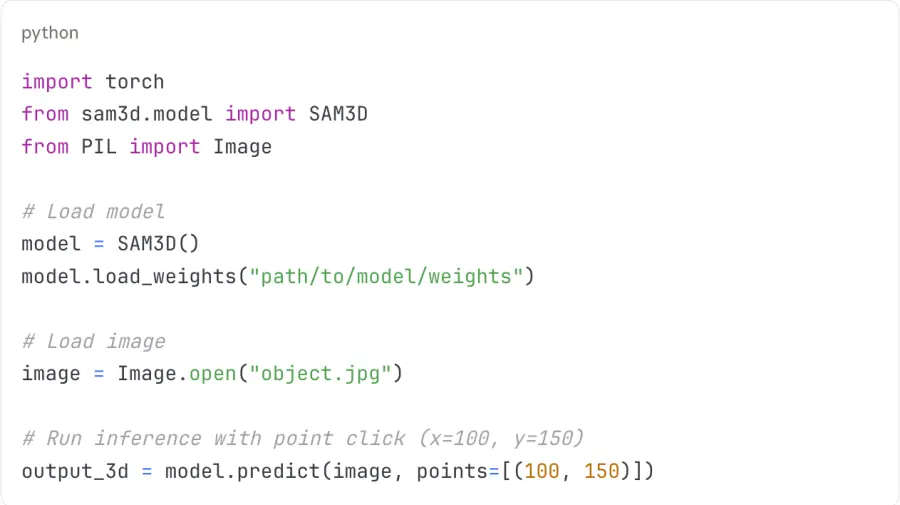
The model returns a dictionary containing the 3D mesh, texture maps, and camera parameters. Processing time typically ranges from 2-10 seconds depending on image resolution and hardware.
Step 3: Exporting and Visualizing Results
SAM3D exports results in standard formats compatible with 3D software. Save the mesh to OBJ or GLB format, then import into Blender, Unity, or Unreal Engine for further refinement or integration.
python
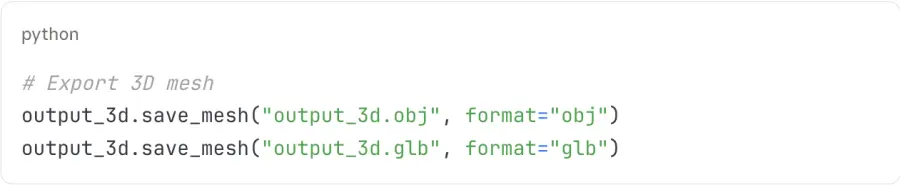
For quick visualization without external software, use open-source libraries like Trimesh or Open3D to preview results before exporting. These libraries also enable batch processing multiple images efficiently.
Python integration with SAM3D is straightforward and well-documented, making 3D asset generation accessible to developers with intermediate Python skills.
GPT Proto Unified AI Platform Support for SAM3D Soon
GPT Proto currently provides unified API access to leading AI models from OpenAI, Google, and Anthropic, with plans to integrate SAM3D in the coming months. As developers increasingly need to combine 3D reconstruction with generative AI, video creation, and language models, unified platforms eliminate vendor fragmentation and reduce infrastructure complexity. When GPT Proto adds SAM3D support, developers will access cutting-edge 3D capabilities alongside image, video, and text AI through a single API key, streamlining development workflows and reducing costs. For teams building AI-powered applications today, monitoring GPT Proto's SAM3D integration roadmap signals the industry's shift toward consolidated AI infrastructure that eliminates context-switching between multiple vendor platforms.
FAQs about SAM3D
Q: Can I use SAM3D commercially?
A: Yes. The SAM License permits commercial usage, so you can build products and services using SAM3D. Whether you're creating software for businesses or offering 3D reconstruction as a service, the open-source license allows commercial applications without licensing fees.
Q: What technical skills do I need to use SAM3D?
A: For the online demo, no technical skills are required. You simply upload an image and click on the object you want to convert to 3D. For integration into your own applications, Python programming knowledge and familiarity with machine learning frameworks is helpful, though Meta provides well-documented code examples.
Q: What file formats does SAM3D export?
A: The model exports standard 3D formats including OBJ, GLB, and PLY (Polygon file format). These formats are compatible with virtually all 3D software including Blender, Unity, Unreal Engine, and professional visualization tools. The MHR format is used specifically for human body models and offers superior animation capabilities.
Q: How does SAM3D handle complex scenes with multiple objects?
A: You select which object you want to reconstruct through the interface. SAM3D then isolates that object and converts it to 3D while maintaining awareness of spatial context. Multiple objects in a scene can be reconstructed individually and combined into a single 3D environment.
Conclusion
SAM3D represents a watershed moment in how we interact with three-dimensional content. The ability to instantly convert photographs into detailed, texturally accurate 3D models was the domain of specialized professionals just months ago. Today, it's freely available to anyone with an internet connection.
The implications ripple across industries. E-commerce will deliver more immersive shopping experiences that reduce returns and increase satisfaction. Content creators will produce higher quality work faster with lower barriers to entry. Augmented reality applications will become more realistic and responsive. Game developers will access professional-grade assets instantly.
What makes this moment significant is Meta's commitment to open-source development rather than gatekeeping technology behind paywalls. As AI infrastructure platforms like GPT Proto evolve and expand their integrations, using breakthrough models like SAM3D will become even more frictionless. The next chapter of this technology will be written by the global developer community experimenting with open-source SAM3D.