What Is GLM-5.3 Flash?
Z.ai describes GLM-5.3 Flash as a model built for coding, multimodal agents, and professional tasks involving interfaces, documents, charts, and other visual information. Unlike GLM-5.3, which is a text model improved mainly through additional post-training, Flash uses a new base model trained on a 30-trillion-token multimodal corpus.
Here are the main specifications at launch:
| Specification |
GLM-5.3 Flash |
| Developer |
Z.ai / Zhipu AI |
| Release date |
August 26, 2026 |
| Architecture |
Mixture of Experts with hybrid linear and sparse attention |
| Total parameters |
320B |
| Active parameters |
18B per token |
| Transformer layers |
45 |
| Context window |
1,048,576 tokens |
| Maximum output |
131,072 tokens |
| Input |
Text, images, video, and files |
| Output |
Text |
| Reasoning |
Always enabled; low, high, and max effort |
| Official model ID |
glm-5.3-flash |
| Weight license |
MIT |
The official model weights are available under the MIT license. That makes the model open-weight and commercially usable under the license terms. It does not make hosted inference free: compute, storage, and API tokens still cost money.
Is GLM-5.3 Flash Z.ai’s flagship model?
No. Z.ai positions GLM-5.3 as its flagship text model, while GLM-5.3 Flash occupies a different place: lower-cost inference plus native multimodal input.
That distinction matters because the two models do not share the same base. GLM-5.3 is a post-training upgrade built on the GLM-5.2 base. GLM-5.3 Flash was trained as a new multimodal base model. Calling Flash a cheaper GLM-5.3 setting misses the most important architectural difference.
What Is the Relationship Between GLM-5.3 Flash and OxAlpha?
OxAlpha was the anonymous preview identity of GLM-5.3 Flash.
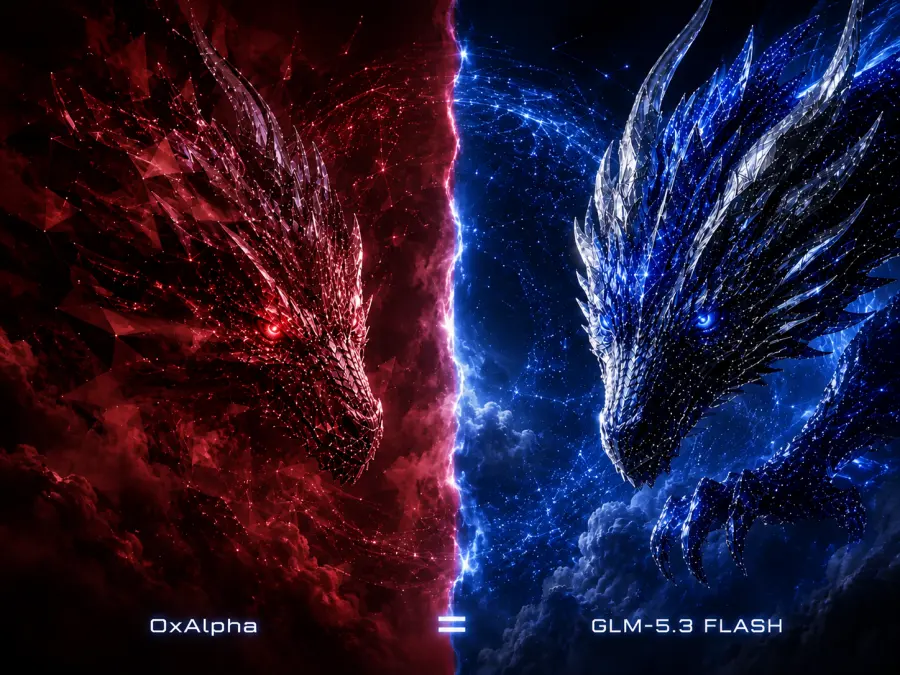
Before the formal release, Z.ai served the model under the name ox-alpha through OpenCode and a public preview route. The company says it used the anonymous launch to collect feedback without putting the GLM brand in front of users. According to Z.ai, OxAlpha became the most-used model on those services during its preview week, with the traffic served on Chinese AI chips.
This was not Z.ai’s first anonymous model test. The approach separates some user behavior from brand expectations, although free access, placement inside coding tools, and curiosity still affect usage.
The mystery still produced useful evidence. Stripe CEO Patrick Collison tried the model and wrote that “It’s very impressive”. A small community coding test reported eight successful repository tasks out of ten. That headline traveled quickly, but the sample was tiny and the comparison used one OxAlpha attempt against four attempts for the reference models.
A later public DeepSWE community run offers better context: OxAlpha solved 66 of 113 tasks, or 58.4%, using a documented mini software-engineering agent setup. It also lost some tasks to tool-call formatting rather than the underlying code solution. This is still one community run, not a universal model ranking. But 113 tasks tell us more than ten.
Reddit reaction followed the same pattern. Reveal threads in r/LocalLLaMA and r/singularity drew hundreds of votes. Developers liked the MIT license and token price; local-model users pointed out that a 320B checkpoint is not desktop-sized. Others reported inconsistent planning or slow preview responses. These are anecdotes, but they identify the right tests: instruction retention, agent reliability, latency, and total token use.
The practical takeaway is simple: OxAlpha and GLM-5.3 Flash are the same model line, but OxAlpha results describe an anonymous preview period. Use those reports as early field evidence, then validate the released model on your own repository and workflow.
What Changed in GLM-5.3 Flash?
The model’s efficiency comes from more than activating fewer experts.

First, GLM-5.3 Flash combines linear attention for local dependencies with sparse attention for retrieving information from distant parts of the context. Z.ai also introduced IndexPool, which pools four indexer key vectors into one. This reduces the memory and latency cost of finding relevant tokens in a one-million-token prompt.
Second, the model uses Manifold-Constrained Hyper-Connections, or mHC. In plain English, mHC changes how information is mixed across layers so Z.ai can scale the model while keeping training and inference stable.
Third, multimodality is part of pretraining rather than an image adapter added after a text model was finished. A coding agent can inspect a rendered page, notice a broken layout, edit the code, and check the next render. The same loop applies to browser use, desktop operation, charts, and documents.
Z.ai calculates that Flash uses about three times less attention compute than GLM-5.3 and a 4.4-times smaller average KV cache. Those are vendor calculations, not independent serving measurements. They do explain how a 320B-total model can be offered at a much lower token price.
One phrase captures the trade-off: cheaper to call, not necessarily faster to watch.
What Can GLM-5.3 Flash Do?
GLM-5.3 Flash is designed for tasks where language reasoning and visual feedback meet.

For coding agents, that includes repository analysis, debugging, terminal work, function calling, and long-running changes that require several tool steps. Native vision adds frontend replication from screenshots, rendered UI inspection, browser operation, game development, and visual checks for 3D scenes. A text-only model can write CSS; a multimodal model can also look at the result.
For office work, it can interpret PDFs, spreadsheets, presentations, dashboards, diagrams, and screenshots. It can locate a chart, compare it with surrounding text, return structured JSON, and pass the result to another tool. The one-million-token window provides room for large repositories or long reports, although using it raises input cost and latency.
The API feature set includes function calling, structured output, streaming, context caching, browser use, and computer use. Reasoning remains enabled, with low, high, and max effort levels. Lower effort is the better starting point for routine extraction; max effort is intended for difficult coding and agent tasks. More reasoning can improve a hard answer, but it also adds tokens and time.
Does GLM-5.3 Flash Support Video Input?
Yes. GLM-5.3 Flash supports native video input and returns text.
Video input matters when information is temporal rather than contained in one frame. The model can analyze a screen recording, identify the sequence that caused a UI error, summarize a demonstration, locate events in a meeting, or turn a tutorial into ordered instructions. It can also combine video with code—for example, reviewing a broken interaction and suggesting frontend changes.
This is video understanding, not video generation. GLM-5.3 Flash can describe, reason about, and act on information from video, but it does not output a new video file.
GLM-5.3 Flash Pricing
Z.ai launched GLM-5.3 Flash with a temporary 50% promotion. The promotion ends at 24:00 on September 9, 2026, UTC+8. GPT Proto’s rollout price is calculated from Z.ai’s standard list rate, not the temporary promotion.
| Per 1M tokens |
Z.ai standard |
Z.ai launch promotion |
GPT Proto rollout price |
| New input |
$0.15 |
$0.075 |
$0.015 |
| Cached input |
$0.03 |
$0.015 |
$0.003 |
| Output |
$0.50 |
$0.25 |
$0.05 |
Budget against the standard rate, not the launch rate. Promotions expire; production workloads usually do not.
The standard price is much lower than GLM-5.3’s $1.40 input and $4.40 output rate. But token price is only part of the bill. Artificial Analysis found the model unusually verbose in its Intelligence Index evaluation. A model that emits more reasoning and answer tokens can erase part of its apparent per-token advantage. Context caching helps when a coding agent repeatedly sends the same repository context, but new prompts and generated output still count.
At $0.015 per million new input tokens and $0.05 per million output tokens, GPT Proto’s rollout price is 10% of Z.ai’s standard rate—a 90% reduction. You can check the latest availability and billing details on the GLM-5.3 Flash API model page.
How Good Is GLM-5.3 Flash?
There are two answers: Z.ai’s launch benchmarks and the first independent measurements. They should not be blended into one claim.
Z.ai’s published benchmark results
Z.ai reports the following results. The comparison is useful for identifying intended strengths, but it remains a vendor-run evaluation.
| Benchmark |
GLM-5.3 Flash |
GLM-5.2 |
DeepSeek V4 Vision Exp |
Claude Opus 4.8 |
| Terminal-Bench 2.1 |
84.3 |
81.0 |
83.9 |
85.0 |
| DeepSWE v1.1 |
63.4 |
46.2 |
59.3 |
58.0 |
| Toolathlon Verified |
78.4 |
59.9 |
75.9 |
76.2 |
| AutomationBench |
48.8 |
26.2 |
38.8 |
41.0 |
| Chartography with tools |
78.0 |
— |
64.3 |
75.0 |
These results support a narrower conclusion than “Flash beats Opus.” Z.ai’s model looks competitive in coding, tool use, and visual agent tasks, but Opus 4.8 still leads some rows, including Terminal-Bench and NL2Repo. More importantly, this table compares Opus 4.8—not Claude Opus 5.
What independent testing shows
As of August 27, Artificial Analysis gives GLM-5.3 Flash an Intelligence Index score of 57. It measured output at roughly 50 tokens per second and estimated a cost of about $0.09 per Intelligence Index task at list pricing. The evaluation also labeled the model slower than average and very verbose within its comparison class.
That is a good result for the price. It is not evidence that Flash is the fastest model or the strongest model overall.
GLM-5.3 Flash vs GLM-5.3, DeepSeek V4 Pro, and Claude Opus 5
The table below uses the same independent evaluator and max-effort reasoning variants where available. These are changing service snapshots, so treat the speed numbers as measurements, not permanent specifications.
| Model |
Intelligence Index |
Output speed |
Cost per task |
List input / output |
| GLM-5.3 Flash |
57 |
~50 tok/s |
$0.09 |
$0.15 / $0.50 |
| GLM-5.3 |
60 |
~87 tok/s |
$0.68 |
$1.40 / $4.40 |
| DeepSeek V4 Pro 0813 |
53 |
~67 tok/s |
$0.27 |
$1.32 / $3.96 |
| Claude Opus 5 |
63 |
~55 tok/s |
$2.34 |
$5.00 / $25.00 |
Choose GLM-5.3 Flash when you need image or video input, open weights, or the lowest token cost. Choose GLM-5.3 when the work is text-only and the extra three Intelligence Index points, higher coding scores, and faster output justify the price.
This is not a normal upgrade path in which the newer suffix replaces the older model. The two branches optimize for different constraints. See GLM-5.3 on GPT Proto if your current workload is text-only coding or long-horizon agent work.
GLM-5.3 Flash vs DeepSeek V4 Pro
GLM-5.3 Flash scored four points higher in the independent snapshot and costs less at list price. It also accepts visual inputs, while the tested DeepSeek V4 Pro route is text-only. DeepSeek V4 Pro generated output faster and may remain the better fit for established text and coding pipelines where multimodality adds no value.
Do not choose from a composite score alone. Run the same repository task with fixed acceptance tests and a record of retries and tokens. You can review DeepSeek V4 Pro on GPT Proto before testing both workflows.
GLM-5.3 Flash vs DeepSeek V4 Flash Vision Exp
These are closer competitors in product shape: both target lower-cost coding and visual tasks. In Z.ai’s own evaluation, GLM-5.3 Flash scored 63.4 versus 59.3 on DeepSWE and 78.0 versus 64.3 on Chartography with tools. Treat those figures as Z.ai’s claims until the models receive a controlled independent visual-agent comparison.
GLM-5.3 Flash has MIT-licensed weights, native video and file input, and a one-million-token context window. DeepSeek V4 Flash Vision Exp remains an experimental vision branch and may make more sense for teams already using its surrounding model family. See DeepSeek V4 Flash Vision Exp on GPT Proto.
GLM-5.3 Flash vs Claude Opus 5
Claude Opus 5 remains stronger in the independent composite: 63 versus 57. Its upstream list price is also much higher at $5 per million input tokens and $25 per million output tokens. GLM-5.3 Flash is the cost choice; Opus 5 is the quality-first choice when a failed task costs more than the token bill.
The key correction is methodological. Z.ai’s release chart compares Flash with Opus 4.8, so it cannot support the claim that GLM-5.3 Flash beats Opus 5. For the current Opus option, see Claude Opus 5 on GPT Proto.
Can You Run GLM-5.3 Flash Locally?
Yes, but “18B active” does not mean the model fits like an 18B dense model.
Think of 320B parameters as a warehouse and 18B active parameters as the shelves consulted for one order. The router reduces computation per token, but the warehouse still needs somewhere to live.
The FP8 checkpoint is approximately 328GB in decimal storage, or about 306GiB. The model-specific KTransformers deployment guide recommends at least 350GB of available system memory before accounting for everything else running on the machine. Z.ai also lists SGLang, vLLM, and TokenSpeed as supported inference options.
So the honest description is not “a small local model.” It is a compute-efficient large model that can be self-hosted by teams with serious memory capacity. For most individual developers and small teams, hosted API access will be simpler than storing and serving the full checkpoint.
Cheap to call. Expensive to own.
How to Access GLM-5.3 Flash
At launch, developers can use Z.ai’s hosted model with the ID glm-5.3-flash, access it through eligible coding plans, or download the MIT-licensed weights for local serving.
The GLM-5.3 Flash API on GPT Proto is now rolling out with the model’s native text, image, video, and file inputs. It uses GPT Proto’s shared balance and is priced at 10% of Z.ai’s standard list rate.
For alternatives, use GLM-5.3 for text-focused coding, DeepSeek V4 Pro for text and agent workflows, or Claude Opus 5 when capability matters more than token price.
Is GLM-5.3 Flash Worth Using?
Yes—if your workload actually benefits from the combination of multimodal input, long context, and low token prices.
GLM-5.3 Flash is a strong candidate for visual coding agents, large documents, video understanding, and batch agent tasks where GLM-5.3 or Opus 5 would cost too much. The MIT weights also provide a self-hosting path.
It is a weaker fit when you need the fastest visible response, expect a small local checkpoint, or want the highest available reasoning score regardless of price. GLM-5.3 is faster in the current independent measurement. Opus 5 scores higher. Both cost more.
My read is that Z.ai chose the right compromise. GLM-5.3 Flash does not replace the flagship. It makes a different class of workload economical: multimodal agents that have to look, reason, call tools, and keep going without charging flagship rates for every token.