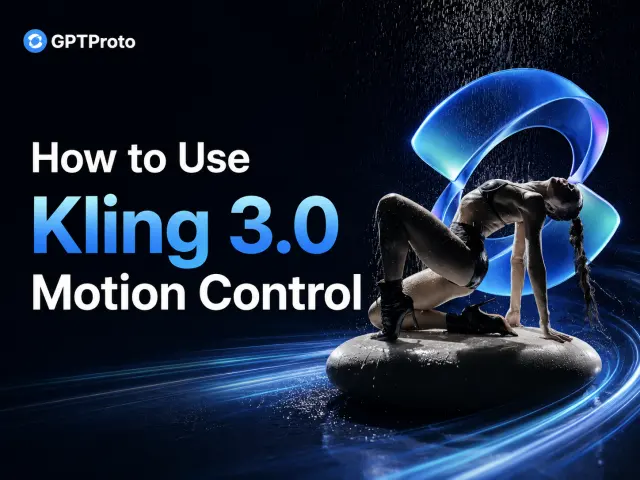
Kling 3.0 Motion Control анимирует статичное изображение персонажа движениями из эталонного видео. Вы передаёте два входных файла — изображение персонажа и видео с движениями человека — и получаете новый ролик, в котором персонаж точно повторяет эту хореографию, сохраняя собственное лицо, одежду и внешний вид.
Это перенос движений, а не преобразование текста в движения. Вместо того чтобы описывать действие в промпте и надеяться, что модель правильно его интерпретирует, вы показываете ей действие покадрово. Поэтому инструмент гораздо надёжнее подходит для повторяемой анимации персонажей, танцев и жестов.
В этом руководстве рассмотрены оба варианта: веб-приложение Kling для отдельных роликов и API GPTProto для интеграции Motion Control в ваш конвейер. Мы разберём входные данные и ограничения, уровни `pro` и `std`, технику написания промптов, полностью готовый код, цены и типичные ошибки, о которых стоит знать до того, как вы начнёте расходовать кредиты.
Как использовать Kling 3.0 Motion Control: руководство для разработчиков (веб + API)
Руководство для разработчиков по Kling 3.0 Motion Control — сравнение pro и std, ограничения входных данных, советы по промптам и готовый код API (Python + cURL) через GPTProto.
What Is Kling 3.0 Motion Control
Motion Control takes one character image and one driving (reference) video, then generates a video in which the character matches the reference's movements, facial expressions, and — optionally — camera orientation. The visual identity comes from your image; the motion comes from your video.
| Spec | Detail |
|---|---|
| Task type | Image-to-video only (a character image is required; no text-to-video Motion Control) |
| Inputs | 1 character image + 1 driving video (+ optional prompt / negative prompt) |
| Reference video length | 3–30 seconds; output length aligns to the reference |
| Min extractable motion | 3 seconds of continuous action |
| Image resolution | Short edge ≥ 340px, long edge ≤ 3850px |
| Multi-character video | The character occupying the largest frame area drives the motion |
| Tiers | std (720p) and pro (1080p) |
| Orientation modes | image (max 10s output) or video (max 30s output) |
What changed from 2.6 to 3.0
If you used Motion Control on Kling 2.6, the 3.0 upgrade is about consistency and physics rather than a new interface:
- Better identity preservation — less face drift across the clip.
- Grounded physics — feet stay anchored instead of "sliding on ice."
- Element consistency — multi-angle face and outfit detail hold up better through turns.
- Longer outputs — up to 30 seconds when orientation follows the video.
- Faster inference — materially quicker turnaround per generation.
One behavior to keep in mind: 3.0 Motion Control transfers movement only. It does not blend scene elements from the driving video into your character — the output sticks to the character image you supplied.
Kling 3.0 pro Motion Control vs Kling 3.0 std Motion Control
The two tiers run the same model with different output quality. Use std while you iterate on the reference video and prompt, then switch to pro for the final render.
| Kling 3.0 std Motion Control | Kling 3.0 pro Motion Control | |
|---|---|---|
| Output resolution | 720p | 1080p |
| Best for | Iteration, drafts, high-volume runs | Final delivery, client work |
| Speed | Faster | Slightly slower |
| Price (Per Time) | $0.3024 (20% off, market $0.378) | $0.4032 (20% off, market $0.504) |
| API model slug | kling-v3.0-std |
kling-v3.0-pro |
"Per Time" means the final cost scales with the generation you run; the model page's playground shows the live total before you submit.
Input Requirements (Read This First — It Saves Credits)
Most failed generations come from bad inputs, not the model. The single biggest predictor of a clean result is the quality of frame 1 and the driving video.
Character image
- One person, clean half-body or full-body framing.
- Face clearly visible and reasonably large in the frame — small faces force the model to invent detail, and likeness drifts.
- Match the framing roughly to your reference video (don't pair a head-and-shoulders portrait with a full-body dance video).
Driving (reference) video - 3–30 seconds, single continuous shot, no cuts or hard camera moves — cuts can truncate the output.
- One subject, full body and head visible and unobstructed.
- Steady, moderate motion. Very fast or complex action may make the output shorter than the input, because only valid continuous segments are extracted.
- Keep hands visible if you need good hands in the result.
If less than 3 seconds of usable continuous motion can be extracted, the generation can fail and — per Kling's terms — those credits are not refunded. Validate your reference clip before submitting at scale.
How to Use Kling 3.0 Motion Control in the Web App
For one-off clips, the Kling web UI is the fastest route:
- Open Kling, select the 3.0 model, then click Motion Control.
- Upload your driving video into the "character actions to mimic" box.
- Upload your character image into the box on the right.
- (Optional) Add a prompt describing the scene — lighting, environment, camera. Do not describe the action; that comes from the video.
- Set character orientation: follow the video (up to 30s) or the image (up to 10s).
- Choose std (720p) or pro (1080p) and click Generate.
That's enough for manual work. The rest of this guide is for automating it.
How to Use the Kling 3.0 Motion Control API
This is the part most teams come for: a guide to the Kling 3.0 Motion Control API you can run end to end. GPT Proto exposes Kling through a unified, OpenAI-compatible account with a single key, and the video tasks follow a create-then-poll pattern.
Step 1 — Get an API key
Sign up at gptproto.com/dashboard and generate a key. One key works across every model on the platform. Export it so the examples pick it up:
export GPTPROTO_API_KEY="your_key_here"
Step 2 — Create a Motion Control task
You submit the character image, the driving video, the tier, and an optional prompt. The API returns a task id you'll poll for the result.
Note: GPT Proto authenticates Kling with a
Bearertoken in theAuthorizationheader. The Motion Control task takesimage(character),video(driving clip),prompt,negative_prompt,character_orientation, andkeep_original_sound.
cURL
curl -X POST "https://gptproto.com/api/v3/kling/kling-v3.0-pro/motion-control" \
  -H "Authorization: Bearer $GPTPROTO_API_KEY" \
  -H "Content-Type: application/json" \
  -d '{
    "image": "https://example.com/character.jpg",
    "video": "https://example.com/driving-motion.mp4",
    "prompt": "studio lighting, plain grey background, static camera",
    "negative_prompt": "warped background, extra fingers, motion blur",
    "character_orientation": "video",
    "keep_original_sound": false
  }'
Swap kling-v3.0-pro for kling-v3.0-std to run the 720p tier.
Step 3 — Poll for the result
Video generation is asynchronous. Take the id from the create response and poll the predictions endpoint until status is finished, then read the output URL.
Python (end to end)
import os
import time
import requests

BASE = "https://gptproto.com/api/v3"
API_KEY = os.environ["GPTPROTO_API_KEY"]
HEADERS = {"Authorization": f"Bearer {API_KEY}", "Content-Type": "application/json"}

def create_motion_control(image_url, video_url, prompt="", negative_prompt="",
                          tier="pro", orientation="video"):
    url = f"{BASE}/kling/kling-v3.0-{tier}/motion-control"
    payload = {
        "image": image_url,                       # character identity
        "video": video_url,                       # driving motion (3-30s, single shot)
        "prompt": prompt,                         # describe the SCENE, not the action
        "negative_prompt": negative_prompt,       # artifacts to suppress
        "character_orientation": orientation,     # "video" (<=30s) or "image" (<=10s)
        "keep_original_sound": False,
    }
    r = requests.post(url, json=payload, headers=HEADERS, timeout=60)
    r.raise_for_status()
    return r.json()["data"]["id"]

def wait_for_result(task_id, interval=5, timeout=600):
    deadline = time.time() + timeout
    while time.time() < deadline:
        r = requests.get(f"{BASE}/predictions/{task_id}/result", headers=HEADERS, timeout=60)
        r.raise_for_status()
        data = r.json()["data"]
        status = data.get("status")
        if status in ("succeeded", "completed"):
            return data["outputs"]          # list of output video URLs
        if status in ("failed", "error"):
            raise RuntimeError(data.get("error") or "generation failed")
        time.sleep(interval)
    raise TimeoutError(f"task {task_id} did not finish within {timeout}s")

if __name__ == "__main__":
    task_id = create_motion_control(
        image_url="https://example.com/character.jpg",
        video_url="https://example.com/driving-motion.mp4",
        prompt="studio lighting, plain grey background, static camera",
        tier="pro",
        orientation="video",
    )
    print("task:", task_id)
    outputs = wait_for_result(task_id)
    print("video:", outputs)
Confirm the exact
statusstrings against the live response — the image-to-video docs exposedata.status,data.outputs, anddata.error, which is what the poller reads here.
Writing a Good Kling 3.0 Motion Control Prompt
The prompt in Motion Control is not where the action lives — the driving video handles that. A Kling 3.0 Motion Control prompt should describe everything except movement: the setting, lighting, wardrobe details, mood, and camera behavior.
Do describe:
- Environment and background ("neon-lit alley at night", "plain white studio cyclorama")
- Lighting ("soft key light from the left", "hard rim light")
- Camera intent ("static camera", "locked-off tripod shot")
- Style notes ("cinematic, shallow depth of field")
Don't describe: - The action itself ("waving", "dancing", "turning around") — that comes from the reference video and a conflicting prompt can fight it.
A reliable starting template:
[scene/background], [lighting], [camera behavior], [style]
Example: plain grey studio background, soft even lighting, static camera, cinematic
Use the negative prompt to suppress recurring artifacts: warped background, extra fingers, motion blur, duplicate limbs.
Orientation and Duration
character_orientation does double duty — it controls how the character is posed and caps the output length:
| Setting | Behavior | Max output |
|---|---|---|
video |
Character follows the reference video's orientation and camera | 30s |
image |
Character keeps the image's orientation | 10s |
Rule of thumb: if identity drifts, try image; if motion feels stiff or under-transferred, try video. The output length tracks the reference video, so a 12-second result needs a ~12-second driving clip and the video orientation.
Common Problems and Fixes
| Symptom | Likely cause | Fix |
|---|---|---|
| Warped / wobbling background | Camera moving too aggressively | Add static background / static camera to the prompt; add warped background to negative prompt |
| Face likeness drifts | Face too small in the source image | Use an image where the face fills more of the frame; try character_orientation: image |
| Output shorter than the reference | Fast/complex motion; only continuous segments extracted | Slow the action; use a single clean continuous take |
| Bad / mangled hands | Hands hidden in the reference video | Use a reference where hands stay visible |
| Generation truncated | Cuts or camera moves in the reference | Use one continuous shot, no edits |
Pricing
GPT Proto bills per task, pay-as-you-go — no subscription floor. Pricing is "Per Time," so the final cost scales with the generation you run; the model page's playground shows the live total before you submit.
| Model | Tier | Motion Control Per Time rate |
|---|---|---|
kling-v3.0-pro |
pro (1080p) | $0.4032 (20% off, market $0.504) |
kling-v3.0-std |
std (720p) | $0.3024 (20% off, market $0.378) |
Live rates are on each model page.
Next Steps
- Try the model: Kling 3.0 Pro on GPT Proto
- Standard tier: Kling 3.0 Std on GPT Proto
- Compare costs across video models: Browse GPT Proto models
- Get a key and ship: GPT Proto Dashboard
Универсальная творческая студия
Создавайте здесь изображения и видео. API GPTProto обеспечивает быстрые обновления моделей и самые низкие цены.
Начать создание


Часто задаваемые вопросы
Можно ли использовать Motion Control без изображения персонажа?
Какой может быть максимальная длительность результата?
В чём разница между std и pro?
Что произойдёт, если в эталонном видео два человека?
Сохраняется ли звук из эталонного видео?
Похожие статьи
Ещё блоги
Как создать постер фильма с помощью ИИ, на котором отображается название (2026)
Сложность постера фильма, созданного с помощью ИИ, заключается не в изображении. Любая модель генерации изображений примерно за двадцать секунд выдаст вам атмосферный кадр с главным героем. Сложность — во всём, что превращает изображение в постер: название, не превратившееся в бессмыслицу, читаемый слоган, блок с титрами внизу и вертикальный формат настоящего постера вместо квадрата. Я провёл выходные, создавая постеры в пяти жанрах, и почти каждая ошибка сводилась к одной из трёх причин — неправильным пропорциям, отсутствию места для текста или просьбе к модели нарисовать абзац текста одновременно с самой иллюстрацией. Это руководство решает все три проблемы. Вы получите готовые к копированию промпты для разных жанров, набор промптов для превращения собственной фотографии в постер, двухэтапный приём для получения чёткого названия и — если вы хотите создать пятьдесят таких постеров, а не пять, — готовые к запуску вызовы API. В работе участвуют две модели: gpt-image-2 для точного многоязычного текста и Gemini 3 Pro Image (многие называют её Nano Banana Pro) для стилистики и вывода в 4K. Обе работают через GPTProto, поэтому переключение между ними занимает одну строку.
Schuyler Stacy | 2026-06-16
Вышел ли уже Seedance 2.5? Дата выхода и то, что нам действительно известно (2026)
На этой неделе я обновлял страницу Seed от ByteDance чаще, чем хотел бы признать, ожидая появления Seedance 2.5. Пока безрезультатно. Ни страницы модели, ни спецификаций, ни даты. Именно поэтому я и пишу этот пост: сейчас вокруг Seedance 2.5 появляется множество уверенных публикаций, и в большинстве из них догадки выдаются за факты. Я хочу чётко разделить одно от другого, а затем рассказать, что вы действительно можете запустить уже сегодня.
Tiffany Layne | 2026-06-23
Как создать инфлюенсера, созданного с помощью ИИ, через API (и сколько это на самом деле стоит)
У большинства людей первый ИИ-инфлюенсер перестаёт быть похожим на себя уже на втором изображении. Первый рендер выглядит отлично — убедительное лицо, нормальное освещение. Затем они создают пост номер два, и скулы уже сместились, нос стал шире, а глаза другого цвета. Это другой человек. Пост номер три — уже третий человек. В итоге у них не инфлюенсер, а папка с незнакомцами, которых объединяет только цвет волос. Инструменты без кода, которые появляются в результатах поиска по этому запросу, скрывают проблему за одной кнопкой. Загрузите фотографию, нажмите «Создать», получите результат. Это нормально, пока вам не понадобится масштабировать процесс, менять образ или запускать сотню постов по расписанию — тогда вы окажетесь привязаны к одной модели, одному стилю и подписке, которая обычно стоит от $19 до $99 в месяц независимо от того, создаёте вы 5 изображений или 500. Это руководство предлагает другой путь: API. Настройка займёт больше времени, чем нажатие кнопки в SaaS-сервисе — вам придётся написать несколько строк кода и управлять API-ключом. Зато вы сможете контролировать, какая модель создаёт каждый кадр, платить за изображение, а не за месяц, и автоматизировать весь конвейер. К концу у вас будет одна зафиксированная личность, серия согласованных постов, необязательный вертикальный ролик и — то, что пропускают все остальные руководства, — реальная стоимость одного поста. Чтобы понять, зачем это вообще нужно: Aitana López, ИИ-модель, созданная барселонским агентством The Clueless, зарабатывает до €10,000 в месяц и около €3,000 в среднем, по словам её создателей , как сообщает Euronews . Запомните эту цифру. Мы вернёмся к ней, когда узнаем фактическую стоимость производства, потому что разница между этими двумя показателями — это и есть весь бизнес.
Schuyler Stacy | 2026-06-17