TL;DR:
GPT-5.4 is OpenAI's newest model that merges reasoning, coding, and desktop control into one. It outperforms GPT-5.2 across most benchmarks, supports a 1M token context window, and is now available through platforms like GPT Proto at reduced API rates.
OpenAI Just Released GPT-5.4
OpenAI has launched GPT-5.4, their most capable model to date, along with a Pro variant built for the most demanding tasks. Available now in ChatGPT for Plus, Team, and Pro users, and on the API, this release marks a meaningful step forward for AI in everyday professional work. GPT-5.4 is the first OpenAI general-purpose model to include native Computer Use, meaning it can interact with your desktop like a real user, not just generate text.
Here is what this guide covers:
-
What GPT-5.4 actually is and how it differs from GPT-5.2
-
Key performance improvements across writing, coding, and reasoning
-
The new Computer Use and visual understanding features
-
How GPT-5.4 handles long documents and large codebases
-
Pricing for GPT-5.4 and GPT-5.4 Pro in ChatGPT and the API
-
How to access GPT-5.4 affordably through GPT Proto
What Is GPT-5.4 and What Makes It Different
GPT-5.4 is not just a small update to the previous version. It brings together three things that used to live in separate models: general reasoning, coding ability, and Computer Use. Before this release, developers who needed all three had to route requests between different specialized models. Now there is one unified option.
The model supports a context window of 1 million tokens and can output up to 128,000 tokens in a single response. Its knowledge cutoff is August 31, 2025.
Three Capabilities Now in One GPT-5.4 Model
Previously these were separate tools or model variants. GPT-5.4 rolls them into a single API endpoint:
-
General reasoning and writing — including document drafting, analysis, and Q&A
-
Code generation and debugging — with inheritance from GPT-5.3-Codex
-
Computer Use — direct control of desktop environments through screenshots and mouse/keyboard input
This consolidation makes building AI-powered applications significantly easier, especially for developers who need flexible, multi-purpose model access through a single integration point like GPT Proto.
GPT-5.4 Academic and Reasoning Benchmarks
| Benchmark | GPT-5.2 | GPT-5.4 | GPT-5.4 Pro |
| ARC-AGI-2 | 52.90% | 73.30% | 83.30% |
| GPQA Diamond | — | 92.80% | — |
| FrontierMath Tier 4 | 18.80% | 27.10% | 38.00% |
| Humanity's Last Exam (no tools) | — | 39.80% | — |
| BrowseComp | 65.80% | 82.70% | 89.30% |
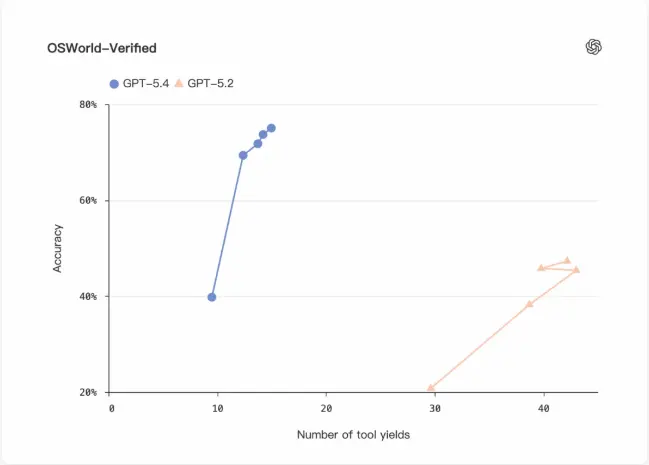
| OSWorld-Verified | 47.30% | 75.00% | — |
ARC-AGI-2 showed the largest jump of any benchmark, from 52.9% to 73.3% for the standard model and 83.3% for Pro. This test measures abstract pattern recognition, something that has historically been difficult for language models.
One notable regression: GPT-5.4 scored slightly lower than GPT-5.2 on HealthBench (62.6% vs 63.3%). OpenAI disclosed this in their system card rather than minimizing it, which is worth noting.
GPT-5.4 Access Through ChatGPT
GPT-5.4 Thinking is rolling out now to Plus, Team, and Pro subscribers and will replace GPT-5.2 Thinking as the default model. GPT-5.2 Thinking will remain available in the Legacy section until June 5, 2026. Free users may encounter GPT-5.4 through automatic routing but cannot select it manually.
GPT-5.4 Pricing: Standard vs. Pro
Here is how the API pricing compares between versions:
| Model | Input (per 1M tokens) | Output (per 1M tokens) |
| gpt-5.2 | $1.75 | $14.00 |
| gpt-5.4 | $2.50 | $15.00 |
| gpt-5.2 Pro | $21.00 | $168.00 |
| gpt-5.4 Pro | $30.00 | $180.00 |
A few things to know about these numbers:
-
Batch and Flex processing are available at half price
-
Priority processing is 2x the standard rate
-
Requests over 272K tokens in a single session are billed at 2x input and 1.5x output for that entire session
-
Regional data residency processing adds 10%
GPT-5.4 Pro is 12 times more expensive than the standard version. That said, the benchmarks show the two have different strengths. The standard version actually scored slightly higher on GDPval (83.0% vs 82.0%), while the Pro version outperforms on deep web research and complex agent tasks.
Coding with GPT-5.4
GPT-5.4 carries over the programming strength of GPT-5.3-Codex while improving its ability to stay on task during long, multi-step coding sessions.
On SWE-Bench Pro, a benchmark based on real GitHub issues, GPT-5.4 scored 57.7% versus GPT-5.2's 55.6%. On Terminal-Bench 2.0, which tests command-line operations, GPT-5.4 scored 75.1% (GPT-5.3-Codex scored slightly higher at 77.3% on this specific test, a small regression worth noting).
New in Codex: a /fast mode that increases token generation speed by up to 1.5 times without changing the underlying model. There is also an experimental Playwright Interactive mode, which lets Codex launch a live browser window while writing web or desktop apps to do real-time visual testing during development.
If you want to use GPT-5.4 for coding projects through tools like Codex or Claude Code, GPT Proto supports direct API integration and offers meaningful discounts compared to OpenAI's list prices.
How GPT-5.4 Performs on Real Work Tasks
OpenAI tested GPT-5.4 on something they call GDPval, an internal benchmark designed to simulate real work across 44 job categories in the nine largest US economic sectors. Tasks include building spreadsheets, drafting presentations, scheduling, creating charts, and more.
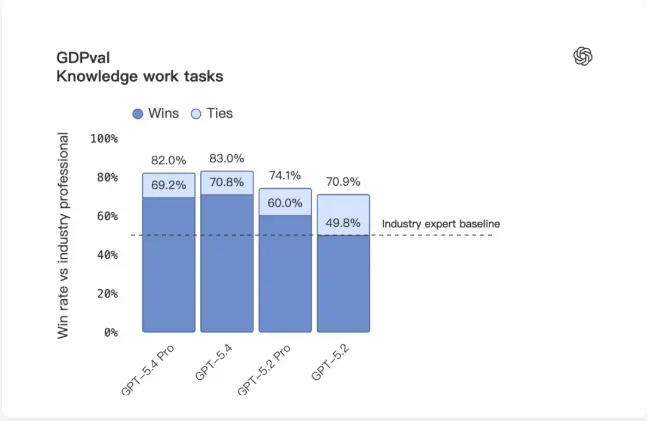
GPT-5.4 scored 83.0% on GDPval. GPT-5.2 scored 70.9%. That is a 12-point jump for tasks that closely mirror what professionals actually do at work.
Spreadsheets and Presentations
OpenAI ran additional tests specifically on office productivity tasks:
-
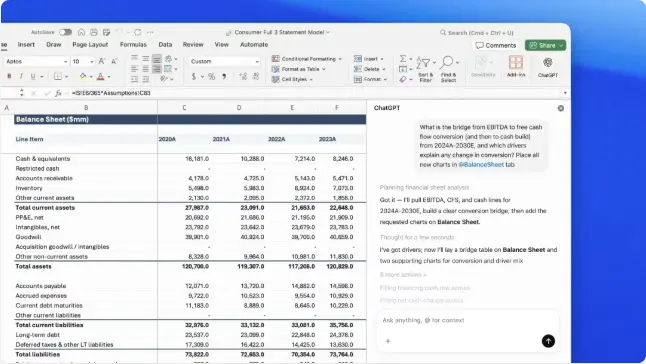
In a spreadsheet modeling test designed to mirror investment banking analysis work, GPT-5.4 scored 87.3% compared to GPT-5.2's 68.4%, a 19-point improvement.
-
In blind presentation comparisons, human reviewers preferred GPT-5.4's output 68% of the time, citing better image use and more varied visual layouts.
A ChatGPT for Excel plugin was launched alongside the model, along with updated skill packages for spreadsheet and presentation generation in Codex and the API.
Accuracy and Hallucinations
GPT-5.4 is currently OpenAI's most factually accurate model. Using a set of prompts that real users had previously flagged for containing errors, OpenAI found that GPT-5.4 produced incorrect individual claims 33% less often than GPT-5.2, and full responses with at least one error 18% less often.
Computer Use: GPT-5.4 Can Now Control Your Desktop
This is one of the biggest additions in this release. GPT-5.4 scored 75.0% on OSWorld-Verified, a benchmark that measures how well a model can control a real desktop environment through screenshots. The human baseline on the same test is 72.4%. GPT-5.4 has surpassed human-level performance on this task.
How the Computer Use Feature Works in GPT-5.4
Developers can use this capability in two ways:
-
Screenshot-driven control — the model receives a screenshot and outputs mouse coordinates and keyboard commands to interact with the interface
-
Browser automation via code — the model writes Playwright scripts to control a browser programmatically, useful for form filling, data entry, and web testing
This feature is available directly through the standard API using the built-in computer tool. No special model routing is required. You can also configure confirmation policies to require human approval before the model takes high-stakes actions.
For teams building agent workflows or automation tools, platforms like GPT Proto make it straightforward to access GPT-5.4's Computer Use capability through a unified API at competitive rates.
Better Tool Use and Agent Capabilities
GPT-5.4 introduces a smarter way of handling large tool libraries. Previously, every API call had to include the full definitions of every available tool, which was expensive when you had many tools configured. Now the model uses a retrieval approach: it sees a short list of available tools, then fetches the full definition of any tool it actually needs to use.
This change alone cut token usage by 47% in tool-heavy tasks on the MCP Atlas benchmark, without reducing accuracy. GPT-5.4 scored 67.2% on that benchmark, up from GPT-5.2's 60.6%.
On BrowseComp, a test of web research and multi-page information retrieval, GPT-5.4 scored 82.7% and the Pro variant scored 89.3%, both well above GPT-5.2's 65.8%.
You can try GPT-5.4's web search and research capabilities directly at GPT Proto's web search interface, which supports file-based queries as well at GPT Proto's file analysis page.
How to Access GPT-5.4 More Affordably with GPT Proto
If OpenAI's direct API pricing feels steep, especially for teams running high volumes or building production applications, GPT Proto AI API Platform offers a practical alternative. GPT Proto is a unified AI API platform that aggregates access to top models including GPT-5.4 at discounted rates, typically 30 to 40% below market prices for GPT models.
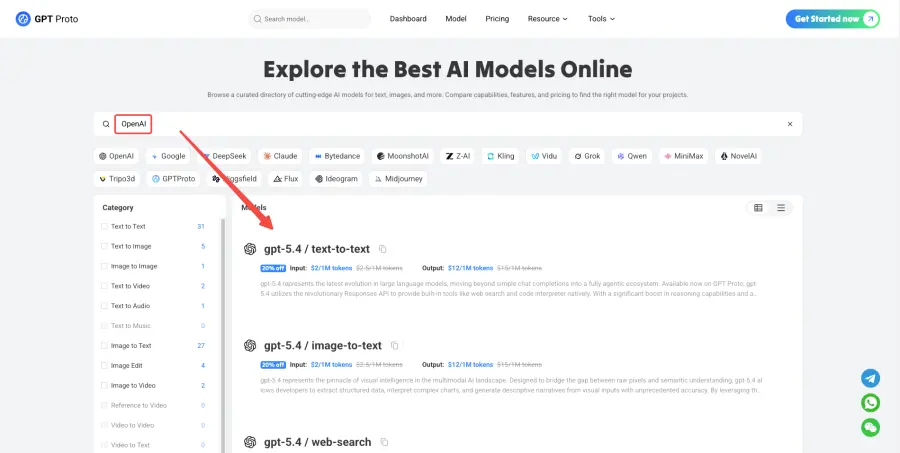
Rather than managing separate API keys for every provider, developers connect once to GPT Proto and get access to GPT-5.4 along with hundreds of other models through a single, standardized API endpoint. The platform uses intelligent routing and automatic failover, so if a provider has downtime, your requests are redirected without interruption.
GPT Proto also supports GPT-5.4's multimodal features. You can explore image-to-text processing at GPT Proto's image-to-text page, which is especially useful for document analysis, high-resolution screenshot processing, and Computer Use workflows where visual understanding matters.
For individuals and teams who are already juggling multiple AI tools or who found their current provider's pricing or reliability unpredictable, GPT Proto provides a stable, cost-effective way to build on GPT-5.4 without lock-in or long-term contracts.
FAQs About GPT-5.4
What is GPT-5.4 and how is it different from GPT-5.2?
GPT-5.4 is OpenAI's newest model, released as an upgrade to GPT-5.2. The main differences are that GPT-5.4 includes native Computer Use capability (the ability to control desktop software through screenshots), scores higher on most professional and reasoning benchmarks, and consolidates coding, reasoning, and visual control into a single model rather than requiring separate tools for each.
What does GPT-5.4's Computer Use feature actually do?
It lets the model look at a screenshot of your computer screen and then send mouse clicks and keyboard inputs to interact with software. This works for web browsers, desktop applications, and form-based workflows. Developers can use this through the standard API without needing a separate specialized model.
How much does GPT-5.4 cost through the API?
The standard GPT-5.4 model costs $2.50 per million input tokens and $15.00 per million output tokens. GPT-5.4 Pro is significantly more expensive at $30.00 per million input tokens and $180.00 per million output tokens. Platforms like GPT Proto offer GPT-5.4 access at reduced rates through their unified API.
Who can use GPT-5.4 in ChatGPT?
GPT-5.4 Thinking is available to ChatGPT Plus, Team, and Pro subscribers. Enterprise and Education users can be enabled by administrators. Free users may encounter the model through automatic routing but cannot choose it manually. GPT-5.4 Pro is limited to Pro and Enterprise accounts.
Conclusion
GPT-5.4 is a meaningful upgrade, particularly for anyone who needs a model that can reason, code, and interact with software in a single workflow. The Computer Use feature crossing the human baseline on OSWorld is a genuinely significant milestone. The improvements in spreadsheet work, code generation, and long-context handling are practical and well-documented.
The pricing is higher than GPT-5.2, but for most professional use cases the performance gains justify the cost. If you want to manage costs without sacrificing access to the model, GPT Proto is worth exploring as a more affordable entry point into the GPT-5.4 ecosystem.