Why Developers Are Switching to DeepSeek API?
The AI landscape experienced significant shifts throughout 2025 that reshaped how developers approach model selection. When major multimodal platforms undergo acquisition or restructuring, developers quickly experience the ripple effects. Uncertain pricing structures emerge, service priorities shift unexpectedly, and newly introduced constraints limit what was previously possible. The roadmap that supported your project's needs may no longer align with platform direction, forcing teams to find alternatives or face escalating costs.
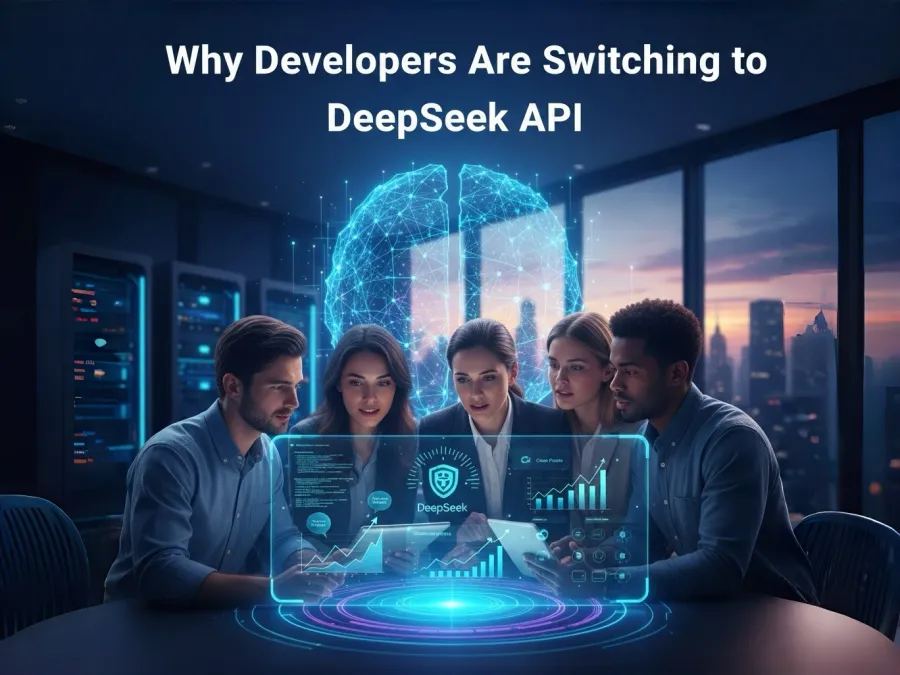
This uncertainty created urgent demand for stable, transparent alternatives. DeepSeek API emerged at precisely this moment, offering something developers desperately needed: predictable costs, clear pricing structures, and models that improve without sudden limitations. DeepSeek delivers Claude-level reasoning power and ChatGPT-scale context at substantially lower costs—without the unpredictability of acquisition-driven platforms.
Unlike premium providers where API access requires significant ongoing investment with shifting terms, DeepSeek offers a refreshingly different approach. The platform provides both free chat access and affordable API pricing, making it ideal for startups, researchers, and cost-conscious development teams who need stability in their tooling.
This guide covers everything you need to understand DeepSeek API, from obtaining your credentials to optimizing costs at scale. We'll also explore how platforms like GPT Proto provide unified access to multiple AI models including DeepSeek, offering developers flexibility beyond single-platform dependence.
What Is DeepSeek API?
DeepSeek API provides programmatic access to powerful language models without the infrastructure burden. Unlike downloading and running open-source models on your own hardware, the API handles all compute resources, scaling, and maintenance. You simply send requests and pay for what you use.
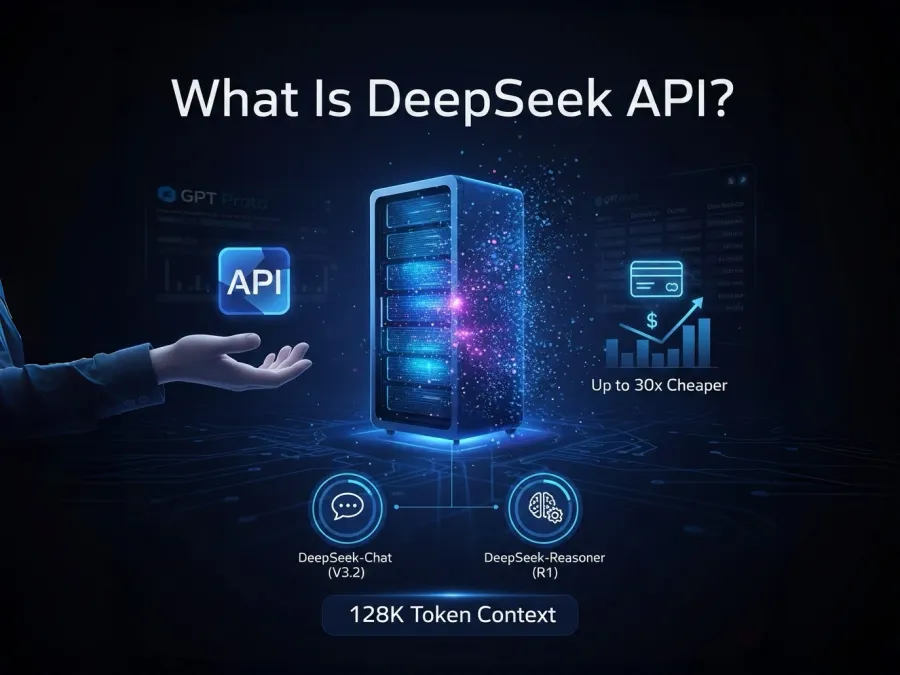
The real advantage lies in DeepSeek's approach to efficiency and affordability. DeepSeek remains up to 30 times cheaper compared to alternatives like GPT-5 and Claude, with competitive performance across reasoning, coding, and analysis tasks. For developers evaluating options, platforms like GPT Proto provide unified access to compare DeepSeek against other leading models before committing infrastructure to a single provider.
Key Models Available
DeepSeek offers two primary model families through its API, with full documentation available on specialized model pages:
Both models feature 128K token context windows, meaning they can process substantial amounts of text in a single request.
Getting Your DeepSeek API Key
Starting with DeepSeek API requires just four straightforward steps. The process takes roughly five minutes from account creation to your first working API request.
Step-by-Step Setup Process
Step 1: Create Your Account
Visit platform.deepseek.com to create your API key. You can register using email or GitHub authentication. Complete the signup form and confirm your email address—check your spam folder if needed.
Step 2: Generate Your API Key
Once your email is verified, log into your dashboard and navigate to the API Keys section. Click "Generate New Key" and give your key a descriptive name like "Production App" or "Testing". Choose clear labels that reflect the project's purpose.
Step 3: Secure Your Key
Copy your API key immediately after generation. Some platforms display keys only once. Store it securely using a password manager rather than hardcoding it into source files or sharing it publicly.
Step 4: Set Up Your Environment
Your key works with any OpenAI-compatible SDK. Simply update your base URL to "https://api.deepseek.com" and use your API key for authentication.
Making Your First API Call
Once you have your API key, testing is straightforward using OpenAI's Python library:
from openai import OpenAI
client = OpenAI(
api_key="your-api-key-here",
base_url="https://api.deepseek.com"
)
response = client.chat.completions.create(
model="deepseek-chat",
messages=[
{"role": "system", "content": "You are a helpful assistant"},
{"role": "user", "content": "Explain how transformers work"}
]
)
print(response.choices[0].message.content)
This simple example makes your first API call and prints the response. From here, you can integrate DeepSeek into production applications, chatbots, automation workflows, or analysis pipelines.
DeepSeek API Pricing Plan
DeepSeek's pricing model differs fundamentally from subscription services. You pay only for tokens consumed—the smallest unit of text that the model processes.
How Token-Based Pricing Works
A token represents roughly four characters of English text. A 1000-word article generates approximately 1400 tokens. When you send a request, you pay based on two components: input tokens (your prompt) and output tokens (the model's response).
The formula is simple: calculate input tokens plus output tokens, multiply by the relevant price per million tokens, then sum both costs.
Current Pricing Breakdown
DeepSeek pricing adjusted in September 2025 when the company sunset nighttime discounts and implemented unified rates. As of current rates, DeepSeek V3.2-Exp offers cache hit pricing of $0.028 per million input tokens versus $0.28 for cache misses, with output tokens at $0.42 per million.
| Model |
Cache Hit Input |
Cache Miss Input |
Output |
| DeepSeek-Chat (V3.2) |
$0.03 |
$0.28 |
$0.42 |
| DeepSeek-Reasoner (R1) |
$0.07 |
$0.55 |
$1.68 |
| R1 Distill (Budget) |
$0.01 |
$0.10 |
$0.27 |
The reasoning model (R1) costs more because it performs visible chain-of-thought reasoning and supports output up to 64K tokens, compared to chat's 8K limit.
What Affects Your Actual Costs
Several factors influence your final bill:
-
Cache effectiveness: Reusing identical prompt prefixes triggers cache hits, saving 90% on those tokens
-
Model selection: Chat handles most tasks efficiently; reserve Reasoner for complex reasoning only
-
Output length: Longer responses accumulate more output token charges
-
Volume scale: Higher usage doesn't increase per-token rates, but absolute costs scale linearly
Optimizing DeepSeek API Costs
Smart usage patterns dramatically reduce expenses without sacrificing quality or capability.
Practical Cost-Reduction Strategies
Leverage Context Caching
When multiple requests share the same prompt prefix, DeepSeek automatically caches and reuses that content. Group similar requests together to maximize cache hits. A cached query costs just $0.028 compared to $0.28 for uncached—a 90% savings.
Choose the Right Model
DeepSeek-Chat handles the vast majority of real-world tasks. Use Reasoner only when you specifically need visible reasoning steps for math, logic, or complex coding. Most projects save money defaulting to Chat.
Control Output Length
Set appropriate max_tokens limits. For most tasks, Chat's default 8K output limit is excessive. Many requests complete in under 1000 tokens. Shorter responses cost significantly less.
Batch Similar Requests
Process multiple inputs together when possible. This approach maximizes your cache hit rate since requests with identical system prompts benefit from caching.
Comparing DeepSeek API Alternatives
Several alternatives exist for developers evaluating language model APIs. Understanding the tradeoffs helps you choose the right fit.
OpenAI's ChatGPT API offers premium models but provides no free API access—GPT-4.5 costs $75 per million input tokens and $150 per million output, while ChatGPT Plus subscriptions start at $20 monthly but only unlock limited API testing.
Claude by Anthropic provides comprehensive code assistance with detailed explanations, excelling at creative tasks, while DeepSeek takes a more direct approach with faster code generation and modular style especially useful for rapid prototyping.
Consider your specific needs:
-
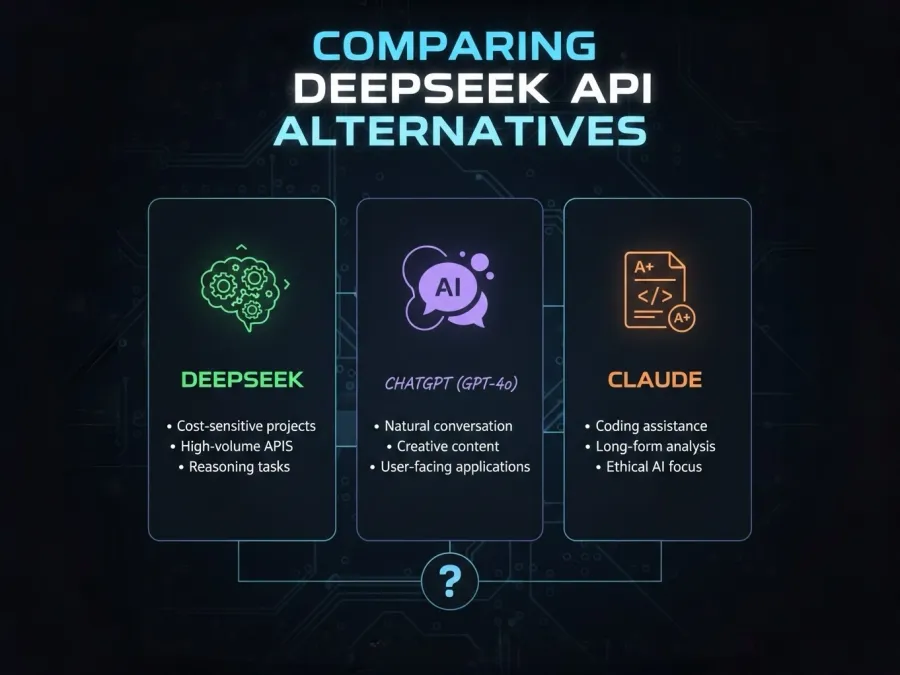
DeepSeek: Best for cost-sensitive projects, high-volume APIs, reasoning tasks
-
ChatGPT (GPT-4o): Best for natural conversation, creative content, user-facing applications
-
Claude: Best for coding assistance, long-form analysis, ethical AI focus
Best DeepSeek API Alternative - Unified Model Access with GPT Proto AI API Platform
Rather than managing multiple API keys across different platforms, GPT Proto offers a unified interface to access multiple AI models through a single integration. This approach eliminates the single-platform dependency problem that drives developers toward alternatives.
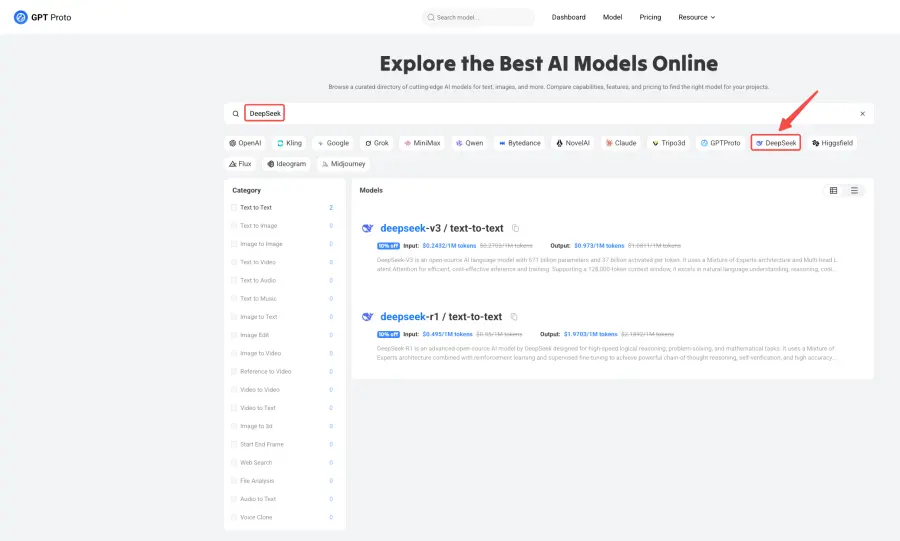
GPT Proto allows developers to use the same API calls while switching between different models and providers. This flexibility proves invaluable when you want to evaluate DeepSeek alongside other options. You can test DeepSeek-R1 for reasoning tasks, compare it against competing reasoning models, and easily route requests to the most cost-effective option.
The platform supports both DeepSeek-Chat and DeepSeek-Reasoner models through a unified interface. Instead of facing vendor lock-in or sudden platform changes, developers using GPT Proto's model selection can diversify their infrastructure and maintain control over which models power their applications.
This approach directly addresses the ripple effects problem: when one platform changes direction, your application continues functioning by routing requests elsewhere. You're no longer hostage to acquisition-driven decisions from a single provider.
DeepSeek API Frequently Asked Questions
Can I use DeepSeek API for free?
Yes, partially. Chat access at chat.deepseek.com is completely free with rate limiting. However, direct API calls require payment. You can get started with affordable token packages—many teams find $5-10 monthly sufficient for experimental projects.
How quickly can I start building with DeepSeek API?
Less than five minutes. Sign up at platform.deepseek.com, generate your API key, and make your first request using an OpenAI-compatible SDK. The API follows the same format as ChatGPT's API, so existing integrations often work with just a base URL change.
What's the difference between Deepseek cache hit and cache miss pricing?
Cache hits occur when your request's prefix matches previous requests. DeepSeek reuses the cached computation, costing $0.028 per million tokens. Cache misses require fresh computation at $0.28 per million. Grouping requests with identical prompts maximizes cache benefits.
Do I need to worry about DeepSeek's rate limiting?
Unlike some platforms, DeepSeek doesn't implement strict rate limits. Instead, the system naturally manages traffic through server capacity. During high-traffic periods, requests remain queued but connected. This approach provides fair access without sudden failures.
Conclusion
DeepSeek API represents a genuine shift in AI accessibility. For developers previously locked into expensive API tiers, the combination of affordability and competitive performance makes it worth serious consideration. The free API key generation, simple OpenAI-compatible format, and transparent token pricing remove friction from adoption.
However, the broader lesson from 2025's platform consolidation is clear: avoid single-platform dependence. Even as you build with DeepSeek, consider architectures that allow flexibility. Tools like GPT Proto AI API Platform demonstrate how unified interfaces can protect against future platform changes. By designing integrations that support multiple model providers, you insulate your application from the pricing shifts, priority changes, and roadmap uncertainty that plague acquisition scenarios.
Your choice depends on your specific requirements. If you prioritize cost efficiency, handle high-volume requests, or need reasoning capabilities without premium pricing, DeepSeek API deserves evaluation. If you value specific model features or established ecosystem integrations, alternatives may suit your needs better. Either way, DeepSeek has fundamentally changed pricing expectations across the industry—and smart developers are using this shift to build more resilient, flexible infrastructure.