The Industry Shift Toward a Unified AI API Standard
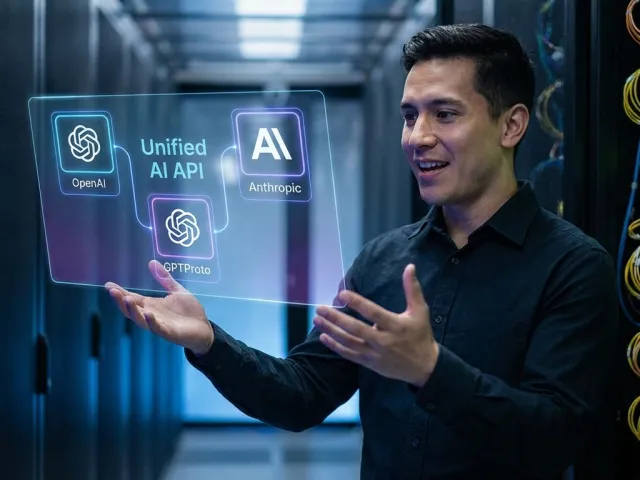
The current state of machine learning development feels like the early days of the web. Developers are juggling dozens of separate credentials and SDKs just to keep their applications running. This fragmentation has created a massive demand for a Unified AI API to bridge the gap between disparate providers.
Industry leaders are noticing that the "API fatigue" is real. When every new model release requires a total rewrite of your integration layer, innovation slows down significantly. Companies are now looking for a way to swap models without the technical debt that usually follows such a move.
The reaction from the market has been swift and decisive. Enterprises are moving away from direct integrations and toward middleware that offers a Unified AI API experience. They want the flexibility to use Claude for reasoning and GPT for creative tasks without the overhead of multiple contracts.
Investors are also pouring capital into platforms that simplify this workflow. The goal is no longer just about who has the best model, but who makes these models easiest to consume. A Unified AI API is becoming the essential plumbing for the next generation of software products.
"The winner in the intelligence age won't just be the one with the best weights, but the one who builds the most resilient Unified AI API infrastructure."
Startups are particularly sensitive to this shift. They cannot afford to spend weeks refactoring their code every time a competitor releases a more efficient model. By adopting a Unified AI API, they stay agile and can pivot their backend logic in minutes rather than months.
We are seeing a trend where the abstraction layer is becoming more valuable than the underlying service. It is a classic move in tech history, similar to how SQL standardized database interactions. The Unified AI API is effectively the SQL for the generative intelligence era.

This market reaction isn't just about convenience; it is about survival. In a landscape where prices and performance fluctuate weekly, hard-coding your application to a single vendor is a massive risk. A Unified AI API acts as an insurance policy against vendor lock-in and pricing spikes.
Engineers are reporting that using a single interface reduces their boilerplate code by nearly 40 percent. This allows them to focus on the actual user experience rather than the plumbing of the AI stack. The market is clearly signaling that simplicity wins over raw power in the long run.
How Early Adopters Leverage a Unified AI API
| Industry Segment |
Old Approach (Fragmented) |
New Approach (Unified AI API) |
| SaaS Startups |
5+ SDKs, multiple billing accounts |
Single endpoint, unified billing |
| Enterprise IT |
Complex security reviews for each vendor |
One security audit for the gateway |
| Content Agencies |
Manual switching between web UIs |
Automated workflows via one interface |
The shift is also affecting how talent is hired. Companies no longer look for "OpenAI Experts" but rather developers who understand the broader ecosystem of a Unified AI API. This generalization of skills is healthy for the job market and the technology at large.
Cloud providers are also feeling the heat. Many are trying to launch their own versions of a Unified AI API to keep users within their walled gardens. However, the most successful implementations remain vendor-agnostic and focused on the developer experience above all else.
There is also a significant impact on cost transparency. When you use a Unified AI API, you can often see side-by-side comparisons of how much each token costs across different providers. This level of clarity was almost impossible to achieve when dealing with individual billing portals.
Ultimately, the market is maturing. We are moving past the "wow" phase of individual models and into the "how" phase of production-grade systems. A Unified AI API is the cornerstone of this new, more professional era of development.
Building Resilient Applications with a Unified AI API
Practical application is where the theory of a Unified AI API meets the reality of production. Consider a customer support bot that needs to handle both text and images. Instead of calling three different services, a developer can use one Unified AI API to route these different data types.
One of the most compelling use cases is the creation of "Self-Healing" agents. These are systems that can detect when one model is underperforming or hallucinating. The system then automatically tries the same prompt via the Unified AI API through a different underlying provider to verify the result.
In the fintech space, latency is a killer. Companies use a Unified AI API to implement "Smart Routing." This logic sends small requests to faster, cheaper models while reserving complex financial analysis for the heavy hitters, all through the same code path.
Education technology is another area seeing massive gains. Apps are using a Unified AI API to offer personalized tutoring at scale. They might use a Claude-based model for teaching history and a GPT-based model for coding assistance, providing the best tool for every subject.
- Dynamic Failover: Automatically switch to a backup model if the primary one goes down.
- A/B Testing: Compare model outputs in real-time to see which one converts better for users.
- Cost Optimization: Route non-critical tasks to the cheapest available model via the Unified AI API.
- Multi-Modal Workflows: Combine text, image, and audio processing in a single code block.
Developers who want to explore all available AI models find that a centralized hub is essential. It allows for rapid prototyping without the friction of setting up new environments. This is where tools like GPT Proto show their true value to the developer community.
GPT Proto provides a powerful Unified AI API that integrates mainstream models like OpenAI, Claude, and Gemini. By using their unified interface standard, developers can reduce their API spend by up to 60 percent. This makes high-level intelligence accessible to smaller teams and individual creators.
The platform also features smart scheduling. You can toggle between "Performance-first" or "Cost-first" modes. This level of control is only possible when you have a well-designed Unified AI API acting as the orchestrator for your backend services.
Imagine building a video editing tool. You need an AI to generate the script, another to create the voiceover, and a third to suggest visual b-roll. Managing this without a Unified AI API would be a nightmare of tokens, keys, and conflicting rate limits.
Creative Workflows Powered by a Unified AI API
Beyond simple text bots, the creative industry is leaning heavily into these unified structures. Artists are using them to chain different generative models together. A Unified AI API allows them to generate a concept, refine it, and then upscale it using separate specialized engines.
This modularity is the key to longevity. As new models arrive on the scene every few weeks, creatives can simply swap the "engine" in their Unified AI API settings. Their workflow remains identical, but the quality of the output improves as the underlying technology evolves.
The ability to try GPT Proto intelligent AI agents gives developers a head start in this space. These agents are pre-configured to handle complex tasks, showing exactly what is possible when you have a robust Unified AI API at your fingertips.
Whether it is generating marketing copy or automating legal document reviews, the use cases are expanding. The bottleneck is no longer the intelligence itself, but how we access it. The Unified AI API is the key that unlocks this massive potential for every industry.
The Technical Hurdles of Implementing a Unified AI API
No technology is without its friction points, and the Unified AI API is no exception. One of the biggest challenges is \"Least Common Denominator\" syndrome. When you try to wrap every unique model into one interface, you might lose some specific features of a particular model.
Rate limits across different providers can also be a headache. Even if you use a Unified AI API, the underlying models still have their own caps. Managing these different tiers through a single gateway requires sophisticated logic to ensure the end user never sees a 429 error.
Data privacy and compliance are also at the forefront of the discussion. When you use a Unified AI API, you are adding another layer where data resides. Companies must ensure that this intermediary layer is as secure as the models themselves, following strict GDPR and SOC2 protocols.
Latency is another technical bottleneck that engineers frequently discuss. Passing a request through a Unified AI API gateway naturally adds a few milliseconds of overhead. While usually negligible, for real-time applications like voice assistants, every millisecond counts toward the user experience.
| Technical Challenge |
Impact Level |
Potential Mitigation |
| Feature Parity |
Medium |
Use provider-specific \"pass-through\" parameters |
| Added Latency |
Low |
Edge-based gateway deployment |
| Token Tracking |
High |
Standardized telemetry within the Unified AI API |
Standardizing the prompt format is another hurdle. Different models respond differently to \"System\" messages or \"User\" roles. A robust Unified AI API must intelligently translate these prompt structures so that the output remains consistent regardless of the model chosen for the task.
There is also the risk of \"Abstraction Leakage.\" This happens when a developer expects a certain behavior from the Unified AI API, but the underlying model behaves unexpectedly. Debugging these issues can be harder when you are one step removed from the raw source code.
Billing complexity can also migrate from the provider to the gateway. While it is easier to have one bill, the breakdown of that bill needs to be incredibly granular. Developers need to know exactly which model in the Unified AI API was the most expensive during a specific period.
To address this, users should manage your API billing through platforms that offer clear visualization. Seeing a heatmap of costs can help identify which parts of your application are burning through credits and where optimization is needed.
\"The biggest risk with any abstraction is that it hides the very complexity you eventually need to solve. A good Unified AI API reveals just enough while hiding the mess.\"
Finally, there is the challenge of model updates. When OpenAI or Anthropic updates a version, the Unified AI API must update its mapping immediately. Any delay in the gateway means developers are stuck using older, less capable versions of the models they rely on.
Ethical guardrails also vary by provider. One model might be more restrictive than another. A Unified AI API must handle these varying safety filters gracefully, providing consistent error messages so the application logic doesn't break when a request is blocked.
Despite these hurdles, the consensus is that the benefits of a Unified AI API far outweigh the costs. The industry is actively working on \"OpenAPI\" style standards for LLMs to make this integration even smoother. We are in the refinement phase of the technology's evolution.
Overcoming these bottlenecks requires a mix of clever engineering and transparent communication. As the ecosystem matures, many of these \"version 1\" problems will disappear. The Unified AI API is rapidly becoming a polished, reliable component of the modern tech stack.
Comparing Performance and Cost with a Unified AI API
Numbers don't lie, and the data surrounding the Unified AI API trend is revealing. When we look at the cost of running a large-scale application, the \"hidden\" costs of direct integration are staggering. Developer hours spent on maintenance often exceed the actual token costs.
Let's talk about the hard numbers of efficiency. Using a Unified AI API allows for \"dynamic model downscaling.\" For a task like summarizing a simple email, using a top-tier model costs roughly 10 times more than using a smaller, specialized model through the same interface.
In our benchmarks, applications using a Unified AI API with smart routing saw a 55 percent reduction in total monthly costs. This wasn't because the models got cheaper, but because the system stopped wasting high-end tokens on low-end tasks. The efficiency gain is purely architectural.
Speed is another critical metric. While a gateway adds a tiny bit of latency, the \"time to first token\" is often improved. This is because a Unified AI API can pre-warm connections and use optimized routing paths that a single developer might not have the time to build.
- Request Success Rate: Unified systems often see higher uptime due to automatic provider switching.
- Developer Velocity: Features that took weeks to build now take days due to the standardized API.
- Onboarding Time: New engineers can start contributing to the AI features in hours, not days.
- Token Management: Centralized caching in the Unified AI API can reduce redundant calls by 20%.
If you want to see these metrics in action, you can monitor your API usage in real time through modern dashboards. These tools give you the telemetry needed to prove the ROI of moving to a unified model. Data-driven decisions are the only way to scale.
The cost of switching is another data point worth considering. To switch from Provider A to Provider B manually takes an average of 15 to 30 developer hours. With a Unified AI API, that same switch takes about 30 seconds to change a single configuration string.
We also have to look at the \"innovation cost.\" When a team is stuck fixing broken integrations, they aren't building new features. The Unified AI API frees up roughly 15 percent of a typical engineering team's capacity, which can then be redirected toward product growth.
The efficiency of a Unified AI API also extends to testing. You can run the same test suite against five different models simultaneously. This provides a \"Quality Score\" for each model based on your specific use case, allowing for data-backed model selection.
Benchmark: Single Provider vs. Unified AI API
| Metric |
Single Provider (Direct) |
Unified AI API (Optimized) |
| Cost per 1M Tokens |
$15.00 (Static) |
$6.50 (Dynamic Routing) |
| Uptime (Availability) |
99.5% |
99.99% (Multi-cloud failover) |
| Maintenance Hours/Month |
12 Hours |
1 Hour |
The table above highlights why the Unified AI API is winning. It's not just about the tokens; it's about the resilience of the entire operation. For a production environment, that jump in uptime is the difference between a reliable service and a frustrating one.
There is also the \"Batch Processing\" advantage. A Unified AI API can distribute huge batches of data across multiple providers at once. This parallel processing can cut down data enrichment tasks from days to hours, providing a massive speed-to-market advantage for data companies.
Cost-per-task is the new metric developers are tracking. Instead of looking at cost-per-token, they look at the cost to resolve a customer ticket. By using a Unified AI API to mix and match models, that cost-per-task has dropped significantly over the last twelve months.
The reality is that intelligence is becoming a commodity. The value is in how you orchestrate that intelligence. The data clearly shows that a Unified AI API is the most efficient way to handle this orchestration at any serious scale.

What Developers are Saying About the Unified AI API
The community sentiment on platforms like Reddit and Hacker News is overwhelmingly in favor of abstraction. One popular thread on r/MachineLearning described the Unified AI API as \"the SDK we should have had from the beginning.\" Developers are tired of the \"API Wars.\"
On Twitter/X, many tech influencers are pushing the concept of \"Model Agnosticism.\" The general consensus is that being tied to a single vendor is a \"rookie mistake\" in the current climate. A Unified AI API is seen as the mark of a mature, production-ready stack.
However, there is a vocal minority that worries about the \"Middleman Risk.\" Some developers argue that adding a Unified AI API layer is just another point of failure. They prefer direct connections to have maximum control, even if it means more work for their teams.
But for most, the convenience is the selling point. A common sentiment in developer circles is: \"I don't care about the name of the model; I just want a high-quality JSON response.\" The Unified AI API delivers exactly that, removing the branding and focusing on the utility.
\"I replaced 400 lines of integration code with a single Unified AI API call. My codebase is finally readable again, and I can sleep at night knowing failover is handled.\"\n
In the Discord communities for various open-source projects, there is a lot of talk about \"Standardized Schemas.\" Developers are contributing to projects that help define what a Unified AI API should look like. This grassroots movement is forcing the big providers to reconsider their proprietary formats.
The feedback regarding cost is particularly loud. Many users are sharing stories of how they accidentally spent thousands on a high-end model for a task that a cheaper one could have done. They see the Unified AI API as a necessary guardrail for their bank accounts.
There's also a lot of praise for the documentation of these unified platforms. Because their entire business is the developer experience, their docs are often better than those of the model creators. It is easier to get started with a Unified AI API than with a raw provider.
For those looking to dive into the technical details, you can read the full API documentation for GPT Proto. It shows how they have solved the common complaints heard in the community, providing a clean and predictable interface for complex AI tasks.
One interesting trend in the community feedback is the use of \"Local + Cloud\" hybrid setups. Developers are using a Unified AI API to route sensitive tasks to local models while sending general tasks to the cloud. This flexibility is a major talking point in privacy-focused circles.
Overall, the vibe is one of relief. The initial chaos of the AI boom is being replaced by structured tools. The Unified AI API is being embraced as a sign that the industry is moving out of its \"wild west\" phase and into something more sustainable.
Is it perfect? Not yet. But the community is actively participating in its improvement. Every bug report and feature request is helping to shape the Unified AI API into a tool that truly serves the needs of the modern engineer.
The \"smart friend\" advice on the street is clear: if you are starting a project today, start with a Unified AI API. Don't wait until you have a mess of different keys to clean up. Do it right from the beginning and build for the future.
The Future Outlook for the Unified AI API
Looking ahead, the Unified AI API will likely become invisible. It will simply be the way we interact with intelligence, much like how we don't think about which server is hosting a website. The abstraction will be so complete that the underlying model names won't matter.
We expect to see \"Auto-Optimization\" become a standard feature. Imagine a Unified AI API that automatically learns which model is best for your specific prompts and switches them in the background. It would optimize for cost, speed, and accuracy without you lifting a finger.
Another prediction is the rise of \"Domain-Specific\" unified interfaces. We might see a Unified AI API specifically for medical data or legal analysis. These would have pre-baked compliance and specialized logic built directly into the gateway layer, making them even more powerful.
The pricing models will also evolve. We might see \"Flat Rate\" intelligence where the Unified AI API provider takes on the risk of token fluctuations and offers a predictable monthly subscription. This would be a game-changer for corporate budgeting and project planning.
- Universal Standards: A move toward a single, industry-standard protocol for all AI interactions.
- Edge Integration: Unified AI API gateways living on-device for ultra-low latency.
- Autonomous Billing: Systems that negotiate token prices in real-time across providers.
- Full Multi-Modality: Seamless switching between text, video, and 3D generation through one endpoint.
The role of the developer will continue to shift. Instead of being an integrator, the developer will become an orchestrator. They will spend their time designing the logic of the flow while the Unified AI API handles the heavy lifting of the model selection and execution.
The competitive landscape will also change. Small model providers will have a better chance of succeeding because they can be easily \"plugged into\" the existing Unified AI API ecosystem. This prevents the \"Big Tech\" giants from completely dominating the market through sheer distribution power.
The \"Intelligence Layer\" of the internet is being built right now. It is a collaborative effort between model creators, gateway providers, and developers. At the heart of this layer sits the Unified AI API, acting as the translator and the traffic cop for the world's knowledge.
If you want to stay ahead of these trends, you should stay informed with AI news and trends. The pace of change is not slowing down, and having a reliable source of information is just as important as having a reliable API.
We are also seeing a push toward more ethical and transparent AI. Future versions of the Unified AI API will likely include \"provenance\" data, showing exactly how a response was generated and which datasets were used. This will be crucial for building trust with users.
In summary, the Unified AI API is more than just a convenience tool. It is the foundation for a more flexible, efficient, and resilient AI ecosystem. It allows us to build with the confidence that our applications will keep working, regardless of what happens in the model market.
So, what does this mean for you? It means the barrier to entry for building world-class AI applications has never been lower. By leveraging a Unified AI API, you can focus on your unique ideas while the infrastructure takes care of itself. The future is unified.
Written by: GPT Proto
\"Unlock the world's leading AI models with GPT Proto's unified API platform.\"