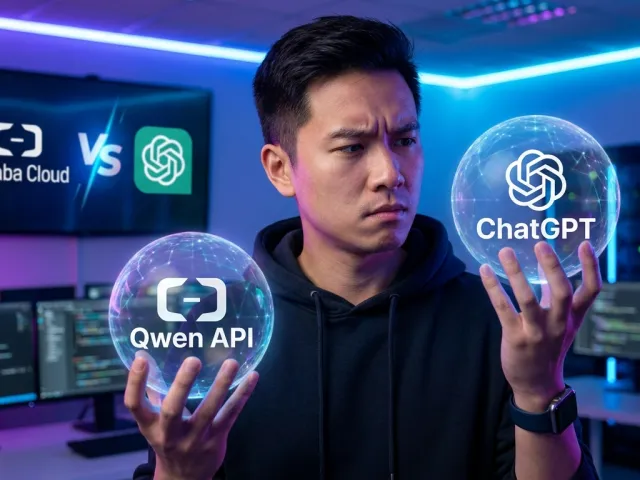
Qwen API Performance: Better Than ChatGPT?
I've spent the last few years jumping between OpenAI, Anthropic, and Google. We all have. But lately, there's a new name popping up in every developer Slack channel: Qwen. Developed by Alibaba, this series of models isn't just a regional player anymore. In fact, many practitioners are finding that the Qwen API offers a level of precision that ChatGPT sometimes misses.
Here's the thing: Qwen 2.5 isn't just about raw scale. While the 72B version is a monster, the smaller models are what actually impress me. They punch way above their weight class in coding and mathematics. When you look at the raw benchmarks, the Qwen model often edges out GPT-4o in specific logic-heavy tasks.
Redditors have been vocal about this shift for a while. One seasoned dev mentioned they realized Qwen was light-years ahead in quality once they stopped looking at the UI and started looking at the output. That’s a bold claim, but when you’re building modular systems, you need that kind of reliability.
If you're looking for a fast Qwen API experience, you should check out the fast Qwen API options available for the latest Qwen 3 Max releases. It handles complex data reviews with much less "AI fluff" than the incumbents.
"Qwen doesn't just generate text; it solves problems with a level of structural integrity that feels more like a senior engineer than a chatbot."
Comparative AI Performance Metrics
When we talk about AI performance, we usually look at MMLU or HumanEval scores. Qwen consistently places at the top. But the real-world feel is different. It’s about how the Qwen API handles nuances in instructions without getting lost in its own hallucinations.
The coding performance is particularly striking. While some models struggle with Python indentation or obscure library logic, Qwen tends to get it right the first time. This makes it a serious contender for anyone building autonomous agents or complex CI/CD integrations.
Getting Started With Qwen API Access
Getting your hands on a Qwen API key is surprisingly straightforward. Alibaba Cloud hosts these through their DashScope platform. For those of us used to the "credits" system of OpenAI, the Alibaba Cloud API setup feels familiar but offers some unique perks for early adopters.
Currently, the Qwen API provides a generous free tier. You can get up to 1,000 requests per day for free on the CLI. Plus, new users often get a 90-day free window through Alibaba Cloud to test the waters. This is a massive advantage for bootstrapped developers.
But there’s a catch. Rate limits can be a hurdle if you’re trying to scale quickly. I’ve seen users hit their cap right when they were hitting their stride. If you're building a production app, you need to plan your Qwen API access strategy carefully to avoid sudden downtime.
For those who want to skip the multi-platform headache, GPT Proto offers a unified interface. You can explore all available AI models including the Qwen Plus model through a single endpoint, often with significant cost savings.
Step-by-Step API Integration
Integration starts with grabbing your environment variables. The Qwen API uses a standard RESTful structure. If you’ve ever written a fetch request for a GPT model, you’re 90% of the way there. Just swap the base URL and the model identifier.
Wait, before you push to production, check your parameter settings. Qwen is sensitive to temperature and top_p. Finding the sweet spot for your specific use case—whether it’s creative writing or rigid JSON extraction—is the difference between a "satisfactory experience" and a frustrating one.
Key Features of the Qwen AI Model
What makes the Qwen AI model stand out isn't just the text. It’s the versatility. We’re talking about a series that handles philosophy, science, and technology with equal grace. It’s not just a language model; it’s a knowledge engine that understands technical context.
One of the coolest features is the local deployment option. Unlike many closed-source models, you can run Qwen on your own hardware. Even a 2B model on an Android device can handle low-context general knowledge tasks. That’s insane portability for a model this capable.
Then there's the modality. While the text models are the stars, the Qwen-VL (Vision-Language) and Qwen-Audio variants are gaining ground. They allow for a more holistic approach to AI applications. You can process images and text within the same ecosystem without jumping through hoops.
| Model Variant |
Parameters |
Primary Use Case |
Local VRAM Req. |
| Qwen-0.5B |
500 Million |
Edge Devices / Mobile |
< 2 GB |
| Qwen-7B |
7 Billion |
General Purpose Bots |
6-8 GB |
| Qwen-14B |
14 Billion |
Research & Logic |
12-16 GB |
| Qwen-72B |
72 Billion |
Enterprise / Coding |
40 GB+ |
Multilingual and Technical Prowess
Qwen was trained on a massive dataset that includes a high percentage of non-English content. This makes its multilingual AI performance objectively better than models that treat other languages as an afterthought. It understands cultural nuances, not just direct translations.
For those of us in tech, the math and science capabilities are the real winner. Qwen API calls regarding complex physics problems or architectural data reviews often return more coherent results than the "Big Three" US-based models. It’s a specialized tool for specialized people.
Qwen API Coding and Agentic Use Cases
If you're into agentic workflows, pay attention. The Qwen 2.5 9B model is a sweet spot for agentic calls. It runs comfortably on consumer-grade GPUs with 12GB of VRAM. This allows you to build locally-hosted agents that don't rely on a constant internet connection.
However, tool calling can be finicky. Some developers report that smaller Qwen models might loop infinitely when trying to use external tools unless you disable the "thinking" parameters. It's a classic case of the model being too smart for its own good, trying to over-calculate the logic.
The solution? Correct parameter settings are vital. By tuning the system prompt and adjusting the repetition penalty, you can get the Qwen API to execute tool calls with high precision. This makes it a perfect coding assistant for modular system builds.
Working with agents often requires monitoring. You can track your Qwen API calls in real time using the GPT Proto dashboard. It provides a clean view of your token usage and latency, which is essential when debugging agent loops.
Building Autonomous Coding Agents
Imagine an agent that can review your entire codebase and suggest modular improvements. That's where Qwen shines. Because it handles code so well, you can feed it complex snippets and expect a review that actually makes sense. It identifies logic flaws that other models breeze over.
I’ve used it for reviewing data pipelines and the experience was surprisingly smooth. The model didn't just find syntax errors; it suggested better ways to structure the data flow. That’s the kind of practitioner-level insight we need from an AI coding assistant.
Limitations and Qwen API Pricing Realities
Let's be real: no API is perfect. The Qwen API pricing is competitive, but the "free" honeymoon phase doesn't last forever. Once you transition to the paid tier on Alibaba Cloud, you need to keep a close eye on your budget. It’s affordable, but high-volume applications add up.
Another concern is the "closed-source" trend. While Qwen has been a champion of open weights, there’s talk that newer versions like Qwen Image 2.0 might stay closed. If the team moves toward a purely proprietary model, it might lose that "community-first" edge that made it popular.
Rate limits are also a persistent pain point. If you’re used to the massive limits of an Enterprise OpenAI account, the DashScope limits might feel restrictive. You might hit a wall just as your user base starts to grow, which is every developer's nightmare.
To mitigate this, many teams use a multi-model approach. By using GPT Proto, you can manage your API billing for multiple models in one place. This allows you to failover to a different model if you hit a rate limit on the Qwen API.
Navigating the Rate Limit Maze
Hitting a rate limit feels like hitting a brick wall at 60 mph. It usually happens right when you're in the middle of a critical low-context testing session. To avoid this, implement a smart retry logic with exponential backoff in your application code.
Also, keep an eye on the context window. While Qwen supports large contexts, stuffing the prompt with irrelevant data will eat your tokens and hit those limits faster. Be surgical with your data. A lean prompt is a fast prompt, especially when dealing with the Alibaba Cloud API.
Is the Qwen API Worth It?
So, should you switch? If you’re doing heavy lifting in coding, math, or need a model that runs locally on a "shitty laptop GPU" (as one Redditor hilariously put it), then yes. Qwen is a powerhouse that offers a refreshing alternative to the standard US-centric models.
The Qwen API performance is consistent, the community is active, and the local deployment options are second to none. It’s a tool for people who actually build things, not just those who want a fancy chatbot to talk to. It’s direct, efficient, and surprisingly powerful.
But don't just take my word for it. Test it. Use the free daily requests to run your hardest prompts. Compare the output side-by-side with your current favorite. You might find that the "underdog" from Alibaba is actually the lead dog in your specific race.
For more technical guides and the latest industry shifts, you can learn more on the GPT Proto tech blog. We’re constantly benchmarking these models to see who’s actually winning the AI arms race. The results might surprise you.
"The best API isn't the one with the biggest marketing budget; it's the one that returns the right JSON at 3:00 AM without a hallucination."
In the world of AI, things move fast. Qwen 2.5 is here today, and Qwen 3 is already on the horizon. Staying flexible and keeping your options open is the only way to win. The Qwen API is a vital part of that flexibility. Don't sleep on it.
Written by: GPT Proto
"Unlock the world's leading AI models with GPT Proto's unified API platform."